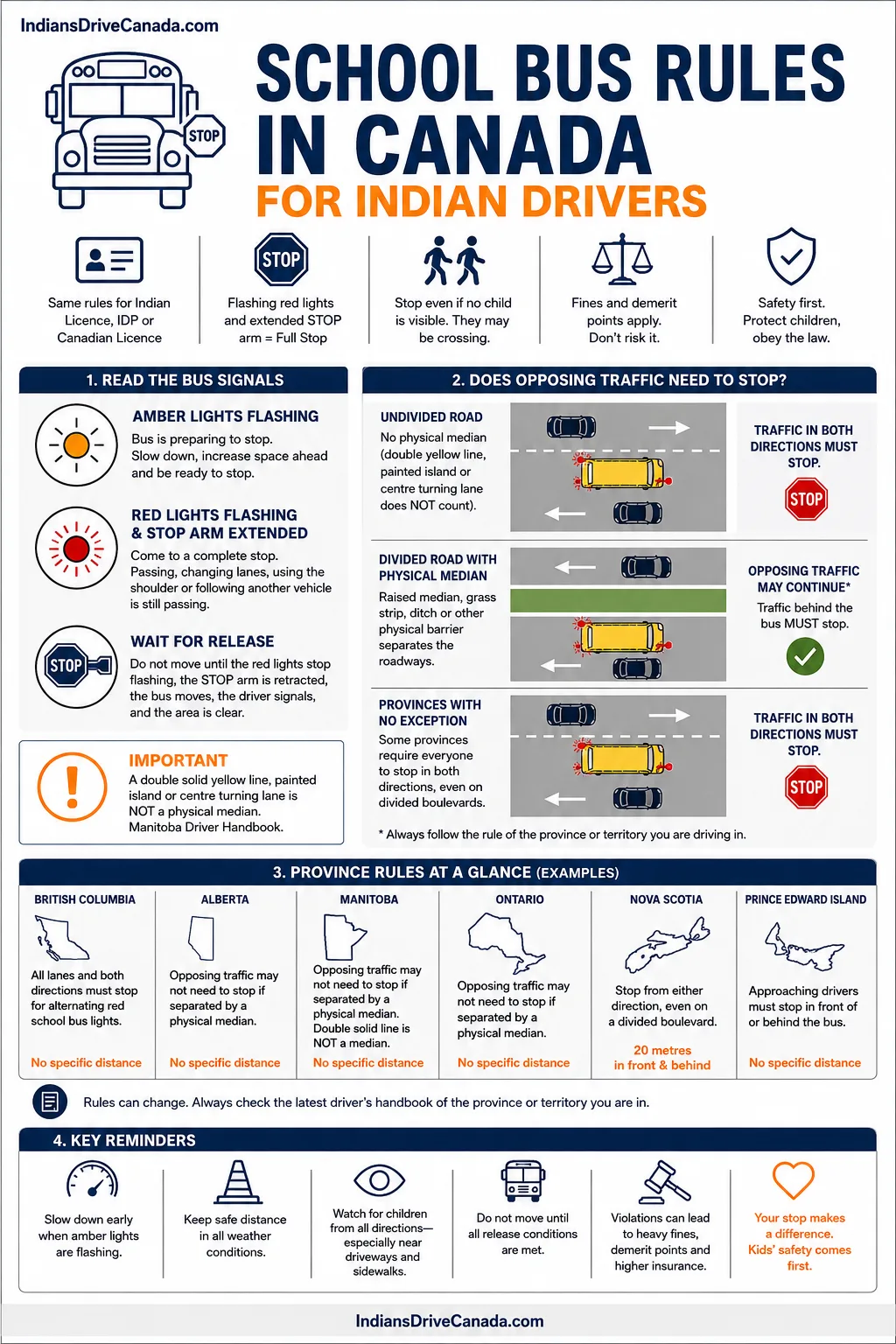
Flashing red lights on a Canadian school bus mean a full stop. On an undivided road, vehicles normally stop in both directions. The exception for traffic approaching from the opposite direction depends on the province or territory and on whether the road has a physical divider.
A double yellow line, painted island or centre turning lane should not be treated as a physical median. The required distance from the bus also varies: some jurisdictions specify 5 metres, 6 metres or 20 metres, while others tell drivers to stop before reaching the bus without setting one national distance.
School bus rules in Canada for Indian drivers do not change according to the licence being used. The same stopping obligation applies when a person is otherwise permitted to drive with an Indian licence, an international driving permit or a Canadian provincial licence.
The unfamiliar part may be the traffic-control equipment attached to the bus. Its roof lights and side-mounted STOP arm can control vehicles behind it, vehicles beside it and, in many situations, vehicles approaching from the opposite direction.
Read the bus signals before deciding what to do
Amber lights warn that the bus is preparing to stop
Alternating amber lights normally mean the school bus is slowing to pick up or drop off students. Reduce speed, increase the space ahead and prepare for a full stop.
Do not accelerate to pass before the red lights begin. On snow, ice or wet pavement, early speed reduction gives the driver behind more time to react and prevents a harsh last-second stop.
Safe response: Check the rear-view mirror, ease off the accelerator and begin controlled braking while the lights are still amber. The objective is to be ready before the bus opens its door and activates the red-light stop phase.
Red lights and the STOP arm create the protected area
When the alternating red lights are flashing or the STOP arm is extended, come to a complete stop. Passing slowly is still passing. Changing lanes to go around the bus, using the shoulder or following another vehicle through the stop area does not remove the obligation.
The stop applies even when no child can be seen. A student may be crossing in front of the bus, standing in a blind area or approaching from a driveway or roadside path.
Wait for the province’s release conditions
Do not restart merely because a child has reached the curb. Provincial wording commonly requires one or more of the following:
- The red lights have stopped flashing.
- The STOP arm has been retracted.
- The bus has started moving.
- The bus driver has signalled that traffic may proceed.
- The roadway and the child-crossing area are visibly clear.
Where the rule mentions both the red lights and STOP arm, wait until both have ended. A vehicle ahead moving early is not permission to follow it.
The centre of the road changes the answer
Drivers approaching from behind the school bus must stop when the red stop signals are active. The more difficult decision usually concerns a vehicle approaching from the opposite direction.
Painted lines do not make two separate roadways
A single centre line, double solid yellow lines, a painted island or a shared centre turning lane separates traffic movements, but it does not physically prevent a child from crossing. Manitoba’s driver handbook expressly states that a double solid line is not a physical separation.[Median definition]
Four lanes do not automatically mean a divided highway. If the opposing lanes are separated only by paint, treat the road as undivided unless the applicable provincial rule clearly says otherwise.
A physical median may create an exception
Several jurisdictions allow opposing traffic to continue when the school bus is on a separate roadway divided by a raised median, grass strip, ditch or another physical barrier. Traffic travelling behind the bus must still stop.
The divider must satisfy the wording used by that jurisdiction. A narrow painted buffer should not be assumed to have the same legal effect as a concrete or grass median.
Do not carry the median exception into every province
Nova Scotia directs drivers to stop from either direction even on a divided boulevard. Its handbook also illustrates a 20-metre stopping distance in front of and behind the bus.[Divided boulevard rule]
British Columbia’s driver manual instructs vehicles in all lanes and both directions to stop for alternating red school-bus lights. Prince Edward Island’s published safety instructions also tell approaching drivers to stop in front of or behind the bus and do not present the usual physical-median exception.
| Road feature | How to treat it | School-bus decision |
|---|---|---|
| Single or double yellow lines | Painted separation only | Opposing traffic normally stops where the province applies the rule to undivided roads. |
| Shared centre turning lane | Part of one roadway | Do not treat it as a median. |
| Painted or hatched island | Not a physical barrier | Do not rely on a divided-road exception. |
| Raised concrete median | Physical separation | An opposing-traffic exception may apply where provincial law recognizes it. |
| Grass strip or ditch | May create separate roadways | Check the jurisdiction’s definition and stopping rule. |
| Divided boulevard in Nova Scotia | Special provincial treatment | Traffic in both directions must stop. |
Stopping rules by province and territory
There is no single stopping distance or median rule for all of Canada. The table separates the points that affect the driver’s immediate decision.
| Province or territory | Distance stated in the published rule | Opposing traffic | Physical-divider treatment | When traffic may move |
|---|---|---|---|---|
| Ontario | At least 20 m when approaching from behind; a safe distance when approaching from the front | Stops on an undivided road | Opposing traffic does not stop when a median physically separates the roadways | When the bus moves, or its red lights have stopped and the STOP arm is no longer active [Ontario rule] |
| British Columbia | No fixed minimum stated in the manual section | Vehicles approaching from the front or rear must stop | The ICBC instruction says vehicles in all lanes must stop; it does not give a median exception in that section | When the bus moves or the driver ends the lights and pulls in the stop sign [BC rule] |
| Alberta | Stop before reaching the bus; no fixed minimum in the information used here | Stops on an undivided road | Opposing traffic may continue when a physical median divides the two-way highway | When the flashing red lights have stopped [Alberta rule] |
| Quebec | At least 5 m | Stops when approaching in the opposite direction | No stop is required when the bus is on another roadway separated by a median | When the red lights are off and the mandatory stop sign is retracted [Quebec rule] |
| Manitoba | At least 5 m | Stops on an undivided road | Opposing traffic may continue when a physical median or ditch divides the roadways | When the red lights are off and the STOP arm is folded in [Manitoba rule] |
| Saskatchewan | No closer than 5 m from the front or back | Stops on an undivided highway | Opposing traffic does not stop on a divided highway | When the red lamps are off and the STOP arm is deactivated [Saskatchewan rule] |
| New Brunswick | At least 5 m | Stops on an undivided highway | The Act provides an exception for a bus on the other side of a median-divided highway | When the bus moves again or the flashing red lights cease [New Brunswick rule] |
| Nova Scotia | 20 m in front of or behind the bus | Stops in both directions | Drivers must stop even on a divided boulevard | Remain stopped through the red-light loading or unloading phase [Nova Scotia rule] |
| Prince Edward Island | At least 6 m from the front or rear | Approaching traffic must stop | The published motorist instruction does not give a physical-median exception | When the red lights stop flashing [PEI rule] |
| Newfoundland and Labrador | No fixed minimum stated in the handbook section | All directions and lanes stop on a multi-lane undivided highway | A driver on a separate roadway does not stop for a bus on the other roadway | When the bus moves, the driver signals, or the lights and stop sign are deactivated [Newfoundland and Labrador rule] |
| Yukon | Stop before reaching the bus | Stops from either direction on an undivided highway | On a physically divided highway, only traffic approaching from behind the bus must stop | When the bus resumes motion, the driver signals, or the red lights stop [Yukon rule] |
| Northwest Territories | Stop before reaching the bus and remain well back | Stops from either direction on an undivided highway | Opposing traffic may continue when a physical median separates the roadways | When the red-light stop phase has ended [NWT rule] |
| Nunavut | Stop before reaching the bus | The manual instructs vehicles approaching from the front or rear to stop | No divided-road exception is described in the manual section used here | When the bus starts again, the lights cease or the driver waves traffic through [Nunavut rule] |
Municipal operation can affect what appears on the bus. Saskatchewan notes that some communities may prohibit the use of flashing red stop lamps and STOP arms. If the bus displays only four-way hazard lights, Saskatchewan does not treat that signal as the red-light stop command, although drivers must slow down and watch for children.
Follow every active signal and local sign rather than assuming that all yellow school buses will use identical equipment in every community.
Distance rules cannot be carried from one province to another
A driver who learned the 5-metre rule in Manitoba should not apply it in Nova Scotia, where the official diagram uses 20 metres. Ontario also requires a vehicle approaching from behind to remain at least 20 metres away, while Prince Edward Island specifies at least 6 metres.
Where no fixed number is stated, stop before reaching the bus and leave enough room for:
Do not stop bumper-to-bumper behind the bus. The rear of the bus is not the boundary of the child safety area.
Road scenes where the wrong decision is easy to make
The bus is across four lanes and only yellow lines separate traffic
The road is still undivided. In provinces that stop opposing traffic on an undivided highway, every affected lane must stop. The number of lanes does not create the exception.
A raised median separates the bus from the approaching vehicle
Ontario, Alberta, Quebec, Manitoba, New Brunswick, Newfoundland and Labrador, Yukon and the Northwest Territories provide some form of opposite-roadway exception when there is a qualifying physical separation.
Do not apply that response automatically in Nova Scotia, British Columbia or Prince Edward Island. Their published instructions are different.
The child has reached the sidewalk but the red lights remain active
Remain stopped. The bus driver may still be checking mirrors, waiting for another student or protecting a child who is not visible from the vehicle.
The vehicle ahead passes the stopped bus
Do not follow it. Each driver must respond independently to the bus signals. The other vehicle may be committing an offence or may have overlooked the lights.
The bus is stopped near an intersection
A turn does not create a way around the stop command. Do not turn through the space beside the bus, cross in front of it or enter a road section where children may be walking.
If the bus is on the road being entered, complete the stop before the turn would carry the vehicle past the bus or through its protected area.
The bus stops at railway tracks without opening its STOP arm
A school bus may stop at a railway crossing for a separate safety procedure. That action is not automatically the same as a student-loading stop.
Read the equipment that is actually operating. Red student-loading lights and an extended STOP arm create the passing prohibition. When they are not active, maintain space and do not attempt to overtake until the road position and markings permit it safely.
The bus has four-way hazard lights but no red overhead lights
Hazard lights do not necessarily create the same legal command as alternating red school-bus lights. Slow down, look for local signs and watch for children. Never assume that the absence of the red signal makes an immediate pass safe.
School-bus signals and school-zone signs are separate rules
| Feature | School-bus stop rule | School-zone rule |
|---|---|---|
| What activates it | The bus’s amber or red lights and STOP arm | Posted road signs, time plates, flashing beacons or local conditions |
| Where it applies | Wherever the bus lawfully loads or unloads students | The signed road area near a school |
| Main driver action | Prepare to stop or come to a complete stop | Follow the posted speed and pedestrian rules |
| Does a school building need to be visible? | No | The signed zone controls the location |
| Can both rules apply together? | Yes | Yes |
A school bus may pick up a student on a rural highway, residential street or another location with no school nearby. Its red lights still control traffic.
Likewise, driving through a school zone does not mean every stopped yellow bus has activated a student-loading stop. Observe the bus equipment and the roadside signs as two separate controls.
Driving habits to reset after moving from India
Adapting to a new traffic system requires more than remembering that Canadian vehicles travel on the right. School-bus signals require several deliberate changes in visual scanning and decision-making.
Scan the opposite side of the road
A school bus travelling toward the vehicle may still control its lane. On an undivided road, do not limit attention to vehicles moving in the same direction.
Treat the bus lights as traffic-control signals
The lights are not merely a warning for parents or students. Red overhead lights and the STOP arm directly instruct other drivers.
Do not replace a full stop with a slow pass
Moving past at walking speed remains a violation when the stop phase applies. Stop the wheels completely at the required distance.
Do not use painted centre lines as proof of separation
Double yellow lines usually regulate passing. They do not form a barrier between the child and the approaching vehicle.
Do not copy surrounding traffic
A driver unfamiliar with the area may be tempted to follow the vehicle ahead. Make the decision from the bus signals, road structure and provincial rule instead.
Expect the bus to hide part of the crossing
A child walking in front of the bus may disappear from view. Waiting for the signal to end prevents a decision based on an incomplete sight line.
When the bus appears late on snow or ice
A bus may be hidden by a curve, hill, snowfall, parked vehicle or low winter sun. The safest response begins before the red lights activate.
- Increase following distance whenever a school bus is visible ahead.
- Reduce speed as soon as amber lights appear.
- Check the mirror before applying firmer braking.
- Keep the steering wheel stable and brake progressively.
- Do not swerve into the next lane or onto the shoulder.
- Do not accelerate in an attempt to pass before the bus stops.
- Leave more than the legal minimum when traction is poor.
The minimum legal distance is not a target stopping point on ice. A vehicle needs enough space to stop without sliding into the bus’s protected area. Slow earlier when snowbanks, darkness or blowing snow may hide children near the road.
A school-bus offence may affect the licence and the vehicle owner
Consequences are set by each jurisdiction. A fine may be accompanied by demerit points, a suspension or additional consequences for a later offence.
| Province | Published consequence | What the figure does not show |
|---|---|---|
| Ontario | A first offence carries a fine of $400 to $2,000 and six demerit points. A later offence within five years carries a fine of $1,000 to $4,000, six points and possible imprisonment for up to six months. [Ontario penalties] | Additional court or licence consequences depend on how the charge is handled. |
| Quebec | Passing during the red-light stop phase may result in a fine of $200 to $300 and nine demerit points. [Quebec penalties] | The stated range does not include every possible administrative cost. |
| Saskatchewan | The driver handbook states a minimum fine of $360. [Saskatchewan penalty] | The final consequence may depend on the offence record and enforcement process. |
| Prince Edward Island | Failing to stop results in 12 demerit points, a three-month licence suspension and a fine of up to $5,000. Reinstatement conditions also apply. [PEI penalties] | The maximum fine is different from a fixed ticket amount that may apply in a particular proceeding. |
An Indian licence, international driving permit, rental vehicle or employer-owned vehicle does not prevent enforcement. The person driving remains responsible for following the traffic rule, while separate registered-owner provisions may determine how camera evidence or a plate-based offence is processed.
Cameras can record a passing vehicle
Ontario’s Highway Traffic Act authorizes automated school-bus camera systems for enforcing the passing prohibition.[Camera enforcement]
Prince Edward Island states that many of its school buses are equipped with cameras that can capture the licence plate of a vehicle passing while the red lights are flashing.[PEI cameras]
No police vehicle at the roadside does not mean there is no evidence. The bus camera, licence plate, time and location may allow an incident to be reviewed later. A rental or company vehicle can also be traced through its registered owner.
Before moving again
Use the complete signal and road situation rather than relying on one visual clue.
- Confirm that the flashing red lights have stopped.
- Confirm that the STOP arm has fully retracted where one is in use.
- Follow any requirement for the bus to move or the driver to signal.
- Look for children in front of the bus, beside it and near the road edge.
- Check that no child is returning for a dropped item.
- Scan both sides before releasing the brake.
- Move slowly until the bus and crossing area are fully clear.
When the road design or provincial exception is unclear, stopping is the safer immediate decision. The legality of continuing can be checked later; a vehicle cannot undo entering an active child-crossing area.