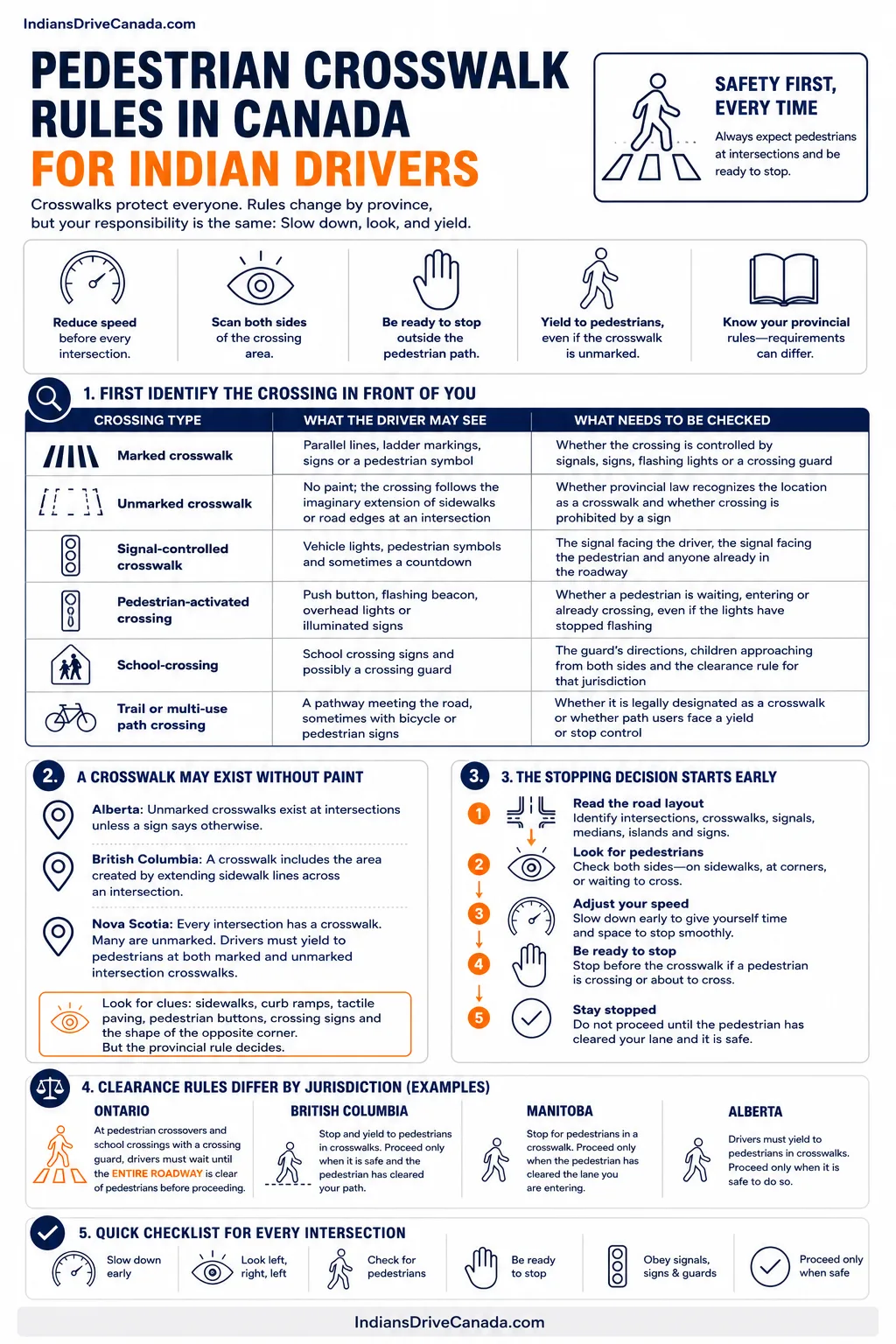
Pedestrian crosswalk rules in Canada are not limited to painted zebra lines. Depending on the province or territory, a legal crosswalk may exist at an intersection even when there are no road markings, pedestrian lights or crossing signs.
The safest working rule is to reduce speed before every intersection, scan both ends of the crossing area and be ready to stop outside the pedestrian path. The exact point at which a driver must stop, how long the vehicle must remain stopped and whether a pedestrian must first enter the roadway can change by jurisdiction and crossing type.
Do not apply one province’s clearance rule across Canada. Ontario requires drivers to wait until the entire roadway is clear at pedestrian crossovers and school crossings with a crossing guard. British Columbia, Manitoba and several other jurisdictions describe the required clearance differently. The local driver’s handbook must control the decision.
First identify the crossing in front of you
The word crosswalk covers more than one road layout. Treating every crossing as the same can lead to an incorrect stop position or an unsafe early restart.
| Crossing type | What the driver may see | What needs to be checked |
|---|---|---|
| Marked crosswalk | Parallel lines, ladder markings, signs or a pedestrian symbol | Whether the crossing is controlled by signals, signs, flashing lights or a crossing guard |
| Unmarked crosswalk | No paint; the crossing follows the imaginary extension of sidewalks or road edges at an intersection | Whether provincial law recognizes the location as a crosswalk and whether crossing is prohibited by a sign |
| Signal-controlled crosswalk | Vehicle lights, pedestrian symbols and sometimes a countdown | The signal facing the driver, the signal facing the pedestrian and anyone already in the roadway |
| Pedestrian-activated crossing | Push button, flashing beacon, overhead lights or illuminated signs | Whether a pedestrian is waiting, entering or already crossing, even if the lights have stopped flashing |
| School crossing | School crossing signs and possibly a crossing guard | The guard’s directions, children approaching from both sides and the clearance rule for that jurisdiction |
| Trail or multi-use path crossing | A pathway meeting the road, sometimes with bicycle or pedestrian signs | Whether it is legally designated as a crosswalk or whether path users face a yield or stop control |
Crosswalk and pedestrian crossover are not interchangeable terms in Ontario. A pedestrian crossover is a specially designated crossing identified by prescribed signs, markings, lights or other devices. Ontario’s whole-roadway clearance rule applies to pedestrian crossovers and school crossings where a crossing guard is present.[Ontario crossover]
A crosswalk may exist without paint
Drivers arriving from countries where zebra markings are the main visual cue may naturally search the road surface first. In several Canadian jurisdictions, the road layout matters just as much as paint.
An unmarked crosswalk is commonly formed by the imaginary continuation of the sidewalk across an intersection. Where there is no sidewalk, legislation or a driver’s handbook may use the curb line or road edge to define the crossing area.
Alberta states that unmarked crosswalks exist at intersections unless a sign says otherwise.[Unmarked crossing] British Columbia’s Motor Vehicle Act definition also includes the area created by extending sidewalk lines across an intersection.[Crosswalk definition]
Nova Scotia takes an especially direct approach: every intersection has a crosswalk, many are unmarked and drivers must yield to pedestrians at both marked and unmarked intersection crosswalks.[Intersection crossing]
When paint is missing, look for matching sidewalks, curb ramps, tactile paving, pedestrian buttons, crossing signs and the shape of the opposite corner. These clues help identify the likely pedestrian path, but the provincial rule still decides its legal status.
The stopping decision starts before the pedestrian reaches your lane
Waiting until a person is directly in front of the vehicle leaves little room for a smooth stop. A repeatable scanning sequence produces a safer and more predictable response.
Read the road layout
Identify the intersection, stop line, crosswalk markings, median, pedestrian island, signals and any signs that prohibit crossing. Do not rely on a single painted line.
Scan both approaches to the crossing
Check the left sidewalk, right sidewalk, curb ramps, bus stops, parked vehicles and the area behind snowbanks. A second pedestrian may approach after the first person has entered.
Release the accelerator early
Reducing speed before the decision point gives following traffic more time to react and makes a controlled stop possible on wet, snowy or icy pavement.
Stop outside the pedestrian path
Use the stop line when one is provided. If there is no stop line, remain before the crosswalk. At an unmarked crossing, keep the vehicle behind the imaginary sidewalk extension rather than placing the front bumper in the walking path.
Scan again before moving
Check for a second pedestrian, a child following an adult, a wheelchair user, a cyclist, someone turning back or a person hidden by the vehicle beside you.
Where the front of the vehicle should wait
A vehicle stopped too far into the intersection can block the crosswalk even when it does not directly prevent a pedestrian from passing. This reduces visibility for people crossing and for drivers in neighbouring lanes.
- Stop line present: stop before the line.
- Crosswalk present but no stop line: stop before entering the marked or unmarked crossing.
- Stop sign with limited visibility: complete the first stop before the pedestrian area. Move forward only after the crosswalk is clear and only as far as needed to check traffic.
- Driveway or parking-lot exit: stop before crossing the sidewalk and yield to people using it.
- Traffic queue beyond the intersection: do not enter if the vehicle cannot clear the crosswalk.
Do not creep through an occupied crosswalk. Slow forward movement can pressure a pedestrian to change speed or direction. It can also hide the pedestrian from another driver.
Right turns and left turns create different pedestrian conflicts
Canada uses right-side traffic. A driver whose previous experience was mainly in India may need to rebuild the order in which traffic and pedestrian areas are checked during a turn.
Right turns: the left-look trap
Before a right turn, a driver often looks left for an opening in vehicle traffic. While the head remains turned left, a pedestrian may begin crossing from the right.
Use two separate checks:
- Check the pedestrian path before moving toward the corner.
- After checking traffic from the left, look right and forward again immediately before the vehicle enters the crosswalk.
Do not move into the crosswalk while waiting for a gap. At a red light, a permitted right turn remains optional. The driver may wait for the next green signal when visibility or pedestrian movement makes the turn uncertain.
Left turns: the gap-focus problem
A left-turning driver must judge oncoming traffic and then cross the pedestrian path on the road being entered. Concentrating only on the traffic gap can cause the driver to miss a pedestrian who started crossing during the wait.
Before releasing the brake, check:
- the crosswalk directly ahead;
- the far corner on the road being entered;
- the near corner that may have been hidden by the windshield pillar;
- the pedestrian signal facing people crossing the destination road;
- cyclists or mobility-device users approaching beside the vehicle.
A green light or green arrow does not remove the duty to yield to a pedestrian who is lawfully using the crossing. Ontario’s driver’s handbook states that drivers turning left or right must yield to pedestrians crossing the intersection.[Turning rule]
Right turn on red is not a Canada-wide permission
Rules and local prohibitions must be checked before turning right on a red signal. Even where the movement is permitted, the driver must first make the required full stop and yield to pedestrians and other road users.
Québec permits right turns on red except on the island of Montréal and at locations where a sign prohibits the turn. The vehicle must stop before the stop line or crosswalk and check for pedestrians and cyclists approaching from the right.[Red-light turn]
Pedestrian signals do not replace the driver’s own scan
Pedestrian signals control when a person should enter the roadway. They do not permit a driver to endanger someone who is already crossing.
| Signal shown to pedestrians | What it normally communicates | Driver response |
|---|---|---|
| White walking person or WALK | Pedestrians may begin crossing in the indicated direction | Yield before turning across their path and expect people to enter from either side |
| Flashing hand or flashing DON’T WALK | People should not begin a new crossing; those already crossing continue toward safety | Do not treat the countdown or flashing hand as permission to pass in front of someone already in the roadway |
| Steady hand or DON’T WALK | Pedestrians should not enter | Check for anyone who entered earlier, moves slowly or remains in the crossing |
| Countdown display | Shows time remaining in the pedestrian clearance phase | Do not race the countdown or use it as a target for completing a turn |
| Pedestrian signal changes while someone is crossing | The person may still be completing a lawful crossing | Wait until the required safe clearance exists under the local rule |
Ontario identifies the white walking symbol as permission for pedestrians to cross. A flashing or steady orange hand means pedestrians must not begin a new crossing, while people already in the roadway still need time to finish safely.[Pedestrian signal]
The pedestrian’s position does not produce the same answer everywhere
| Pedestrian position | Safe first response | Jurisdiction issue to check |
|---|---|---|
| Waiting beside a marked crosswalk | Reduce speed and prepare to stop | Whether clearly indicated crossing intent triggers the duty to stop |
| Stepping into the crosswalk | Stop before the crossing | How the province defines the pedestrian’s proximity to the vehicle’s side of the road |
| In the driver’s lane | Remain stopped and leave a safe buffer | No attempt should be made to pass in front of or behind the person within the same conflict area |
| On the opposite half of the road | Continue assessing rather than moving automatically | Whether the applicable rule requires whole-road clearance, half-road clearance or another standard |
| Standing on a physical median | Identify whether the crossing is divided into separate stages | A painted line is not the same as a physical refuge or median |
| Still crossing after the signal changes | Allow the person to reach safety | The signal change does not make the pedestrian disappear from the driver’s duty of care |
Québec requires drivers and cyclists to yield at a pedestrian crosswalk when a person has started crossing or has clearly indicated an intention to cross. The province gives waiting beside the crossing, eye contact and a hand gesture as examples of visible intent.[Crossing intent]
A stopped vehicle beside a crosswalk is not an open lane
A vehicle may be stopped because its driver can see a pedestrian who is hidden from the next lane. Passing that vehicle creates a second line of traffic through the same crossing.
Never assume the stopped driver is waiting for ordinary traffic. The vehicle may be shielding a child, wheelchair user, runner or pedestrian who is about to enter your lane.
The correct response is to slow down, stay behind the stopped or slowing vehicle and identify why it has stopped. Do not move around it until the crossing and surrounding area can be seen and the local passing rule permits movement.
Ontario prohibits passing a vehicle within 30 metres of a pedestrian crossover and instructs drivers never to pass a vehicle stopped to let pedestrians cross.[Passing restriction]
British Columbia, Manitoba, Saskatchewan, New Brunswick, Prince Edward Island, Nova Scotia and Nunavut also state that a driver must not pass a vehicle that has slowed or stopped for a pedestrian at a crosswalk or intersection.
Provincial and territorial rules that can change the answer
The table identifies the distinction most likely to affect a driver’s decision. It is not a substitute for the full provincial handbook, traffic statute, road signs or directions from a police officer or crossing guard.
| Jurisdiction | Driver-facing distinction | Practical response |
|---|---|---|
| Ontario | Pedestrian crossovers and school crossings with a crossing guard require drivers to wait until pedestrians and the guard are safely on the sidewalk.[Ontario rule] | Identify whether the location is a pedestrian crossover, an ordinary crosswalk or a guarded school crossing before deciding when to proceed. |
| British Columbia | A crosswalk can be marked or formed by the extension of sidewalk lines. At an uncontrolled crossing, the driver yields when the pedestrian is on the driver’s half of the highway or approaching so closely from the other half that the pedestrian is in danger.[B.C. rule] | Do not use Ontario’s whole-roadway wording as the legal test. Continue only when the B.C. condition is met and movement is safe. |
| Alberta | Unmarked crosswalks exist at intersections unless a sign states otherwise.[Alberta rule] | Scan the imaginary sidewalk connection even when there are no lines or signs. |
| Québec | At marked pedestrian crosswalks, the duty to yield applies when a person begins crossing or clearly shows an intention to do so.[Québec rule] | Slow early enough to respond to a pedestrian waiting beside the crossing rather than waiting for the person to reach the vehicle’s lane. |
| Manitoba | Drivers must stop and yield to pedestrians crossing the roadway unless the pedestrian is on the opposite side of a divided highway separated by a physical median. A double solid line is not a physical separation.[Manitoba rule] | Distinguish a constructed median from paint before deciding that the opposite side is a separate crossing. |
| Saskatchewan | The crosswalk may be painted or may be an imaginary extension of the sidewalk. A pedestrian already crossing keeps the right-of-way if the traffic light changes.[Saskatchewan rule] | Stop before the crossing and do not restart merely because the signal has changed. |
| Nova Scotia | Every intersection has a crosswalk, and many are unmarked. Drivers must yield at marked and unmarked intersection crosswalks.[Nova Scotia rule] | Treat the sidewalk extension as a crossing even where winter conditions or road design leave no visible paint. |
| New Brunswick | Drivers must yield at pedestrian crossings and must not pass a vehicle stopped at a marked or unmarked crosswalk at an intersection.[New Brunswick rule] | Remain behind a stopped vehicle until the pedestrian area can be assessed safely. |
| Prince Edward Island | Pedestrians have the right-of-way in marked and unmarked crosswalks at stop-controlled, yield-controlled and open intersections. A driver approaching from behind must not pass a vehicle stopped for a pedestrian.[PEI rule] | Expect a legal crossing at the intersection even without pavement markings. |
| Newfoundland and Labrador | Provincial road-safety instructions require drivers to yield to pedestrians at crosswalks. The current Driver’s Handbook is the study source for signs and road rules.[N.L. rule] | Use the current handbook and posted controls rather than importing an unmarked-crosswalk rule from another province. |
| Yukon | The handbook instructs drivers who must stop at an unmarked crosswalk to stop where they would stop if the crossing were marked.[Yukon rule] | Keep the vehicle behind the imaginary crosswalk rather than stopping at the edge of the intersecting roadway. |
| Northwest Territories | When a pedestrian has entered a marked or unmarked crosswalk, the driver must stop before entering it and yield. In an urban area, the handbook also describes a pedestrian signalling an intention to cross by raising an arm and pointing toward the opposite curb.[N.W.T. rule] | Watch the pedestrian’s position and any clear hand signal before the person steps from the curb. |
| Nunavut | The driver’s manual requires a stop for a pedestrian in the crosswalk and says driving may continue only when the person has safely crossed. Passing a vehicle stopped at a crosswalk is prohibited.[Nunavut rule] | Wait for safe completion and do not move around a stopped vehicle. |
Your immigration status does not change the pedestrian right-of-way rule. A visitor, international student, work permit holder, permanent resident and Canadian licence holder must follow the same traffic controls in the jurisdiction where the vehicle is being driven.
School crossings require an independent scan
Do not follow the vehicle ahead through a school crossing without checking the crossing yourself. The first vehicle may move because its driver can see a clear path that is not yet visible from the following vehicle.
At a guarded crossing:
- slow before reaching the crossing;
- stop when directed by the crossing guard;
- remain behind the stop line or crosswalk;
- watch both sidewalks for children who arrive late;
- do not move because another lane begins moving;
- wait until the guard and pedestrians satisfy the local clearance rule;
- scan again after the guard leaves the roadway.
A school crosswalk is not reserved only for children. Other pedestrians using the crossing receive the protection given by the local rule.
Snow can hide paint but does not remove the crossing
Winter conditions can cover crosswalk lines, stop lines and curb edges. Drivers still need to identify the pedestrian route from the surrounding road design.
Use fixed features when markings are hidden
Allow more distance for the stop
A speed that permits a smooth summer stop may be too fast on packed snow or ice. Release the accelerator earlier and avoid a late, hard brake that could carry the vehicle into the crosswalk.
Check behind snowbanks and parked vehicles
A snowbank can hide a child, wheelchair user or mobility scooter until the person reaches the road edge. Reduce speed enough to stop within the distance that can actually be seen.
Keep the windshield, side windows, mirrors, headlights and camera lenses clear. A clean central viewing area is not enough when the pedestrian approaches from a corner hidden by ice or condensation on a side window.
Pedestrians using mobility aids need time and space, not pressure
A person may cross slowly, pause to maintain balance or change direction to avoid ice, standing water or damaged pavement. Do not move forward to encourage faster movement.
Watch carefully for:
Legal definitions of a pedestrian and the treatment of particular mobility devices can vary. The safe response is to keep the crossing clear and avoid making assumptions based on the device’s appearance.
A pedestrian outside a crosswalk can still require an emergency response
A pedestrian crossing outside a legal crosswalk may be required to yield to vehicles. That does not permit a driver to continue toward a visible collision.
British Columbia’s Motor Vehicle Act, for example, requires a pedestrian outside a crosswalk to yield, while separately requiring drivers to exercise due care to avoid colliding with a pedestrian on the highway.[Driver duty]
When someone enters unexpectedly:
- release the accelerator;
- brake in a controlled manner;
- check adjacent traffic before steering away;
- use the horn only when it is needed to warn of immediate danger;
- do not accelerate to pass before the person reaches your path;
- expect the person to stop, run or reverse direction.
A cyclist in a crosswalk may have a different legal status
A cyclist walking a bicycle is generally treated differently from a person riding through the crossing. Provincial laws, designated multi-use crossings and local traffic controls can change the result.
Do not use the cyclist’s possible violation as a reason to maintain speed. Reduce the collision risk first. Legal right-of-way and the driver’s duty to avoid a crash are related but separate questions.
Before turning across a crosswalk, check for:
- a cyclist approaching from behind on the right;
- a bicycle entering from a multi-use path;
- a person riding against the expected direction;
- a cyclist hidden beside a truck, bus or parked vehicle;
- a bicycle being walked through the crossing.
Road-test behaviour must make the safety check visible
A road-test examiner cannot rely on what the driver intended to check. The vehicle position, head movement, speed control and timing need to show that the pedestrian area was assessed.
| Situation | Observable driving action | Risk avoided |
|---|---|---|
| Approaching an intersection | Reduce speed and visibly scan both sidewalks | Missing an unmarked crossing or a person approaching the curb |
| Stopping | Bring the vehicle to a complete stop before the line or crossing | Rolling into the pedestrian path |
| Right turn | Check left for traffic, then return the head and eyes to the right-side crosswalk | Turning while looking away from the pedestrian conflict |
| Left turn | Recheck the destination crosswalk after the oncoming-traffic gap appears | Focusing only on the traffic gap |
| Vehicle stopped in another lane | Slow and remain behind until the reason for the stop is known | Passing a hidden pedestrian |
| Pedestrian finishes crossing | Scan both sides again before releasing the brake | Missing a second pedestrian or cyclist |
Do not use exaggerated head movements that take the eyes away from the road for too long. The check should be clear, controlled and matched to the actual hazard.
Crossing decisions in everyday situations
No paint at a residential four-way intersection
Reduce speed and scan the imaginary sidewalk extensions. Do not assume there is no crosswalk. Apply the unmarked-crosswalk rule of the province or territory.
The vehicle beside you stops before a mid-block crossing
Do not pass. A pedestrian may be hidden in front of the stopped vehicle. Remain back until the crossing can be assessed and movement is permitted.
Your light turns green while a pedestrian is still crossing
Remain stopped. A green vehicle signal does not authorize movement through an occupied pedestrian path.
A pedestrian waits beside a Québec crosswalk
Reduce speed and be prepared to stop. Waiting beside the marked crossing or another clear indication of intent can trigger the driver’s duty to yield.
A pedestrian has reached the opposite half of the road
Do not use a Canada-wide answer. Identify the jurisdiction, the crossing type, any physical median and the required clearance before moving.
Flashing lights stop while the pedestrian remains in the road
Keep the vehicle stopped. The device provides warning; it does not make an occupied crossing safe when the flashing phase ends.
A person runs across outside a crosswalk
Brake and avoid the collision. Whether the pedestrian was required to yield can be addressed only after immediate safety has been protected.
The crosswalk reset before every turn
- Check both sidewalks. Look beyond the nearest curb.
- Reduce speed early. Create time for a smooth stop.
- Identify the crossing type. Marked, unmarked, signal-controlled, activated or guarded.
- Stop outside the path. Keep the front of the vehicle behind the line or crossing.
- Recheck after looking for traffic. Vehicle gaps and pedestrian gaps are separate decisions.
- Use the local clearance rule. Do not rely on a rule learned in another province.
- Never pass a vehicle stopped for a pedestrian. Expect someone to be hidden.
- Look for the second road user. Another pedestrian, cyclist or mobility-device user may follow.
- Move only when the full path is safe. A signal or right-of-way does not replace the final scan.