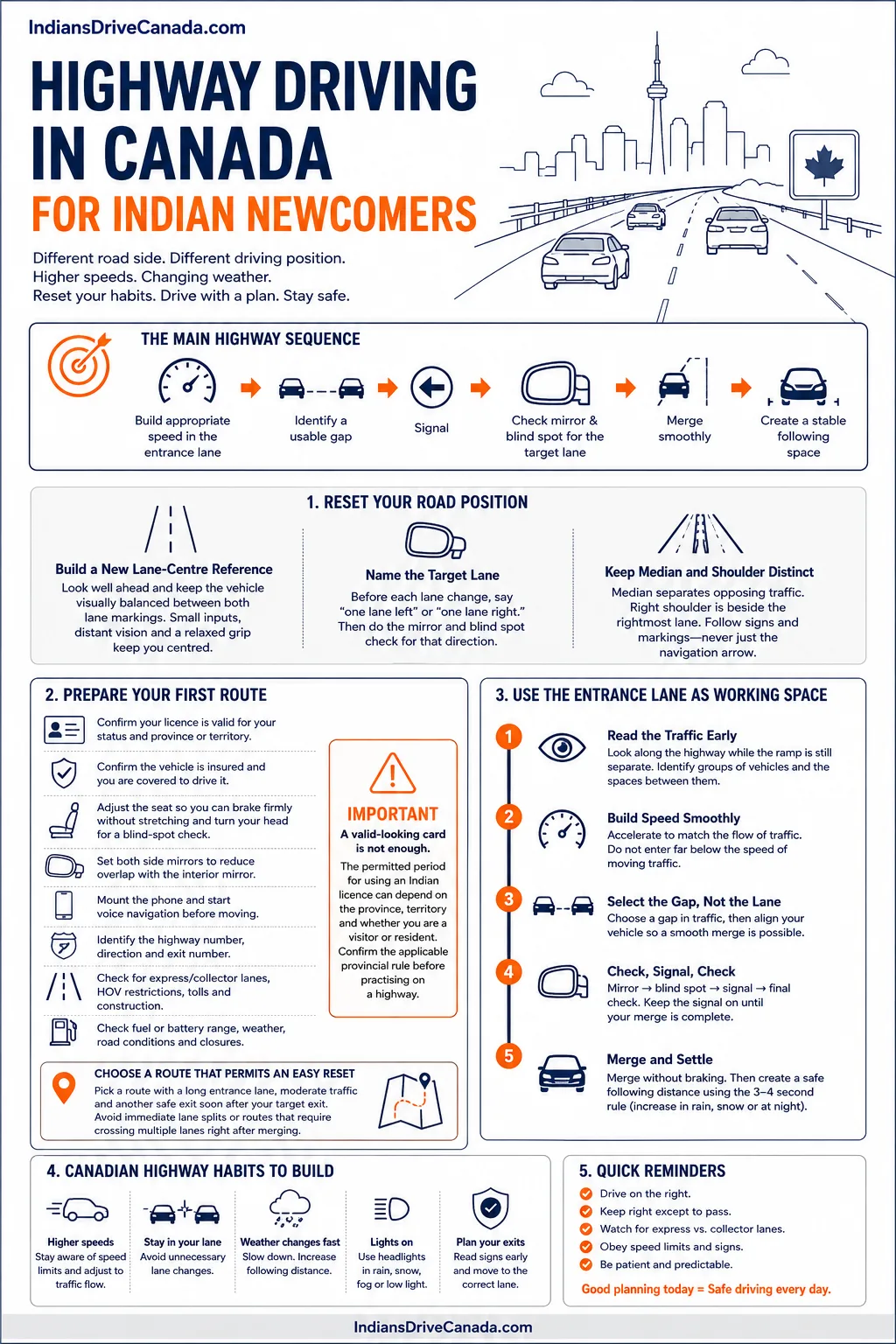
Highway driving in Canada can feel unfamiliar even when you already have years of driving experience in India. The difficulty is rarely basic vehicle control. It is the need to rebuild several automatic habits at the same time: traffic moves on the right, the driver sits on the left side of the car, most entrance ramps join from the right, lane changes happen at higher speed, and winter can change the road surface within a few kilometres.
The safest approach is to treat the first few highway trips as controlled practice rather than ordinary transportation. Choose a short route, use daylight and dry weather, study the interchange before leaving, and practise one task at a time.
The main highway sequence is simple: use the entrance lane to build an appropriate speed, identify a usable gap, signal, check the mirror and blind spot for the target lane, merge smoothly, and then create a stable following space. Do not enter far below the speed of moving traffic unless congestion or road conditions require it.
Reset the road position before adding highway speed
Driving on the right affects more than the side of the road. It changes where the centre median appears, which mirror receives the first check on a typical entrance ramp, how the vehicle sits between lane markings, and which side usually carries the exit lane.
Build a new lane-centre reference
A driver who is used to sitting on the right side of a vehicle may initially place a Canadian car too close to one lane line. Avoid using the bonnet edge or the road shoulder as the main reference. Look well ahead and keep the vehicle visually balanced between both lane markings.
This becomes more important at highway speed because small steering corrections can turn into side-to-side movement. A relaxed grip, distant vision and small inputs help the vehicle remain centred.
Name the target lane before the mirror check
A typical right-side entrance ramp joins a lane to the driver’s left. The usual scan therefore includes the road ahead, the left mirror and the left blind spot. A move toward an exit lane on the right requires the opposite checks. Some interchanges have left-side ramps, so the road design—not a memorised routine—must determine the check.
Useful practice: before each lane change, quietly identify the target as “one lane left” or “one lane right.” This makes the mirror and shoulder check deliberate while the old traffic-side reflex is fading.
Keep the median and outer shoulder distinct
On a divided highway, the median separates opposing directions of travel. The outer shoulder lies beside the rightmost through lane on a typical roadway. Do not follow a navigation arrow into a service road, ramp or divided-road opening until the road signs and lane markings also confirm the movement.
Prepare the first route before the wheels move
A first highway practice should not begin with an unfamiliar multi-level interchange, rush-hour traffic or poor visibility. A ten-minute setup removes several decisions that otherwise arrive while the car is moving.
- Confirm that the licence you are using is valid for your status and province or territory.
- Confirm that the vehicle is insured and that you are covered to drive it.
- Adjust the seat so you can brake firmly without stretching and turn your head for a blind-spot check.
- Set both side mirrors to reduce overlap with the interior mirror.
- Mount the phone and start voice navigation before moving.
- Identify the highway number, direction and exit number.
- Check for express and collector lanes, HOV restrictions, toll facilities and construction.
- Check fuel or battery range, weather, road conditions and closures.
Canada’s federal newcomer information states that foreign-licence use depends on the province or territory, and that driving without car insurance is illegal. A person who regularly drives a relative’s or friend’s vehicle should also make sure they are included under the insurance arrangement.[Driving eligibility]
A valid-looking card is not enough. The permitted period for using an Indian licence can depend on the province, territory and whether the driver is a visitor or resident. Confirm the applicable provincial rule before practising on a highway.
Choose a route that permits an easy reset
A suitable first route has a long entrance lane, moderate traffic and another safe exit soon after the intended one. Avoid a route where express and collector lanes divide immediately after the merge, or where several lanes must be crossed to reach the exit.
Study the route at interchange level. A map may show the correct road while hiding the fact that the driver must choose between local and express lanes. The useful details are the entrance number, lane split, exit number and the road name shown on overhead signs.
Use the entrance lane as working space
The entrance lane is not a place to wait until the last moment. It provides distance to observe traffic, increase speed and place the vehicle into a gap without forcing another driver to brake sharply.
1. Read the traffic before the merge area
Look along the highway while the ramp is still separate. Identify groups of vehicles and the spaces between them. Do not stare at one car; traffic behind it may close the gap you intended to use.
2. Create space behind the vehicle ahead
If another vehicle is entering in front of you, leave enough room for both cars to accelerate independently. Following too closely on the ramp can trap you at the merge point if the first driver hesitates.
3. Signal and build an appropriate speed
Use the acceleration portion of the entrance lane to approach the speed of highway traffic while remaining within the posted limit and adapting to the ramp, weather and congestion. The signal communicates your intention; it does not give you an automatic right to enter.
4. Check the target lane, mirror and blind spot
Confirm that the selected gap still exists. A small car or motorcycle may be beside the vehicle even when the mirror appears clear. Keep the steering steady during the shoulder check.
5. Move smoothly into the lane
Use one controlled lateral movement, centre the vehicle and cancel the signal. Rebuild space in front and behind before considering another lane change.
Ontario’s driver handbook describes the acceleration lane as the place to increase speed toward the speed of freeway traffic, then signal and merge smoothly. It also says drivers already on the freeway should make room when it is safe, but the entering driver still needs a safe opening.[Merge method]
When the entrance lane is short
Begin observing earlier and protect some acceleration space. If the ramp curves sharply, use a safe speed through the curve and accelerate once the vehicle is straighter. Do not rush into a small gap because the lane is ending.
Stopping at the end of a normal acceleration lane makes it harder to join moving traffic. Still, avoiding a collision takes priority: if traffic is stopped, the lane is blocked or no safe opening exists, slowing or stopping may be unavoidable. Do not use the shoulder to manufacture a longer merge lane.
Courtesy is not a guarantee
A driver on the highway may move left or adjust speed to help. Do not assume that will happen. The other lane may be occupied, the driver may not have seen you, or the road may not allow a lane change. Select a gap that remains safe even when the highway vehicle holds its lane.
| Ramp situation | Safer response | Avoid |
|---|---|---|
| A clear gap is approaching | Adjust speed early so your vehicle reaches the gap, not the vehicle beside it. | Holding one speed until the lane ends. |
| A truck is beside the merge lane | Choose clearly to enter behind it or, when space and speed allow, ahead of it. | Remaining beside the trailer while the lane disappears. |
| The vehicle ahead is very slow | Leave extra ramp space and prepare for its late merge. | Closing the gap and trying to merge as a pair. |
| Traffic is stop-and-go | Match the actual traffic speed and merge into an open space. | Accelerating toward the normal highway limit. |
| Snow or heavy rain reduces grip | Use gentler acceleration and accept a larger opening. | Abrupt throttle, braking or steering. |
Stabilise the lane before trying to make progress
After the merge, settle the vehicle in the lane, check the traffic ahead and establish space. Entering the highway is not a signal to cross immediately toward the far-left lane.
Use the right lane as a normal travel lane
The right lane is not reserved for uncertain or inexperienced drivers. It is often the correct place for steady travel and upcoming exits. The left side is generally used for passing, lane connections or other movements permitted by local rules and signs.
The legal wording is not identical across Canada. British Columbia, for example, requires drivers to keep right and let others pass on highways with at least two lanes in the same direction and a posted limit of 80 km/h or higher, subject to listed exceptions such as passing, making room for merging traffic and moving over for a stopped official vehicle.[B.C. lane rule] Do not turn that provincial example into a Canada-wide formula; follow the handbook, signs and lane markings where you are driving.
Change one lane at a time
Complete a separate mirror, signal and blind-spot check for each lane. Crossing several lanes in one diagonal movement reduces the time available to notice a vehicle approaching from the next lane.
A lane change is complete only when the vehicle is centred and the signal is cancelled. Pause long enough to reassess traffic before beginning another move.
Do not camp beside another vehicle
Avoid matching speed beside a car, bus or truck for a long period. That position limits escape space and may place the vehicle in a blind spot. Either remain behind with a useful gap or pass legally and return only when there is enough room.
Read express, collector and exit-only signs early
Some urban highways separate through traffic from lanes serving local exits. An express lane can bypass the exit you need, while a collector lane may provide the necessary connection. An exit only panel means the marked lane leaves the highway rather than continuing as a through lane.
HOV, HOT and other managed lanes may have occupancy, vehicle, time, entry-zone or payment conditions. Read the sign that applies to the lane. Do not cross solid or painted buffer areas simply because navigation asks for a late move.
Control speed through space, not by copying traffic
The fastest nearby vehicle does not set the legal or safe speed. Use the posted limit as the maximum under suitable conditions, then reduce speed when visibility, grip, traffic or road geometry requires it.
Separate ramp speed from highway speed
A curved ramp may have an advisory speed lower than the highway limit. Keep the vehicle controlled through the curve, then use the straighter acceleration lane to build speed. On an exit, move into the deceleration lane before completing most of the slowdown, unless traffic or a hazard requires earlier braking.
Measure following distance in time
Choose a fixed point ahead. When the vehicle in front passes it, count until your vehicle reaches the same point. ICBC states that at least two seconds is needed in good weather and road conditions, and at least three seconds should be allowed behind a large vehicle that blocks the view or a motorcycle that can stop quickly.[Following distance]
Those intervals are minimum reference points, not a promise that stopping will be possible. Add more room for rain, snow, ice, darkness, downhill grades, poor tires, low visibility and heavy traffic. If another driver moves into the gap, release the accelerator and rebuild it gradually rather than braking sharply.
Use cruise control selectively
Cruise control can be useful on a clear, dry and lightly travelled road. Direct pedal control is usually the better choice in stop-and-go traffic, on snow or ice, during heavy rain, through roadworks, on winding mountain sections or whenever speed must change frequently.
Speed and flow are different decisions. A driver can avoid blocking faster traffic by moving right when safe without exceeding the posted limit. Do not respond to tailgating with an unsafe increase in speed.
Win the exit before reaching the painted triangle
Highway exits are easier when the lane decision is made early. Read the exit number, road name, direction and lane panel on overhead signs. Navigation is useful for advance notice, but the physical signs decide which lane continues and which lane leaves.
Move toward the exit in separate stages
If you are several lanes away, start early and change one lane at a time. Each move needs its own scan. Avoid waiting for the final few hundred metres and then searching for one large opening across multiple lanes.
Use the deceleration lane
Signal before entering the exit lane. Once established in it, reduce speed for the ramp and prepare for a tighter curve, stopped traffic, a traffic signal or a stop sign at the end. A ramp that looks open from the highway can contain a queue around the bend.
Missed the exit? Keep driving
A missed exit costs time. A last-second correction can cause a collision.
Give trucks room to remain predictable
Large trucks accelerate, brake and turn differently from passenger cars. Their mirrors also leave areas where a smaller vehicle may not be visible.
Avoid the trailer-side waiting position
Do not remain beside the cab or trailer when traffic ahead prevents a clear pass. If you cannot complete the move, return to a position behind the truck where the driver can more easily account for your vehicle.
Leave more room before returning
After passing, wait until the truck is clearly visible in the interior mirror before moving back. ICBC advises leaving extra room before returning in front of a truck.[Truck spacing] Cutting in closely removes the truck driver’s braking space.
Expect temporary loss of visibility
Rain spray, slush and loose snow can hide the lane markings while you are passing. Make sure the wipers and washer fluid are working before the trip. If visibility drops, hold a steady lane and create space rather than making a sudden lateral move.
Watch the front wheels and signals
A truck may move left to avoid a stopped vehicle, road debris or work crew. Its trailer can take longer to follow the cab. Signals, lane position and the space ahead give better warning than waiting for the trailer to begin moving.
Keep the shoulder available for real emergencies
The highway shoulder is not a navigation area, meeting point or phone stop. Use a service centre, rest area or exit when the vehicle is operating normally.
When the vehicle can still move
Signal, reduce speed smoothly and move as far from the traffic lane as the location safely permits. Switch on the hazard lights. Avoid stopping on a bridge, inside a tunnel, near a blind curve or beside a narrow barrier when the vehicle can reach a safer location.
When the vehicle cannot clear the lane
Use hazard lights and call emergency services when the stopped vehicle creates immediate danger. Do not stand behind the vehicle, between vehicles or in a live lane. Whether it is safer to remain belted inside or leave from the passenger side depends on traffic, fire risk, the barrier, weather and the vehicle’s position.
911 and 511 serve different purposes. Use 911 for an emergency. Provincial 511 services provide traveller information and are not a substitute for emergency response.
Slow down and move over for flashing roadside vehicles
Move-over duties differ in wording, covered vehicles and required speed. Ontario requires drivers approaching certain stopped emergency vehicles or tow trucks with flashing lights to slow down and, on multi-lane roads, move over when it can be done safely.[Ontario roadside rule]
British Columbia’s rule covers vehicles stopped with flashing red, blue or yellow lights, including emergency, maintenance, utility and other listed roadside work vehicles. Drivers on a multi-lane road must move into another lane where safe, and the province publishes specific reduced speeds for passing the scene.[B.C. roadside rule]
Because the details vary, identify the provincial rule before a long interprovincial trip. In every province, treat flashing roadside lights as an early signal to check mirrors, reduce speed smoothly and create space without cutting off another driver.
Winter changes every highway decision
A road can look merely wet while containing ice. Bridges, overpasses, shaded sections, ramps and areas near freezing temperatures can become slippery before surrounding pavement. Snowdrifts and blowing snow can also create a sudden change between one open section and the next.
“Open” does not mean normal driving conditions
An open road may still be partly covered, fully covered, icy or affected by reduced visibility. Read the road-condition description and camera image, not only the closure status. A weather icon for the destination cannot show every highway segment between the start and finish.
| Report or condition | What it means for the driver | Practical response |
|---|---|---|
| Bare wet or dry | The route is reported mainly clear, but local ice or standing water can still occur. | Continue scanning and adapt to temperature and visibility. |
| Partly covered | Snow or ice affects sections of the travelled surface. | Reduce speed, increase space and expect grip to change without warning. |
| Covered | Snow or ice covers most or all of the surface. | Delay when possible, or travel only with suitable equipment and winter-driving ability. |
| Reduced visibility | Blowing snow, fog or precipitation can hide traffic and lane markings. | Reconsider the trip; never drive faster than the visible stopping area allows. |
| Travel not recommended | The road authority advises against non-essential travel. | Delay or cancel the trip unless an emergency requires travel. |
| Closed | The road is not available for travel. | Do not enter; use an officially open route or postpone the journey. |
Winter tire law depends on registration and route
There is no single winter-tire rule for every Canadian driver. Québec requires motor vehicles registered in Québec, including rental vehicles, to have compliant winter tires from December 1 to March 15, subject to listed exceptions.[Québec tire rule]
British Columbia requires winter tires or chains on most designated routes from October 1 to April 30. On selected highways outside mountain-pass or high-snowfall areas, the requirement ends March 31. The affected roads are marked by regulatory signs, and some coastal routes are not included.[B.C. winter routes]
Do not rely on the rules where the vehicle is rented or where the trip begins. Check the registration jurisdiction, the province being entered, the exact highway and the dates shown on route signs.
Leave snowplows working space
A working snowplow may create a cloud of snow and throw wet snow across the lane. Several plows can travel in a staggered formation across a freeway. Ontario’s driver handbook warns drivers not to pass between plows in that formation, and Ontario’s winter-driving information says never to pass a working snowplow.[Snowplow safety]
Stay well back where the driver can see you. Do not use the shoulder or a narrow opening to get around maintenance vehicles. The road behind the plow is usually the treated portion; the surface ahead may be worse.
Choose delay before skill is tested
Delay the trip when freezing rain, whiteout conditions, a travel-not-recommended notice, unsuitable tires, low fuel, weak mobile coverage or driver fatigue create several risks at once. A schedule is not a reason to test a new highway skill in poor conditions.
Check the road itself, not only the forecast
Provincial traveller-information services show different combinations of road surface, incidents, closures, construction, cameras, weather alerts, snowplows and rest areas. Check before departure and again from a safe stopped location when conditions are changing.
| Area | Service | Useful checks |
|---|---|---|
| Ontario | Ontario 511[Ontario road reports] | Closures, collisions, construction, cameras, rest areas, weather and selected winter-maintenance information. |
| British Columbia | DriveBC[B.C. road reports] | Road conditions, closures, delays, planned events and highway cameras. |
| Alberta | 511 Alberta[Alberta road reports] | Road surface, visibility, incidents, closures, cameras, maintenance vehicles, weather alerts and rest areas. |
| Saskatchewan | Highway Hotline[Saskatchewan road reports] | Road condition categories, closures, reduced visibility, cameras and tracked plows where available. |
- Read the condition for each highway segment, not only the destination city.
- Open one or two camera views near the highest, most exposed or most congested part of the route.
- Check whether an incident blocks the direction you will travel.
- Confirm that the alternate route is also open before leaving the main highway.
- Put the phone away before moving; recheck only after stopping safely.
Urban freeways and long-distance highways require different plans
Urban freeways compress decisions
City highways bring frequent exits, short spacing between interchanges, collector and express splits, merging traffic from both sides, HOV lanes and stop-and-go waves. Leave a larger planning margin than navigation suggests and avoid last-second lane hunting.
Rural highways stretch the distance between help
Fuel, charging, food, washrooms and mobile service can be far apart. Do not assume the next town shown on a map has an open fuel station or a working charger. Keep enough range to reach an alternative and download the route where mobile coverage may be weak.
Wildlife risk changes with time and location
Wildlife warning signs identify areas where animals may enter the road. Reduce speed where sight lines are limited, especially near dawn, dusk, forest edges and water. One animal may be followed by another. Hard swerving at highway speed can create a second danger, so brake firmly while keeping control and change direction only when the path is known to be clear.
Mountain roads need speed control before the slope
Reduce speed before a curve rather than braking hard inside it. On long descents, use an appropriate lower gear or the vehicle’s designed descent-control feature so the service brakes are not carrying the entire load continuously. Check pass conditions, chain or tire signs, fuel and weather before entering a mountain section.
Fatigue appears in small driving errors
Drifting within the lane, missing signs, inconsistent speed, repeated yawning or not remembering the last few kilometres are reasons to leave the highway at a safe place. Coffee, cold air and loud music do not replace rest.
Build highway confidence in three separate drives
First drive: one entrance and one planned exit
Use daylight, dry pavement and a quiet period. Choose a route with a long entrance lane and leave after one or two exits. Practise only ramp observation, speed matching, blind-spot checking, lane centring and an early exit setup.
Second drive: lane changes and one major interchange
Add several deliberate lane changes, one truck pass and one express-collector or highway-to-highway connection. Keep the route familiar enough that the driving task—not navigation—receives most of the attention.
Third drive: moderate traffic with an escape plan
Use a busier period without choosing peak congestion. Identify the next exit after every planned exit so a missed instruction never becomes urgent. Do not combine this practice with darkness, snow or heavy rain.
Professional instruction can be useful even for an experienced driver. A lesson can focus only on Canadian lane position, mirror setup, freeway merging and local road-test expectations rather than repeating basic vehicle operation.
Replace transition reflexes with visible actions
| Transition reflex | Why it creates difficulty | Replacement action |
|---|---|---|
| Checking the familiar shoulder automatically | The target lane may now be on the opposite side. | Name the target lane, then check its mirror and blind spot. |
| Entering far below traffic speed | Vehicles behind close the distance quickly. | Use the acceleration lane to approach the moving traffic speed when conditions permit. |
| Moving left immediately after merging | The car has not yet developed stable spacing. | Centre the vehicle and assess traffic before another move. |
| Treating a signal as permission | The target space may still be occupied. | Signal intention, then enter only after confirming a safe opening. |
| Following the fastest vehicle | Another driver’s speed may be illegal or unsuitable. | Use the posted limit, road conditions and a timed following gap. |
| Trying to save a missed exit | Late braking or crossing the gore area surprises other drivers. | Continue to the next exit. |
| Stopping on the shoulder for navigation | The vehicle remains close to high-speed traffic. | Use a rest area, service centre or exit. |
| Assuming an open winter road is clear | Open routes may still be covered or have poor visibility. | Read the condition category and camera view before travel. |
Province checks before an unfamiliar highway trip
Driving technique travels across provincial borders, but legal details do not always travel with it. Before using an unfamiliar highway, check the current provincial handbook and route information for the items that affect that trip.
- The validity and conditions of the licence being used.
- Any learner or graduated-licence highway, passenger or supervision restrictions.
- Keep-right and passing-lane rules.
- HOV, HOT, toll-lane and electronic-billing conditions.
- Move-over duties and the vehicles covered by them.
- Winter tire, chain and designated-route requirements.
- Hand-held device and navigation restrictions.
- Collision reporting and emergency procedures.
- Current road reports, closures and construction.
Do not combine provincial rules. A date, speed, licence condition or lane rule published by one province should not be treated as the rule for the rest of Canada. Use the source for the province where the vehicle is being driven.