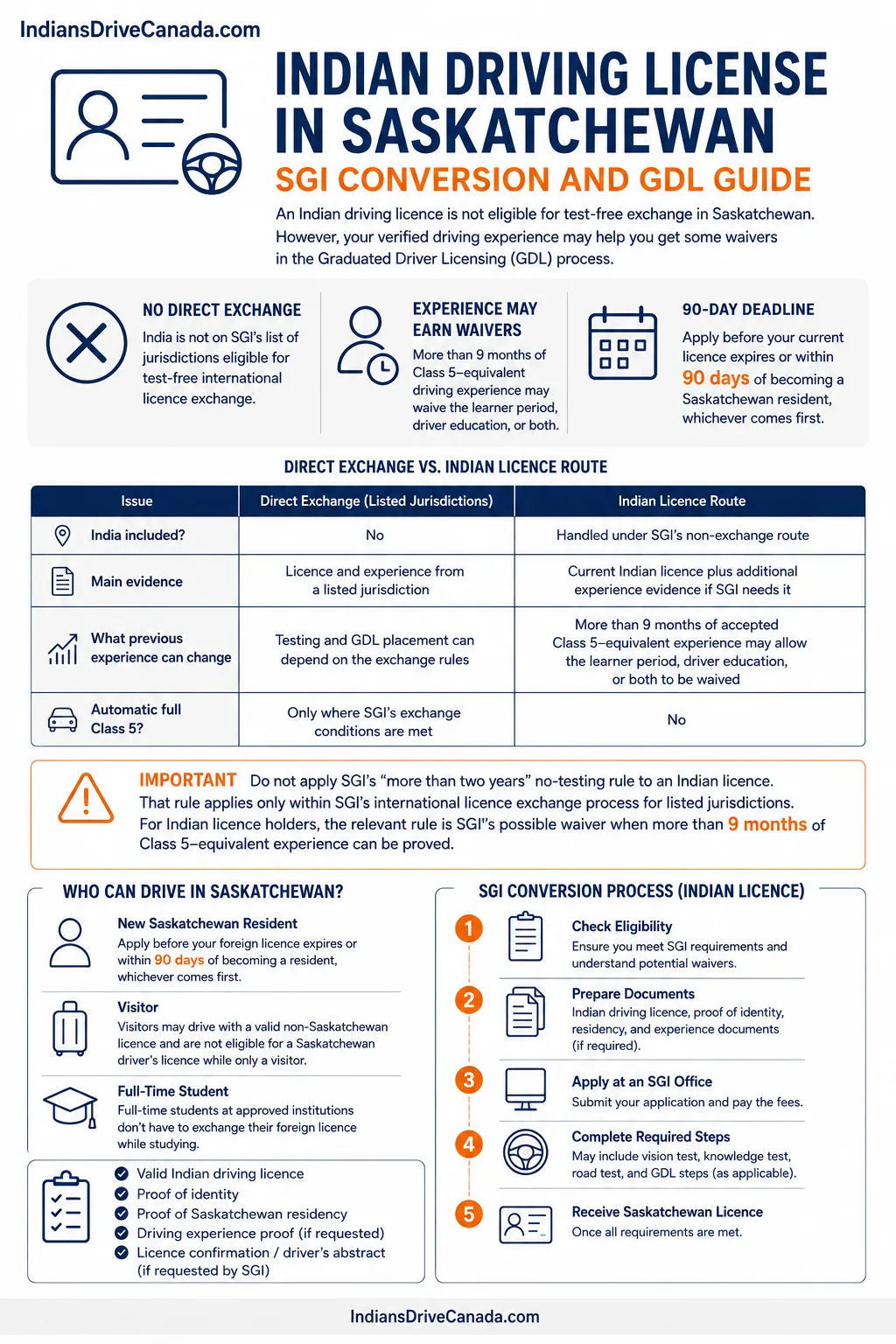
An Indian driving licence does not qualify for Saskatchewan’s test-free international licence exchange. India is not on SGI’s published list of jurisdictions whose full licences can be exchanged without testing. An Indian licence holder who becomes a Saskatchewan resident therefore enters the non-exchange route, although verified driving experience can change how much of the normal Graduated Driver Licensing process must be completed.[Exchange rule]
The part that can shorten the Saskatchewan route is driving experience, not direct exchange. SGI may waive the normal GDL learning period, the required driver education, or both when an applicant can prove more than nine months of driving as a Class 5 or equivalent driver. SGI first looks at the issue date on the current foreign licence and can request a licence confirmation or driver’s abstract when that date does not establish enough experience or cannot be verified.[Experience waiver]
Direct exchange and experience credit lead to different outcomes
Two SGI rules can look similar but should not be combined. A driver from one of Saskatchewan’s listed exchange jurisdictions may qualify for a Saskatchewan licence without testing when the published experience conditions are met. India is outside that list.
| Issue | Direct exchange | Indian licence route |
|---|---|---|
| India included? | No | Handled under SGI’s non-exchange route |
| Main evidence | Licence and experience from a listed jurisdiction | Current Indian licence plus additional experience evidence if SGI needs it |
| What previous experience can change | Testing and GDL placement can depend on the exchange rules | More than nine months of accepted Class 5-equivalent experience may allow the learner period, driver education, or both to be waived |
| Automatic full Class 5? | Only where SGI’s exchange conditions are met | No |
Do not apply SGI’s “more than two years” no-testing rule to an Indian licence. That rule appears within SGI’s international licence exchange process for the jurisdictions on its published exchange list. India is not on that list. The separate rule relevant to an Indian licence is SGI’s possible waiver when more than nine months of Class 5-equivalent experience can be proved.[Exchange scope]
The 90-day deadline starts with Saskatchewan residency
A new Saskatchewan resident must apply for a Saskatchewan Class 5 licence before the existing out-of-province licence expires or within 90 days of becoming a Saskatchewan resident, whichever happens first.[Resident deadline]
The rule is tied to becoming a Saskatchewan resident. A person who entered Canada earlier as a visitor, lived in another province first, or later changed living arrangements should not automatically use the original Canadian arrival date as the start of Saskatchewan’s 90-day period.
| Situation | Published SGI position | What to check |
|---|---|---|
| New Saskatchewan resident | Apply before the foreign licence expires or within 90 days of becoming a resident, whichever comes first. | Confirm when Saskatchewan residency began and whether the Indian licence remains valid. |
| Visitor | A visitor may drive under the authority of a valid non-Saskatchewan licence and is not eligible for a Saskatchewan driver’s licence while only a visitor. | Keep the home licence valid and meet translation requirements if applicable. |
| Full-time student | Full-time students attending approved educational institutions do not have to exchange their licence while living in Saskatchewan to attend classes. | Reassess the rule if student status ends or Saskatchewan residency is established on another basis. |
| Temporary foreign worker | SGI’s Driver’s Handbook allows a temporary foreign worker to use an existing licence for the privileges it provides at home, excluding Class 1 vehicles. | If the person becomes a Saskatchewan resident, the resident licensing deadline becomes relevant. |
SGI treats visitor, student, temporary-worker and resident situations differently, so immigration status alone does not answer when an Indian licence must be replaced.[Status rules]
The nine-month experience rule can change the normal learner route
For a valid licence from a country outside SGI’s exchange list, Saskatchewan classifies the applicant under its new-driver route. SGI then allows an important exception: if more than nine months of Class 5 or equivalent driving can be proved, the normal learning period, the required driver education, or both may be waived.
This is not a promise of a direct Class 5 exchange. It is a decision about which GDL requirements must be completed before or around the testing process.
SGI first looks at the issue date on the current Indian licence
The current licence card matters because SGI says it uses the issuing date on the current out-of-country licence when judging experience. A card that clearly shows more than nine months of qualifying experience may provide the information SGI needs.
A renewed or reissued Indian licence can create a different problem. Someone may have driven since 2017 while the current card shows an issue date in 2026. The recent date on the card does not automatically demonstrate the earlier years.
A licence confirmation or driver’s abstract may become necessary
If the date on the foreign licence does not show enough experience, or SGI cannot verify it, SGI says its Driver Development team will request either a licence confirmation or a driver’s abstract from the previous jurisdiction.[Experience document]
Records worth preparing when the current card does not show the full history
- The current original Indian driving licence.
- A licence confirmation or driver’s abstract if SGI requests evidence beyond the card.
- An official record that clearly connects an older and current licence number when the licence has been reissued or renumbered, if such a record is available from the issuing authority.
- The original foreign licence together with an acceptable translation when the licence is not in English or French.
Translation and driving-history proof perform different jobs. A translation makes the foreign licence readable. It does not by itself prove an earlier first-licensed date. SGI can still request a licence confirmation or driver’s abstract when the experience shown on the licence cannot be established.
More than nine months does not guarantee the same result for every file
SGI states that, depending on how the road test goes, an applicant may still be required to practise as a learner for nine months and complete SGI-approved driver training. For that reason, an Indian driver with many years of experience should wait for SGI’s assessment rather than treating the number of years on an Indian record as a self-calculated Saskatchewan licence stage.
Prepare the Saskatchewan identity and residency file separately
Driving-experience evidence does not replace the documents used to establish identity and Saskatchewan residency. SGI requires new drivers and new residents to provide a minimum of two pieces of original identification and two Saskatchewan residency documents. Residency records must show a civic address or land location and be dated within the previous 90 days.[Identity documents]
The identification used together must establish the applicant’s legal name, complete date of birth and signature. The documents need to be in the same name. Name changes or differences between an Indian licence and Canadian records should therefore be supported with the type of original documentation accepted by SGI rather than explained only verbally at the counter.
Check the issue date on every residency document before the licensing visit. A valid lease or financial document can still fail the published residency-document timing rule if it falls outside SGI’s required period.
When an IDP or translation is needed
If the Indian licence is not written in English or French, SGI recommends obtaining an International Driving Permit before leaving the home country. If an IDP was not obtained, SGI’s moving information says an official translation of the out-of-country licence can be obtained from the Open Door Society or a professional entity.[Translation rule]
An IDP should not be treated as a replacement for the underlying Indian driving licence or as automatic proof of several years of experience. Keep the original licence with the translation document and be prepared for SGI to request separate history evidence when the issue date is not enough.
Testing after SGI reviews the Indian licence
The normal Saskatchewan GDL testing route begins with the Class 7 basic knowledge exam, signs exam and vision test. A foreign-experience waiver can change the amount of learner time or driver education required, but it does not turn an Indian licence into a reciprocal exchange licence.
Basic knowledge and signs exams
The basic knowledge exam covers Saskatchewan road rules, while the signs exam checks traffic-sign meanings. SGI lists an 80% passing grade and a $25 fee for each attempt at either exam. In larger centres, the basic knowledge exam is computer based with translation available in more than 100 languages; smaller centres use paper exams.
Regina and Saskatoon accept walk-in written testing. Elsewhere, an appointment is required.[Knowledge test]
Vision test
The vision test is part of the knowledge-exam appointment. If the required standard is not met, the examiner provides the next step. The vision test itself is included in the knowledge-exam fee.
Class 5 road test
When the applicant has completed or received the applicable waivers for the learner and education requirements, the Class 5 road test assesses actual driving. SGI tests starting, stopping, turning, lane use, signs and signals, controlled and uncontrolled intersections, backing, hazard anticipation, speed selection, steering, parallel parking and two-point turns.
The test usually takes about 20 minutes. SGI lists a passing result as nine demerits or fewer, a failing result as 10 or more demerits, and a fee of $55 for each attempt.[Road test]
The road test is conducted in English
SGI conducts Class 5 road tests in English. Only the examiner and driver are allowed in the vehicle during the test. The examiner uses simple directions, so it is useful to be comfortable with terms such as right turn, left turn, backing, intersection, stop, parallel parking and two-point turn before the appointment.[Test language]
For someone accustomed to driving on the left side of the road, practice should also cover Saskatchewan lane positioning and turning from the right side of the roadway. The goal is not simply to reverse old habits: observation, shoulder checks, yielding and lane selection have to match Saskatchewan road rules throughout the test.
Smaller-centre appointments are not a shortcut
SGI states that road-test appointments in smaller centres are reserved for local residents. The Class 5 test content is also published as the same across the province. Choosing a distant town because it is believed to have an easier test is therefore not a sound booking strategy.[Booking rule]
GDL still matters when previous experience is accepted
Saskatchewan’s ordinary Class 5 GDL sequence has three pre-graduation stages: Class 7 Learner, Class 5 Novice 1 and Class 5 Novice 2. The foreign-experience rule specifically allows SGI to waive the learning period, driver education, or both. It should not be read as permission to independently remove every novice stage from the process.[GDL stages]
| Stage | Standard duration | Main requirement |
|---|---|---|
| Class 7 Learner | 9 months | Supervised practice and mandatory driver education under the ordinary route |
| Class 5 Novice 1 | 6 months | Drive under Novice 1 restrictions |
| Class 5 Novice 2 | Minimum 12 months | Complete 12 months without an at-fault collision, traffic conviction or licence suspension |
| Experienced Class 5 | After GDL requirements are completed | Graduate from the novice program |
A waiver of the nine-month learner period is not the same as a waiver of the entire GDL program. The licence status recorded by SGI determines which restrictions and waiting periods apply after the foreign experience has been reviewed.
What the standard driver-education requirement contains
A Class 7 driver following the ordinary commercial-training route must complete at least six hours of in-class and six hours of in-car instruction with an SGI-certified instructor before becoming eligible for a higher licence class. If SGI waives the education requirement because sufficient foreign experience has been accepted, the applicant should rely on the waiver recorded on the SGI file rather than purchasing training simply because it appears in the standard GDL sequence.[Driver education]
Restrictions can apply even to someone who drove for years in India
Once a driver is placed in a Saskatchewan GDL stage, the restrictions attached to that stage apply regardless of how long the person previously drove abroad.
These restrictions are part of SGI’s published GDL rules.[GDL restrictions]
If the learner period is not waived, the supervisor must qualify
A Class 7 learner must have an experienced supervising driver in the front passenger seat. SGI requires the supervisor to hold at least a valid Class 5 licence from a Canadian or U.S. jurisdiction, to have held a valid licence for at least 12 months during the previous three years, and not to be a novice driver.[Supervisor rule]
A friend or family member who has only recently reached Saskatchewan Novice 1 or Novice 2 therefore cannot serve as the learner’s supervising driver.
A renewed Indian licence can change the evidence problem, not the driving history
| Record situation | What it establishes | Likely issue to resolve |
|---|---|---|
| Current licence shows an issue date several years ago | The card itself may show more than nine months of experience. | SGI still decides whether the class and experience can be verified as equivalent. |
| Driver has years of experience but the current card was recently renewed | The current card may show only the recent issue date. | SGI may request a licence confirmation or driver’s abstract to establish earlier experience. |
| Current full-licence experience is under nine months | The published waiver threshold has not been demonstrated. | The normal learner period and driver-education requirements may remain applicable. |
| Full-time student using a valid Indian licence | Student status can change whether immediate exchange is required. | Confirm that the SGI student exemption still applies before treating the person as a new resident subject to the 90-day deadline. |
The document package should make the licensing history understandable without requiring SGI to infer that a recently issued card represents an older record.
Check the SGI file before booking the Class 5 road test
A road-test appointment can be rescheduled when required driver education is not recorded, the learner has not completed the required learning period, the applicant lacks the appropriate licence, vision or medical standards are not met, or the test vehicle is unsafe or not legally equipped.[Test readiness]
Before paying for the road test
- Confirm whether the nine-month learner period is completed or formally waived on the SGI file.
- Confirm whether driver education is completed, recorded or waived.
- If education is still required and no electronic training record appears on the SGI file, have the Driver Education Certificate available.
- Book the Class 5 road test at the appropriate examination office.
- Use a Class 5 vehicle with working signal lights, brake lights and horn.
- Check that the windshield is legal and the vehicle has a valid licence plate.
- Practise the English directions used during the test before the appointment.
A failed Class 5 test creates a minimum waiting period
If a Class 5 applicant fails the road test, SGI requires a wait of at least two weeks before another road test can be taken, although the next appointment can be booked immediately. A new test fee is required. SGI may also recommend additional training or impose a longer learning period depending on the result.[Retest rule]
For an Indian licence holder whose nine-month learner period or education requirement was initially waived, this provision matters: poor road-test performance can affect what SGI requires next. The safest assumption is therefore that the waiver changes eligibility to move through the process; it does not remove SGI’s ability to require further learning when the test result shows it is needed.