DL Extract From India for Ontario G1: How to Get It and Use It
An Indian DL Extract can support an Ontario G1 application when it works as an official authentication document....
Driving in Canada as an Indian Student, Worker or PR: What Changes?
Student, worker and permanent resident are immigration categories, not separate driver’s licence classes. Your right to use an...
How to Prove Indian Driving Experience in Canada
An Indian driving licence can show that you are licensed, but it may not prove your full driving...
Indian Driving Licence Translation in Canada: When You Need It
An Indian driving licence does not automatically need translation simply because it was issued in India. A modern...
Indian Driving License in Alberta: How to Get Your Class 5 Licence
An Indian driving licence cannot be swapped directly for an Alberta Class 5 licence. India is not listed...
Indian Driving License in British Columbia: ICBC Conversion Guide
A valid Indian driving licence does not qualify for a test-free, card-for-card exchange in British Columbia. A new...
Indian Driving License in Manitoba: MPI Conversion, Tests and Documents
An Indian driving licence cannot be exchanged for a Manitoba Class 5 licence without testing. A new Manitoba...
Indian Driving License in Nova Scotia: Tests, Exchange and New Resident Rules
A valid Indian driving licence can be used in Nova Scotia only while the province's foreign-licence rules still...
Indian Driving License in Ontario: G1, G2 and Full G Guide (2026)
111 An Indian driving licence cannot be directly exchanged for an Ontario G licence. India does not have...
Indian Driving License in Prince Edward Island: Exchange and Newcomer Driver Course
An Indian driving licence does not qualify for a test-free direct exchange in Prince Edward Island. India does...
Indian Driving License in Quebec: SAAQ Conversion Steps for Newcomers
Verified on August 23, 2026. An Indian driving licence does not qualify for a simple, test-free swap in...
Indian Driving License in Saskatchewan: SGI Conversion and GDL Guide
An Indian driving licence does not qualify for Saskatchewan’s test-free international licence exchange. India is not on SGI’s...
Moving to Another Province in Canada: When to Exchange Your Driver’s Licence
If you become a resident of another Canadian province while holding a valid provincial driver's licence, the destination...
13 articles in Driving License Canada Indians
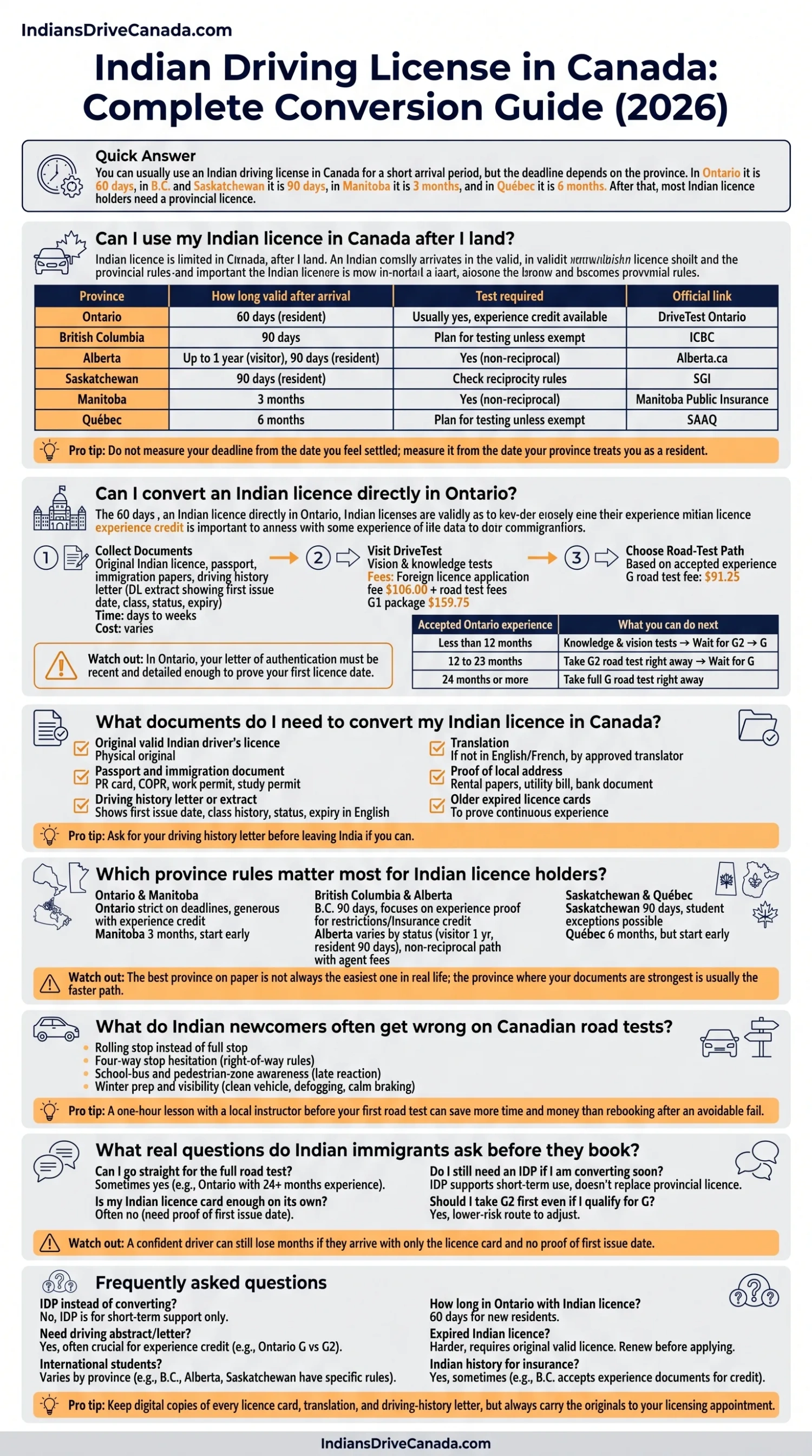
An Indian driving licence is not converted under one Canada-wide rule. The province where you become a resident decides the licence-use window, whether an exchange is available, how previous experience is credited, which documents are accepted, and which tests are required.
Start with the province table below. It tells you how long the Indian licence is usually usable after residence begins and whether you should plan for testing. After that, use the matching provincial section rather than following an Ontario process in B.C., Alberta, Saskatchewan, Manitoba, or Québec.
As of August 2026, Ontario treats India as a non-exchange jurisdiction and limits Class G foreign driving-experience credit to 12 months. Twelve months of accepted credit can remove the additional wait before G2, but it cannot remove G2 or shorten the mandatory 12-month wait from G2 to G.
Choose your province before planning the conversion
A valid Indian licence is usually usable only for a limited period after residence begins, and the deadline comes from the province where you live.
If you are moving as a permanent resident, most provinces expect you to switch fairly soon. If you are coming as a student or temporary worker, some provinces give extra room, but not all of them. The same Indian licence can therefore lead to a different process in Alberta than in Ontario.
An International Driving Permit can help with translation during short-term use, but it does not replace provincial licensing. It also does not create a shortcut around knowledge or road tests. For most newcomers, it is a support document, not the final answer.
| Province | How long an Indian licence is usually valid after arrival | Test required | Official link |
|---|---|---|---|
| Ontario | 60 days after becoming a resident | Yes for Indian licence holders; verified experience can reduce the wait before G2 | DriveTest Ontario |
| British Columbia | 90 days | Plan for testing unless ICBC confirms you fit an exchange path | ICBC |
| Alberta | Up to 1 year as a visitor, usually 90 days once you become a resident | Yes if your licence is from a non-reciprocal jurisdiction | Alberta.ca |
| Saskatchewan | 90 days after taking up residence | Check SGI reciprocity rules before booking | SGI |
| Manitoba | 3 months | Yes if you are moving from a non-reciprocal country | Manitoba Public Insurance |
| Québec | 6 months | Plan for testing unless SAAQ confirms an exchange path | SAAQ |
Do not measure your deadline from the date you feel settled; measure it from the date your province treats you as a resident.
If you are moving to Ontario
Ontario gives new residents 60 days to move from a valid foreign licence into the provincial licensing system. A valid licence from another country can generally be used for 60 days after you become an Ontario resident. After that, you need an Ontario licence to continue driving.
India is not on Ontario’s direct exchange list for passenger vehicles. Indian licence holders therefore enter Ontario’s graduated licensing process rather than receiving a straight one-for-one exchange. Previous driving experience can still help, but Ontario changed how that experience is credited on July 1, 2026.
For Class G applicants from jurisdictions without an exchange agreement, Ontario now credits a maximum of 12 months of verified foreign driving experience. Experience beyond 12 months does not provide additional licensing credit and cannot be used to skip the G2 stage. Ontario also limits the credit to eligible experience within the previous three years.
If Ontario accepts at least 12 months of your foreign driving experience, you can take the G2 road test without an additional G1 waiting period. After passing G2, however, you must hold the G2 licence for at least 12 months before taking the Class G road test. Foreign experience cannot shorten that G2-to-G waiting period.
If less than 12 months of experience is credited, the credited amount reduces the normal wait before the G2 road test. For example, six months of accepted foreign experience generally leaves another six months before you can attempt G2. The usual G1-to-G2 period can be reduced to eight months through an approved Beginner Driver Education course, subject to the applicable Ontario rules.
For an Indian licence holder, the Ontario sequence is:
- Collect your India-side documents before or soon after landing. Bring your original valid Indian licence, accepted identity documents, and any driving-history or authentication record needed to prove your experience. A document commonly called a DL extract may help if your current licence does not show enough history. Time and cost vary by the issuing authority, translator, or consular channel.
- Apply at a DriveTest centre. You will normally complete a vision test and knowledge test as part of the process. Starting May 11, 2026, Class G applicants must also declare that Ontario is their primary place of residence and their presence in Canada is legal.
- Have your foreign experience assessed. Ontario may credit up to 12 months. If your current licence does not establish the experience you are claiming, an acceptable authentication letter may be required. DriveTest states that a supporting authentication letter used for this purpose must be in English or French, dated within the previous six months, and issued through an accepted licensing authority, embassy, or consulate.
- Follow the G2 path based on the experience Ontario accepts. With less than 12 months of credit, you serve the remaining applicable G1 waiting period before the G2 road test. With 12 months of accepted credit, you may take the G2 road test immediately.
- Complete the G2-to-G period. After passing the G2 road test, you must wait at least 12 months before attempting the Class G road test. Indian driving experience cannot be applied against this second waiting period.
| Accepted Ontario experience | What you can do next |
|---|---|
| 0 to 11 months | Complete the vision and knowledge requirements, then wait only the remaining applicable period before the G2 road test |
| 12 months | Take the G2 road test without an additional G1 waiting period |
| More than 12 months | Maximum credit remains 12 months; take the G2 road test first and then hold G2 for at least 12 months before the G road test |
There is no longer a 24-month foreign-experience route that lets an Indian licence holder skip G2 and go directly to the Class G road test. That former Class G path ended for non-reciprocal jurisdictions on July 1, 2026.
Ontario’s current Class G fee table does not list the old fixed $106 foreign licence application fee for passenger-vehicle applicants. Fees depend on the services and tests required in your case. DriveTest currently lists the G1 licence package, extra knowledge-test attempts, G2 road tests, G road tests, and licence fees separately. Check the official DriveTest fee page before applying because fees can change.
Ontario looks at the experience it can verify, not simply the number of years you say you have driven in India. Supporting documents may be needed when your current licence does not establish the period being claimed.
Build the document file your province may ask for
The exact document list changes by province. Licensing authorities may need to confirm identity, legal status, provincial residence, the current licence, and previous driving history. A missing issue date or a weak driving record letter can slow the whole process.
Prepare the file before the first licensing visit so a missing issue date, translation, or history document does not create a repeat trip.
| Document | Why it matters | Note for Indian applicants |
|---|---|---|
| Original valid Indian driver’s licence | Shows you are already licensed | Bring the physical original, not only a scan or phone image |
| Passport and immigration document | Confirms identity and legal status | PR card, COPR, work permit, study permit, or another accepted document may be needed depending on your status |
| Driving history letter or extract | Can help verify previous driving experience | Ask for the original licence date, status, class, and expiry information in English if possible |
| Translation | Needed when required by the province for documents not in English or French | Use a translator or translation method accepted by the licensing authority |
| Proof of local address | Can help establish provincial residence where required | Accepted documents vary by province |
| Older expired licence cards | May support your licence history | Useful when your current card shows only a recent renewal or issue date |
If your Indian licence is already in English, you may still need a history or authentication document if the card does not show enough information to establish your previous experience. In Ontario, that experience can now provide no more than 12 months of licensing credit.
Ask for your driving history record before leaving India if you can, because getting it later from abroad can take longer than your provincial driving window.
If you are moving outside Ontario
Manitoba
Manitoba gives new residents up to 3 months to drive on a valid out-of-province licence before a Manitoba licence is required. If you are coming from a non-reciprocal country, start the licensing process early enough that testing and document issues do not push you beyond that window. Manitoba also expects the original licence rather than only a copy.
British Columbia and Alberta
B.C. gives new residents 90 days to switch to a B.C. licence. ICBC focuses heavily on proof of previous experience. If you can prove enough non-learner driving experience with accepted documents, that history can affect where you enter the licensing system. ICBC may also use documented driving experience when determining insurance-related experience.
Alberta works differently for different statuses. Visitors can generally drive for up to one year on a valid home licence. People living in Alberta permanently must normally exchange their licence within 90 days of becoming a resident. If your licence is from a non-reciprocal jurisdiction, testing requirements apply, and road-test charges can depend on the registry service involved.
Saskatchewan and Québec
Saskatchewan gives new residents 90 days to obtain a Saskatchewan licence. Full-time students attending approved educational institutions can fall under separate rules that allow continued use of an existing licence while studying, provided the applicable conditions are met. Indian licence holders who do not qualify for an exchange can still have previous experience considered within Saskatchewan’s licensing process.
Québec allows new residents to drive a passenger vehicle on a valid foreign licence for up to six consecutive months. If you plan to remain in Québec and continue driving after that period, start the SAAQ process early. Drivers from countries without a reciprocal agreement can face knowledge and road testing before receiving a Québec licence.
The province where you live controls the licensing process. Rules that apply to an Indian licence in Ontario do not automatically carry over to B.C., Alberta, Saskatchewan, Manitoba, or Québec.
Before booking a road test
Previous driving experience helps, but the local road test still expects province-specific observation, stopping, lane, and right-of-way habits. Canadian examiners look for visible, repeatable habits, not just safe movement from point A to point B.
- Rolling stop instead of full stop: At stop signs, examiners want a clear full stop. A slow creep can still count as a mistake.
- Four-way stop hesitation: The rule is based on arrival order, not who looks most eager to move. If two vehicles arrive together, the vehicle on the right usually goes first.
- School-bus and pedestrian-zone awareness: Many newcomers know the signs but react late. On a road test, late reaction can still cost marks.
- Winter prep and visibility: In cold provinces, you need a clean windshield, clear mirrors, working defogging, and controlled braking habits. Vehicle readiness matters as well as driving technique.
Based on reports from Indian immigrants in Ontario forums, a common surprise is how closely local testers watch full stops, mirror checks, lane changes, and right-of-way decisions in ordinary neighbourhood driving.
A lesson with a local instructor before your first road test can help you identify habits that do not match the test standard in your province.
Decisions to settle before the first licensing appointment
Check these points against the province where you will be licensed:
- Can I go straight for the full G road test in Ontario?
No. Since July 1, 2026, an Indian licence holder applying through Ontario’s non-reciprocal Class G route cannot use foreign driving experience to skip the G2 road test. Even if you have many years of driving history in India, Ontario credits no more than 12 months for this purpose. You must pass G2, hold G2 for at least 12 months, and then pass the G road test. - Is my Indian licence card enough on its own?
Sometimes, but not always. If the card does not show enough information to verify the experience you are claiming, you may need an official authentication or driving-history record. - Do I still need an IDP if I am converting soon?
An IDP can help with translation during the short-use period, but it does not replace a provincial licence or change the licensing tests you must complete. - Can my Indian driving experience let me take G2 sooner in Ontario?
Yes. Ontario can credit up to 12 months of verified foreign experience. If the full 12 months is accepted, you can be eligible for the G2 road test without an additional G1 waiting period. You will still have to wait at least 12 months after obtaining G2 before attempting the G road test.
The document side of the process matters almost as much as the testing schedule. A licence card that shows only a recent issue or renewal date may not establish the full period of experience you want Ontario or another province to recognize.
Many years of driving in India no longer create a direct-to-G route in Ontario. For Class G applicants from non-reciprocal jurisdictions, the foreign-experience credit is capped at 12 months.
Keep digital copies of every licence card, translation, authentication document, and driving-history record, but bring the originals whenever the licensing authority requires them.