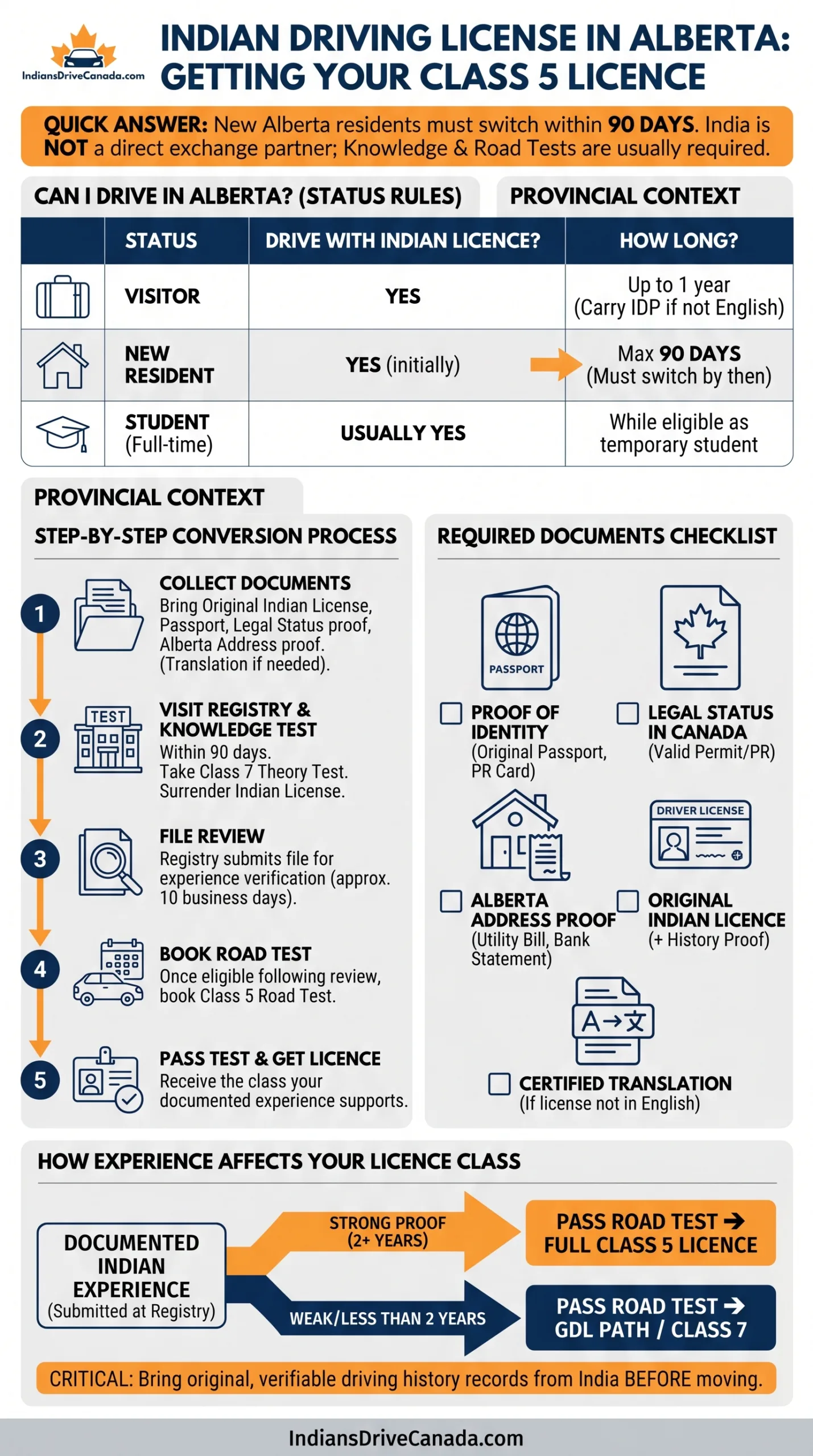
An Indian driving licence cannot be swapped directly for an Alberta Class 5 licence. India is not listed among Alberta’s reciprocal licence-exchange jurisdictions as of July 27, 2026.
An eligible Alberta resident normally has to pass the Class 7 knowledge test, surrender all Indian and other out-of-Alberta licences in their possession, apply to have previous driving experience assessed, and pass a Class 5 road test.
If Alberta accepts at least 24 months of previous driving experience and the applicant meets the other full-licence conditions, a full non-GDL Class 5 licence may be issued after the road test. A person with less accepted experience may receive a Class 5-GDL licence or may have to complete part of the Class 7 learner period before becoming eligible for the road test.
Rule verification date: July 27, 2026. Driver licensing decisions are made by Alberta registry agents and the Government of Alberta based on the applicant’s identity, residency, immigration documents and authenticated driving history.
First determine whether Alberta requires you to change your licence
The deadline and available licensing route depend on whether Alberta treats you as a resident, visitor, student or temporary worker. The date you entered Canada is not always the same as the date you became an Alberta resident.
| Situation | Use of Indian licence | Likely next action |
|---|---|---|
| New Alberta resident | Must change the licence within 90 days of becoming an Alberta resident. | Prepare Alberta residency evidence and begin the non-reciprocal licence process. |
| Visitor | May drive the same vehicle class for up to one year with a valid home-jurisdiction licence. | Carry the valid Indian licence. Carry an IDP as well when the licence is not in English. |
| Student at an accredited institution | May be able to continue using a valid home-jurisdiction licence while studying. | Confirm the rule with a registry before surrendering the Indian licence, especially when applying for Alberta licensing. |
| Work permit holder living in Alberta | May qualify to apply when Alberta residency and legal entitlement requirements are met. | Bring the work permit, identity documents and Alberta address evidence to a registry. |
| Seasonal Agricultural Worker Program participant | Generally continues using a valid home-jurisdiction licence under Alberta’s temporary-resident rules. | Confirm licence validity, vehicle class and insurance conditions before driving. |
The 90-day deadline applies to residents. A trip outside Alberta during those 90 days does not restart or pause the exchange period. Start collecting address and driving-history documents soon after establishing Alberta residence.
A registry agent must be satisfied that the applicant is legally entitled to remain in Canada and genuinely lives in Alberta. A permit, visa or PR card proves immigration status, but separate Alberta address evidence is normally required.
Direct exchange and experience credit are different processes
A direct exchange allows a driver from a recognized jurisdiction to receive an Alberta licence without the usual knowledge and road tests. An Indian licence does not qualify for that test-free route.
The licence can still be valuable as evidence of previous driving experience. Alberta’s Graduated Driver Licensing Exemption Program allows a person from a non-reciprocal jurisdiction to ask the Special Investigations Unit to authenticate the licence and credit eligible experience.
GDL exemption does not mean exemption from every test. An Indian licence holder normally still takes the Class 7 knowledge test and the Class 5 road test. The exemption can remove or reduce the waiting periods that normally apply between Alberta’s licensing stages.
| Experience accepted by Alberta | Possible result | What still has to be completed |
|---|---|---|
| 24 months or more | Possible full non-GDL Class 5 licence | Knowledge test, authentication review, road test, vision check and all other eligibility conditions |
| 12 to 23 months | Possible access to the Class 5 road test followed by a Class 5-GDL licence | Knowledge test, authentication review, road test and any remaining probation period |
| Less than 12 months | Part of the normal Class 7 waiting period may remain | Class 7 conditions until the road-test eligibility date recorded by Alberta |
| No experience accepted | Standard Alberta learner route | At least 12 months as a Class 7 learner before the Class 5 road test |
| Documents cannot be authenticated | Experience credit may be refused | Additional evidence or the standard learner route |
The date printed on the newest Indian licence card may be a renewal date rather than the date the person first became licensed. Alberta cannot credit years that are not supported by acceptable evidence.
Build a usable Indian driving-history file
The strength of the application depends on what the documents prove, not simply on how many documents are submitted. Alberta needs to identify the licence holder, authenticate the licence, determine the vehicle class and establish the beginning of the driving history.
Documents normally needed for the Alberta transaction
- Valid Indian driving licence
- Any expired or previously issued driving licences still in your possession
- Valid passport or another acceptable government-issued photo ID
- Permanent Resident Card, work permit, eligible immigration document or other proof of legal entitlement in Canada
- Recent document showing your full name and Alberta residential address
- Approved English translations when a document is not fully in English
- Additional official driving-history evidence when the licence does not establish the complete history
When an RTO or DTO record may help
An official record from the Regional Transport Office or District Transport Office may support the application when the Indian licence does not clearly show the original issue date or complete driving history. Depending on what the issuing authority provides, the document may be called a driving licence extract, verification letter, confirmation letter or licence particulars.
A useful record should identify:
- The driver’s full name and date of birth
- The Indian driving licence number
- The original date of issue, not only the latest renewal date
- The vehicle classes authorized
- The current licence status and validity dates
- The name and details of the issuing authority
An online printout, DigiLocker display, Parivahan result or scanned letter should not be assumed to satisfy Alberta’s authentication standards. It may be useful for reference, but the GDL exemption application requires original supporting documents. The registry agent and the Special Investigations Unit decide whether a particular record is acceptable.
Obtain the driving-history record before leaving India when possible. Correcting a missing issue date or requesting a fresh RTO document can be harder after the original licence has been surrendered in Alberta.
Translation requirements
Documents presented for an Alberta licence must be in English or accompanied by a written translation from an approved translator. A translation should cover licence classes, dates, restrictions, stamps and handwritten entries, not only the driver’s name.
An International Driving Permit is not a replacement for an approved document translation in a GDL exemption application. An IDP is mainly used with the valid home licence to explain driving privileges while a visitor or other eligible temporary driver is using that licence.
Names must connect across every document
The name on an Indian licence may differ from the passport or Canadian immigration record because of initials, name order, marriage or transliteration. Bring an original document that explains the difference, such as a marriage certificate or legal name-change record.
Do not alter a licence, extract or translation to make the names match. The registry needs evidence that connects the different versions of the name to the same person.
Prepare identity and Alberta address evidence
A first Alberta licence application must establish three separate facts: identity, Alberta residence and legal entitlement to be in Canada.
| Document group | Examples | Detail to check |
|---|---|---|
| Identity | Passport, PR card or official government photo ID | Original document and matching legal name |
| Alberta residence | Utility bill, bank statement, lease, mortgage document or signed employment confirmation | Full name, Alberta address and a date less than 90 days old |
| Legal entitlement in Canada | PR card, eligible permit, resident visa or refugee claimant document | Original, unexpired document that supports status for more than the next 90 days where applicable |
| Name connection | Marriage certificate or legal name-change document | Clear connection between the licence, passport and immigration record |
Alberta residence documents may be shown on paper or electronically. The registry may accept other records, but it must be satisfied that the address is the applicant’s genuine place of residence.
What happens at the first registry visit
1. Present the identity and residency documents
The registry agent checks identity, legal entitlement in Canada and Alberta residence. Phone the office before visiting to confirm that it provides knowledge testing and GDL exemption services.
2. Take the Class 7 knowledge test
The test has 30 multiple-choice questions. A score of 25 out of 30 is required to pass. The test can be attempted once per day, and a fee applies to every attempt.
The Class 7 test is available in 25 languages. Hindi, Punjabi and Urdu are included. The translated test is still based on Alberta traffic laws, signs and safe-driving rules.
3. Complete the vision check and obtain Class 7 status
After passing the knowledge test, the registry completes the required vision screening. The agent may request a medical report when the person’s medical or vision information requires further review.
4. Surrender the out-of-Alberta licences
All valid and expired out-of-Alberta driving licences in the applicant’s possession must be surrendered. The Indian licence will not be returned after it is surrendered.
5. Submit the GDL exemption application
The registry checks whether the applicant can seek previous-experience credit. The application, surrendered licence and supporting documents are sent to Alberta’s Special Investigations Unit for examination.
6. Return to the registry after 10 business days
Alberta instructs applicants to visit a registry office after 10 business days from the application date. The agent checks whether the application was accepted and whether the person can proceed to a Class 5 road test.
Make clear copies before surrendering the licence. Keep colour copies of the front and back of the Indian licence, older licences and every supporting record. Copies do not provide legal driving authority, but they may be needed later for personal records or an insurance application.
Driving while the experience review is pending
Passing the knowledge test does not allow the applicant to continue driving alone under the old Indian licence privileges. During the Special Investigations Unit review, the person drives under Alberta Class 7 conditions.
Before practising in a family member’s or friend’s vehicle, confirm that the owner’s insurer allows a learner driver to use it. The licensing permission and the insurance contract are separate matters.
The decision after Alberta reviews the Indian licence
The application is accepted with at least two years of experience
The applicant can proceed to the required Class 5 road test. After passing, a full non-GDL Class 5 licence may be issued when the person is at least 18 and meets the other full-licence conditions.
The application is accepted with less than two years
The accepted months can reduce the time spent in Alberta’s graduated licensing system. A person with enough credited experience may receive road-test access but be issued a Class 5-GDL licence after passing.
The registry record determines how much learner or probationary time remains. Do not calculate the remaining period only from the issue date printed on the Indian licence.
The application is not accepted
The applicant remains subject to the Class 7 requirements. This can happen when the licence or supporting record cannot be authenticated, the original issue date is not proven, the documents are incomplete, or the driving class cannot be matched to an Alberta passenger-vehicle licence.
Ask the registry whether the file can be supported with another original record or whether the standard Class 7 period must be completed. A refusal of experience credit does not prevent the person from continuing through Alberta’s regular licensing system.
Adjusting driving habits before the Class 5 road test
Driving experience from India can help with basic vehicle control and road awareness. The road test, however, measures how the candidate applies Alberta rules. Practice should focus on observable test behaviour rather than only accumulating hours behind the wheel.
| Driving situation | Alberta test expectation | Practice focus |
|---|---|---|
| Road position | Drive on the right and finish turns in the correct lane. | Repeat left and right turns on quiet roads with an instructor or qualified supervisor. |
| Stop signs | Bring the vehicle to a complete stop at the proper position. | Separate the stop, observation and decision to proceed. |
| Lane changes | Use mirrors, signal and make a visible shoulder check. | Check the blind spot before moving laterally, even when the road appears empty. |
| Right turn on red | Stop first, check for a prohibition sign and yield to pedestrians, cyclists and traffic. | Treat the turn as permitted only after the way is clear. |
| Four-way stops | Follow arrival order and right-of-way rules. | Identify which vehicle stopped first instead of relying on informal eye contact alone. |
| Speed control | Follow the posted limit and reduce speed for conditions. | Scan for school, playground, construction and residential-zone signs. |
| Parked vehicles | Leave safe clearance and watch for doors, pedestrians and movement. | Avoid driving too close to the right edge of the usable lane. |
| Winter conditions | Use smooth control and choose a speed suitable for traction and visibility. | Practise following distance, gentle braking and windshield preparation. |
Canada does not use one national road-test standard. Advice about Ontario’s G1, G2 or G test should not be used to predict an Alberta Class 5 examination.
Booking the Class 5 road test
A road test can be booked after Alberta confirms eligibility. Passenger-vehicle tests are delivered through participating registry agents.
- Obtain the nine-digit Alberta Motor Vehicle Identification number shown near the barcode on the Alberta licence document.
- Pay outstanding fines owed to the Government of Alberta before attempting to book.
- Compare the published fee, cancellation terms and no-show policy of the chosen registry.
- Confirm which original documents must be presented on the test date.
- Ask whether the registry offers a test vehicle when a suitable personal vehicle is unavailable.
Alberta does not set one province-wide Class 5 road-test price. Registry agents set and publish their passenger-vehicle road-test fees. Confirm the total before paying, including any booking or vehicle-rental charge.
The test vehicle must be legal and safe
The examiner can refuse to begin the test when the vehicle does not meet legal or safety requirements. The applicant should inspect the vehicle before travelling to the test location.
- Valid vehicle registration
- Valid insurance evidence
- Working brake lights, turn signals, headlights and horn
- Usable seat belts for the examiner and driver
- Safe tires with adequate condition for the weather
- Clear windshield and working wipers
- Properly adjusted and undamaged mirrors
- Working parking brake
- No safety defect or warning that makes the vehicle unsafe
- Enough fuel or battery charge to complete the appointment
When using a rented, borrowed or driving-school vehicle, confirm that the agreement and insurance allow it to be used for a road test.
How the Class 5 road test is marked
The examiner assigns points when the candidate does not show a required skill, breaks a road rule or performs a manoeuvre poorly. Examples include missing a blind-spot check, failing to respond to a sign, signalling at the wrong time or using unsafe lane position.
A Class 5 candidate fails after receiving more than 75 points. The test can also end in an automatic failure when the candidate:
- Endangers a pedestrian or another road user
- Drives unsafely
- Breaks a traffic law
Passing depends on the complete drive, not on finding a supposedly easier registry or memorizing a particular route. The examiner chooses the route and observes how the candidate handles actual conditions.
Full Class 5 and Class 5-GDL do not carry the same conditions
| Licence status | When it may be issued | Restrictions or next requirement |
|---|---|---|
| Full non-GDL Class 5 | At least 24 months of accepted experience and all full-licence conditions are met | No GDL probationary restrictions |
| Class 5-GDL | Road test passed but fewer than 24 months of qualifying experience are credited | Complete the remaining probation period and maintain the required driving record |
A Class 5-GDL driver:
A person who must complete GDL probation can normally reduce the 24-month probation period by up to six months through an approved Alberta Class 5 or Class 6 driver-training program, provided all other conditions are met.
Alberta removed the advanced road test requirement on April 1, 2023. A Class 5-GDL driver does not take a second advanced road test merely to leave the GDL program. The person must complete the applicable probation time and remain free of suspensions and demerits during the final 12 months.
After passing the road test
The registry completes a vision check and processes the licence purchase. The driver receives a temporary licence that is valid for 30 days or until the permanent card arrives.
Alberta advises that the card should arrive within 21 business days. Follow the instructions on the temporary licence if it has not arrived. Mail forwarding can prevent delivery, so the registry must have a usable Alberta mailing address.
Destroy the temporary licence after receiving the permanent card.
Card change from July 2, 2026: Alberta began issuing redesigned driver’s licence and ID cards with added security features. The cards display a Canadian citizenship marker where applicable and may display the Personal Health Number for eligible Albertans. These card changes do not remove the knowledge test, experience review or road-test requirements for Indian licence holders.
Where document problems can delay the process
The Indian licence has expired
Bring it if it is still in your possession. Alberta requires applicants to surrender valid and expired out-of-Alberta licences. An expired licence may support the history, but it does not by itself authorize continued driving.
The licence displays only a recent renewal date
Obtain an original record from the issuing licensing authority that confirms the first issue date and complete vehicle-class history. Without that evidence, Alberta may credit only the period it can verify or may refuse the experience request.
The original licence was lost before the application
Tell the registry what happened and ask which official replacement or verification record is acceptable. A photo, app screenshot or photocopy should not be presented as though it were the original licence.
The name differs across Indian and Canadian records
Bring the original marriage, name-change or identity document that explains the difference. A translator can translate a name as printed but cannot legally establish that two different name versions belong to the same person.
The applicant plans to visit India soon
Consider the timing before surrendering the Indian licence. The surrendered licence will not be returned, and a photocopy does not authorize driving in India. Confirm the Indian reissue or replacement process separately when future driving in India will be necessary.
The road test is not passed
Review the examiner’s result and separate the errors into observation, right-of-way, speed, lane position and vehicle-control issues. A focused lesson may be more useful than repeating the test without correcting the recorded weaknesses. A new test booking and fee will normally be required.
Registry-day check before leaving home
- Confirm that the registry provides Class 7 testing and GDL exemption services.
- Bring all valid and expired Indian or other out-of-Alberta licences in your possession.
- Bring original identity and immigration documents.
- Bring recent Alberta address evidence showing your full name.
- Bring original driving-history records and approved translations.
- Keep clear copies of every licence and supporting document.
- Take glasses or contact lenses used for driving.
- Be prepared to pay the knowledge-test, registry and licence charges.
- Arrange a qualified supervising driver if you will practise under Class 7 conditions.
- Return to the registry after 10 business days to check the GDL exemption decision.