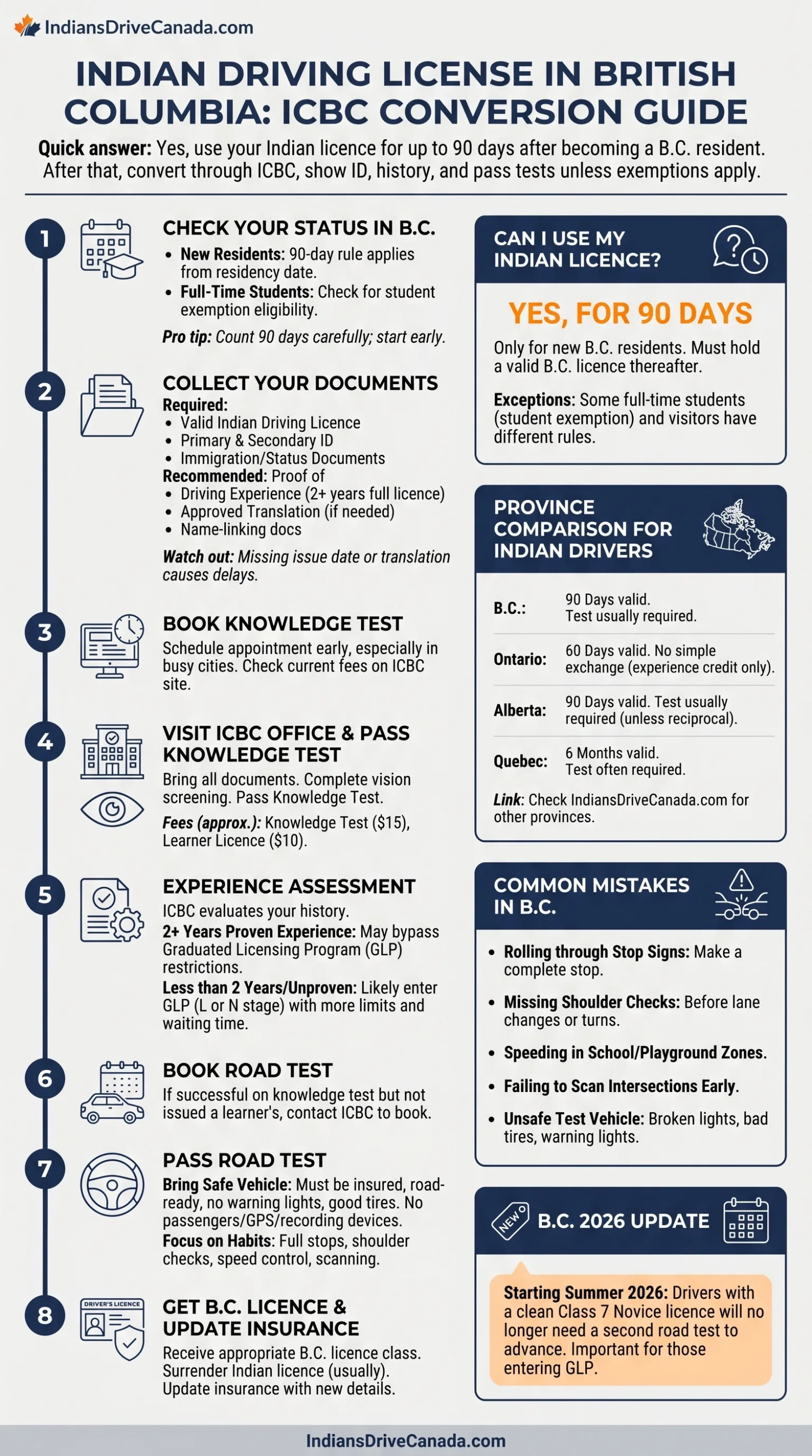
A valid Indian driving licence does not qualify for a test-free, card-for-card exchange in British Columbia. A new B.C. resident can normally use a valid foreign licence for up to 90 days after moving to the province, but obtaining a B.C. passenger-vehicle licence usually requires an ICBC knowledge test and a road test.
Your documented full-licence experience determines whether ICBC may assess you for a Class 5 route or place you in the Graduated Licensing Program with a Class 7 licence. The issue date printed on the current card may not be enough if it only shows the most recent renewal.
When the 90-Day Period Applies
The 90-day period begins after you move to British Columbia as a new resident. It should not automatically be counted from the date you first entered Canada. A person may enter Canada, spend time in another province and become a B.C. resident later.
Your Indian licence must remain valid during the period in which you use it. An International Driving Permit does not extend an expired licence and does not replace the underlying Indian licence.
| Your situation | General ICBC rule | Action to take |
|---|---|---|
| New B.C. resident | Valid foreign licence can normally be used for up to 90 days after moving to B.C. | Begin the ICBC process before the 90-day period ends. |
| Tourist | A visitor may use a valid home-jurisdiction licence for up to six months. | Confirm that visitor status and insurance remain valid. |
| Full-time student | A valid student exemption may apply while enrolled full-time at a designated educational institution in B.C. | Confirm that the institution and enrolment meet ICBC’s exemption conditions. |
| Ordinarily resident outside B.C. | The 90-day new-resident rule may not apply. | Confirm where you are ordinarily resident before relying on the exemption. |
| SAWP worker | A worker whose federal permit identifies the Seasonal Agricultural Worker Program may use a valid home-jurisdiction licence for up to 12 months. | Obtain a B.C. licence if staying beyond the permitted period and continuing to drive. |
| Other work permit holder | A general work permit does not by itself create the SAWP exemption. | Use the new-resident rule if B.C. has become your ordinary home. |
Do not wait until the final days of the 90-day period. A driving record may need translation or verification, and road-test appointments may not be available on the date you prefer. A booked test does not automatically extend the period in which your Indian licence can be used.
Why an Indian Licence Requires Testing
ICBC has reciprocal exchange arrangements with selected jurisdictions. Drivers from those jurisdictions may be able to exchange an eligible licence without a knowledge test or road test.
An Indian passenger-vehicle licence follows the non-reciprocal process. The word conversion is commonly used, but the process is not a simple exchange of one card for another. ICBC reviews the licence, identity documents and driving history before deciding which B.C. licence class you are eligible to test for.
For a normal car or light passenger vehicle, the likely routes are:
| Documented experience | Likely assessment | Testing position |
|---|---|---|
| At least two years with a full, non-learner licence | ICBC may exempt you from the Graduated Licensing Program. | Plan for a knowledge test and a road test for the class approved by ICBC. |
| Less than two years of full-licence experience | Your previous experience can be considered, but you may enter the Graduated Licensing Program. | A Class 7 route may apply. |
| Two or more years claimed but not documented | ICBC may be unable to grant the GLP exemption. | You may be treated as having less experience until acceptable records are presented. |
| Licence expired for more than three years | Recent valid driving activity becomes relevant. | If you cannot prove valid licensed driving during the last three years, ICBC requires a knowledge test and road test. |
Driving experience credit and a test-free exchange are different. A long Indian driving history may support a GLP exemption and insurance experience credit. It does not remove the testing normally associated with an Indian licence.
The Date on the Licence Card May Not Prove Your Full Experience
Many Indian licences are renewed or reissued over time. The current card may display a recent issue date even though the driver first received a full licence many years earlier. ICBC needs the original date on which the full, non-learner licence was issued.
For example, a card printed in 2025 may belong to a person who first received a full licence in 2014. If the card does not show the 2014 date, the card alone may not establish the full period of experience.
This can affect two separate decisions:
Driving Record or Letter of Experience Requirements
Documents that can establish the experience period
- A current Indian driving licence that clearly shows at least two years of full driving experience or the original first-issue date.
- An original driver licence record issued by the licensing authority.
- An original letter of experience issued by a verifiable licensing authority.
- Records from more than one jurisdiction when the documents must be combined to reach the two-year period.
A driver licence record or experience letter used for a GLP exemption should meet ICBC’s document conditions. It should:
- Be an original document, not an ordinary photocopy or email printout.
- Alternatively, be a copy approved and stamped by the licensing body that issued the record.
- Be signed by the licensing body or printed on its official letterhead.
- Show the licensing body’s name, address and telephone number.
- Show your full name and date of birth.
- Show your driving licence number or another unique identifier.
- Identify the licence class or classes held.
- State the original date on which the licence was first issued.
An email printout cannot be used to obtain the GLP exemption. For an Indian driving record, prepare to present the original document in person at an ICBC driver licensing office. A screenshot from an app, a scan saved on a phone or a printout downloaded from an email should not be treated as a substitute for the document ICBC describes.
Combining experience from different places
ICBC allows documents from multiple jurisdictions to be combined when they are needed to establish at least two years of full-licence experience. This can matter if you held an Indian licence and later drove under a licence issued in another country or Canadian province.
Each record must still meet the applicable document conditions. The documents should also make the sequence of licences clear. Unexplained gaps, overlapping dates or different names may lead to further review.
Learner experience is treated differently
Time spent with an Indian learner’s licence is not the same as time held with a full-privilege licence. The two-year GLP assessment is based on full, non-learner driving experience.
A person who has held a full Indian licence for 18 months cannot normally reach the two-year threshold by adding an earlier learner period.
Obtain the experience record before leaving India when possible. It is usually easier to correct a missing date, unclear vehicle class or name mismatch while you still have direct access to the issuing authority.
Identity Documents for the ICBC Visit
ICBC requires two accepted identity documents: one primary document and one secondary document. Immigration documents issued by the Government of Canada can often serve as primary identification, but the accepted combination depends on the applicant’s status and documents.
Prepare these document groups
- Your physical Indian driving licence.
- One accepted primary identity document.
- One accepted secondary identity document.
- Your original driving record or experience letter when the licence card does not show the full history.
- Proof of a legal name change when the names on your documents do not match.
- An ICBC-approved translation when ICBC requires one.
- Corrective lenses used for driving or vision testing.
- A payment method accepted by the driver licensing office.
Identity documents must be originals or true copies certified by the government agency that issued them. A notarized photocopy is not automatically the same as a true copy certified by the issuing government agency.
Check the accepted-ID tool before the appointment, particularly if a Permanent Resident card has expired, a work or study permit is close to expiry, or the name on the Indian licence differs from the Canadian immigration document.
When Translation Is Required
A licence printed partly or fully in English is not automatically free from translation review. ICBC may request a translation when the licence or supporting record:
When translation is required, it must be completed by an ICBC-approved translator. The translation must be prepared from the original document or from a copy that an ICBC driver licensing office has approved and stamped. The original or approved copy must also be presented with the translation.
Translation and interpretation serve different purposes. Document translation deals with the licence, identity papers and driving record. Interpretation helps you communicate with ICBC staff. ICBC offers telephone interpretation at driver licensing offices, but interpreters are not permitted during a road test.
What Happens When ICBC Opens the Application
Identity and residency review
ICBC checks the primary and secondary identification and confirms that you are eligible to apply for or hold a B.C. driver’s licence. A B.C. licence is issued to a B.C. resident, not simply to anyone who has entered the province.
Indian licence review
The licence is checked for validity, class, original issue information and any need for translation or further verification.
Experience assessment
ICBC compares the current card and supporting records to determine how much full, non-learner experience can be accepted and which licence class you may test for.
Vision screening and licensing questions
A vision screening is part of the licensing process. Bring glasses or contact lenses if you use them for driving. A licence restriction may be added when corrective lenses are required.
Testing route
For an Indian passenger-vehicle licence, the expected route includes a knowledge test and a road test. The road-test class depends on the experience ICBC accepts.
Surrendering the Indian licence
When applying for a B.C. driver’s licence, you are required to surrender the driving licences you hold. British Columbia permits a person to hold only one driver’s licence.
Keep a clear colour copy of both sides for your personal records before the appointment. The copy is not a valid licence and cannot be used to drive.
Ask the driver licensing office which licence or temporary document will authorize you to drive during each stage of the process. Do not assume that an application receipt, a photocopy of the Indian licence or a passed online knowledge test gives permission to drive.
The ICBC Knowledge Test
The passenger-vehicle knowledge test covers B.C. traffic law, road signs and safe-driving decisions. The test requires 40 correct answers out of 50, which is an 80 percent pass mark.
Punjabi is available for the official knowledge test. Other available languages include English, Arabic, Croatian, French, Farsi, Traditional Chinese, Simplified Chinese, Russian, Spanish, Ukrainian and Vietnamese.
Online testing introduced in June 2026
Since June 9, 2026, Class 5 and Class 7 passenger-vehicle knowledge tests can be taken online or at an ICBC driver licensing office. The online and in-person versions use the same pass standard and the same 45-minute testing period.
| Item | ICBC condition |
|---|---|
| Test fee | $15 for the online knowledge test |
| Start window | Up to 72 hours after registration |
| Test time | 45 minutes in one session |
| Pass mark | 80 percent |
| Result validity | One year |
| After passing | Visit a driver licensing office to complete identification, vision and licensing steps |
Passing online does not issue a licence and does not create legal permission to drive. At the office, bring two accepted identity documents, including the same primary document used to register for the online test. Also bring the pass-confirmation email, any corrective lenses and payment for the separate licence fee.
What to study beyond practice questions
The official Learn to Drive Smart manual should be the main study material. Practice questions can show the test format, but memorizing question patterns is not a replacement for learning the rules.
Areas that deserve close attention when moving from India to B.C. include:
- Driving on the right side of the road.
- Four-way stop priority.
- Full stops at stop signs and red lights before a permitted right turn.
- Pedestrian right of way.
- School and playground zones.
- Lane markings and lane-use signs.
- Shoulder checks before moving sideways.
- Right turns across or beside bicycle lanes.
- Space around motorcycles, cyclists and large vehicles.
- Emergency vehicles and roadside workers.
- Driving in rain, snow, ice and reduced visibility.
Booking the Road Test as a Foreign-Licence Holder
A person driving on a non-B.C. licence who has passed the knowledge test but has not been issued a B.C. learner’s licence may not be able to use the normal online road-test booking route. ICBC directs these applicants to contact its driver licensing information line to book the road test.
This distinction matters because the online booking system is built mainly around B.C. licence records. Call ICBC if the booking system does not recognize your information rather than creating another profile or using a third-party service.
Book directly through ICBC. Third-party websites offering ICBC appointments or selling supposed test routes are not affiliated with ICBC. ICBC does not release road-test routes for sale.
The vehicle must be accepted for testing
The road-test vehicle must be safe, reliable, properly insured and display a Canadian licence plate. At check-in, you must provide the plate number and present one primary and one secondary identity document.
A test may be cancelled when the vehicle has a safety or legal problem. Check the vehicle before leaving for the appointment.
- Windshield and windows are not badly cracked or illegally tinted.
- Seatbelts work and are not frayed.
- Brake lights, turn signals and headlights work.
- The horn works.
- Tires are safe and suitable for the conditions.
- Doors and windows operate correctly.
- Warning lights do not indicate a fault affecting safe operation.
- The passenger area is clean and free from loose objects.
- The vehicle has enough fuel or electric charge.
- No unsafe or illegal modification is present.
A car-sharing vehicle may require an original authorization letter when the applicant is not the named member. The letter must meet ICBC’s conditions and a new letter is required for each attempt.
GPS and navigation systems must be turned off. Audio, video and other recording devices cannot be used during the test. Only the applicant and examiner are permitted in the vehicle, apart from an approved guide or service dog where applicable.
Driving Behaviours ICBC Expects to See
Years of driving in India can provide vehicle-control experience, but the B.C. road test assesses whether that experience is applied according to local rules. The examiner needs to see predictable observation, lane control, speed choice and communication with other road users.
Right-side road position
Practice on quiet roads before entering dense traffic. The change affects more than the side of the road:
Shoulder checks must be visible
Mirrors do not show every area beside a vehicle. ICBC expects a physical shoulder check before moving into a space that may contain another road user.
Typical situations include:
- Changing lanes.
- Leaving the curb.
- Moving across or beside a bicycle lane before a right turn.
- Leaving a parallel parking space.
- Entering traffic from a parking area.
The movement should be clear enough for the examiner to observe without becoming exaggerated or taking attention away from the road ahead.
Stop means a complete stop
The vehicle must fully stop where the law requires it. Slowing to walking speed and continuing is not a stop. At a stop sign, control the vehicle before the stop line, crosswalk or intersection boundary, depending on the road layout.
A permitted right turn on a red light still requires a full stop and a check for signs prohibiting the turn, pedestrians, cyclists and other traffic.
Do not copy the speed of surrounding traffic
The posted limit is a maximum under suitable conditions, not a speed that must always be maintained. The road test also assesses whether you reduce speed for visibility, weather, traffic and hazards.
Driving much slower than conditions require can also interfere with traffic. The expected choice is a lawful speed suited to the road, not simply the speed selected by the vehicle ahead.
Lane choice must be deliberate
Keep the vehicle centred and use the correct lane before turning. Do not drift across lane lines, cut a corner during a left turn or finish a turn in an unintended lane.
When a parked vehicle, cyclist or obstruction requires a change in position, check mirrors, signal when required, complete the shoulder check and leave safe space.
| Driving task | Road-test expectation |
|---|---|
| Lane change | Mirror check, signal, shoulder check and controlled movement |
| Stop sign | Complete stop followed by a clear right-of-way decision |
| Right turn | Speed control and checks for pedestrians and cyclists |
| Left turn | Correct gap, lane position and completion in the proper lane |
| School or playground area | Active sign recognition and lawful speed choice |
| Parking manoeuvre | Observation throughout the movement, not only before it begins |
Class 5 or Class 7: What the Result Means
When ICBC accepts at least two years of full experience
Acceptable proof of at least two years with a full, non-learner licence may allow ICBC to exempt you from the Graduated Licensing Program. You still need to complete the tests required for the Indian-licence route.
ICBC determines the test class after reviewing the records. Do not book lessons or a vehicle on the assumption that the current Indian card alone guarantees a Class 5 road test.
When experience is under two years or cannot be proved
You may enter the Graduated Licensing Program and receive a Class 7 Novice licence after meeting the applicable requirements and passing the Class 7 road test.
The Class 7 licence carries novice restrictions. Check the restrictions printed or recorded for your licence rather than relying on another driver’s situation.
A person with eight years of actual driving may still be placed in the GLP if the submitted documents do not establish the experience in the form ICBC accepts. The problem is not necessarily the number of years; it may be the evidence used to prove them.
The October 19, 2026 GLP Change
The existing and scheduled rules must be kept separate. As of August 24, 2026, the new Driving Record Assessment process has been announced but has not yet taken effect.
| Period | Class 5 progression |
|---|---|
| Through October 18, 2026 | The existing GLP process remains in effect. Eligible Class 7 drivers can still choose to take the second road test. |
| From October 19, 2026 | The second road test is replaced by a Driving Record Assessment for eligible Class 7 Novice drivers, followed by a 12-month Class 5 restriction period. |
Under the announced assessment rules, an eligible Class 7 driver must meet the applicable safe-driving period:
- At least 24 months of safe driving when under age 25.
- At least 18 months when under age 25 and an approved GLP course was completed during the learner phase.
- At least 12 months of safe driving when age 25 or older.
- No conviction for excessive speed or electronic-device use during the assessment period.
- No driving prohibition or suspension during the assessment period.
From October 19, 2026, the minimum age for a qualified supervisor accompanying a Class 7L learner drops from 25 to 22.
Some existing Class 7 drivers may also qualify for a one-time automatic upgrade on October 19, 2026. This does not apply to every Class 7 licence holder. Drivers ICBC identifies as eligible should follow the upgrade information sent to them.
A second road test booked for October 19, 2026 or later is scheduled to be cancelled by ICBC. Affected drivers should follow the instructions sent by ICBC rather than booking through another service.
This change does not make an Indian licence eligible for a direct exchange. It mainly affects a person who enters the GLP and later progresses from Class 7 to Class 5.
How Indian Driving Experience Can Affect Insurance
ICBC can credit up to 15 years of previous driving experience when it receives an acceptable record showing the original licence date. Learner experience is excluded.
New B.C. residents are asked for their driver licence history for this purpose. Proof of previous insurance is not required by ICBC for the experience-credit process.
The experience credit does not create a fixed premium or guaranteed discount. Insurance cost still depends on the drivers listed on the policy, vehicle, use, location, coverage and other rating details. ICBC also applies an adjustment during a new resident’s first three years of driving in B.C.
The same date can affect two different records. The original full-licence date may support a GLP exemption during licensing and up to 15 years of experience for insurance rating. Approval for one purpose should not be assumed to complete every insurance-record step automatically.
Application Problems That Cause Avoidable Delays
The card shows only the renewal date
A recently printed card may not show when the full licence was first issued. Obtain an original history document that states the first full-licence date.
The experience letter lacks licence-class information
A letter that lists only a name and issue date may not show whether the experience was for a learner licence, motorcycle, commercial vehicle or passenger vehicle. The class held should be stated.
The document cannot be verified
A record should identify the issuing licensing body and provide its address and telephone number. ICBC may place the application on hold while additional verification is completed.
An email printout is brought for the GLP assessment
ICBC does not accept an emailed record toward a GLP exemption. Bring the original or a copy approved and stamped by the issuing licensing body.
The names do not match
Differences caused by marriage, shortened names, initials, spelling or name order may require supporting documents. Resolve the mismatch before the appointment when possible.
A general translator is used without checking ICBC approval
ICBC requires an approved translator when translation is requested. Confirm approval before paying for the work.
The process begins near the end of the 90 days
Document correction, translation, verification and road-test availability can extend the process. The safest approach is to begin after establishing B.C. residency rather than treating day 90 as the application date.
An International Driving Permit is treated as a B.C. licence
An International Driving Permit is a supporting translation used with a valid underlying licence. It is not a B.C. licence, does not convert an Indian licence and does not create a new-resident exemption.
How Different Applicant Records May Be Assessed
Long experience with a complete original record
The applicant has a valid Indian licence and an original licensing-authority record showing the first full-licence date, licence class and more than two years of experience. ICBC can assess the GLP exemption and the applicant can prepare for the approved test route.
Long experience but only a newly renewed card
The applicant has driven for many years, but the card shows only a recent printing or renewal date. The applicant should obtain an original history record rather than expecting ICBC to infer the earlier years.
Eighteen months with a full Indian licence
The experience can still be recorded, but it does not reach the two-year GLP-exemption threshold. ICBC may assign a Class 7 route.
Full-time student relying on an exemption
The applicant should verify full-time enrolment at a designated B.C. educational institution and keep the Indian licence valid. A study permit alone should not be treated as proof that every condition of the student exemption is met.
Licence expired more than three years ago
If the applicant has never held a B.C. licence and cannot prove valid licensed driving anywhere during the last three years, ICBC requires a knowledge test and road test. Older experience records may still need separate review.
Appointment Checklist
Before the first ICBC appointment
- Confirm the date you became a B.C. resident.
- Check that the Indian licence is still valid.
- Copy both sides of the licence for personal records.
- Obtain an original driving history when the first full-licence date is not visible.
- Check that the record includes the issuing authority’s contact details.
- Confirm that the licence class and original issue date are stated.
- Arrange an ICBC-approved translation when required.
- Select one accepted primary and one accepted secondary identity document.
- Prepare proof of any legal name change.
- Bring corrective lenses used for driving.
Before the knowledge test
- Study the current ICBC Learn to Drive Smart manual.
- Review road signs and right-of-way rules.
- Choose English, Punjabi or another available test language.
- Use the official practice test to check weak areas.
- Keep the primary identity document used for online registration.
- Save the online pass-confirmation email.
Before the road test
- Confirm whether ICBC requires telephone booking for your foreign-licence record.
- Check the road-test class assigned by ICBC.
- Bring one primary and one secondary identity document.
- Use a properly insured vehicle with a Canadian licence plate.
- Complete a lights, tires, glass, horn, seatbelt and warning-light check.
- Turn off navigation and recording devices.
- Practise right-side lane position, shoulder checks, full stops and bicycle-lane observation.
- Arrive at the check-in time shown by ICBC.
ICBC Pages to Check Before Applying
Rules reviewed: August 24, 2026. Fees, appointment procedures, accepted documents and scheduled GLP rules can change. Confirm the applicable ICBC requirement before surrendering a licence, paying for translation or booking a test vehicle.