Black Ice in Canada: What It Is and How Indian Drivers Can Stay Safe
Black ice in Canada is a thin, mostly transparent layer of ice that lets the dark pavement show...
First Canadian Winter Car Checklist for Indian Newcomers
Four checks decide whether the car is winter-ready A first Canadian winter car checklist is complete only when...
Snow, Slush and Ice Driving Differences Indian Drivers Must Learn in Canada
An experienced driver arriving from India may already be comfortable with heavy traffic, monsoon rain, low visibility and...
Winter Emergency Kit for Indian Drivers in Canada
A winter emergency kit for Indian drivers in Canada should do more than fill space in the trunk....
Winter Tires in Canada: What Indian Drivers Need to Know Before Buying
For an Indian newcomer who expects regular driving through a Canadian winter, a sensible starting choice is four...
5 articles in Winter Driving Canada Indians
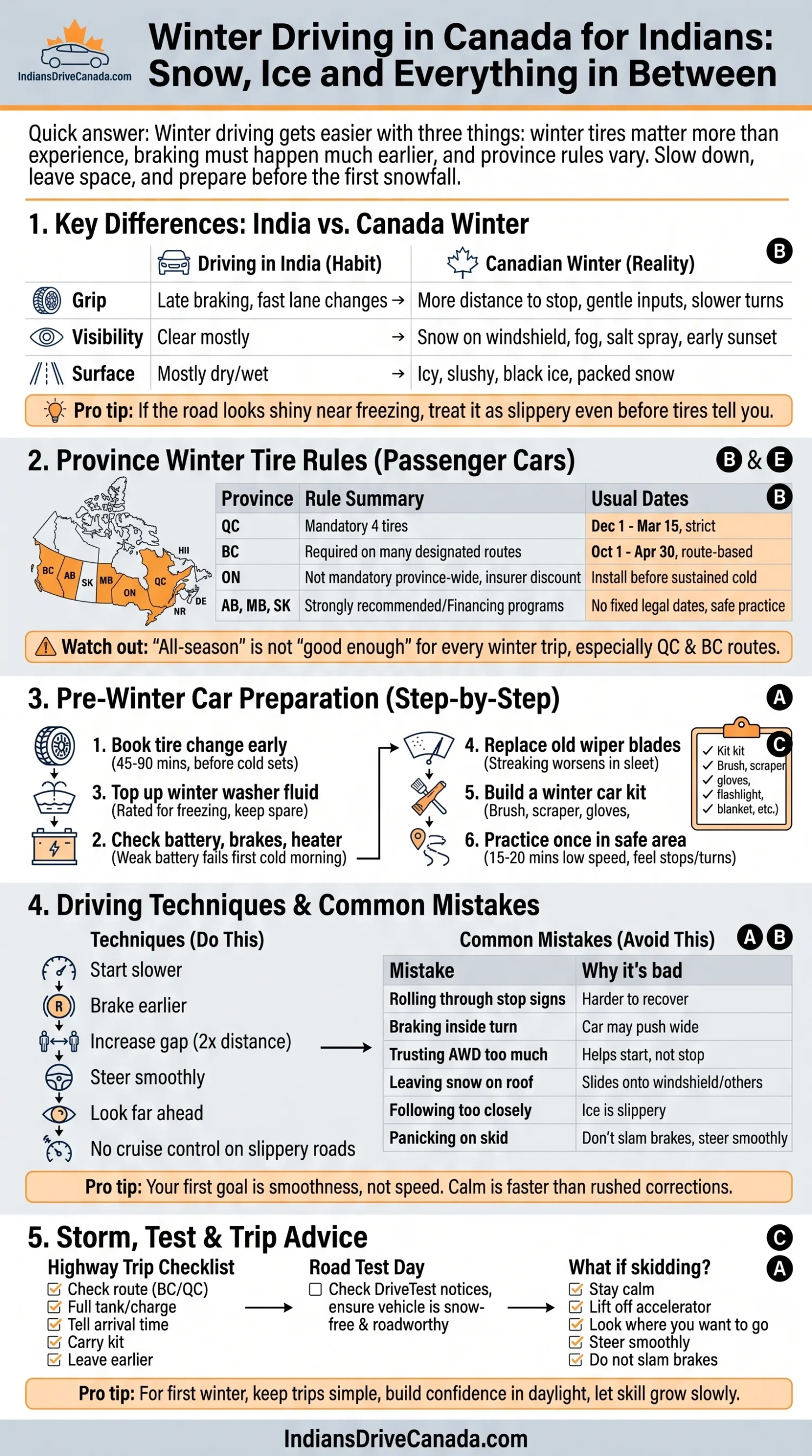
Canadian winter driving changes with the road surface and the weather hour by hour. Snow reduces grip, slush can pull at the tires, black ice may look like wet pavement, and freezing rain can make an ordinary route unsafe. The useful response is different for each hazard, but the same three habits carry through the season: prepare the vehicle before sustained cold, leave more stopping space, and avoid sudden steering, braking, or acceleration.
| When | What to check | What changes |
|---|---|---|
| Before sustained cold | Winter tires, battery, wipers, washer fluid, heater and defroster | Vehicle readiness |
| Before each trip | Forecast, road conditions, visibility, snow and ice on the vehicle | Route and departure decision |
| On a slippery road | Grip, following distance, braking point and steering input | Speed and driving technique |
Province rules still matter. Québec sets a fixed winter-tire period, B.C. uses designated winter routes, and Ontario does not impose a province-wide winter-tire mandate for passenger cars.
Road-surface hazards: snow, slush, and black ice
the road may look only wet when it is actually icy. In many Canadian cities, a clean-looking road can still be slippery near bridges, shaded streets, highway ramps, and intersections. That is why winter driving in Canada for Indians often feels harder in the first season than city driving in India, even for people with years of experience.
In India, you may brake later, change lanes faster, or move with closer spacing in slow traffic. In a Canadian winter, that habit can create trouble. Your car needs more distance to stop, more time to turn, and gentler inputs on the steering wheel. If you rush any of those, the car may slide even when you are not driving fast.
Snow on the windshield, fog inside the cabin, salt spray from other vehicles, and early sunset all reduce what you can see. As of April 2026, the official Ontario winter-driving page says winter tires improve traction and control and can shorten braking distance by as much as 25% in winter conditions. Ontario winter driving
How do common winter road surfaces feel?
| Road surface | What it feels like | What to do |
|---|---|---|
| Fresh snow | Soft, slower response, longer braking | Reduce speed early and brake gently |
| Slush | Heavy steering and tire pull | Hold the wheel firmly and avoid sudden lane changes |
| Black ice | Very little warning, sudden slide | Lift off the accelerator and steer smoothly |
| Packed snow | Low grip, especially at turns | Slow down before the curve, not inside it |
If the road looks shiny near freezing temperatures, treat it as slippery even before the tires tell you.
Winter tire rules by province
There is no single Canada-wide rule for winter tires on passenger cars. Winter driving in Canada for Indians depends a lot on the province and, in British Columbia, sometimes the exact highway route. Québec is the strictest for passenger vehicles. B.C. is route-based and strongly enforced on marked highways. Ontario, Alberta, Manitoba, and Saskatchewan focus more on safe practice, insurance, or strong recommendations.
Legal requirement and usual seasonal dates
| Province | How winter tire rules work | Usual dates | Official link |
|---|---|---|---|
| Ontario | Not mandatory province-wide for passenger vehicles, but insurers must offer a winter tire discount | Discount rules apply year-round if you qualify; install before sustained cold weather | ontario.ca / FSRA |
| British Columbia | Winter tires or chains required on many designated routes | Usually October 1 to April 30; some routes end March 31 | gov.bc.ca / ICBC |
| Québec | Four winter tires are mandatory for passenger vehicles | December 1 to March 15 | SAAQ |
| Alberta | No province-wide winter tire law for passenger vehicles, but winter-driving guidance is strongly promoted | No fixed province-wide legal dates | Alberta winter driving tips |
| Manitoba | No general mandate, but MPI offers a winter tire financing program | No fixed province-wide legal dates | MPI Winter Tire Program |
| Saskatchewan | No province-wide mandate for passenger vehicles; winter tires are recommended | No fixed province-wide legal dates | SGI |
If you live in Ontario, many newcomers delay winter tires because they are not legally required for most passenger cars. That often turns into a false sense of safety. If you live in Québec, there is much less room for delay. If you live in B.C. and plan to drive outside the city on mountain or interior routes, always check whether the highway is marked for winter tires.
“All-season” does not mean “good enough for every winter trip,” especially for Québec and B.C. routes with posted winter tire signs.
Prepare the car before the first sustained cold
Vehicle problems are easier to deal with before the first storm than during it. Do not wait for the first snowfall to book tires, replace weak wipers, or buy washer fluid. In busy Indian communities across Ontario, tire shops fill up fast once the weather forecast turns cold.
Before the first snow, work through these checks:
- Book your tire change early. Go to a tire shop, dealership, or warehouse auto centre before the cold sets in. Plan around 45 to 90 minutes. Cost depends on tire size, brand, and whether you already have winter tires on separate rims.
- Check battery, brakes, heater, and defroster. Use a trusted garage for a basic winter inspection. Plan 30 to 60 minutes. A weak battery often shows itself only on the first very cold morning.
- Top up winter washer fluid. Buy fluid rated for freezing conditions. Keep an extra bottle at home. Salt spray can cover your windshield in minutes on major roads.
- Replace old wiper blades. If they streak in autumn, they will struggle even more in sleet and freezing rain. This is a small fix that makes a big difference at night.
- Build a winter car kit. Keep a snow brush, ice scraper, gloves, flashlight, phone cable, water, snacks, and a blanket in the car. Transport Canada also lists items such as a small shovel and first aid kit for an emergency car kit.
- Practice once in a safe, empty area. After the first snow, spend 15 to 20 minutes feeling how the car starts, stops, and turns at low speed. That first practice session removes a lot of fear.
Items to keep in the car through winter
- Snow brush and ice scraper
- Warm gloves and extra layer
- Phone charger or cable
- Flashlight
- Water and shelf-stable snacks
- Small shovel if you park outdoors
- First aid kit
- Blanket
Clear all snow from the roof, hood, windows, mirrors, and lights before driving, not just a small patch on the windshield.
Driving actions for snow, slush, and black ice
On a dry road in India, you may brake late and still be fine. On an icy road in Canada, that same move can push the car forward with very little grip. Start each action earlier and make steering, braking, and acceleration more gradual than you would on dry pavement.
Changes to make behind the wheel
- Start slower. Use light acceleration so the tires can find grip.
- Brake earlier. Begin slowing well before a red light, stop sign, or turn.
- Increase your gap. ICBC says to allow at least twice the normal braking distance on wet or slippery roads.
- Steer smoothly. Fast steering on a slippery road can unsettle the car.
- Look far ahead. You need more planning time in winter than in dry conditions.
- Do not use cruise control on slippery roads. Alberta and ICBC winter guidance both warn against it.
If the car starts to skid
First, stay calm. Take your foot off the accelerator. Keep your eyes where you want the car to go, not where you fear it will go. Steer smoothly in that direction. Do not slam the brakes. Many modern cars have ABS, but even with ABS, panic braking on ice usually makes the situation harder to correct.
Winter situations newcomers often ask about
- “Do I really need winter tires if I only drive in the GTA?”
- “Why did my car slide at such a low speed?”
- “Can I trust all-wheel drive on black ice?”
- “Is highway driving in light snow okay for a beginner?”
Reports from Indian immigrants in Ontario forums repeatedly raise these situations: city roads can still be icy, low speed does not remove risk, all-wheel drive helps you move but does not help you stop like winter tires do, and highways feel much easier after you build confidence on local roads first.
Black ice often forms on bridges, overpasses, shaded streets, and near-freezing mornings when the road looks only wet.
Habits that become risky in winter
Many skilled Indian drivers arrive with strong traffic awareness, quick reactions, and good control in dense urban traffic. The issue is that some habits that work in India do not work well on snow and ice. These habits are worth changing before the first difficult road conditions.
Actions to avoid on slippery roads
- Rolling through a stop sign. On a dry day this is risky. In winter it is also harder to recover if another car is coming.
- Braking inside the turn. Slow down before the curve. If you brake hard while turning on snow, the car may push wide.
- Trusting all-wheel drive too much. AWD helps you start moving, but it does not remove the need for winter tires or longer stopping distance.
- Leaving snow on the roof. It can slide onto your windshield or blow onto cars behind you.
- Following too closely in slow traffic. Winter traffic often looks slow enough to feel safe, but stop-and-go ice is still slippery.
- Panicking at a 4-way stop. The rule stays the same in winter: first vehicle to stop goes first. When two arrive together, the vehicle on the right goes first.
- Missing school bus rules. If the stop arm is out and red lights are flashing, you must stop as required by local law. Learn the province rule before daily school-zone driving.
Do not try to preserve dry-road speed or timing on snow and ice. Deliberate inputs are easier to correct than rushed ones.
Your first goal in winter is not speed. It is smoothness.
Storm-day decisions: road tests, commutes, and highway trips
Some winter days are fine for normal driving. Some are not worth forcing. If blowing snow, freezing rain, or whiteout conditions are forecast, change your plan if possible. Ontario’s driver handbook warns that when blowing snow is forecast, you should drive only if necessary and use extreme caution. That is good advice for any province.
Road test day
If you have a road test booked in winter, check official service notices before you leave. DriveTest service disruptions notes that delays or cancellations can happen, and applicants should not cancel online if DriveTest is the one cancelling due to a service issue or weather-related disruption. Also make sure your test car is roadworthy, fully cleared of snow, and ready for safe driving conditions.
Highway trip
- Check the route before leaving, especially in B.C. and Québec
- Start with a full tank or enough charge
- Tell someone your arrival time on longer trips
- Carry your winter kit even for short drives
- Leave earlier so you never feel pushed to speed
If you are new to winter roads, do your first few trips in daylight. Night highway driving in snow feels much harder because lane markings, spray, and glare reduce visibility. A short daytime practice trip is a better first step than a long evening highway run.
In B.C., a city car without legal winter tires can become a problem the moment your trip moves onto a marked winter route.
Winter driving questions
Can I drive with all-season tires in Ontario?
Yes, many passenger vehicles can legally do that in Ontario. Still, winter tires are the better choice once temperatures stay low. Ontario insurers must also offer a winter tire discount if you qualify.
Do I need four winter tires in Québec?
Yes. As of April 2026, Québec requires passenger vehicles to have four winter tires from December 1 to March 15. This is a legal rule, not only a safety suggestion.
How long before winter should I install my tires?
A good rule is to book before the first major cold stretch, not after the first snowfall. Many drivers switch once temperatures stay close to or below 7°C. Waiting too long usually means longer shop delays and more stress.
Can I use my Indian driving experience to handle snow right away?
Your driving experience still helps with awareness and judgment. What changes is grip, braking distance, and winter road reading. Most newcomers need a short adjustment period before winter driving feels normal.
What happens if I drive past a B.C. winter tire sign without the right tires?
You may be turned around and may face enforcement action on designated routes. In B.C., posted winter tire and chain signs must be followed. Always check your route before leaving the city in colder months.
Do I need a winter emergency kit even for city driving?
Yes, it is smart to keep one in the car all season. A dead battery, long traffic delay, or getting stuck after parking can happen even on short city trips. A basic kit takes little space and helps a lot.
Can I use cruise control on icy roads?
No. Winter-driving guidance from Alberta and ICBC advises against cruise control on slippery roads. You need full manual control when grip changes suddenly.
What happens if my road test vehicle is not ready for winter conditions?
Your test can be cancelled if the vehicle is not safe or roadworthy. That can also affect your test fee. Clear all snow, make sure lights work, and check tires, wipers, and defroster before you leave.
For your first Canadian winter, keep your trips simple, build confidence in daylight, and let skill grow one calm drive at a time.