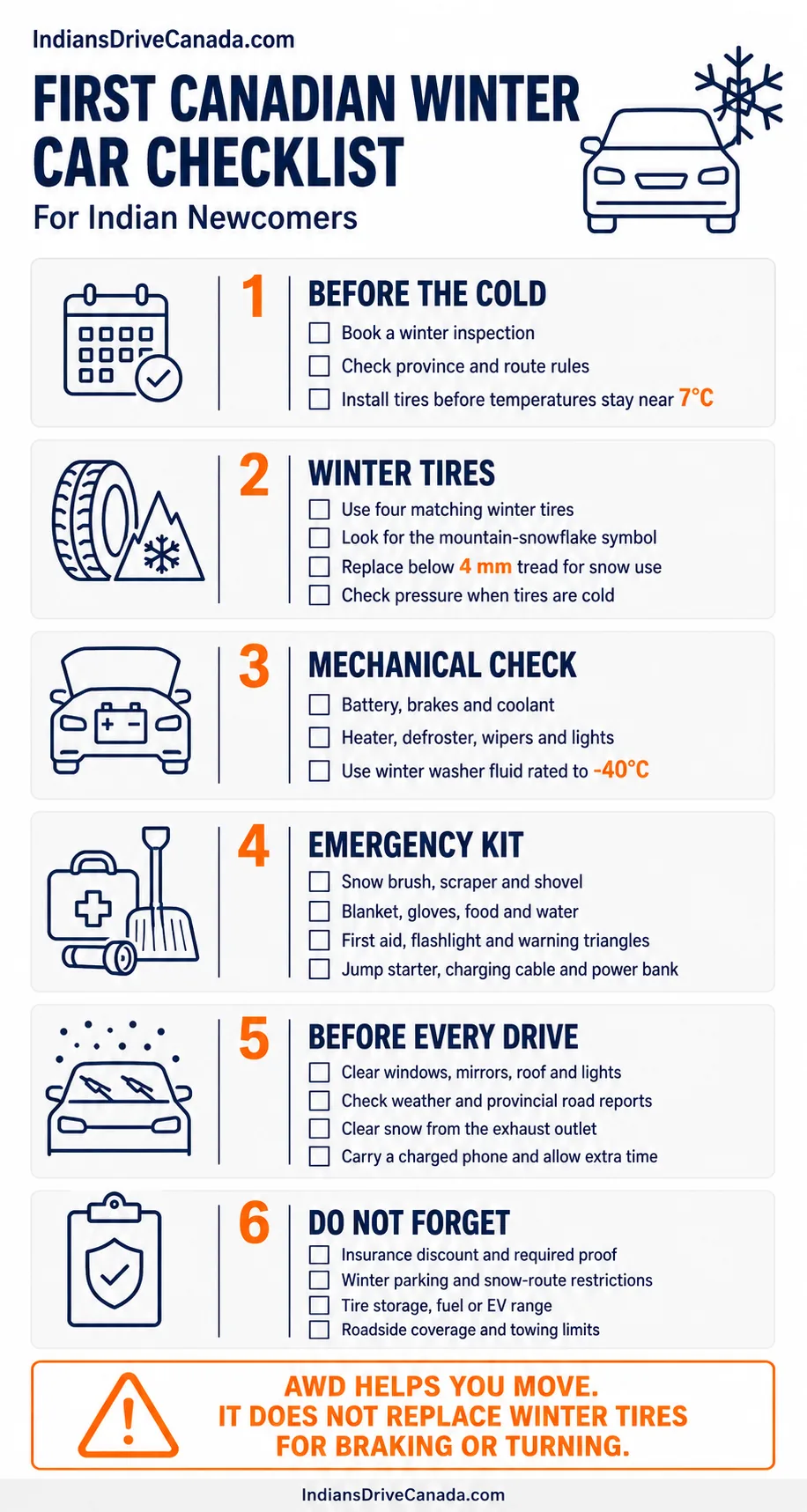
Four checks decide whether the car is winter-ready
A first Canadian winter car checklist is complete only when the vehicle has suitable tires for the province and roads being used, has passed a cold-weather mechanical inspection, has winter-rated visibility equipment and contains emergency supplies that can be reached when they are needed.
An SUV, all-wheel drive system or remote starter does not replace any of these checks. AWD may help a vehicle begin moving, but braking and steering still depend on the tires gripping the road.
For an Indian newcomer, the main adjustment is not relearning how to operate a car. It is building a vehicle-preparation routine for prolonged sub-zero temperatures, freezing rain, snow-covered roads, road salt and repeated freeze-thaw cycles.
Do not wait for the first snowy workday to discover that the washer fluid has frozen, the battery is weak or the snow brush is locked beneath luggage. Complete the mechanical and equipment checks before regular freezing weather reaches your area.
Start with the conditions your car will actually face
A city commuter parked in an underground garage needs a different level of preparation from a vehicle parked outdoors in Winnipeg, driven through a British Columbia mountain pass or used for long evening trips in northern Ontario.
Before purchasing tires or equipment, identify the conditions that apply to the vehicle:
- Will the car remain outdoors overnight?
- Will it be driven mainly on urban roads, rural roads or mountain highways?
- Will regular trips continue during freezing rain or heavy snowfall?
- Does the province or planned route impose a winter tire or chain requirement?
- Is the vehicle front-wheel drive, rear-wheel drive, AWD or four-wheel drive?
- Is it a gasoline, diesel, hybrid or electric vehicle?
- Is roadside assistance included with the insurance policy, vehicle warranty or another service?
- Does a condo, landlord or workplace control access to outdoor electrical outlets?
Underground parking can hide a weak winter setup. A battery that starts normally in a heated garage may behave differently after the vehicle spends several hours outside. Tire pressure can also change after moving between a warm garage and sub-zero outdoor conditions.
Read the sidewall before paying for winter tires
The word all-season does not mean that a tire provides the same grip in every Canadian winter condition. Transport Canada advises drivers to look for the three-peaked mountain and snowflake symbol, commonly called 3PMSF. Tires carrying this symbol meet a defined snow-traction performance requirement.
Transport Canada also states that all-season and summer tires begin losing elasticity below approximately 7°C. It recommends installing winter tires as a set of four and not using winter tires with less than 4 mm of tread in severe snow conditions.[Winter tire guidance]
How to separate the tire labels
| Label or category | What it tells you | What to check before buying |
|---|---|---|
| Summer tire | Designed mainly for warmer conditions | Do not treat it as winter equipment |
| All-season | A broad-use tire that may carry an M+S marking | Do not assume it has the 3PMSF symbol |
| M+S | Mud-and-snow marking based on tire design criteria | Check whether the province or route accepts it and whether it suits expected conditions |
| 3PMSF | The three-peaked mountain and snowflake symbol | Confirm the symbol appears on the actual tire being installed |
| All-weather | A year-round category that may provide stronger winter capability than a normal all-season tire | Confirm the 3PMSF symbol rather than relying only on the product name |
| Studded tire | A tire fitted with metal studs for specific winter conditions | Check provincial dates, restrictions and local rules before use |
Four matching tires are the safer setup
Installing winter tires only on the drive wheels can create different levels of grip between the front and rear of the car. That imbalance can make the vehicle less predictable when braking, changing lanes or turning.
The four tires should be compatible in size, construction, load rating and intended use. Their tread depths should also be reasonably even. When one pair has deeper tread than the other, Transport Canada advises placing the better tires on the rear to help preserve directional control.
AWD changes acceleration, not the road surface
AWD can distribute power to more than one axle and may help the car pull away from a snowy parking space. It does not create additional tire grip while stopping. A heavy AWD vehicle on unsuitable tires can still slide through an intersection or lose direction on ice.
The same limitation applies to SUVs. Extra ground clearance may help with deeper snow, but it does not shorten the stopping distance.
Check tread condition, tire age and cold pressure
Do not evaluate a used winter tire only by looking at the centre groove. Check several points across each tire for uneven wear, cracking, repairs and damage to the sidewall.
The four-digit manufacturing code on the tire identifies its production week and year. Age alone does not determine whether a tire must be replaced, but an older tire with cracking, hard rubber or uncertain storage history needs professional assessment.
Measure tire pressure when the tires are cold. Use the vehicle manufacturer’s recommended pressure shown on the driver-door label or in the owner’s manual. The maximum number moulded into the tire sidewall is not the normal target pressure for the vehicle.
Do not buy winter tires by wheel diameter alone. Two tires that both fit a 16-inch wheel can have different widths, sidewall heights, load ratings and speed ratings. Match the complete approved tire specification for the vehicle.
Province and route rules change the checklist
Canada does not use one identical winter tire rule for every province, municipality and highway. A vehicle that is legal for an urban trip may not meet the equipment rule on a signed mountain route.
| Location | Rule or practical check | Action before driving |
|---|---|---|
| Québec | Most motor vehicles registered in Québec, including Québec-registered rental vehicles, must use compliant winter tires from December 1 to March 15. The published fine for non-compliance is $200 to $300, subject to listed exceptions.[Québec tire rule] | Confirm that all installed tires carry the required winter pictogram or otherwise meet the provincial rule. |
| British Columbia designated routes | Winter tires or chains are required on most designated routes from October 1 to April 30. Requirements on some routes end March 31, and roadside regulatory signs determine where the rule applies.[B.C. route rule] | Check the planned route, not only the city where the journey begins. |
| British Columbia tire standard | A legal winter tire for a standard passenger vehicle must have at least 3.5 mm of tread and carry either M+S or the 3PMSF symbol. The province recommends 3PMSF tires for better snow and ice traction.[B.C. tire standard] | Do not confuse the provincial legal minimum with the tire most suitable for severe conditions. |
| B.C. visitors and rental vehicles | Out-of-province passenger vehicles must follow B.C. winter tire and chain requirements while using the affected highways. Rental vehicles may have M+S tires, so the actual tire marking should be checked before a mountain or interior trip.[Visitor vehicle rule] | Inspect the rental vehicle before accepting it and discuss 3PMSF availability with the rental company. |
| Ontario insurance | Ontario insurers must offer a winter tire discount. The insurer determines how a driver qualifies, including any required installation period or proof.[Insurance discount] | Ask the insurer or broker what evidence is needed before installation receipts are discarded. |
This table is not a substitute for checking the province and route being used. Studded-tire periods, local bylaws, private-road rules and temporary travel restrictions can add another requirement.
Book the inspection before cold weather exposes a weak part
A general oil change does not automatically include every winter-readiness check. Ask the repair facility to record the condition of the battery, charging system, coolant protection, brakes, exhaust, defrosters, lights and wipers.
Transport Canada’s winter preparation guidance includes checking the battery and charging system, brakes, exhaust leaks, coolant strength, heater, defroster, lights and wipers. It also recommends winter washer fluid in the approximately −40°C range and at least 4 mm of winter tire tread for safer winter use.[Vehicle inspection]
A clear request to give the repair facility
“Please check the vehicle for winter use, including a battery condition or load test, the charging system, coolant freeze protection, front and rear defrosters, brakes, exhaust leaks, lights, wipers, washer system and tire condition.”
| Component | Question to answer | Do not accept as a complete check |
|---|---|---|
| Battery | Is it strong enough for cold starts, and is the charging system working? | “It started today.” |
| Coolant | Does the coolant mixture provide adequate freeze protection? | A visual level check without testing protection |
| Defrosters | Do the front and rear systems clear moisture and frost? | Checking only that warm air comes from a vent |
| Brakes | Are the pads, rotors and hydraulic system in serviceable condition? | Assuming no dashboard light means the brakes are ready |
| Exhaust | Are there leaks or damaged sections that could allow carbon monoxide into the cabin? | Checking only the tailpipe opening |
| Wipers and washer system | Do the blades, pump and nozzles clear the full viewing area? | Adding fluid without testing the spray |
| Lights | Do all headlights, brake lights, indicators and reverse lights work? | Checking from the driver’s seat only |
| Spare and tools | Is the spare inflated, and are the jack and wheel tools present? | Assuming every used car still contains its original tool kit |
Battery warning signs to address before the freeze
A portable jump starter can be useful, but it should not become a substitute for replacing a failing battery. Check the device’s storage-temperature instructions and recharge it on the schedule stated by its manufacturer.
Use the correct fluid in the correct reservoir
Two products may both contain the word antifreeze, but they are not interchangeable.
| Product | Where it goes | Purpose | Risk to avoid |
|---|---|---|---|
| Engine coolant or antifreeze | Engine cooling system | Controls engine temperature and protects the cooling system from freezing | Never pour it into the windshield washer reservoir |
| Winter washer fluid | Windshield washer reservoir | Cleans salt, slush and road film at sub-zero temperatures | Do not assume every coloured washer fluid is rated for severe cold |
Read the temperature rating on the washer-fluid container. If the reservoir contains summer fluid, adding a small amount of winter fluid may not give the entire mixture the protection shown on the new container.
When the existing fluid’s rating is unknown, ask a repair facility how to replace or sufficiently dilute it before freezing weather. Test both the front and rear washer systems, where fitted, after the change.
Do not pour hot water onto a frozen windshield. The sudden temperature difference can damage glass, and the water can refreeze around the wipers, doors and ground beside the vehicle.
Squeegee-shaped streaks are an early warning
Replace wiper blades that chatter, skip or leave bands of water across the viewing area. A blade that works during summer rain may become stiff in cold weather.
Do not switch on wipers that are frozen to the glass. Release them gently after the defroster begins softening the ice. Forcing them can damage the rubber, wiper arm or motor linkage.
Pack the emergency kit by reach, not by shopping category
A well-stocked kit can still fail if every item is buried under suitcases or trapped in a frozen trunk. Divide the supplies according to when and where they may be needed.
| Location | Items | Reason |
|---|---|---|
| Reachable from the cabin | Warm gloves, hat, flashlight, phone cable, charged power bank, first-aid kit, reflective vest, blanket, seat-belt cutter and window hammer | These may be needed before it is safe or possible to open the trunk |
| Top layer of the trunk | Snow brush, ice scraper, shovel, traction mats, warning triangles, booster cables or jump starter | Equipment needed first should not be placed beneath luggage |
| Protected trunk storage | Extra washer fluid, non-perishable food, spare socks, waterproof gloves, hand warmers and basic tools | These items need secure storage but should remain easy to retrieve |
| Carried indoors | The only lock de-icer, devices that require recharging and items damaged by prolonged extreme cold | A de-icer locked inside the car cannot open the frozen lock |
Minimum winter kit for daily city driving
- Snow brush long enough to reach the centre of the roof
- Separate or integrated ice scraper
- Warm gloves suitable for clearing snow
- Compact shovel
- Flashlight
- Reflective warning device
- Phone charging cable and charged power bank
- Blanket and spare warm clothing
- First-aid kit
- Booster cables or a maintained portable jump starter
- Extra winter washer fluid
- Roadside-assistance contact details
Additions for highways, rural roads and long trips
- Traction mats or an appropriate traction aid
- Additional warm footwear and socks
- Non-perishable food
- Water stored and rotated with freezing conditions in mind
- Hand and foot warmers
- Paper map or written route information
- Any personal medication that may be needed during an extended delay
- Extra charging capacity for the phone
Open and inspect the kit once a month during winter. Recharge electronic devices, replace consumed items, dry wet gloves and check that washer fluid has not leaked onto other supplies.
The first snowy morning has a fixed order
Allow more time than a normal departure. Remote starting may warm the cabin, but it does not clear the roof, lights, cameras or space around the car.
Check the area before entering
- Look for ice where you will stand while cleaning the car.
- Check whether a snowplow has created a hard ridge around the wheels.
- Make sure the tailpipe is not blocked by snow.
- Check that the driver’s door can open without forcing the handle.
- Confirm that no person, animal or object is hidden by a snowbank around the vehicle.
Start the defrosting systems
- Start the vehicle according to its owner’s manual.
- Switch on the front defroster and rear-window defogger.
- Activate heated mirrors or heated windshield features if fitted.
- Do not run the engine in an enclosed garage.
- Do not leave the vehicle unattended where local law or building rules prohibit it.
Clear the vehicle from the top down
- Remove snow from the roof.
- Clear the windshield, rear window and every side window.
- Clear the hood and trunk lid.
- Clean the headlights, tail lights and turn signals.
- Make the licence plates visible.
- Clear reversing cameras, parking sensors and driver-assistance sensors.
- Remove packed snow around the wheel openings.
Verify the car before selecting Drive
- Confirm that the wipers move freely.
- Test the washer-fluid spray.
- Check that all mirrors provide a clear view.
- Confirm that no warning light requires attention.
- Make sure loose snow cannot slide from the roof onto the windshield.
- Move slowly at first and assess the available grip without disrupting traffic.
A small cleared opening in the windshield is not enough. It limits side vision, hides pedestrians and can become blocked again when roof snow moves forward.
Decide whether the trip should leave at all
Vehicle preparation does not turn severe weather into safe weather. Before a winter trip, check the official weather warning and the road-condition service for the province being travelled through.
Transport Canada advises checking Environment Canada warnings and provincial or territorial traveller-information services such as 511. It also recommends delaying travel when conditions are poor, carrying a charged phone, telling someone the route and expected arrival time, keeping adequate fuel and allowing extra range for an electric vehicle.[Trip planning]
Delay the trip when the car cannot provide basic visibility or control
Longer trips need a departure check
- Weather warnings checked
- Road conditions and closures checked
- Fuel tank adequately filled or EV range adjusted for cold and delays
- Phone fully charged
- Emergency kit present and accessible
- Warm clothing worn or carried
- Route and expected arrival time shared with another person
- Alternative route or postponement option considered
If the car will not start, identify the symptom before repeating attempts
| What happens | Possible direction | Safer next action |
|---|---|---|
| No lights and no sound | Fully discharged battery, loose connection or electrical fault | Stop repeated attempts and inspect or obtain assistance |
| Rapid clicking | Battery may not have enough power to operate the starter | Use only the vehicle-approved jump-start procedure |
| Engine turns very slowly | Cold-weakened battery or starting-system problem | Avoid prolonged cranking and arrange a battery and charging test |
| Engine turns normally but does not start | The problem may not be the battery | Do not continue assuming a jump start will solve it |
| Warning message appears | The vehicle may require a model-specific procedure | Read the owner’s manual before another attempt |
Switch off unnecessary electrical loads before attempting a restart. Do not connect booster cables to unfamiliar terminals. Many vehicles provide designated jump points away from the battery, and the connection order can differ.
After a successful jump start, arrange a battery and charging-system check. The fact that the engine is running does not show that the battery can reliably start again after the next period of parking.
Hybrid and electric vehicles require model-specific instructions. The high-voltage traction battery and the smaller 12-volt battery perform different jobs. Do not assume that a normal gasoline-vehicle procedure applies to every hybrid or EV.
Separate a stuck vehicle from a stranded vehicle
A car that cannot move from a parking space is not the same as a vehicle trapped during a storm. The response should match the actual risk.
When the wheels are stuck but help is nearby
- Clear snow from in front of and behind the driven wheels.
- Check whether the underside of the car is resting on packed snow.
- Straighten the wheels where practical.
- Use a traction mat or appropriate traction material.
- Apply gentle power rather than spinning the tires at high speed.
- Check the owner’s manual before switching traction control off.
- Stop if repeated attempts are digging the wheels deeper.
- Use only the manufacturer-approved towing points if recovery is needed.
When the vehicle is stranded rather than merely stuck
If the car is trapped in severe weather and is not at immediate risk of being struck, Transport Canada advises remaining inside for shelter, keeping the tailpipe clear, allowing some fresh air into the cabin, using warning devices and running the engine as little as possible.[Stranded vehicle safety]
- Call emergency or roadside assistance as appropriate.
- Share the location and direction of travel.
- Keep the tailpipe clear of snow before running the engine.
- Open a window slightly on the side protected from the wind.
- Use reflective triangles, warning lights or other visibility equipment when it is safe to place them.
- Wear the stored warm clothing and use blankets or hand warmers.
- Preserve phone power after sharing the location.
- Do not perform exhausting pushing or shovelling in severe cold.
- Remain alert for rescuers and other traffic.
A blocked tailpipe can allow carbon monoxide to enter the vehicle. Snow can build around the exhaust again after it has been cleared, so recheck it before each period of engine use.
Outdoor parking adds its own winter tasks
The car may be ready while the parking arrangement is not. Street restrictions, snow routes, snowplow schedules and condo electrical rules can affect whether the vehicle can remain where it is parked.
- Check municipal overnight parking and snow-route restrictions.
- Learn how temporary parking bans are announced.
- Confirm whether a condo or landlord permits use of an outdoor electrical outlet.
- Do not run an extension cable across a public walkway without an approved safe arrangement.
- Keep a shovel accessible without first needing to move the car.
- Expect a snowplow to leave a dense ridge at the end of a driveway or parking space.
- Check garage ramps for meltwater that may freeze near the entrance.
- Do not store the only lock de-icer inside the locked vehicle.
Block heater, battery maintainer or jump starter?
| Equipment | When it may be relevant | What to verify |
|---|---|---|
| Block heater | Outdoor parking in very low temperatures or when recommended by the manufacturer | Vehicle compatibility, correct cord location, outlet permission and safe connection |
| Battery maintainer | A vehicle parked for long periods or driven mostly on short trips | Battery type, charger compatibility, ventilation and electrical access |
| Portable jump starter | Emergency starting support where another vehicle may not be available | Cold-storage limits, charge level and vehicle-approved connection points |
The owner’s manual should decide whether a block heater is recommended and how it is used. Do not install or improvise an electrical system based only on the outside temperature.
Electric and hybrid vehicles need a separate cold-weather branch
Winter tires, visibility equipment and emergency supplies remain necessary for an EV or hybrid. Cold weather also changes charging and energy planning.
- Use scheduled preconditioning while connected to a charger when the vehicle supports it.
- Clear snow and ice from the charging port before inserting the connector.
- Keep the charging cable dry, clean and easy to reach.
- Plan a reserve rather than arriving with only the displayed minimum range.
- Allow for cabin heating, road conditions, speed and delays when planning energy use.
- Check the condition of the 12-volt auxiliary battery.
- Locate the manufacturer’s instructions for towing and jump starting.
- Do not assume every public charger will be accessible during a snow event.
- Clear cameras and sensors that may be used by driver-assistance systems.
Do not publish or rely on one fixed winter range-loss percentage for every EV. Temperature, battery design, route, speed, wind, heating use and preconditioning can produce very different results.
Shortcuts that leave the car only partly prepared
| Assumption | What is missing | Better action |
|---|---|---|
| “The tires say all-season.” | The actual winter-performance marking | Look for 3PMSF and check provincial requirements |
| “AWD will keep the car from sliding.” | AWD does not replace braking and cornering grip | Install suitable tires and adjust speed to conditions |
| “Two winter tires are enough.” | Front-to-rear grip may become unbalanced | Use four compatible winter tires |
| “The battery started yesterday.” | Cold-start capacity and charging-system condition | Request a battery and charging test |
| “Blue washer fluid is winter fluid.” | The temperature rating | Read the container and replace an unknown mixture |
| “Only the windshield needs clearing.” | Roof, lights, mirrors, plates, cameras and sensors | Clear the entire vehicle from the top down |
| “The emergency kit is somewhere in the trunk.” | Fast access during a storm or collision | Keep first-use items at the top and warm items in the cabin |
| “A jump start fixed the battery.” | The cause of the discharge | Test the battery and charging system afterward |
Master checklist for the first Canadian winter
Before regular freezing weather
- Check the winter tire rule for the province and regular routes.
- Confirm the correct tire size, load rating and approved specification.
- Install four suitable tires before the normal seasonal rush.
- Check tread condition and cold tire pressure.
- Book a battery and charging-system test.
- Test coolant freeze protection.
- Inspect brakes and exhaust.
- Test front and rear defrosters.
- Replace weak or streaking wiper blades.
- Replace summer washer fluid with properly rated winter fluid.
- Test washer pumps and nozzles.
- Check every exterior light.
- Inspect the spare tire, jack and wheel tools.
- Assemble the emergency kit.
- Save roadside-assistance information.
- Read the owner’s-manual sections on winter use, jump starting and getting unstuck.
- Check municipal parking and snow-clearing rules.
Before every snowy or icy trip
- Check official weather warnings.
- Check the provincial road-condition service.
- Clear the roof, hood, trunk, windows, lights, mirrors and sensors.
- Make sure the tailpipe is clear.
- Test the defroster, wipers and washer spray.
- Confirm adequate fuel or EV range.
- Carry a charged phone and suitable clothing.
- Share the route for a longer journey.
- Delay the trip if visibility, equipment or official road information makes travel unreasonable.
Once a month during winter
- Check tire pressure while the tires are cold.
- Inspect tread and visible tire damage.
- Refill winter washer fluid.
- Recharge the power bank and portable jump starter.
- Inspect food, water, medication and first-aid supplies.
- Dry wet gloves, blankets and traction equipment.
- Check battery starting behaviour.
- Remove packed snow from wheel wells.
- Clean road film from lights, cameras and sensors.
- Replace any emergency item that has been used.