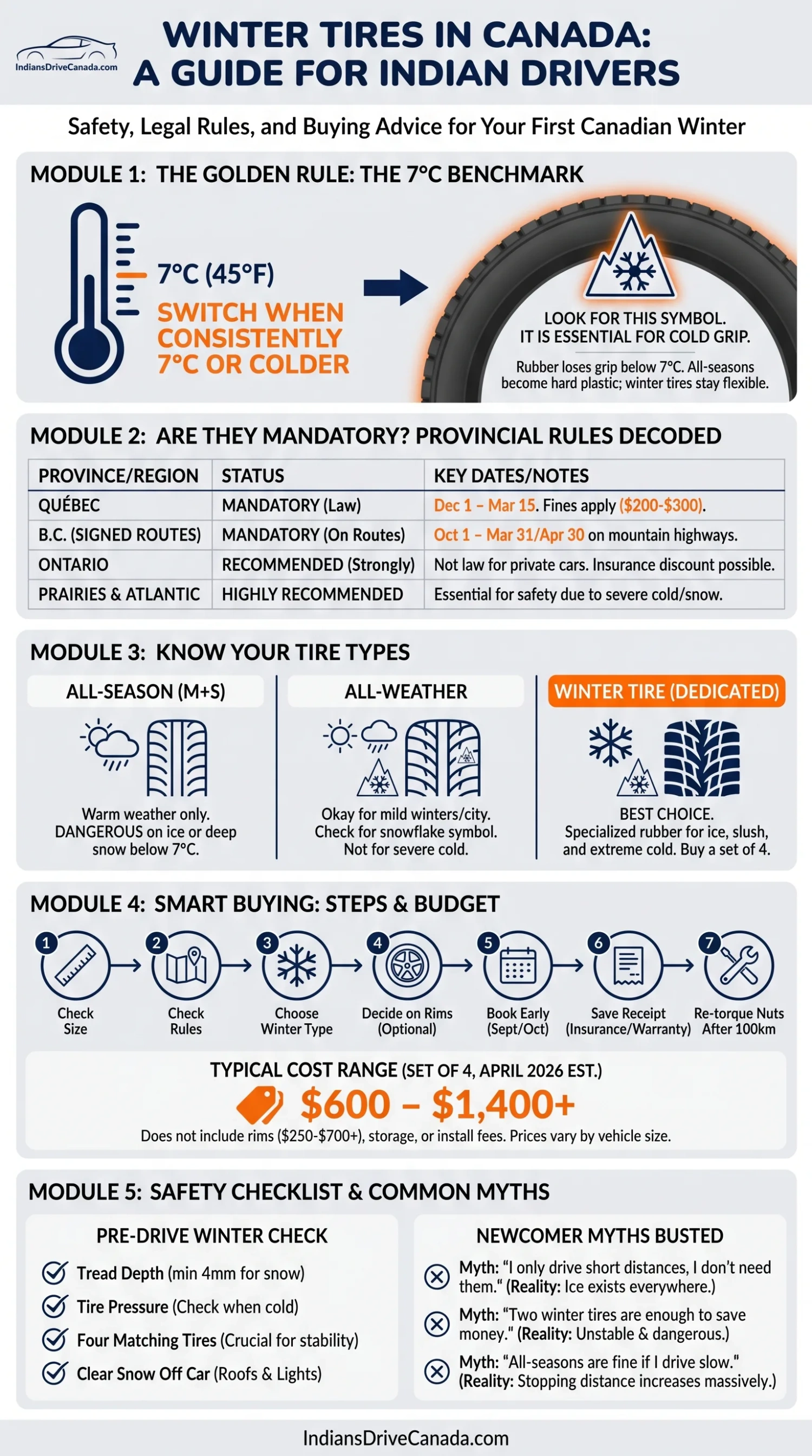
For an Indian newcomer who expects regular driving through a Canadian winter, a sensible starting choice is four matching tires carrying the three-peak mountain snowflake symbol. Buy according to the province, routes, temperatures and vehicle you will use—not only the brand name or the lowest advertised price.
A complete buying decision also includes wheel size, load rating, mounting, balancing, tire-pressure sensors, seasonal changes, storage and any insurance or financing conditions.
Canada does not use one nationwide passenger-vehicle winter-tire calendar. A vehicle registered in Québec is subject to a province-wide date requirement, while British Columbia applies winter-equipment rules on designated routes. Other provinces may rely on different road rules, insurance terms or safety recommendations. Check the rule for the place where the vehicle is registered and the roads it will travel.
Begin with the province and the road you will drive
A driver commuting within Toronto, a Montréal resident buying a used car, and a Vancouver driver planning trips toward Whistler do not have the same purchase requirement. Before comparing tire models, identify where the vehicle is registered and whether regular trips include signed mountain or high-snow routes.
| Location or program | Rule or benefit | What to confirm before buying |
|---|---|---|
| Québec | Motor vehicles registered in Québec, including rental vehicles, must use compliant winter tires from December 1 to March 15. Vehicles registered outside Québec are excluded from this province-wide requirement. Non-compliance can result in a $200 to $300 fine. | Confirm that each tire carries the required three-peak mountain snowflake pictogram or is a permitted studded tire. Review any exemption before relying on it. |
| British Columbia | Winter tires or chains are required on most designated routes from October 1 to April 30. On selected routes, the requirement ends March 31. | Check the route map, not only the city forecast. A legal passenger-vehicle winter tire must have at least 3.5 mm of tread and carry either M+S or the three-peak mountain snowflake symbol. The province recommends the mountain-snowflake type for better snow and ice traction. |
| Ontario | Auto insurers must offer a winter-tire discount for eligible private passenger vehicles. | Ask the insurer which tire markings, installation dates and proof of purchase are required. The amount and qualification process can vary by insurer. |
| Manitoba | Eligible Manitoba Public Insurance customers may finance up to $2,000 per vehicle at prime plus 2%, with payments spread over one to four years. | Confirm eligibility and use a participating retailer. Approved costs can include qualifying tires, rims, mounting, balancing, alignment, TPMS, some studding, and certain initial storage or switchover costs. |
| Elsewhere in Canada | Requirements and permitted studded-tire periods differ by province, territory, road and sometimes municipality. | Check the provincial transportation authority and any local or route-specific rule before placing the order. |
A legal minimum and the best tire for a particular winter trip are not always the same. For example, B.C. accepts qualifying M+S tires on designated routes, but recommends three-peak mountain snowflake tires for colder conditions and stronger snow-and-ice traction.
Read the tire sidewall before comparing brands
The product name on a retailer’s website is not enough. The sidewall shows whether the tire has a winter-performance marking, whether its size fits the vehicle, how much weight it is designed to carry and when it was manufactured.
The three-peak mountain snowflake symbol
The three-peak mountain snowflake marking, often shortened to 3PMSF, identifies a tire that meets a prescribed snow-traction performance requirement. Transport Canada tells winter-tire shoppers to look for this symbol. It can appear on dedicated winter tires and on some all-weather tires.
The symbol does not rank every tire model for ice braking, wet roads, noise, tread life or fuel use. Two products carrying the same marking can still perform differently. Use the marking as the first screening test, then compare independent test information, warranty terms and suitability for the vehicle.
Why M+S is not the same buying signal
M+S means mud and snow. It appears on many all-season products and can satisfy the minimum legal winter-tire definition on designated B.C. routes when the tire also meets the tread-depth rule. It does not represent the same severe-snow traction test as the three-peak mountain snowflake symbol.
Practical rule: do not assume that every tire labelled “all-season,” “winter capable” or “SUV tire” carries the mountain-snowflake marking. Look at the actual sidewall or obtain written confirmation for the exact model and size being quoted.
Size, load index and speed rating
A code such as P205/55R16 89V contains several separate specifications:
Start with the tire-information label inside the driver’s door or door frame and the owner’s manual. A retailer should not reduce the required load capacity or approve a different wheel package without checking vehicle compatibility, brake clearance and overall tire diameter.
Manufacturing date and pressure markings
The tire identification number ends with a four-digit manufacturing date code. The first two digits show the production week and the last two show the production year. The date helps assess a new or used tire, but age alone does not reveal storage conditions, heat exposure, repairs, cracking or internal damage.
The maximum pressure printed on the tire sidewall is generally not the normal pressure setting for the vehicle. Use the cold-pressure specification on the vehicle label or in the owner’s manual. Transport Canada advises checking pressure when the tires are cold and notes that pressure can fall by about 1 psi for every 5°C drop in temperature.
Dedicated winter tires or all-weather tires
A dedicated winter set is not the only product carrying a winter symbol, but it is often the more suitable choice for regular driving in prolonged cold, packed snow, freezing rain or repeated highway use. An all-weather set can be reasonable when winters are milder, annual distance is lower, storage is difficult and the driver can postpone trips during poor conditions.
| Tire category | Winter marking | Better suited to | Main limitation |
|---|---|---|---|
| All-season | Often M+S; many models do not carry 3PMSF | Mild weather and vehicles not used in winter conditions | Rubber begins losing elasticity below 7°C, reducing cold-weather traction |
| All-weather | Can carry 3PMSF; verify the exact model | Lower annual distance, limited storage and milder winter use | Year-round compromise; performance and tread life vary widely by model |
| Dedicated winter | Look for 3PMSF | Regular cold, snow, ice, highway commuting and mountain travel | Requires seasonal change and usually a second storage space |
| Studded winter | May carry 3PMSF and includes metal studs | Specific recurring ice conditions where local law permits use | Restricted dates, more road noise and possible local limitations |
AWD and 4WD do not replace winter grip
All-wheel drive and four-wheel drive can help a vehicle move from a stop, but they do not create extra tire grip during braking or a turn. The contact between four tires and the road still controls how the vehicle responds. A heavier AWD SUV can also carry more momentum, making tire condition and stopping distance especially relevant.
Do not install only two winter tires as a budget solution. Transport Canada recommends a set of four with the same type, size, speed rating and load index. Mixing tread patterns, construction or sizes can make the vehicle less stable. If tread depths differ, the tires with deeper tread should be on the rear to support directional control.
Match the winter package to the vehicle
The original wheel diameter is not automatically the only winter option. Some vehicles can use a smaller approved wheel with a taller tire sidewall, often called winter downsizing. This can reduce tire cost and provide more sidewall protection against potholes. It is not suitable for every car.
- Check the driver-door tire label and the owner’s manual.
- Keep the overall tire diameter within the vehicle manufacturer’s accepted range.
- Confirm that the wheel clears the brake calipers and suspension components.
- Do not reduce the required load index.
- Confirm wheel width, offset, bolt pattern and centre bore.
- Check whether the vehicle needs direct TPMS sensors in the winter wheels.
- Ask whether separate wheel nuts, hub rings or a different wheel-lock key are required.
- Obtain written confirmation that the quoted package fits the exact year, trim and brake package.
SUV, hybrid and electric-vehicle checks
Larger SUVs, hybrids and electric vehicles may require tires with higher load ratings or other manufacturer-specified characteristics. A winter tire should not be chosen only because the size appears to match; the service description and load capacity must also suit the exact vehicle.
Regenerative braking does not overcome low road grip. On ice, the tires still limit how much braking force can be transferred to the road. Use the vehicle’s winter or low-traction settings as described in the owner’s manual, but do not treat software settings as a substitute for suitable tires.
Price the complete setup, not only four tires
An advertised tire price may exclude the parts and services that make the set usable. Ask for one written quote showing every line before comparing retailers.
| Cost item | Question for the retailer |
|---|---|
| Four tires | Is the quote for the exact brand, model, size, load index and speed rating? |
| Wheels | Are steel or alloy wheels included, and do they fit the vehicle’s brakes and hubs? |
| TPMS | Are sensors, installation and programming included? |
| Mounting and balancing | Does the price include mounting each tire, balancing each wheel and new valve components? |
| Seasonal change | What will each future spring and autumn change cost? |
| Storage | Is seasonal storage included, and what is the annual renewal price? |
| Alignment | Is an alignment required, recommended after inspection or automatically added? |
| Warranty | What is covered by the manufacturer warranty and any separate road-hazard plan? |
| Disposal and shop fees | Are environmental, disposal and shop-supply fees included? |
| Tax | Is the displayed total before or after applicable tax? |
Compare ownership cost over the years you expect to keep the vehicle. Add the initial package, two seasonal changes per year, storage and financing interest. Then subtract only an insurance discount that the insurer has confirmed. A cheaper first invoice can become the more expensive setup after repeated mounting and storage charges.
Separate wheels or remounting on the same wheels
Both arrangements can work, but they distribute the cost differently. The better choice depends on how long the vehicle will be kept, whether it uses expensive sensors and whether the driver has space to store a complete wheel set.
| Setup | Initial cost | Future seasonal work | Often suits |
|---|---|---|---|
| Winter tires remounted on the original wheels | Lower because a second wheel set is not purchased | Tires must be removed, mounted and balanced during each change | Shorter vehicle ownership or vehicles with costly replacement wheels and sensors |
| Winter tires on separate steel wheels | Higher because wheels and possibly TPMS are added | Complete wheel assemblies can usually be swapped with less labour | Drivers keeping the vehicle for several winters |
| Winter tires on separate alloy wheels | Usually the highest | Similar seasonal swap to steel wheels | Vehicles where appearance, corrosion resistance or wheel availability matters |
| One all-weather set | No second wheel set or seasonal swap | Regular rotation and condition checks still apply | Lower-distance use where the tire’s winter and summer compromises are acceptable |
Ask the retailer to calculate both options over the expected ownership period. The break-even point for separate wheels is reached when the extra purchase cost is offset by lower seasonal labour charges. Include TPMS programming, wheel hardware and storage in that comparison.
Used winter tires and the “free set” with a used car
A used vehicle may be advertised with a second set of tires. Treat the set as unverified equipment until each tire has been inspected. A low asking price has little value if the tires are too worn for snow, do not match or require replacement after one season.
Information to request for a used set
- The exact brand, model, size, load index and speed rating on all four tires
- Clear photographs of the complete sidewalls and date codes
- Tread-depth measurements at several points across every tire
- Confirmation of repairs, punctures, sidewall damage or previous air-loss problems
- Details of how the tires were stored when not in use
- Confirmation that the wheels fit the exact vehicle and clear its brakes
- TPMS compatibility and whether the sensors still operate
Reasons to reject the set
Transport Canada advises against using tires worn close to 4 mm on snow-covered roads and recommends four matching winter tires. A provincial legal minimum may be lower than the tread depth that provides useful winter performance.
Buy before the first major snowfall
The purchase date and installation date do not need to be the same. Research the size, obtain quotes and reserve an appointment before demand rises. Install according to local temperatures, travel plans and legal dates.
1. Confirm the rule and route
Check the vehicle’s registration province, normal commuting area and any planned mountain, rural or interprovincial trips.
2. Verify the exact package
Confirm the tire marking, size, load index, wheel fit, TPMS requirement and complete installed price.
3. Reserve installation using temperature and deadline
Transport Canada notes that all-season and summer tires begin to lose elasticity below 7°C. Do not wait for the first storm if regular temperatures are already falling or a provincial deadline is approaching.
4. Keep the invoice and installation record
Retain the itemized invoice, tire model, size, installation date and proof that four winter tires were installed. These details may be needed for warranty service, resale or an insurer’s winter-tire discount.
Insurance discounts and financing can change the real cost
Ontario winter-tire discount
Ontario insurers must offer a winter-tire discount, but the qualification details are not identical across companies. Before buying, ask the broker, agent or insurer:
- Which markings and tire categories qualify?
- Must all four tires be installed?
- What installation and removal dates apply?
- Is an invoice or signed declaration required?
- Will the discount start immediately or at policy renewal?
- What happens if the vehicle or tire setup changes during the policy term?
Do not assume a fixed percentage. FSRAO states that all insurers must offer the discount and advises drivers to ask their insurer how to qualify. Each company applies discounts through its approved rating rules.
Manitoba Winter Tire Program
An eligible individual MPI customer can use the Winter Tire Program for up to $2,000 per registered passenger vehicle or light truck, at prime plus 2% interest, over one to four years. The customer must have no outstanding MPI payments or restrictions and must use a participating retailer.
Bring the driver’s licence and vehicle registration to the retailer. Financing can cover approved mountain-snowflake tires and related initial costs such as rims, mounting, balancing, alignment, TPMS, applicable taxes and fees. Ongoing storage or future switchover charges are not covered unless they are included in the initial purchase as permitted by the program.
Financing changes when the bill is paid; it does not reduce the purchase price. Compare the total interest cost with other payment options and confirm the current rate before signing.
Studded tires require a separate legal check
Studded tires are not the automatic upgrade from a non-studded winter tire. They can be useful in recurring ice conditions, but they create more road noise and are restricted by provincial dates and technical rules.
Do not order a studded set from a national online listing until the registration province, travel route and local restrictions have been checked. A non-studded 3PMSF winter tire is the more practical default for many urban and highway users.
Four newcomer buying situations
Toronto condo resident with no storage room
Compare a dedicated winter set with tire-hotel storage against a 3PMSF all-weather set. Include two seasonal changes, storage, TPMS and the insurer’s confirmed discount. Regular motorway commuting and an inability to postpone trips may favour dedicated winter tires even when storage is inconvenient.
Montréal resident buying a used vehicle in winter
Confirm that the vehicle has four compliant tires before the Québec requirement applies to the trip. A dealer purchase can fall within a limited seven-day exception when the required proof is carried, but the exception should be treated as time to arrange compliant tires—not as a full winter solution. Inspect any included used set instead of assigning it an automatic value.
Vancouver driver planning Whistler or Interior trips
Do not base the purchase only on mild conditions near home. Check the B.C. designated-route map for every regular or planned trip. M+S can meet the route’s minimum definition when tread depth is sufficient, but a 3PMSF set is the stronger buying choice for repeated mountain travel, snow and ice.
Winnipeg family managing first-year settlement costs
Obtain an itemized quote for tires, separate wheels, TPMS and installation, then check MPI financing eligibility. Compare the loan’s full interest cost with paying upfront. A separate wheel set can cost more at purchase but reduce seasonal labour if the vehicle will be kept for several winters.
Complete the shop inspection before payment
Before installation
- Verify the three-peak mountain snowflake symbol on the exact tires supplied.
- Match all four tires by brand, model, size, load index and construction.
- Read and record the manufacturing date codes.
- Confirm wheel fit, brake clearance, offset, bolt pattern and centre bore.
- Confirm whether TPMS sensors and programming are included.
- Review the itemized total, warranty and road-hazard terms.
- Request the expected cost of future seasonal changes and storage.
- Keep written proof of any insurance qualification promised by the insurer.
At vehicle collection
- Check that directional tires rotate in the correct direction.
- Confirm that the recommended cold pressure follows the vehicle label, not the tire’s maximum sidewall pressure.
- Make sure the TPMS warning light is off and ask how the system relearns each wheel set.
- Confirm whether a wheel-nut torque recheck is required and when it should be done.
- Keep the wheel-lock key and any special installation hardware in the vehicle.
- Label the removed tires by vehicle position if they will be rotated next season.
- Store the invoice, warranty and seasonal service record together.
Official checks used for this buying decision
Rules and program details were checked on July 27, 2026. Recheck the relevant authority before purchase because route designations, program rates, insurer conditions and temporary exemptions can change.