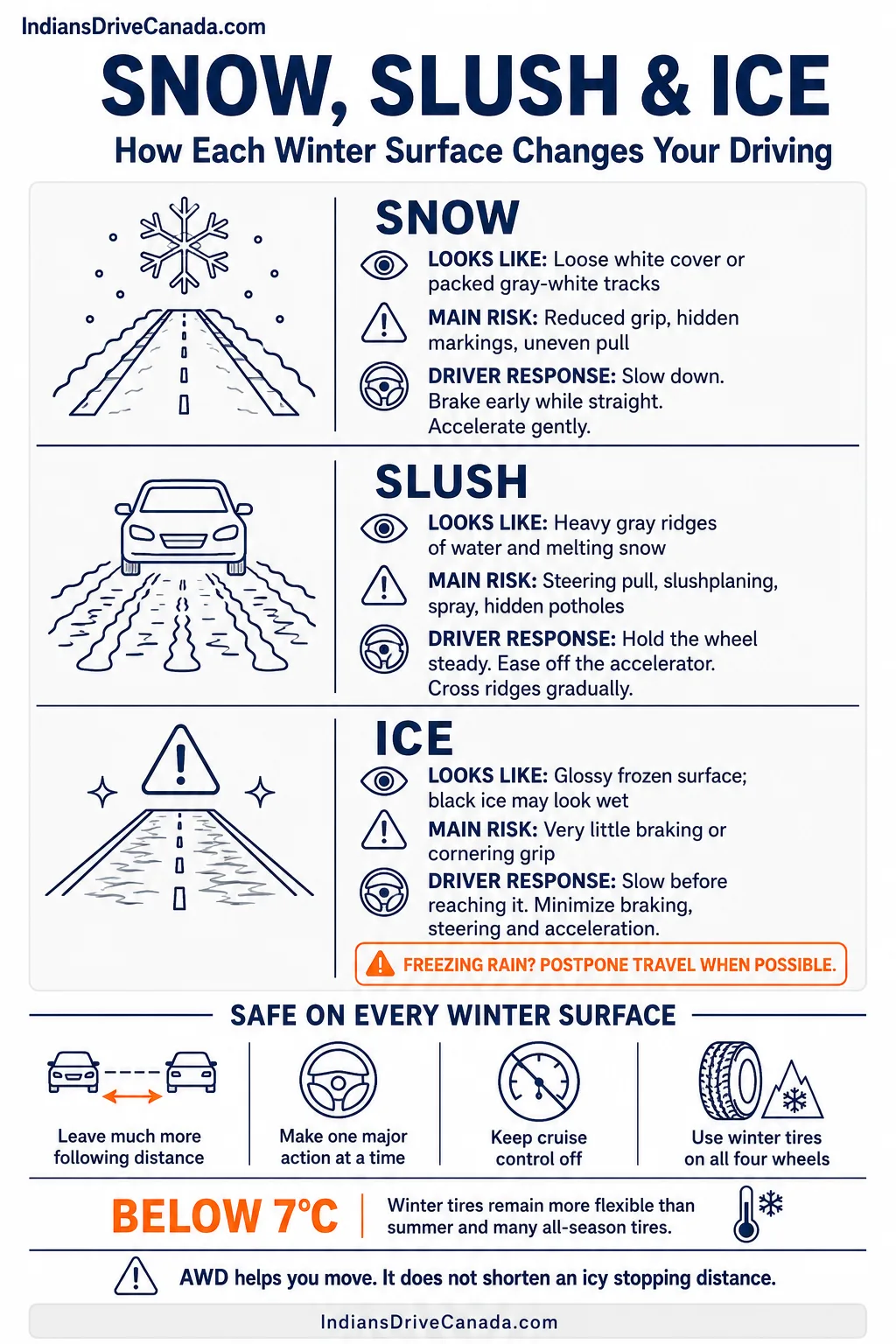
An experienced driver arriving from India may already be comfortable with heavy traffic, monsoon rain, low visibility and long highway journeys. Canadian winter roads add a different task: the driver must identify what is under the tires before deciding how to brake, steer or change lanes.
Snow, slush and ice are not three names for the same slippery condition. Snow can allow some grip while delaying steering and braking. Slush can pull the vehicle sideways or unsettle it during a lane change. Ice may remove most usable grip with little warning. A technique that works on one surface may make the situation worse on another.
Match the response to the surface: use smooth, early inputs on snow; cross slush with the vehicle settled and the steering nearly straight; approach suspected ice only after reducing speed. When the road surface is uncertain, assume the lower-grip condition until the vehicle’s behaviour shows otherwise.
Read the surface before choosing the response
The road may change several times during one commute. A residential street can hold fresh snow, a busy intersection can have polished packed snow, the highway can contain slush between lanes, and a bridge can be coated with thin ice.
| Surface | What it may look like | What the vehicle may do | Main response |
|---|---|---|---|
| Fresh snow | Loose white covering with visible tire tracks | Wheelspin, slower steering response and wider turns | Use gentle acceleration and begin slowing early |
| Packed snow | Hard, smooth or shiny white surface | Longer stopping distance and sudden sideways movement | Reduce speed before turns and leave a large following gap |
| Slush | Grey or brown semi-melted snow, often in ridges | Steering pull, drag, spray and uneven resistance | Cross with small steering inputs and avoid sudden braking |
| Visible ice | Clear, white or polished frozen surface | Very weak braking and steering response | Slow before reaching it and minimize vehicle inputs |
| Black ice | Dark, wet-looking or shiny pavement | Loss of grip without an obvious surface warning | Treat suspicious pavement as ice before the tires reach it |
The colour alone is not enough. Road salt, vehicle traffic, temperature, shade and snowplow activity can leave several surfaces within the same lane. Look far ahead, notice how other vehicles are moving and pay attention to changes in tire sound and steering weight.
Snow gives some grip, but every response takes longer
Drivers can sometimes become overconfident on snow because the vehicle still accelerates, turns and stops. The problem is that each action has less margin. A quick movement that causes no difficulty on dry pavement can exceed the available traction on snow.
Fresh snow moves under the tire
Fresh snow is loose. A tire must push through or compress it before reaching a firmer surface. When too much power is applied, the wheels may spin and polish the snow underneath them, making the next attempt harder.
- Apply the accelerator gradually rather than pressing it in one movement.
- If the drive wheels spin, reduce power instead of adding more.
- Keep the front wheels as straight as possible while beginning to move.
- Allow the vehicle to gain momentum slowly before climbing a gentle slope.
- Do not use wheelspin as a substitute for traction.
Traction-control intervention may feel like reduced engine power, pulsing or hesitation. That does not necessarily mean the vehicle has developed a fault. It may mean the system has detected wheelspin and is trying to control it.
Packed snow can behave more like ice
Traffic repeatedly compresses snow at stop signs, bus stops, intersections, parking exits and hill approaches. The surface can become smooth and polished, especially where many vehicles accelerate or brake in the same place.
A white road should not automatically be treated as soft snow. If the surface is hard, shiny or heavily polished by tires, use a lower approach speed and begin braking while the vehicle is still straight.
Complete most of the slowing before the turn
A tire has limited grip available for braking, steering and acceleration. Asking it to brake hard while also making a sharp turn can exceed that limit.
Approaching the turn
Release the accelerator early and reduce speed while the wheels are mostly straight. Avoid waiting until the corner to discover how much grip is available.
Moving through the turn
Use one smooth steering movement. Do not keep adding steering angle when the vehicle is already sliding toward the outside of the turn.
Leaving the turn
Begin accelerating only after the vehicle is pointed along the new path. Apply power gradually so the drive wheels do not break traction.
Tire tracks are clues, not a guaranteed safe path
Existing tracks may expose firmer pavement or reduce the amount of loose snow under the tires. They may also contain polished packed snow, frozen water or deep grooves that pull the steering.
Do not follow a track only because another vehicle used it. Look at whether it appears wet, shiny, deeply rutted or smoother than the surrounding snow. Maintain enough distance to change your line gradually when the track becomes unsuitable.
Slush can pull the vehicle before the driver expects a skid
Slush is a mixture of water, partly melted snow, road salt and dirt. It can collect beside tire tracks, along lane markings and between lanes. One side of the vehicle may enter a deeper patch than the other, creating unequal resistance at the wheels.
Transport Canada warns that snow or slush can build up between lanes and make lane changes harder in poor winter conditions.[Slush hazard]
What slush feels like through the vehicle
The first reaction should not be a large steering correction. A hard correction can send the vehicle in the opposite direction when the tires leave the slush and regain firmer contact.
Crossing a slush ridge during a lane change
Before crossing
Check that the next lane has enough open space. Reduce any unnecessary speed difference before reaching the slush, and avoid beginning the manoeuvre beside another vehicle.
While the tires enter the slush
Hold a steady path with a small steering angle. Avoid hard acceleration, sudden accelerator release or forceful braking while different wheels are passing through different surfaces.
After all four tires have crossed
Allow the vehicle to settle before changing speed. If the steering pulled during the crossing, return to the intended path with a gradual correction rather than a quick counter-movement.
Missing an exit is safer than forcing a late lane change. If heavy slush, spray or closely spaced traffic prevents a smooth move, remain in the lane and use a later exit or a safe alternative route.
Slush also creates a visibility problem
A truck or SUV can throw a dense sheet of salty slush across the windshield with little warning. The same spray can cover headlights, rear lights, cameras and radar sensors.
- Keep enough washer fluid for repeated cleaning during the journey.
- Use winter-rated washer fluid suitable for expected temperatures.
- Replace wiper blades that leave broad streaks or untreated areas.
- Clean headlights, rear lights and mirrors before departure.
- Increase the following gap behind vehicles producing heavy spray.
Transport Canada recommends winter washer fluid in the −40°C range and carrying an extra container in the vehicle.[Vehicle preparation]
Ice requires less input, not a faster reaction
On ice, the available grip may be too low for normal braking, steering or acceleration. The safest response usually begins before the tires reach the frozen area.
When suspected ice is ahead:
- Release the accelerator gradually.
- Reduce speed while the vehicle is travelling straight.
- Create more space from vehicles ahead.
- Avoid changing lanes on the suspected frozen section.
- Keep steering and pedal movements small.
Black ice is often a visual trap
Black ice is usually a thin, transparent layer that allows the dark pavement beneath it to remain visible. It is not necessarily black and may look like an ordinary wet road.
Ontario’s winter-driving guidance advises drivers to be suspicious when winter pavement looks black and shiny. It also identifies shaded areas, bridges and overpasses as places that can freeze earlier than nearby road sections.[Black ice warning]
Other places that deserve a cautious approach include:
Freezing rain can change the decision, not only the technique
Freezing rain can coat the road, windshield, mirrors and exposed vehicle surfaces. The road may continue becoming more slippery even after a driver has reduced speed.
When freezing rain is forecast or already forming, the correct choice may be to delay a non-essential trip rather than attempt to compensate with slower driving. No tire, all-wheel-drive system or electronic aid can guarantee control on widespread ice.
Mixed surfaces create uneven grip across the vehicle
The most difficult winter road is not always the one completely covered in snow. A partly cleared road can place the left tires on wet pavement and the right tires on packed snow, slush or ice.
This difference can cause the vehicle to pull during braking or acceleration. It can also make the steering response change suddenly as the tires move from one surface to another.
Keep all four tires on a similar surface when possible
Choose a path that avoids repeatedly moving in and out of snowbanks, slush ridges or icy wheel tracks. Do not drive with two tires close to the snow-covered shoulder unless road position or an emergency requires it.
When crossing a boundary between surfaces:
- Reduce speed before reaching the boundary.
- Keep the vehicle as straight as the road permits.
- Avoid braking at the moment the tires cross.
- Expect the steering weight to change.
- Wait until the vehicle is settled before accelerating.
A one-degree change can produce a different road
During a freeze-and-thaw cycle, packed snow may soften into slush during the day and refreeze after sunset. Meltwater may travel away from a snowbank and freeze across a section of otherwise clear pavement.
The main road may be wet while a shaded side road remains icy. A treated highway may offer reasonable traction while an untreated driveway, parking lot or residential street remains frozen. Do not assume that conditions at the start of the journey will continue along the full route.
Braking and steering must be matched to the surface
| Situation | Snow | Slush | Ice |
|---|---|---|---|
| Acceleration | Apply power gradually and reduce it if the wheels spin | Keep power steady while crossing a deep patch | Use very little power and avoid sudden changes |
| Braking | Begin early while travelling straight | Avoid forceful braking while wheels are in different depths | Reduce speed before reaching the frozen section |
| Steering | Use a smooth turn with a lower entry speed | Expect pulling and avoid a large counter-correction | Use the smallest movement needed to maintain the path |
| Lane changes | Check for snow ridges between lanes | Cross gradually with the vehicle settled | Avoid changing lanes on the icy section |
| Following distance | Leave much more space than on a dry road | Allow for spray, drag and uncertain braking | Use the largest practical gap |
There is no universal stopping-distance number for every snowy or icy road. Speed, tire condition, vehicle weight, slope, temperature and the exact surface all change the result. Use visible space rather than a memorized dry-road distance.
When the vehicle begins to lose its intended path
A skid does not always begin with a dramatic sideways movement. Early signs can include a lighter steering wheel, a flashing stability-control light, wheelspin, a wider-than-expected turn or the rear of the vehicle beginning to move outward.
The front tires stop following the turn
If the steering wheel is turned but the vehicle continues toward the outside of the curve, the front tires may not have enough grip to complete the requested turn.
- Look toward the open path where the vehicle needs to go.
- Ease off the accelerator.
- Do not add more and more steering angle.
- Allow the tires time to regain grip.
- Make the next correction smoothly when steering response returns.
The rear of the vehicle moves sideways
If the rear begins moving left or right, avoid staring at the snowbank, barrier or vehicle that you fear hitting. Look toward the usable road ahead and make a controlled steering correction in that direction.
Do not turn the wheel sharply back and forth. An excessive correction can create a second slide in the opposite direction when grip returns.
Know how the vehicle’s braking system responds
Modern vehicles commonly have anti-lock braking and electronic stability control, but the driver still needs to understand the vehicle’s warnings and operating instructions. Read the owner’s manual before winter rather than trying to identify every system during a skid.
Transport Canada advises drivers to avoid sudden steering and forceful braking that can cause a skid, to learn the vehicle’s braking and traction systems, and to slow down when electronic stability control activates. It also advises against using cruise control in extreme weather and warns that lane-keeping and blind-spot systems may not work correctly in bad conditions.[System limits]
Do not switch off stability control for ordinary winter driving. Some manufacturers describe a limited situation in which reduced traction-control intervention may help a stuck vehicle move through deep snow. Follow the owner’s manual and restore the normal setting after the vehicle is free.
Dry-road and monsoon habits need a winter adjustment
The issue is not whether a driver learned in India or Canada. The issue is whether a familiar traffic habit still works when braking distance, lane visibility and tire grip have changed.
Do not protect your lane with a short following gap
In dense traffic, leaving a large space can feel as though it invites another vehicle to enter. On a winter road, the gap is part of the braking plan. If another vehicle enters it, rebuild the space instead of following closely.
Do not copy the speed of another driver
The vehicle ahead may have different tires, weight, ground clearance and driver-assistance systems. Its driver may also be travelling too fast. Another vehicle’s speed does not prove that the road has enough grip for yours.
A horn cannot replace stopping space
A warning signal may attract attention, but it cannot shorten braking distance. Create enough room to respond even if the other driver does not hear, understand or react to the horn.
Do not treat every shiny road as rainwater
During a Canadian winter, a dark wet-looking surface may be water, salty slush, refrozen meltwater or black ice. Approach the uncertainty before testing it with the brake pedal.
Clear more than the driver’s viewing area
Snow left on the roof can slide onto the windshield during braking or blow onto vehicles behind. Snow and ice can also block lights, mirrors, cameras and sensors.
Transport Canada advises removing snow from the hood, roof, windows and lights before driving.[Snow removal]
Give snowplows room to work
A working snowplow can produce blowing snow, reduced visibility and a ridge of heavy snow beside the cleared path. The roadway directly behind it may also remain wet, salty or slippery.
Ontario tells drivers to stay behind working snowplows and winter-maintenance vehicles and not attempt to pass them. Blowing snow and the ridge created by the plow can make passing especially dangerous.[Snowplow safety]
- Stay far enough back to remain outside the dense snow cloud.
- Do not enter the space between plows working across several lanes.
- Expect the blade or wing to extend beyond the visible truck body.
- Do not assume the freshly cleared lane has dry-pavement grip.
- Wait for the maintenance operation to finish rather than forcing a pass.
Winter tires help, but they do not make the surface normal
Winter tires use compounds and tread patterns intended to retain more grip in cold, snowy and icy conditions. They improve the available margin, but they do not cancel the effects of speed, poor visibility or ice.
Transport Canada advises looking for the three-peaked mountain and snowflake symbol. It states that all-season and summer tires begin losing elasticity below 7°C, recommends installing winter tires in matching sets of four and advises against using winter tires worn close to 4 mm of tread on snow-covered roads.[Winter tire guidance]
All-season and all-weather are not interchangeable names. Read the tire sidewall and product specification. A tire carrying the three-peaked mountain and snowflake symbol has met a defined snow-traction performance requirement, but provincial rules may also recognize other markings for particular routes.
Four-wheel drive changes acceleration more than braking
All-wheel drive or four-wheel drive can help distribute engine power when moving from a stop or climbing. It does not create extra tire grip during braking. A four-wheel-drive vehicle can still slide through an intersection or leave the road when its speed exceeds the available traction.
Ground clearance can help in deeper snow, but a taller and heavier vehicle may require more space to stop and can still lose directional control on ice.
Winter-equipment rules are not the same across Canada
Canada does not apply one identical passenger-vehicle winter-tire rule in every province and territory. Requirements can depend on where the vehicle is registered, the road being used, the date and the posted signs.
Québec uses a province-wide seasonal requirement for registered vehicles
Motor vehicles registered in Québec generally must be fitted with compliant winter tires from December 1 through March 15. The rule includes Québec-registered rental vehicles, while vehicles registered outside Québec are listed among the exceptions.[Québec tire rule]
The Québec page also lists limited exceptions and exemption-certificate situations. A driver relying on an exception should confirm the exact conditions rather than assuming that visitor, rental, purchase or temporary-registration rules are identical.
British Columbia uses designated routes and posted signs
On most designated British Columbia routes, winter tires or chains are required from October 1 to April 30. Requirements on selected highways end on March 31, and the affected routes are identified by regulatory signs.[B.C. route rule]
A coastal trip within one part of British Columbia may therefore have different equipment implications from a journey through an interior or mountain route. Check the full route, not only the rules at the departure city.
A legal tire is not automatically the best tire for every condition. Provincial minimum markings and tread rules determine compliance. Actual snow, ice, temperature, tire age and tread condition determine how much grip is available.
Decide whether to start the trip before selecting a driving technique
A weather icon showing that snowfall has ended does not mean the road is clear. Packed snow, drifting snow, slush and refrozen water can remain after precipitation stops.
Transport Canada recommends checking Environment and Climate Change Canada warnings and provincial or territorial traveller-information services, including 511 systems that may report road conditions, closures and snowplow operations.[Trip check]
Checks to complete before departure
- Read the weather warning, not only the temperature or snowfall icon.
- Check the provincial road-condition description for the full route.
- Look for closures, travel-not-recommended notices and visibility warnings.
- Confirm that the tires meet the rules for every province and route involved.
- Clear the roof, hood, windows, mirrors, lights and licence plate.
- Fill the washer-fluid reservoir and carry extra fluid for a longer journey.
- Charge the phone and keep a charging cable in the vehicle.
- Carry winter clothing and an emergency kit appropriate for the route.
Delay the journey when slower driving does not solve the main risk
Reducing speed can provide more time and space, but it cannot restore visibility in a whiteout or create reliable traction during widespread freezing rain. Consider delaying a non-essential journey when:
Use controlled practice to learn the vehicle’s feedback
The first experience of ABS vibration, traction-control intervention or reduced steering grip should not occur during a busy commute if a safer training option is available.
Suitable practice may include professional winter-driver training or an authorized, traffic-free private area with enough open space and no pedestrians, curbs, light poles or parked vehicles. Do not perform skid exercises on public roads or use a commercial parking lot without permission.
A safe learning order
- Practise a gentle start at very low speed.
- Learn how little accelerator pressure is needed before wheelspin begins.
- Practise progressive straight-line braking.
- Recognize normal ABS pedal vibration in a controlled setting.
- Make wide, low-speed turns without braking midway through the turn.
- Observe how the traction-control indicator responds.
- Review the owner’s manual for snow mode, hill-start assistance, ABS and stability-control operation.
Practise with the vehicle that will be used regularly. A front-wheel-drive sedan, rear-wheel-drive vehicle, pickup and all-wheel-drive SUV can provide different feedback even when fitted with suitable winter tires.
Three road situations that require different decisions
Residential street with fresh snow
The vehicle is parked on a slight incline. The road has loose snow, but the stop-sign area ahead is smooth and packed.
Best approach: begin moving with light accelerator pressure, build speed gradually and start slowing well before the polished stop-sign area. Do not wait for the tires to reach the packed snow before testing the brakes.
Highway lanes separated by heavy slush
The current lane is moving steadily, but the exit requires crossing a deep slush ridge while a truck is producing heavy spray.
Best approach: create space first. Cross only when the steering can remain smooth and the next lane is clear. Continue to the next exit when a rushed manoeuvre would require braking or turning sharply in the slush.
Evening bridge after daytime melting
The main road appears wet. The air temperature is falling, and the bridge surface looks darker and shinier than the road before it.
Best approach: treat the bridge as potentially icy. Reduce speed before reaching it, keep the vehicle straight and avoid braking, accelerating or changing lanes while crossing.
A 20-second surface check before moving
Use the word SPACE to check whether the current speed and position still suit the road:
If one answer is uncertain, reduce the demand placed on the tires. Slow gradually, increase the gap and avoid combining braking, steering and acceleration in one sudden movement.