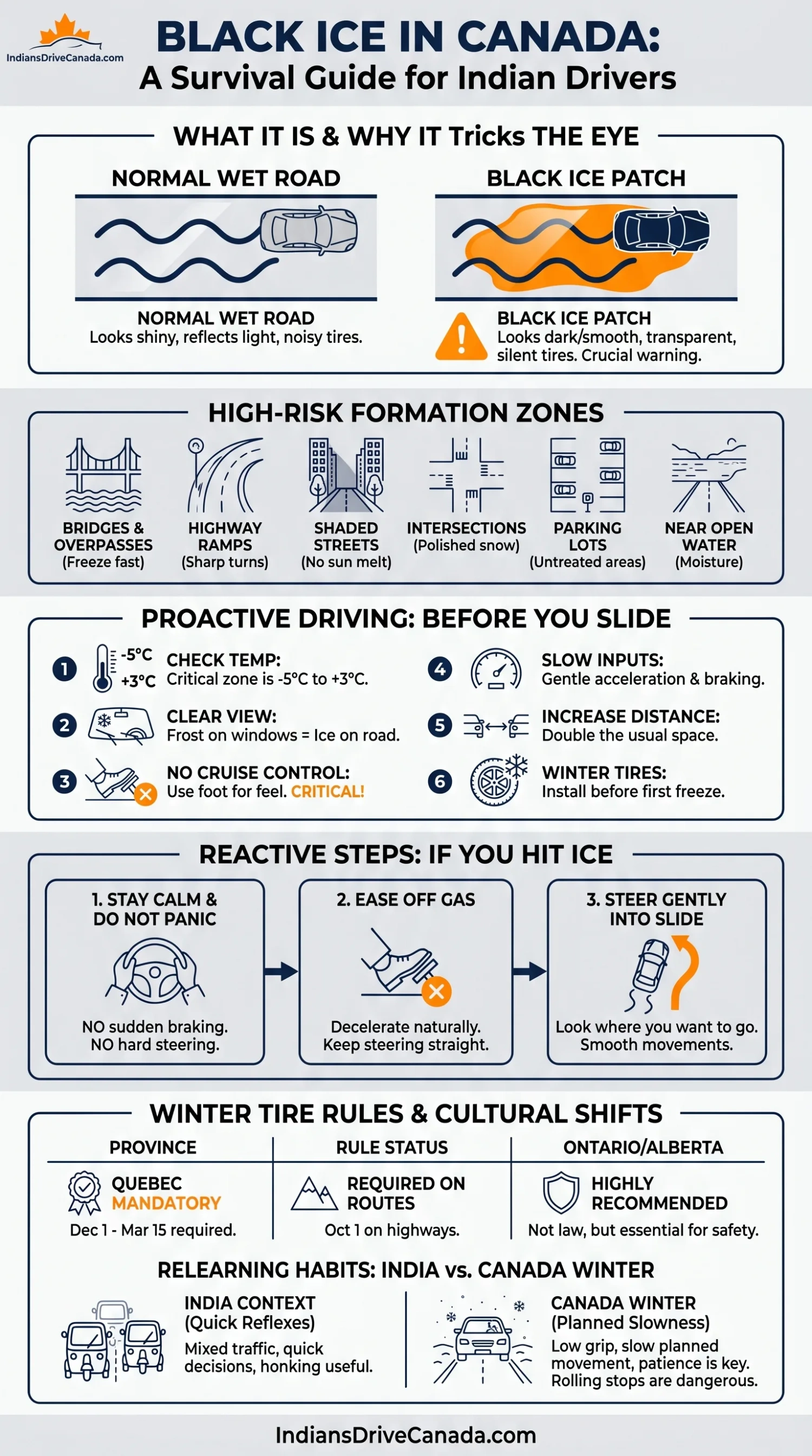
Black ice in Canada is a thin, mostly transparent layer of ice that lets the dark pavement show through. It often looks like ordinary wet asphalt, so a driver may not recognize the loss of traction until the steering feels light, the vehicle stops responding normally, or the tires begin to slide.
Treat any dark, glossy road patch as possible ice when temperatures are near freezing. Reduce speed before reaching it, leave more space, keep the vehicle as straight as possible, and avoid sudden braking, acceleration, or steering. Winter tires add traction, but no tire, AWD system, ABS, or stability control makes black ice safe.
The Road Can Look Wet When It Is Frozen
Black ice is not black. The ice is clear enough for the road surface underneath to remain visible. On a winter road that otherwise looks grey or salt-stained, a smooth black shine deserves caution.
The visual difference can be small, especially at night. Streetlights, headlights, wet pavement, road salt, and glare can all make the surface difficult to judge. A road may also contain isolated frozen patches while the rest of the lane remains wet or dry.
| Surface | What it may look like | What the vehicle may do |
|---|---|---|
| Wet pavement | Dark, reflective, and sometimes uneven | Longer stopping distance; water spray may be visible |
| Black ice | Dark, smooth, glass-like shine | Steering may feel light; traction can disappear suddenly |
| Packed snow | White, grey, or polished by traffic | Reduced grip during braking and turning |
| Slush | Wet, ridged, and grey-brown | The vehicle may pull when changing lanes or crossing ridges |
Do not tap the brake pedal to test a suspicious patch. A deliberate brake test on an open road can create the skid you are trying to avoid. Use the weather, road appearance, vehicle behaviour, and official road report together.
Weather Changes That Create Hidden Ice
Melting snow that freezes again
Snowbanks can melt during the day and send water across a lane, driveway, parking entrance, or intersection. When the temperature falls, that narrow stream can freeze while the surrounding pavement still appears clear. Black ice can therefore appear after a sunny afternoon rather than during a snowstorm.
Freezing rain and freezing drizzle
Freezing rain or drizzle freezes when it reaches a surface below 0°C. The result may be a thin coating on roads, windshields, mirrors, railings, and sidewalks. An official freezing rain or freezing drizzle alert should be treated as a travel warning, not simply a forecast for light rain.
Flash freeze after rain or thawing
A flash freeze occurs when the temperature drops quickly and residual water from rain or melted snow freezes on roads. A route that was wet during an afternoon trip may be icy during the return journey. Environment and Climate Change Canada issues flash freeze alerts when this rapid change is expected.
Near-freezing temperatures can be more deceptive than deep cold. Rain, melting snow, road spray, and repeated thaw-freeze cycles can leave a clean-looking road with scattered ice. Check the forecast for the full travel period, including the planned return time.
Road Sections That May Freeze Before the Rest of the Route
Ice on the windshield or mirrors can also warn that road surfaces are cold enough to freeze. ICBC advises drivers to watch for black ice near freezing temperatures, especially in shaded areas, on bridges and overpasses, and at intersections.
Actions to Take Before the Tires Reach the Ice
Lift off the accelerator smoothly
Begin reducing speed while the tires still have grip. Do not wait until the vehicle is already on the shiny section.
Create more room
Increase the gap to the vehicle ahead. The extra space gives you time to slow without a hard brake application if traffic changes speed.
Settle the vehicle before the patch
Complete any lane change, turn, or strong braking before the suspected ice when traffic conditions allow. Cross the area with calm steering and the wheels close to straight.
Leave cruise control off
Do not use cruise control on slippery roads or during severe winter weather. Manual accelerator control allows a gentler response when traction changes.
A tire has limited grip available for accelerating, braking, and turning. Asking it to perform two hard tasks at once, such as heavy braking while making a sharp turn, raises the chance of losing control.
When the Vehicle Begins to Slide
The safer response depends on whether the vehicle is simply drifting, the front tires are no longer turning the car, the rear is moving sideways, or an emergency stop is needed. Avoid treating every slide as the same event.
| What you notice | Safer response | Avoid |
|---|---|---|
| The vehicle feels light or begins to drift | Look toward the safe path, ease off the accelerator, and use small steering movements | Jerking the wheel or pressing the accelerator harder |
| The front tires slide wide in a turn | Reduce accelerator pressure and slightly reduce the steering angle until grip begins to return | Turning the wheel farther and farther |
| The rear moves sideways | Look where you want to travel and make a smooth correction in that direction | A large correction followed by a large correction the other way |
| A collision requires emergency braking in an ABS-equipped vehicle | Press the brake firmly and continuously while steering toward the safest available path | Pumping the brake pedal or releasing it because it pulses |
When traction returns, straighten the steering gradually. A wheel held at a large angle can make the vehicle move sharply in the opposite direction as soon as the tires grip again.
Know whether your vehicle has ABS before winter driving. Braking advice can differ for a vehicle without anti-lock brakes. Check the owner’s manual, dashboard warning lights, and manufacturer instructions rather than trying to discover the system during a skid.
Transport Canada advises drivers to avoid forceful braking and sudden steering in poor conditions. During an emergency stop, its winter-driving advice says to keep firm brake pressure and focus on steering. A professional winter-driving lesson can help a newcomer practise these reactions in a controlled setting.
Winter Tires Improve the Margin, Not the Road
Transport Canada recommends winter tires on all four wheels for cold, snowy, or icy conditions. A matching set helps the front and rear of the vehicle respond more consistently during braking and turning.
- Look for the three-peak mountain and snowflake symbol when choosing a tire designed for severe snow conditions.
- Use four tires with matching type, size, construction, and similar tread depth.
- Check pressure when the tires are cold; pressure drops as outdoor temperature falls.
- Replace winter tires before the tread becomes too shallow for winter use. Transport Canada advises against using tires with less than 4 mm of tread in snow-covered or severe snow conditions.
- Do not assume a wide performance tire, all-season tire, or summer tire will provide the same cold-weather grip.
Transport Canada also notes that all-season and summer tire rubber begins to lose elasticity below 7°C. That temperature is not a prediction that black ice exists; it is a reminder that tire performance changes before the air reaches deep-winter temperatures.
| System | What it can help with | What it cannot replace |
|---|---|---|
| AWD or 4WD | Moving away and sending drive power to more wheels | Winter tire grip, safe cornering speed, or stopping distance |
| ABS | Reducing wheel lock during hard braking and preserving some steering control | Available traction on the road |
| Traction control | Reducing wheel spin during acceleration | Safe braking and turning behaviour |
| Electronic stability control | Applying selected brakes or reducing engine power when a skid is detected | A safe speed or smooth driver input |
Winter Tire Law Changes With the Province and the Route
Canada does not use one national winter-tire date for passenger vehicles. Legal requirements must be separated from the safer practice of using four proper winter tires in cold and icy conditions.
| Location | Rule checked in July 2026 | What to verify before driving |
|---|---|---|
| Quebec | Most motor vehicles registered in Quebec, including rental vehicles registered there, must use compliant winter tires from December 1 to March 15. Listed exceptions apply. | Vehicle registration, tire symbol, exemption rules, and travel dates |
| British Columbia | Winter tires or chains are required on most designated routes from October 1 to April 30. On selected highways outside mountain-pass or high-snowfall areas, the requirement ends March 31. | Posted highway signs, route map, tire marking, tread depth, and chain requirements |
A legal minimum is not the same as the better tire for black ice. British Columbia accepts M+S as the minimum legal marking on designated routes when the tire also meets the tread requirement, while the province says the three-peak mountain and snowflake type offers better snow and ice traction. Quebec uses its own winter-tire compliance rules for vehicles registered in the province.
Rental-Car Checks for a Winter Trip
Do not rely on the phrase “winter-ready” in a booking description. Ask what is fitted to the actual vehicle and inspect the sidewalls before leaving the rental location.
- Are all four tires the same type and in similar condition?
- Do they show the three-peak mountain and snowflake symbol, M+S, or both?
- Does the selected route require a specific marking, tread depth, or chains?
- Is the tire-pressure warning light off after the tires have been checked cold?
- Are an ice scraper, snow brush, suitable windshield washer fluid, and emergency supplies in the vehicle?
- Does the rental agreement restrict travel on mountain roads or the use of chains?
Ask direct questions at the counter: “Are these four matching winter tires?”, “What symbol is on the sidewall?”, and “Is this vehicle equipped for the signed highway I will use?” Keep the answer in the rental paperwork when possible.
Adjusting Familiar Driving Habits for a Canadian Winter
Drivers arriving from Indian regions where road surfaces rarely freeze may already have years of experience with monsoon rain, crowded streets, mountain roads, or limited visibility. Those skills remain useful, but transparent ice produces a different vehicle response from standing water or a wet road.
Fast avoidance movements need more space
A quick steering correction that works on dry pavement can create a slide on ice. Scan farther ahead, choose the lane early, and avoid leaving navigation decisions until the last moment.
Left-side and right-side traffic add to the workload
India uses left-side traffic, while Canada uses right-side traffic. During a first Canadian winter, lane position, unfamiliar signs, early darkness, navigation, and an icy surface may demand attention at the same time. A slower, familiar route in daylight is a better first choice than a complex highway trip during freezing rain.
Practise through instruction, not public-road experiments
Do not deliberately trigger a skid on a public road or an open parking lot where pedestrians, curbs, light poles, snowbanks, or other vehicles may be present. A licensed driving instructor or closed-course winter program provides a safer place to learn how the specific vehicle responds.
Decide Whether the Trip Should Begin
Black-ice safety starts before the engine is running. Delaying a non-essential trip may be safer than relying on driving technique after freezing rain or a flash freeze.
- Check Environment and Climate Change Canada for freezing rain, freezing drizzle, flash freeze, or winter storm alerts.
- Review the official provincial highway report for road surface, visibility, collisions, closures, and snowplow activity.
- Compare the forecast at departure with the expected conditions for the return trip.
- Confirm that the vehicle has four suitable tires, clear windows, working lights, washer fluid, and an emergency kit.
- Allow enough time to avoid rushing, sharp lane changes, or late braking.
- Use public transit, postpone the trip, or choose a safer route when warnings and road reports show worsening ice.
Three Black-Ice Decisions on Canadian Roads
A bridge looks darker than the road before it
Clues: The air is near freezing, the road is salt-stained, and the bridge deck has a smooth dark shine.
Safer decision: Ease off the accelerator before the bridge, open the following gap, keep the vehicle straight, and cross without a sudden brake or lane change.
Afternoon meltwater freezes after sunset
Clues: Snow has melted beside the road, a narrow wet line crosses the lane, and the temperature is falling.
Safer decision: Treat the narrow line as possible ice, reduce speed on the dry approach, and avoid steering or braking sharply while crossing it.
An AWD rental vehicle approaches a signed B.C. route
Clues: The vehicle has AWD, the tires show only M+S, freezing rain is forecast, and the route has winter-tire signs.
Safer decision: Check the legal tread and marking requirements, confirm the route report, and remember that AWD does not improve braking grip. Change the vehicle, route, or travel time if the equipment and conditions do not match the trip.
After Traction Returns
Do not immediately accelerate back to the previous speed. Straighten the steering, increase the following distance, and expect another frozen patch nearby. A bridge, shaded curve, or meltwater crossing rarely exists in isolation from the weather that produced it.
If the tires struck a curb, deep pothole, snowbank, or road edge, stop in a safe place and check for visible tire damage, unusual steering, vibration, or warning lights. Arrange an inspection rather than continuing at highway speed when the vehicle no longer feels normal.
Official Checks for Black-Ice and Winter Travel
Information on weather alerts, winter-driving practice, tire rules, and provincial route requirements was checked in July 2026. Conditions and regulations can change, so use the links that match the trip before departure.