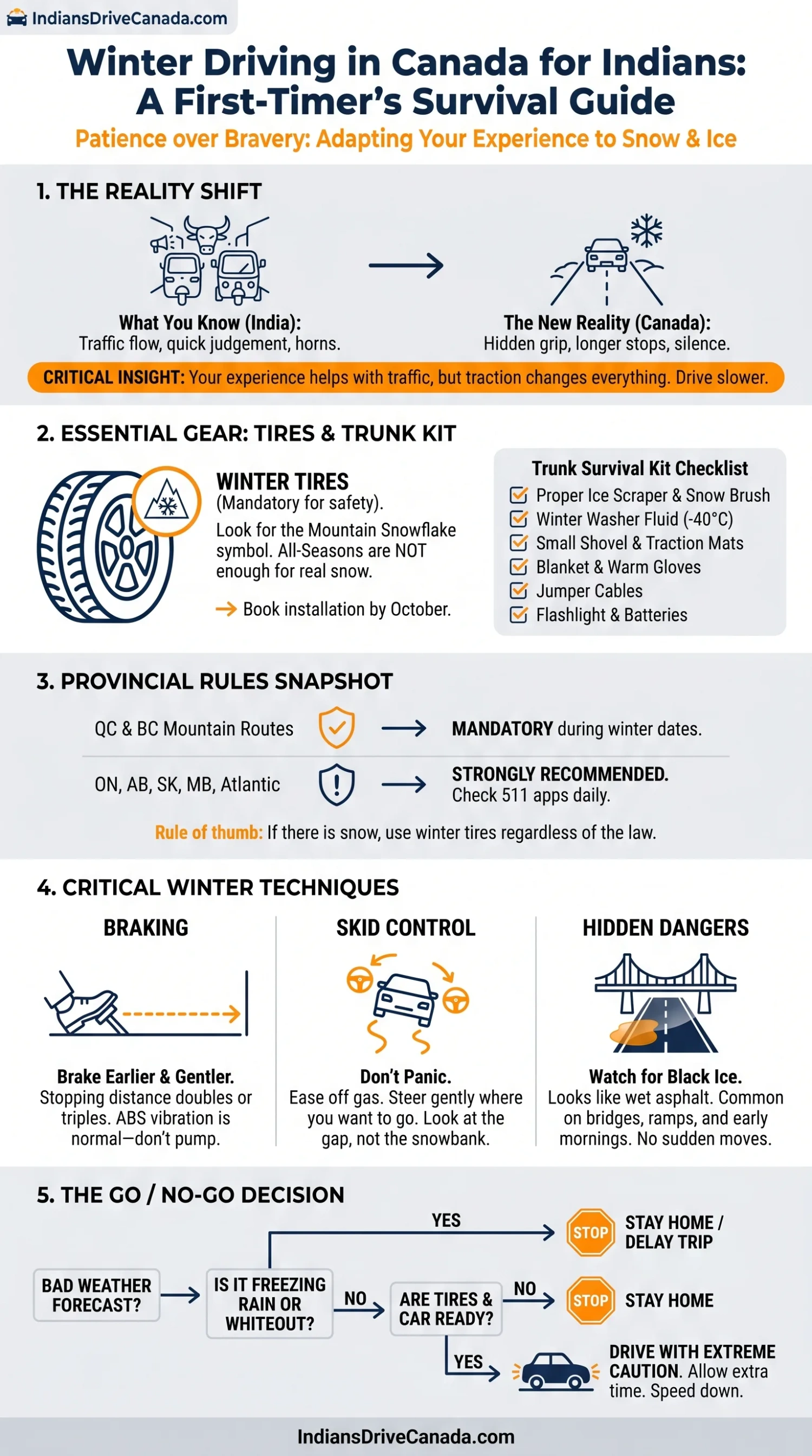
Quick answer: winter driving in Canada for Indians means learning snow, ice, black ice, longer braking distance, winter tires, road-condition checks, and different road habits before your first real storm. Your Indian driving experience helps with confidence, but Canadian winter roads need slower speed, more space, clean visibility, and a prepared car.
You’ve just landed in Ontario with your Indian licence and no idea where to start. The first winter drive can feel normal for five minutes, then the road turns shiny, the lane lines disappear, and braking takes longer than your brain expects.
This page explains what changes when you drive in snow, how winter tires and road-condition apps work, and what habits Indian drivers should adjust before a Canadian road test or daily commute. It also covers province differences, emergency kit basics, and the small mistakes that make winter driving stressful for newcomers.
For a wider licensing and road-rule path, keep this related page open: winter driving Canada Indians. As of April 2026, Transport Canada still advises drivers to match speed to road and weather conditions, use winter tires on all wheels, and leave more distance on slippery roads.
Can I Drive in Canada During My First Winter as an Indian Newcomer?
Yes, you can drive in Canada during your first winter, but do not treat it like a normal rainy day. Winter driving in Canada for Indians is less about bravery and more about patience. Snow, slush, freezing rain, and black ice can all appear on the same route.
Your Indian driving experience is still useful. You already know traffic flow, mirrors, judgement, and city pressure. What changes is traction. In winter, the car may not stop where you expect. A turn taken slightly fast can feel fine at first, then the front wheels may slide wide.
The safest first step is to drive in daylight after roads are plowed. Avoid your first snowstorm drive on Highway 401, Highway 410, Deerfoot Trail, or a mountain route in B.C. Start with local streets, then a quiet parking lot, then short highway trips.
Indian newcomers often ask whether an SUV or AWD car solves the problem. It helps you move, but it does not magically help you stop. Tires, speed, space, and soft steering matter more.
- Drive slower before turns, not during the turn.
- Brake earlier than you do on dry roads.
- Keep both hands relaxed on the steering wheel.
- Avoid cruise control on wet, icy, or snowy roads.
- Check weather before leaving, not after you are stuck.
Pro tip: Treat your first five winter drives as practice drives, even if you have many years of experience in India.
What Makes Canadian Winter Roads Different From Indian Roads?
The biggest difference is hidden grip. In India, you can usually see the danger: potholes, waterlogging, traffic, dust, animals, bikes, or sudden lane changes. In Canada, a road can look clear but still have black ice. This thin ice often forms on bridges, ramps, shaded turns, and early-morning roads.
Another difference is speed discipline. Canadian roads often have faster traffic, fewer horns, and stricter lane behaviour. During winter, drivers expect you to signal early, keep a steady lane, and avoid sudden moves. A small panic correction can cause a skid.
Road salt and slush also create a visibility problem. Your windshield can become white and blurry within seconds behind trucks. That is why winter washer fluid matters. Summer fluid can freeze. Ontario winter advice also reminds drivers to keep an ice scraper and washer fluid that works in deep cold.
Snowbanks can block your view when turning out of plazas or side streets. Pedestrians may step around snow piles. Delivery vehicles may stop in narrow cleared lanes. So, winter driving is not only about snow; it is also about reading a smaller, messier road space.
| Condition | What It Feels Like | Best First Reaction |
|---|---|---|
| Fresh Snow | Soft, slow, and slippery under braking | Reduce speed and leave more space |
| Slush | Heavy pull on tires, especially during lane changes | Hold steady and avoid sharp steering |
| Black Ice | Road looks wet or shiny, but grip is very low | Lift off the gas and steer gently |
| Freezing Rain | Glass-like surface on roads and mirrors | Delay the trip when possible |
Watch out: A road that looks clean at 2 p.m. can become icy again after sunset.
Do I Need Winter Tires in Canada?
For most newcomers, yes. Winter tires are one of the simplest upgrades for safer winter driving in Canada for Indians. Transport Canada says winter tires give better traction than all-season tires because they use softer rubber and tread designed for cold, snow, and ice.
Do not wait for the first snowfall to book tire installation. In cities such as Brampton, Mississauga, Scarborough, Surrey, Calgary, and Winnipeg, tire shops get busy before the first major storm. Booking in October or early November is usually easier than calling during a snow warning.
Look for the mountain snowflake symbol if you expect regular snow and ice. In B.C., both M+S and mountain/snowflake tires can meet the posted winter tire rule if they have enough tread, but mountain/snowflake tires are better for harsh winter roads. In Québec, vehicles registered in the province must use certified winter tires during the legal winter period.
All-wheel drive can help you start moving from a snowy parking spot. It does not replace winter tires. Braking and turning still depend heavily on tire grip.
Ontario Document Note for New Drivers: As of April 2026, Ontario Bill 60 added language allowing the Minister to require evidence related to Ontario residency, legal presence in Canada, and work ability for certain licence, permit, or certificate applications. Newcomers applying for an Ontario licence should keep immigration and address documents ready. See the official Ontario Legislative Assembly page for Bill 60.
Pro tip: If your budget is tight, buy four winter tires before buying cosmetic accessories for the car.
Which Winter Tire Rules Apply by Province?
Canada does not have one single winter tire rule for every province. This is where many newcomers get confused. Winter driving in Canada for Indians depends on where you live and where you travel. A rule that is optional in Ontario may be mandatory in Québec or on many B.C. highways.
The table below keeps the focus on normal passenger cars. If you drive a commercial vehicle, delivery van, rideshare car, or truck, check your licence class, insurance, and employer rules separately.
| Province | Winter Tire Rule to Know | Road Check Before Driving | Official Link |
|---|---|---|---|
| Ontario | Not mandatory province-wide for normal cars, but strongly recommended in winter. | Check road conditions, plows, closures, and weather alerts. | Ontario 511 |
| Québec | Mandatory for vehicles registered in Québec from December 1 to March 15, with listed exceptions. | Check local weather and highway conditions before travel. | Québec Winter Tire Rules |
| British Columbia | Winter tires or chains are required on most routes from October 1 to April 30; some routes end March 31. | Check routes, mountain passes, and posted signs. | B.C. Winter Routes |
| Alberta | No province-wide winter tire rule for normal city driving, but winter tires are recommended. | Check 511 before highway or mountain driving. | 511 Alberta |
| Manitoba | Winter tires are recommended; Manitoba also has a winter tire financing program for eligible drivers. | Check Manitoba 511 before highway trips. | Manitoba 511 |
| Saskatchewan | Winter tires are recommended for snow, frost, and rural highway driving. | Highway Hotline updates conditions and closures. | Saskatchewan Highway Hotline |
| New Brunswick | Winter tires are recommended, especially outside city routes. | Check live road conditions before travel. | New Brunswick 511 |
| Nova Scotia | Winter tires are recommended for snow, ice, and rural routes. | Use 511 for highway reports and closures. | Nova Scotia 511 |
| Prince Edward Island | Winter tires are recommended; winter parking and road restrictions can matter locally. | Check 511 before driving outside town. | PEI 511 |
| Newfoundland and Labrador | Winter tires are recommended for ice, snow, and wind-exposed roads. | Check 511NL, webcams, and winter road reports. | 511NL |
Watch out: A rented car may not always have true winter tires unless you ask and confirm before pickup.
How Should I Prepare My Car Before the First Snowfall?
Do the boring things early. They are what save you on a bad morning. For winter driving in Canada for Indians, preparation starts before the first big snowfall, not when your car is already frozen outside your basement parking.
Here is the exact process, step by step:
- Book winter tire installation at a tire shop or dealership, ideally before the first major snowfall. Ask about tire storage if your apartment has no space.
- Buy a proper snow brush and ice scraper from a Canadian store. A small plastic scraper from a travel kit may not work well after freezing rain.
- Fill winter washer fluid rated for deep cold. Keep one extra jug in the trunk because road salt can empty the tank fast.
- Check the battery if the car is older or slow to start. Cold weather can expose a weak battery quickly.
- Test lights, wipers, defroster, and heater before you need them during a dark commute.
- Build a winter emergency kit and keep it in the car, not inside your condo storage locker.
Transport Canada’s winter emergency kit advice includes items such as first aid supplies, windshield fluid, ice scraper, booster cables, traction mats, shovel, flashlight, reflective gear, extra clothing, blanket, water, and non-perishable food.
- Warm gloves, toque, and spare socks
- Phone charger and power bank
- Small shovel
- Traction mats or non-clumping cat litter
- Blanket or thermal sheet
- Water and snacks
- Flashlight with extra batteries
Clean the full car before leaving. That means roof, windows, mirrors, lights, hood, and licence plates. Snow from your roof can slide onto your windshield when you brake.
Pro tip: Keep winter gloves in the car, because scraping ice with bare hands becomes painful fast.
What Driving Habits Should Indian Drivers Change in Snow?
The habits that work in busy Indian traffic do not always work on Canadian snow. This is not about skill. It is about road design, weather, and expectations. Winter driving in Canada for Indians becomes easier when you replace quick reactions with early, smooth actions.
First, stop fully at stop signs. Rolling stops are risky in winter because the tires may slide over the final few feet. They can also hurt your road test result. At 4-way stops, come to a full stop, look, wait your turn, and move only when it is clearly yours.
Second, do not rush yellow lights. On dry roads, a late stop may still work. On ice, hard braking can push the car forward. If you cannot stop safely, continue with care; if you can stop smoothly, stop early.
Third, keep more room around school buses, pedestrians, and cyclists. School bus rules are strict across Canada, and winter reduces everyone’s visibility. Children may stand near snowbanks, and drivers may not see them early.
Fourth, change lanes gently. Slush between lanes can pull the tires. Check mirrors, signal early, hold the wheel steady, and avoid crossing piled-up snow at speed.
Real Questions From Indian Immigrants
Based on reports from Indian immigrants in Ontario forums, the same worries come up again and again:
- “Will the examiner fail me if I drive too slow in snow?”
- “Can I use all-season tires for my first winter?”
- “Why does the car slide even when I press the brake?”
- “Should I cancel my road test if there is freezing rain?”
The practical answer is simple: drive for conditions, not ego. Examiners expect control, observation, and safe judgement. If the weather is unsafe, rescheduling can be wiser than forcing the test.
Watch out: Sudden steering, sudden braking, and sudden acceleration are the three moves winter roads punish first.
How Do I Handle Skids, Hills, and Highway Driving in Winter?
A skid feels scary because the car stops obeying normal inputs. The right reaction is calm and small. If the front tires slide, ease off the gas and look where you want to go. If the rear starts to swing, steer gently in the direction you want the car to travel. Do not slam the brake.
Modern cars usually have ABS. In an emergency stop, press the brake firmly and keep steering. You may feel vibration through the pedal. That is normal. Do not pump the brake unless your vehicle manual says otherwise for an older car.
For hills, build gentle momentum before the incline. Do not press the gas hard halfway up. Tires can spin and lose grip. Going downhill needs even more care. Slow down before the slope, use steady braking, and leave extra distance.
Highways need a different mindset. The speed limit is for good conditions. In snow, blowing snow, or freezing rain, safe speed may be far below the posted number. Stay out of truck blind spots. Do not pass snowplows closely. They may throw snow, salt, and slush, and their blades can extend wider than expected.
DriveTest centres in Scarborough and Brampton have been known to see many first-time winter drivers from newcomer communities. The drivers who improve fastest usually take one or two winter lessons with a local instructor before mixing road test pressure with snow pressure.
Pro tip: Practise braking and turning in an empty snowy parking lot so your first skid is not in live traffic.
Should I Drive During a Snowstorm or Stay Home?
Sometimes the safest winter driving decision is not to drive. This matters for students, new PRs, night-shift workers, rideshare drivers, and anyone commuting between suburbs. Winter driving in Canada for Indians includes knowing when the road is not worth the risk.
Before leaving, check three things: weather alert, road-condition map, and your route type. A short grocery trip inside Mississauga is not the same as a highway trip from Toronto to London during lake-effect snow. In Alberta and B.C., mountain routes can change even faster.
If the forecast says freezing rain, heavy snow, whiteout, or “travel not recommended,” delay the trip when you can. If you must drive, tell someone your route and expected arrival time. Keep the fuel or battery level high. For EV drivers, cold weather can reduce range, and cabin heat uses energy.
Use this simple decision test:
- If visibility is poor, delay.
- If freezing rain is falling, delay.
- If your tires are not winter-ready, delay.
- If your route has hills, rural roads, or bridges, be extra cautious.
- If you feel rushed, do not start the drive until you reset your plan.
For rented cars, check the tires, washer fluid, brush, and emergency supplies before leaving the lot. Many newcomers assume rental cars are fully winter-ready. Ask directly, especially in Québec and B.C.
Watch out: GPS arrival times do not understand your first Canadian snowstorm, so add time or leave later.
How Can I Build Confidence Without Taking Unsafe Risks?
Confidence comes from controlled exposure. Do not wait until your first day of work in January to learn winter roads. Start small. Drive after light snow on quiet streets. Then practise lane changes, gentle braking, and parking-lot turns. Add highways only when you feel steady.
A winter lesson can be money well spent. Ask the instructor to cover black ice, snow braking, lane changes through slush, 4-way stops, school zones, and road-test expectations. If you are preparing for a G2 or G test, ask for a winter-specific mock test.
Watch local drivers, but do not copy the fastest ones. Some people drive too fast because they have years of winter experience, better tires, or too much confidence. Your aim is not to match them. Your aim is to arrive safely with full control.
Build a personal winter rule. For example: no highway during freezing rain, no night driving during the first storm, and no long trips without checking 511. These rules remove stress because you do not need to decide from scratch every time.
Also, dress for getting stuck, not for sitting in a heated car. Winter boots, gloves, and a coat matter if you need to clear snow, wait for help, or walk from a parked car.
Pro tip: The best winter drivers are not the fastest; they are the ones who make fewer sudden moves.
Frequently Asked Questions
Can I Drive in Canada With Indian Driving Experience During Winter?
Yes, Indian driving experience helps with road awareness, but winter needs new habits. You must brake earlier, turn gently, leave more distance, and learn how snow, slush, and black ice change the car’s grip.
Can I Use All-Season Tires for My First Canadian Winter?
You may be legally allowed in many provinces, but it is not the best choice for regular snow and ice. Winter tires give better cold-weather grip. Québec and many B.C. routes have specific winter tire rules, so check before driving.
How Long Does It Take to Feel Comfortable With Winter Driving?
Many newcomers need a few weeks of short, careful drives to feel normal. Real comfort usually comes after driving through different conditions: light snow, slush, icy mornings, and plowed highways. Do not rush the learning stage.
Do I Need to Warm Up My Car Before Driving in Winter?
You need clear windows and working defrost before moving. Modern cars do not need very long idling for normal city use, but you should wait until visibility is safe. Clear all snow and ice before leaving.
What Happens if My Car Starts Sliding on Ice?
Stay calm and look where you want the car to go. Ease off the gas, avoid sudden braking, and steer gently. If you have ABS during an emergency stop, press the brake firmly and keep steering.
Can I Take My Road Test in Snow?
Road tests can happen in winter if conditions are safe enough. If weather becomes unsafe, the test centre may cancel or reschedule. If you are not comfortable in snow yet, taking lessons before the test is a smart move.
Do I Need an Emergency Kit for City Driving?
Yes. Even city drivers can get stuck in traffic, underground parking exits, or storm delays. Keep gloves, a blanket, flashlight, charger, water, snacks, brush, scraper, and washer fluid in the car.
Can I Drive a Rental Car in Québec or B.C. During Winter?
Yes, but check the tire setup before you accept the car. Québec has winter tire rules for vehicles registered in Québec, and B.C. has winter tire or chain rules on many routes. Ask the rental company directly and inspect the tires.
Winter driving becomes much easier when you prepare early, slow down without feeling embarrassed, and respect the road surface. Your first winter is not a test of courage. It is a season of learning how Canadian roads behave when the temperature drops below zero.