DL Extract From India for Ontario G1: How to Get It and Use It
An Indian DL Extract can support an Ontario G1 application when it works as an official authentication document....
Driving in Canada as an Indian Student, Worker or PR: What Changes?
Student, worker and permanent resident are immigration categories, not separate driver’s licence classes. Your right to use an...
How to Prove Indian Driving Experience in Canada
An Indian driving licence can show that you are licensed, but it may not prove your full driving...
Indian Driving Licence Translation in Canada: When You Need It
An Indian driving licence does not automatically need translation simply because it was issued in India. A modern...
Indian Driving License in Alberta: How to Get Your Class 5 Licence
An Indian driving licence cannot be swapped directly for an Alberta Class 5 licence. India is not listed...
Indian Driving License in British Columbia: ICBC Conversion Guide
A valid Indian driving licence does not qualify for a test-free, card-for-card exchange in British Columbia. A new...
Indian Driving License in Manitoba: MPI Conversion, Tests and Documents
An Indian driving licence cannot be exchanged for a Manitoba Class 5 licence without testing. A new Manitoba...
Indian Driving License in Nova Scotia: Tests, Exchange and New Resident Rules
A valid Indian driving licence can be used in Nova Scotia only while the province's foreign-licence rules still...
Indian Driving License in Ontario: G1, G2 and Full G Guide (2026)
111 An Indian driving licence cannot be directly exchanged for an Ontario G licence. India does not have...
Indian Driving License in Prince Edward Island: Exchange and Newcomer Driver Course
An Indian driving licence does not qualify for a test-free direct exchange in Prince Edward Island. India does...
Indian Driving License in Quebec: SAAQ Conversion Steps for Newcomers
Verified on August 23, 2026. An Indian driving licence does not qualify for a simple, test-free swap in...
Indian Driving License in Saskatchewan: SGI Conversion and GDL Guide
An Indian driving licence does not qualify for Saskatchewan’s test-free international licence exchange. India is not on SGI’s...
Moving to Another Province in Canada: When to Exchange Your Driver’s Licence
If you become a resident of another Canadian province while holding a valid provincial driver's licence, the destination...
13 articles in Driving License Canada Indians
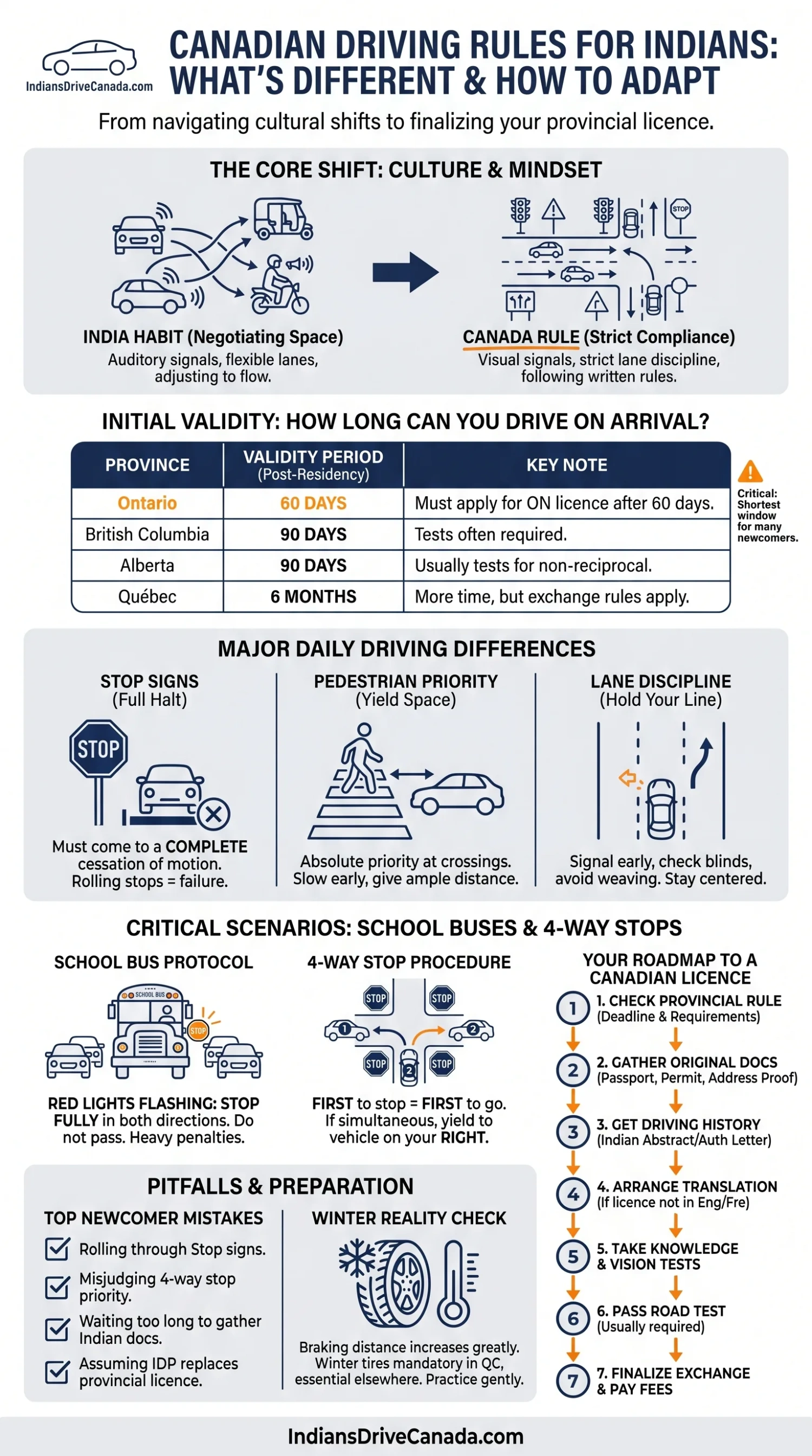
Driving in Canada after learning to drive in India is mostly an adjustment to right-of-way, lane position, stopping, pedestrian space, school-bus rules, and winter conditions. The written rule matters even when traffic is light, and road tests expect the driver to make observation checks and lane choices visibly.
The comparison below puts the everyday differences first. Licence-use deadlines are covered later because they depend on the province rather than on the road rule itself.
| Road situation | Habit that may need changing | What Canadian roads usually expect |
|---|---|---|
| Stop signs | Slowing without a complete stop | Stop fully behind the line or crosswalk before proceeding |
| Lane changes | Changing position as soon as a gap opens | Signal, check mirrors and blind spot, then move while holding a clear lane |
| Pedestrians and cyclists | Turning through a small available gap | Yield clearly and leave enough space before completing the turn |
| School buses | Treating the bus like ordinary stopped traffic | Follow the province’s mandatory stopping rule when red lights and the stop signal are active |
| Winter roads | Using dry-road braking and following distances | Brake earlier, increase the gap, and use smooth steering and acceleration |
As of August 2026, Ontario also limits foreign driving-experience credit for applicants from non-exchange jurisdictions to 12 months. That licensing rule affects how quickly an Indian licence holder can reach G2, but it does not change the road rules described below.
Rule comparison: habits that change most
In Canada, traffic moves on the idea that every driver will follow the written rule, even when the road is empty. That means rolling through a stop sign, edging into a crosswalk, or changing lanes without enough space stands out much more than it might in India.
Lane discipline is one of the first changes Indian drivers notice. Canadian roads expect you to hold your lane, signal early, and avoid weaving. Another change is space. Drivers usually leave more following distance, especially on highways and in winter. Horn use is also lower. You will rarely see the kind of constant sound-based communication that is common in busy Indian traffic.
Pedestrian priority also feels stronger. At marked crossings, school zones, and turns, drivers are expected to slow down early and give clear space. Cyclists matter too. In many cities, road test examiners watch how well you check mirrors and blind spots before a turn.
Parking rules can also surprise newcomers. Street signs are enforced closely. A simple “No stopping,” “No standing,” or time-based parking sign can mean a ticket even when the street looks empty. Snow routes, permit zones, and school zones need more attention than many first-time drivers expect.
Treat signs, lane markings, signals, and right-of-way rules as the fixed order of the road rather than something to negotiate with nearby traffic.
In Canada, a calm road is not a relaxed road; examiners still expect full rule compliance even when traffic is light.
Intersections, school buses, and red lights
These are common points of confusion because the rules are precise and small mistakes are easy to see on a road test.
How does a 4-way stop work?
A 4-way stop is usually first come, first go. If two vehicles stop at the same time, the vehicle on the right usually has priority. If you are turning left, you still give way to straight traffic when needed. This system feels slow at first, but it becomes easy once you stop trying to “read” the intersection and simply follow the order.
What should I do when I see a stopped school bus?
When provincial rules require you to stop for a school bus displaying its flashing red lights and stop signal, stop fully and remain stopped until it is legal and safe to proceed. Do not inch forward or assume children have already crossed. Exact rules can differ on divided roads and by province, so learn the rule where you live.
Can I turn right on a red light?
In much of Canada, yes, after a full stop and only if there is no sign banning it. But there are province and city exceptions. Québec allows right turns on red in many places, but not on the Island of Montréal. Ontario also allows a left turn on red from one one-way street to another one-way street after a full stop, when signs allow and the way is clear.
Roadside reminder: A rolling stop is still a failed stop. That one habit alone causes many avoidable road test failures.
At every unfamiliar intersection, think in this order: stop fully, scan pedestrians, scan cyclists, then move.
Common rule errors during the first weeks
Most mistakes are not about skill. They come from habit. A driver may have years of experience in India and still struggle in Canada because the test checks rule precision, not only car control.
Habits that can lead to tickets or test marks
- Rolling through stop signs: the car must come to a real full stop.
- Misreading 4-way stops: many drivers hesitate too long or move too early.
- Turning too close to pedestrians: Canada expects more space and patience at crossings.
- Forgetting school bus rules: this can lead to serious penalties, and the exact stopping rule depends on the road and province.
- Late winter preparation: many newcomers wait until the first snow instead of preparing before it.
- Assuming an IDP solves everything: it helps with translation, but it does not replace the actual provincial process.
Related licensing issues that affect daily driving
- Will my driving abstract from India be accepted as proof of experience?
- Can I go straight to the full road test?
- Do I need winter tires right away?
- Will my insurance cost drop if I prove past driving experience?
Reports from Indian immigrants in Ontario forums often mention the same document problem: proof is gathered late, after the local licensing process has already started. Original documents, matching names, and early booking reduce repeat visits.
In Ontario, verified foreign experience can reduce the waiting period before G2 by up to 12 months. It no longer allows an applicant from India to skip G2 and go directly to the full G road test. If Ontario accepts at least 12 months, you may take G2 immediately, but you must still wait at least 12 months after obtaining G2 before attempting G. In B.C., proof of driving experience can also affect both your licensing path and insurance record.
Do not assume that “I have driven for 10 years” is enough unless you can prove it with the documents your province accepts. In Ontario, even verified experience beyond 12 months does not provide extra licensing credit for this non-exchange route.
Weather and highway conditions that change daily driving
Cold weather and higher-speed roads add a second set of habits: longer stopping space, smoother inputs, and more attention to changing grip.
How does winter change everyday driving?
In cold weather, braking distance grows, visibility drops, and black ice can make a normal road feel unstable. That means slower steering, gentler braking, and more gap between cars. Sudden inputs that feel normal on dry roads can become risky fast in snow or slush.
When are winter tires required?
The answer depends on province and route. In Québec, winter tires are mandatory from December 1 to March 15. In British Columbia, winter tire or chain rules apply on many signed highways from October 1 to April 30, with some routes ending earlier. In Ontario, winter tires are not province-wide mandatory for passenger cars, but they are still a smart move and may help with insurance pricing.
What feels different on Canadian highways?
Speeds are steadier, merging is more structured, and lane discipline matters more. Keep right unless passing. Leave a larger gap than you think you need. Watch for snow spray from trucks, sudden visibility loss, and changing pavement grip under bridges and shaded areas.
If you arrive in summer, do not wait for your first storm to learn winter habits. Use that early time to practise parking, braking smoothly, and checking road condition tools used in your province.
If your first Canadian winter is coming, practise in daylight on a quiet local road before you try a long highway trip.
Licence-use deadlines still depend on the province
A valid Indian licence can usually be used for a limited period after you become a resident, but the deadline is provincial. Ontario, B.C., Alberta, Québec, Manitoba, and Saskatchewan do not use one common newcomer window.
Start the provincial licensing process well before the local deadline rather than leaving document and translation issues to the final week. If your licence is not fully in English or French, carry an official translation where your province asks for one. An International Driving Permit can help as a translation tool, but it does not replace your actual licence.
| Province | How long an Indian licence is usually valid after you become a resident | Will tests usually be required for an Indian licence? | Key official link |
|---|---|---|---|
| Ontario | 60 days | Yes. For non-exchange jurisdictions such as India, up to 12 months of verified foreign experience can reduce the wait before G2, but it cannot reduce the mandatory 12-month G2-to-G period | DriveTest Ontario |
| British Columbia | 90 days | Often yes unless your licence is from an exchange jurisdiction | ICBC |
| Alberta | 90 days for permanent residents | Usually yes for non-reciprocal countries | Alberta.ca |
| Québec | 6 months | Often yes unless your licence is from a jurisdiction with an agreement | SAAQ |
| Manitoba | 3 months | Usually yes for non-reciprocal countries | MPI Manitoba |
| Saskatchewan | 90 days | Often yes unless you qualify for an exchange path | SGI Saskatchewan |
Ontario deserves special attention because many Indian newcomers first settle there. A new resident can use a valid foreign licence for 60 days and must then apply for an Ontario licence.
For applications from non-exchange jurisdictions such as India, the rules changed on July 1, 2026. Ontario can now credit a maximum of 12 months of verified foreign driving experience. If at least 12 months is accepted, you can take the G2 road test immediately after meeting the applicable vision and knowledge-test requirements. You must still pass G2, hold the G2 licence for at least 12 months, and then pass the G road test. Foreign experience cannot shorten that G2-to-G waiting period.
If less than 12 months of foreign experience is accepted, the credited amount reduces the normal wait before the G2 road test. Only eligible experience from the previous three years can be credited, up to the 12-month maximum. If your licence does not show enough history to establish the experience you are claiming, Ontario may require an acceptable authentication document.
Having two, five, or ten years of driving experience in India no longer creates a direct-to-G route in Ontario.
Start collecting your Indian licence record, translation, and ID before you fly, not after you arrive.
If your Indian licence-use window is ending
The exact licensing path changes by province. The following sequence covers the tasks that usually need to be settled before the foreign-licence window expires:
- Check your province’s newcomer rule. Go to the official licensing page for your province as soon as you arrive. This takes 10 minutes online and tells you your deadline, whether you need an exchange or a fresh application, and whether your Indian licence counts toward experience.
- Gather your identity and immigration documents. Bring your passport, visa or permit, proof of address, and any local ID the province asks for. This is usually done at a licensing office or service centre. Counter time is often 20 to 45 minutes if your documents are complete.
- Bring your original Indian licence. Do not rely on a scan or a phone photo. Several provinces require the original physical licence and may keep it when they issue the provincial one.
- Get your driving history proof ready. This may be called a driver’s abstract, authentication letter, or letter of experience. In Ontario, an applicant from a non-exchange jurisdiction can receive no more than 12 months of foreign experience credit. If your current licence does not establish the experience you are claiming, an acceptable authentication document may be required. In B.C. and other provinces, proof of experience can affect your licence path and insurance history.
- Arrange translation if needed. If your licence or supporting documents are not fully in English or French, your province may require an official translation. Do not assume an IDP will be accepted as a substitute everywhere.
- Take the knowledge, vision, and road tests required in your province. Ontario applicants from India must complete the G2 road test and later the G road test. Twelve months of accepted foreign experience can make you eligible for G2 immediately, but the following 12-month G2-to-G wait cannot be reduced with Indian driving experience.
- Pay the provincial fees and finish the licensing process. Fees differ by province and licence class, so check the official booking page before your visit. Keep copies of everything you submit for your records.
Documents to have ready for the licensing office
- Original Indian driving licence
- Passport
- Work permit, study permit, PR document, or other legal status proof
- Proof of local address
- Driver’s abstract or authentication letter from India, where needed
- Official translation, where needed
- Payment method accepted by the local office
If you plan to buy a car early, do this fast. Your insurance cost may depend in part on how well you document your past driving record.