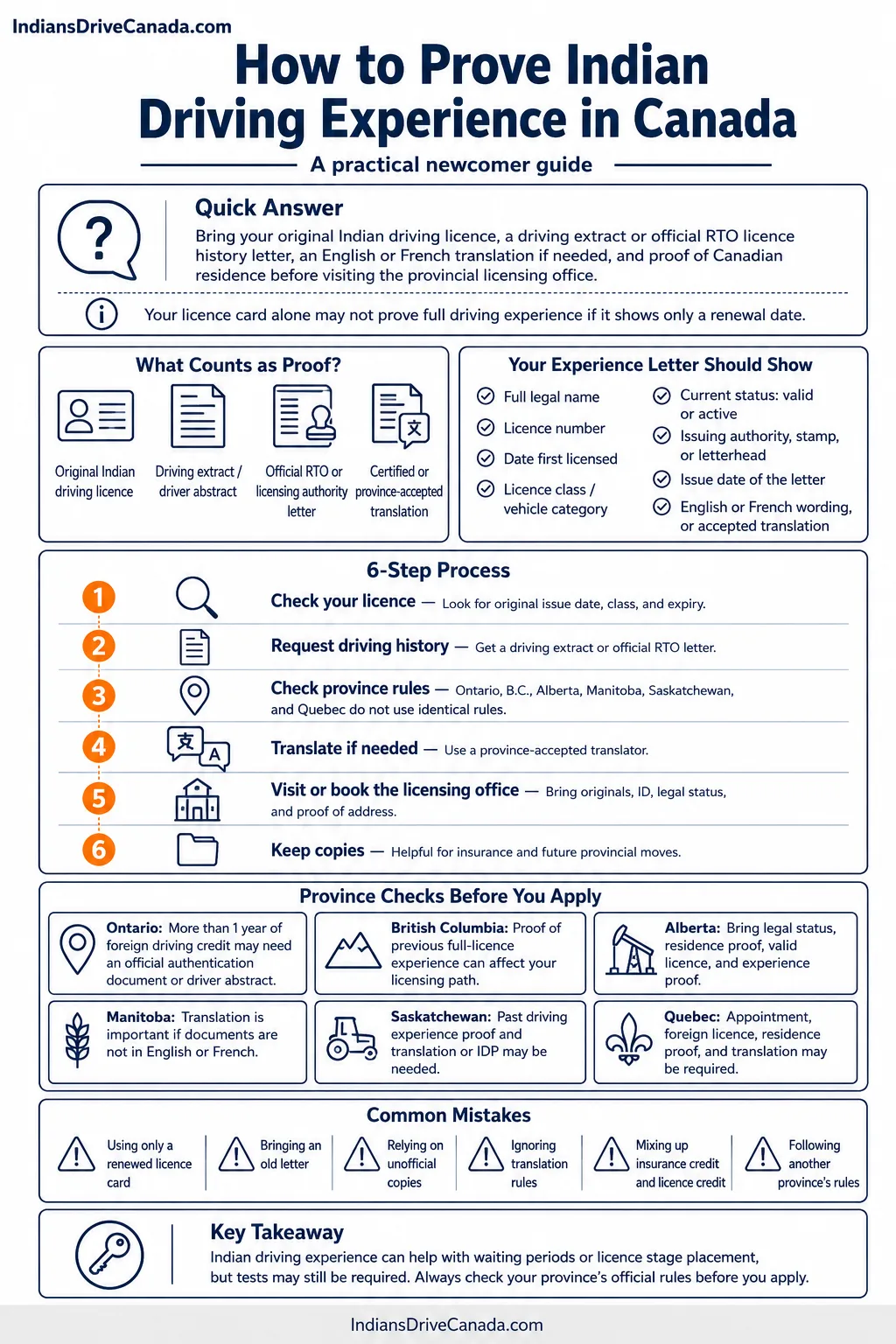
An Indian driving licence can show that you are licensed, but it may not prove your full driving history. For Canadian licensing purposes, the strongest file usually combines your current original Indian licence with an official DL extract, driver record or licence experience letter that states when you were first licensed and which vehicle classes you held.
The document does not produce the same result in every province. It may reduce graduated-licensing restrictions, make you eligible for an earlier road test or support an insurance review. It does not automatically convert an Indian licence into a full Canadian licence.
Indian driving experience is assessed by the provincial licensing authority, not by a single federal office. The useful question is therefore not only how many years you drove in India, but whether an official record can connect those years to your name, licence number, licence class and first licensing date.
Rules and linked government pages were checked on July 27, 2026. Document format, translation rules and testing steps can change, so confirm the provincial instructions again before paying for a translation, consular service or courier delivery.
What Your Indian Driving Record Can—and Cannot—Prove
Canadian licensing offices may use foreign experience to decide where you enter the provincial licensing system. The same record may also be reviewed separately for insurance rating. These are different decisions made under different rules.
| Evidence | What it can establish | What it normally does not establish |
|---|---|---|
| Current Indian driving licence | Current licence status, licence number, vehicle class and card dates | Your full history when the card shows only a renewal or replacement date |
| DL extract or government driver record | Original licensing date, classes held, status and recorded history | Insurance policy periods and claim-free years |
| Authentication or licence experience letter | Authenticity and licensing details confirmed by an accepted authority | Missing experience that the issuing authority does not state |
| Claims experience letter | Policy dates, listed drivers and claims information | Government-issued licence status or road-test eligibility |
| International Driving Permit | A multilingual description of the licence when carried with the valid original licence | Years of experience, a driver abstract or a Canadian licence exchange |
Licence credit and insurance credit are separate. A licensing office may recognize that you have held a full licence for several years while an insurer asks for different evidence, applies its own underwriting rules or gives no credit for the same period.
The Date Printed on Your Licence May Not Be Your First Licence Date
This is one of the main document problems for Indian applicants. A smart-card driving licence may display the date of the current card, a renewal, a replacement or a transfer between licensing offices. That date may be much later than the day you first received a full licence.
Before relying on the card alone, identify what each printed date represents. Check the front and back for the following:
- Your full name and date of birth
- The current driving licence number
- The issuing Regional Transport Office or other licensing authority
- The date of issue for the current card
- The date of first issue, when shown separately
- The validity period
- Vehicle categories such as motorcycle and light motor vehicle
- Separate issue dates for each vehicle category, when available
Do not describe a renewal date as your first licensed date. A licensing office may verify the record, and an incorrect declaration can delay the application or cause the experience claim to be rejected.
The Strongest Document Package to Prepare in India
A single document may be enough in some cases, but a connected file is safer when the card has been renewed, replaced, digitized or transferred. Bring the most detailed official record available rather than relying on a screenshot of an online licence search.
Core licensing evidence
- Current original Indian driving licence: the physical licence should be valid and readable.
- DL extract, driver record or licence particulars: the record should state the date first licensed and the licence classes held.
- Previous or expired licence cards: these may connect an older licence number or earlier issue date to the current card.
- Official authentication or experience letter: useful when the provincial authority requires confirmation beyond the licence card.
- Approved translation: needed when the relevant document is not fully in English or French under the destination province’s rules.
Separate insurance evidence
- Claims experience letter: request it from each insurer that covered you for a period you want reviewed.
- Old policy schedules or renewal records: keep them as supporting evidence, but do not assume they replace an insurer-issued claims letter.
What the DL Extract or Experience Letter Should Contain
The name of the document matters less than the information it contains and the authority that issued it. A useful record should allow a Canadian licensing office to identify the driver, verify the issuer and calculate the non-learner experience attached to the correct class.
- Full legal name
- Date of birth
- Current and previous licence numbers, when they differ
- Date first licensed
- Licence class or vehicle category
- Date each relevant class was first issued
- Current licence status and expiry date
- Restrictions, suspensions or disqualifications, or a clear statement when none are recorded
- Name, address and contact details of the issuing licensing authority
- Date the record was issued
- Official letterhead, stamp, signature or verifiable digital authentication
Ask for the record to state the first full or non-learner licensing date, not only the date the current card was printed. Where motorcycle and car categories were added at different times, request separate class dates.
How to Request the Record From India
Driving licence services are administered through state transport authorities and RTO records. The available online service and the document name can differ by state.
1. Check the licence record in the issuing state
Use the official Parivahan or Sarathi route for driving licence services, select the state that issued the licence and review the services attached to your licence number. Depending on the state, the relevant option may appear as DL services, licence particulars, DL extract, driving licence extract or another record service.
2. Contact the original RTO when the online record is incomplete
An RTO request may be needed when the licence began as a manual record, the number changed during digitization, the licence moved between states, an old class is missing or the portal shows only the latest card date.
3. Check every field before accepting the document
Confirm that the name, birth date, licence number, first licensing date and vehicle categories agree with the licence and passport. A beautifully stamped letter is still weak evidence when it does not state the date needed by the Canadian authority.
4. Keep the original and a separate digital copy
Some provinces require an original record or an approved stamped copy. Scan both sides before travel, but keep the physical document flat, readable and available for in-person submission.
The official Parivahan driving licence services instructions direct applicants to select the concerned state and use the driving licence service menu. The service offered and its name can depend on the state transport system.
When Consular Attestation May Be Useful
Consular attestation and a driving record are not interchangeable. An attestation may support the authenticity or formal presentation of a document, but it cannot add a first licensed date that is missing from the RTO record.
The Consulate General of India in Toronto civil document instructions include driving licence attestation and refer applicants to a driving licence extract. Check the destination province’s requirements before using a consular service, because not every province asks for consular attestation.
How Provinces Use Indian Driving Experience
India is not treated as a direct-exchange jurisdiction in the provincial processes discussed below. Testing is therefore still part of the route in many provinces, even when prior experience is accepted.
| Province | Main value of the record | Document issue to watch |
|---|---|---|
| Ontario | Verified foreign experience credit within the non-reciprocal route | The maximum credit changed on July 1, 2026 |
| British Columbia | Possible exemption from the Graduated Licensing Program and insurance experience credit | Original or licensing-body-stamped evidence is required for the GLP decision |
| Alberta | GDL Exemption Program review and full Class 5 placement after testing | Original documents are validated and are not returned |
| Manitoba | Class and stage review for an experienced driver who must test | All physical licences should be submitted together |
| Saskatchewan | Possible credit toward graduated licensing and review of prior history | Driver abstract and claims letter serve different purposes |
| Québec | Assessment of experience acquired outside Québec | The SAAQ appointment and document instructions control the result |
Ontario: A DL Extract No Longer Creates Direct G-Test Eligibility
Rule in effect from July 1, 2026: a driver from a jurisdiction without an Ontario exchange agreement can receive no more than 12 months of verified foreign driving experience. The driver must complete the G2 road test and then the G road test at least 12 months later.
This rule applies to the non-reciprocal route used by Indian licence holders. A long Indian driving history may still be documented, but it does not allow a new applicant to bypass the G2 road test or move directly to the G road test under the current rule.
When an authentication document is required, DriveTest states that it must be original, issued within the previous six months and carry official government identification such as letterhead, a logo, an emblem or a coat of arms. The licence and letter must be in English or French or accompanied by a translation from an MTO-recognized translator.
Check the Ontario foreign licence experience credit rules and the Ontario passenger vehicle foreign licence process before visiting a DriveTest Centre.
British Columbia: The Original Record Can Affect Both Licensing and Insurance
ICBC may exempt a driver from British Columbia’s Graduated Licensing Program when the driver proves at least two years of full, non-learner experience. The evidence can be a current licence that clearly shows at least two years or an original driver licence record or letter of experience.
An experience record or letter must be original, or a copy approved and stamped by the licensing body. It must identify the licensing authority, include its contact information and state the driver’s name, birth date, licence number, class and original issue date.
ICBC can also credit up to 15 years of driving experience for insurance purposes when acceptable evidence shows the original licensing date. ICBC states that a new resident does not need proof of previous insurance for this particular experience calculation.
India is not included in ICBC’s list of countries from which extra records may be sent later by email or fax. An Indian record should be presented in person. An emailed record cannot be used for a GLP exemption.
Review ICBC’s requirements for proving driving experience before booking the licensing appointment.
Alberta: Experience Is Reviewed Through the GDL Exemption Process
An Indian licence holder follows Alberta’s non-reciprocal process. The applicant takes the Class 7 knowledge test, surrenders all valid and expired licences in their possession and may apply for a Graduated Driver Licensing exemption. The licence, application and supporting records are sent to Alberta’s Special Investigations Unit for validation.
Alberta instructs applicants to return to a registry office after 10 business days to check the review result. An accepted applicant can proceed to the Class 5 road test. After a pass, proof of at least two years of driving experience can lead to a full Class 5 licence; less than 24 months can lead to a Class 5 GDL licence.
Only original documents are accepted for the exemption review. Documents must be in English or include a translation from an approved document translator. Alberta states that the submitted licences and documents are not returned and copies are not provided.
Scan every licence and record before surrendering them in Alberta. Include old licences at the first submission because they may contain the earlier dates needed to prove two years.
Use the Alberta non-reciprocal licence and GDL exemption instructions to check the current document and testing process.
Manitoba: Bring Every Physical Licence Together
India falls under Manitoba’s non-reciprocal route, so the applicant must complete the knowledge and road tests. MPI reviews the class and stage of the foreign licence to determine whether the experienced driver can be treated outside the normal GDL waiting structure.
The original physical out-of-country licence must be surrendered. If the applicant holds several licences, MPI instructs the applicant to submit all of them together because licences provided later will not be considered. The licences are not returned.
On the road-test date, failure to produce the original physical licence can cause cancellation of the test and placement in the GDL program, including a minimum wait before another road test can be booked. A copy is not accepted in place of the original.
For insurance and Driver Safety Rating review, MPI describes a separate evidence standard for eligible foreign history: an original government driver abstract and an original claims experience letter on letterhead covering concurrent periods. MPI links eligibility for this rating credit to reciprocal countries, so an Indian applicant should ask MPI whether any insurance-rating credit is available before ordering costly records solely for that purpose.
Check the MPI process for drivers moving from a non-reciprocal country and the MPI document standard for prior driving and claims history.
Saskatchewan: Separate the Licence Record From the Claims Letter
SGI allows previous driving experience to be supported with a driver abstract and a claims experience letter. The licence record can affect graduated-licensing treatment, while the claims document concerns insurance history. One document should not be assumed to replace the other.
The Saskatchewan Driver’s Handbook also states that the learning period and driver-training requirement may be waived when past driving experience is proved with accepted evidence. The decision depends on the licence, record and SGI review rather than the number of years declared by the applicant alone.
Use the SGI identity, residency and driving experience requirements and the SGI information for new Saskatchewan residents.
Québec: Request Recognition of Experience Acquired Outside Québec
Québec uses an appointment process to assess a licence and driving experience acquired outside the province. An Indian licence holder should complete the SAAQ eligibility route and request an appointment before assuming which tests or licence class will apply.
Bring the original licence and the identity, immigration and Québec residency documents requested for the appointment. The SAAQ may require knowledge and road tests based on the issuing jurisdiction and the licence class. A general statement that the applicant has driven for several years is not a substitute for an official licensing record.
Start with the SAAQ appointment to have outside-Québec driving experience recognized.
Experience Evidence in Atlantic Canada
The Atlantic provinces do not use one shared foreign-licence system. An Indian licence is generally outside their direct reciprocity lists, but the way prior experience affects testing or graduated licensing differs.
Nova Scotia
India is not on Nova Scotia’s listed-country exchange table. An Indian licence holder must complete vision, knowledge and road testing. The province states that the current licence class and the length of time it has been held may affect entry into the Graduated Driver Licence program.
A licence printed in a language other than English or French requires an approved certified translation accompanied by the original licence. Nova Scotia states that an International Driving Permit cannot serve as the translation for a licence exchange.
Review the Nova Scotia foreign licence exchange and testing instructions.
Prince Edward Island
India is not on PEI’s reciprocal exchange list. The standard in-person process includes identity documents, a vision test, a written knowledge exam and a driving test. PEI also publishes an experienced-driver route for some applicants from non-reciprocal countries who can prove at least two years of driving experience through its licensed driver education process.
Because the experienced-driver route has its own eligibility and training conditions, confirm the current option with Access PEI or an approved driver education provider before enrolling.
Check the PEI out-of-province licence requirements and the PEI licensed driver education course rules for foreign experience.
Newfoundland and Labrador
Applicants from countries without a reciprocity agreement must complete written, vision and road tests and enter the Graduated Driver Licensing program. A valid foreign licence can remove the mandatory wait between the Class 5I and Class 5II stages when it is surrendered for the provincial permit. The Registrar may request extra documents to validate the foreign licence.
A foreign driver abstract can also be relevant when prior non-commercial experience is needed before applying for a commercial class, although all commercial prerequisites still apply.
Check the Newfoundland and Labrador foreign licence application process.
New Brunswick
New Brunswick’s new-resident process separates reciprocal exchanges from drivers who must be tested. Indian applicants should take the original licence to Service New Brunswick and ask whether an additional driver record is needed to determine the correct class or graduated-licensing stage before arranging tests.
Use the New Brunswick driver’s licence information for new residents for the current exchange list and testing route.
When Your Indian Records Do Not Match
Small differences can prevent an officer from connecting the licence card to the experience letter. Resolve them before the application where possible.
The Passport Uses a Full Name but the Licence Uses Initials
Carry official documents that connect both versions of the name. A passport, old licence, RTO record, marriage certificate or legal name-change document may be relevant. A personal letter can explain the difference, but it does not replace official evidence.
The Licence Number Changed After Renewal or State Transfer
Ask the issuing authority to list both numbers and state that they belong to the same driver record. Keep the previous physical licence when legally available. A record showing only the new number may make the older experience difficult to verify.
The Card Shows Only the Latest Renewal Date
Obtain a record that states the first full-licence date and the first date of each relevant vehicle class. Do not expect a Canadian counter agent to infer the earlier date from your age, an old insurance policy or a photocopy of an expired card.
The Licence Was Lost
Apply for an official replacement and request the licensing history from the RTO. A police loss report, DigiLocker record or scanned copy can support the explanation, but the destination province may still require the original replacement licence or another government-issued record.
The Licence Has Expired
An expired card may still support historical evidence, but it does not provide current authority to drive. Provincial rules differ on whether an expired foreign licence can be validated, exchanged or used only as part of the history. Contact the licensing authority before booking a road test or surrender appointment.
Car and Motorcycle Categories Began on Different Dates
Experience is linked to the vehicle class. A motorcycle date should not be presented as the first date for passenger-car experience, and an LMV date does not automatically establish Canadian commercial driving experience. Request class-specific dates whenever the record can provide them.
Original, Stamped Copy, PDF or Screenshot?
| Format | Typical strength | Main risk |
|---|---|---|
| Original physical record | Strongest where original evidence is requested | It may be retained or surrendered |
| Copy stamped by the issuing licensing body | Accepted in some provinces when the official rule permits it | A notary stamp may not equal licensing-body approval |
| Official digitally signed PDF | Useful when the receiving authority accepts digital records | A home printout may not meet an original-document rule |
| Scan or photocopy | Useful as a backup and for preliminary questions | Often rejected for final experience credit |
| Portal screenshot | Useful for checking data before ordering the record | Usually lacks formal issuance, contact details and authentication |
A notarized photocopy is not automatically the same as a copy approved by the original licensing authority. Follow the wording used by the province that will receive the document.
Translation Rules Must Be Checked Province by Province
Many Indian licences contain English, but an RTO letter, endorsement or older record may contain another language. The translation usually accompanies the original document; it does not replace it.
Do not order a translation based on another province’s approved-provider list. A translation accepted by ICBC, for example, is not automatically accepted by MPI.
Present the File in a Verifiable Order
Arrange the documents so the officer can follow one identity and one licensing history from the oldest record to the current card.
- Passport and immigration status document
- Provincial residence documents, when required
- Current original Indian driving licence
- Previous or expired licences in date order
- DL extract, driver record or licence experience letter
- Authentication or attestation document, when requested
- Approved translation attached to the document translated
- Name-change or licence-number connection documents
- Claims experience letter in a separate insurance section
- Personal scans retained outside the application package
Before handing over an original, ask whether it will be scanned, retained or surrendered. Provinces such as Alberta and Manitoba state that surrendered foreign licences and certain submitted documents are not returned.
If the Experience Record Is Rejected
Ask for the exact missing element rather than ordering the same document again. The problem may be the issuer, the format, the date, the licence class or the connection between two licence numbers.
| What the office cannot verify | What to request next |
|---|---|
| First licensed date | A revised government record stating the original full-licence date |
| Licence class | Class-specific issue dates and a description of the vehicle category |
| Document authenticity | An original, licensing-body-stamped copy or direct verification method accepted by the province |
| Identity match | Official evidence connecting initials, former names or changed licence numbers |
| Translation | A new translation from a provider approved by the receiving province |
| Insurance history | A claims letter from the insurer rather than another licence record |
Also ask whether the corrected document can be added to the existing file, whether a new appointment is required and whether the document has a maximum age. Ontario, for example, places a six-month issue limit on the authentication document used in its foreign-licence process.
Driving Experience and Claims History Should Travel as Two Files
A driver abstract answers licensing questions. A claims experience letter answers insurance questions. Keeping them separate reduces the risk that the wrong document is presented as proof of the wrong fact.
The Government Driver Record Should Show
- Date first licensed
- Licence number and class
- Current status and expiry
- Restrictions, suspensions, convictions or recorded collisions, where the authority includes them
- Licensing authority contact information
The Insurer’s Claims Letter Should Show
- Insurer name and contact information
- Policy number and policy period
- The applicant listed as a driver or policyholder
- Claim dates, loss type and fault information, or a clear no-at-fault-claims statement
- Date the letter was issued
A Canadian insurer may still apply its own rating method. No government record guarantees a premium reduction, and no claims letter changes the testing rules set by a provincial licensing authority.
Before Leaving India
- Confirm whether the card date is the first issue date or only the latest renewal date.
- Request the most detailed DL extract or driver record available from the licensing authority.
- Ask for separate first-issue dates for car and motorcycle categories.
- Connect old and new licence numbers in one official record.
- Keep every previous licence that may prove an earlier date.
- Check the destination province’s original-document rule before accepting an emailed PDF.
- Order a translation only from a provider accepted by that province.
- Request claims letters from insurers while their records are easier to access.
- Scan both sides of every licence and every page of each letter.
- Carry the physical documents in cabin baggage rather than checked luggage.