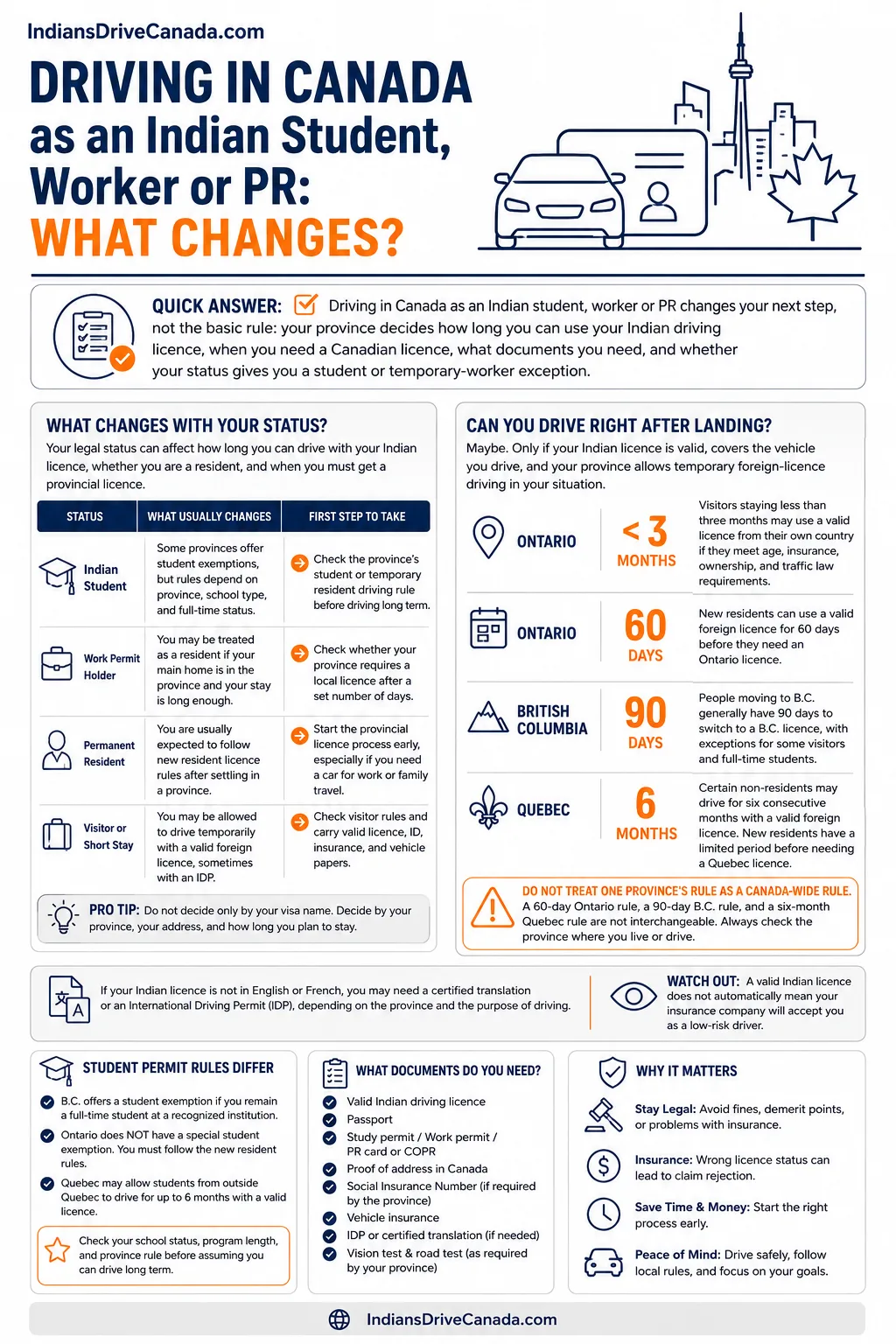
Student, worker and permanent resident are immigration categories, not separate driver’s licence classes. Your right to use an Indian driving licence in Canada depends mainly on the province, whether that province treats you as a resident, whether a student or program-specific exemption applies, and whether your Indian licence remains valid.
A study permit, work permit or PR card can help prove legal status in Canada. None of them automatically converts an Indian licence into a Canadian licence, removes a knowledge or road test, or starts a new foreign-licence driving period.
The Same Indian Licence Can Produce Different Results
An Indian student attending university in British Columbia may qualify for a full-time student exemption. A work permit holder living and working permanently in the same province may instead have 90 days to enter the B.C. licensing system. A person who later becomes a permanent resident should not assume that the PR approval date creates another 90-day period.
The first task is therefore not to ask whether students, workers or permanent residents can drive. It is to identify which provincial category applies on the day of driving.
| Question | International student | Work permit holder | Permanent resident |
|---|---|---|---|
| Can the Indian licence remain usable? | Possibly, if a provincial student exemption applies | Usually only during the provincial new-resident period, unless a specific worker exemption applies | Usually only during the provincial new-resident period |
| Does permit or PR validity set the driving deadline? | Not necessarily | No | No |
| Is a test-free exchange automatic? | No | No | No |
| Can Indian driving experience be credited? | Yes, if accepted evidence is provided | Yes, if accepted evidence is provided | Yes, if accepted evidence is provided |
| What event needs close attention? | End of studies or loss of exemption | Becoming a provincial resident | Earlier residence history, not only PR approval |
Immigration status and provincial residence are related but not identical. A person can be a temporary resident under federal immigration law while being treated as a resident for provincial driver licensing. The words “temporary resident” on an immigration file do not automatically place someone under visitor driving rules.
Identify the Date That Controls Your Driving Right
The expiry date printed on a study permit, work permit or PR card is rarely the only date that matters. Provincial licensing rules may instead use the date you moved to the province, established residence, stopped qualifying for a student exemption or began living there permanently.
Write down the dates that apply to your own situation before calculating how long an Indian licence may be used:
- The date you arrived in Canada
- The date you moved into the province where you now live
- The date you established a home in that province
- The start and end dates of full-time studies
- The date your school confirmed program completion
- The date you stopped meeting a student exemption condition
- The date you began working after graduation
- The date you moved from one province to another
- The issue and expiry dates of your Indian driving licence
- The date you received permanent residence, if applicable
These dates may produce different answers. Someone can arrive in Canada in August, begin school in September, graduate two years later, start working in another province in June and receive permanent residence the following year. The first Canadian arrival date is not automatically the licensing deadline in every part of that timeline.
Do not continue driving simply because your immigration document remains valid. A student exemption may end when studies end. A work permit may remain valid long after the provincial foreign-licence period expires. A PR approval does not automatically reset a deadline that began earlier.
International Students: The Exemption Depends on the Province
Some provinces allow qualifying students to continue using a valid licence from their home jurisdiction. Other provinces rely more heavily on residence and newcomer deadlines. A Canadian study permit alone does not create a nationwide student driving exemption.
British Columbia
British Columbia normally gives a new resident 90 days to switch to a B.C. driver’s licence. ICBC states that this 90-day rule does not apply to a person who has a valid student exemption based on full-time enrolment at a designated educational institution in British Columbia.
This distinction can allow an eligible student to continue using a valid Indian licence while the exemption remains active. It should not be treated as permission that continues automatically after graduation, withdrawal, a switch away from full-time study or another change that removes the stated condition.
Alberta
Alberta separates certain students from people who have moved to the province permanently. Its official licensing information says students may continue using a licence from their home jurisdiction when studying at an accredited educational institution or working as part of a co-op program of study.
A person who finishes the program and remains in Alberta for work should reassess the situation. The fact that the person originally entered as a student does not guarantee that the student treatment continues during later employment.
Quebec
Quebec has a specific rule for students and trainees from outside the province. SAAQ states that an eligible student or trainee may drive for the duration of the studies or traineeship with a valid foreign licence that authorizes the same vehicle class.
The end of the educational program therefore matters. Remaining in Quebec as a worker or permanent resident can move the person into a different SAAQ process even if the immigration document previously used as a student has not yet reached its printed expiry date.
Ontario
Ontario’s published newcomer rule allows a new resident to use a valid licence from another country for 60 days after moving to Ontario. International students should not replace that rule with the expiry date on a study permit without first confirming how their residence is being assessed.
A student who is living in Ontario, has an Ontario address, owns or leases a vehicle, works locally or plans to remain after graduation should check the current position with DriveTest or the Ministry of Transportation rather than relying on visitor assumptions.
Keep current enrolment evidence with your records when relying on a student rule. A study permit proves immigration authorization, while a letter of enrolment, program record or co-op document may help show that the provincial student condition is still being met.
Graduation Can Change the Driving Rule Before the Study Permit Expires
The period between completing a program and receiving a post-graduation work permit creates one of the easiest points for a licensing deadline to be missed.
A student may still hold a study permit, may have applied for a post-graduation work permit and may be authorized under federal rules to remain or work in Canada. That does not by itself confirm that a provincial driving exemption based on active studies continues.
Before program completion
Confirm whether the province grants a student exemption and record the condition used to qualify, such as full-time enrolment, attendance at a designated institution or participation in a recognized traineeship.
When the school confirms completion
Check whether the exemption ends when classes finish, when final results are issued, when the completion letter is dated or at another point defined by the provincial authority. Do not choose the most favourable date without confirmation.
While a work permit application is pending
Treat federal immigration authorization and provincial driving authorization as separate questions. Maintained status may protect immigration status in eligible cases, but it should not be assumed to extend a foreign-licence exemption created for active students.
After beginning full-time work
Determine whether the province now regards you as a resident who must obtain its licence. Use the provincial trigger date rather than the work permit expiry date.
A pending PGWP application is not a substitute for a provincial licensing decision. Before driving after graduation, confirm whether the student exception still applies and, if not, when the provincial conversion period began.
Work Permit Holders: Temporary Immigration Status Does Not Always Mean Visitor Driving Rules
A work permit describes the person’s authority to work in Canada. It does not automatically classify the person as a visitor for driver licensing.
A worker who rents a home, reports to a regular workplace, moves personal belongings into the province and expects to remain there may be subject to that province’s resident licensing rule. The work permit may be valid for one, two or three years while the foreign-licence driving period may be measured in days or months.
| Situation | Licensing issue to check |
|---|---|
| Short business assignment | Whether the person remains ordinarily resident outside the province |
| Closed or open work permit with a local home | When provincial residence began |
| Graduate moving from study to work | When the student exemption ended |
| Seasonal agricultural worker | Whether a named program exemption applies |
| Worker relocating to another province | The new province’s licensing deadline |
| Job involving a truck, bus or paid passengers | Whether a commercial class, endorsement or separate authorization is required |
Seasonal Agricultural Worker Program rules are separate
British Columbia allows a temporary foreign worker whose federal work permit identifies participation in the Seasonal Agricultural Worker Program to drive for up to 12 months on a valid licence from the home jurisdiction. A worker staying longer and wishing to continue driving must obtain a B.C. licence.
Alberta also treats workers brought into the province under the Seasonal Agricultural Worker Program separately and states that they are not classed as Alberta residents for this purpose.
These are program-specific rules. They should not be applied to every person holding an employer-specific or open work permit.
An employer-owned vehicle does not remove the driver’s licensing duty. A company car, delivery vehicle or rental supplied by an employer must still be driven under a licence valid for that vehicle and province. Work involving heavy trucks, buses, taxis, ride-hailing or air-brake vehicles may require more than a standard passenger-car licence.
Permanent Residence Does Not Convert or Reset the Licence
Receiving permanent residence may make it easier to provide stable proof of legal status and provincial residence. It does not turn an Indian driving licence into a Canadian licence.
Permanent residents may still need to:
The exact requirements come from the province and the country that issued the previous licence, not from PR status alone.
PR approval is not automatically a new starting date
Consider a driver who entered British Columbia as an eligible full-time student, graduated, began working and later became a permanent resident. The student exemption may have ended before the PR approval. The provincial residence or licensing period may already have started during the worker stage.
Using the PR approval date as a fresh 60-day, 90-day or six-month starting point can therefore produce the wrong deadline. The safer method is to present the full timeline to the provincial licensing authority and ask which event changed the person’s category.
PR does not create a direct exchange agreement
Licence exchange agreements are based on the jurisdiction that issued the licence. They are not based on the driver’s Canadian immigration category. A valid Indian licence does not become eligible for a test-free exchange because the holder becomes a permanent resident.
Do not report a later arrival, residence or licence issue date to gain more time or experience credit. Provincial authorities may verify the licence, driving record and immigration documents. Inconsistent dates can delay the application and may affect the right to drive.
Provincial Examples for Students, Workers and PR Holders
The table below shows why one Canada-wide deadline cannot be used. It focuses on common destinations for Indian students and workers and does not replace an individual assessment by the provincial authority.
| Province | General resident period | Student or worker difference | Authority |
|---|---|---|---|
| Ontario | 60 days after moving to Ontario as a new resident | Do not use permit expiry as the deadline; confirm whether you are being treated as a resident or visitor | Ministry of Transportation and DriveTest |
| British Columbia | 90 days after moving to B.C. | Full-time students at designated institutions may qualify for an exemption; SAWP workers may drive for up to 12 months | ICBC |
| Alberta | 90 days after becoming a resident | Students at accredited institutions and co-op students may use a home-jurisdiction licence; SAWP workers are treated separately | Alberta registry agents and Motor Vehicles |
| Quebec | Six months for a person taking up residence with a valid foreign licence | Eligible foreign students and trainees may drive for the duration of studies or the traineeship | SAAQ |
A person moving between these provinces must use the rule of the new province. A student exemption granted in British Columbia does not become an Ontario student exemption, and an Alberta residence decision does not control the deadline after a move to Quebec.
Indian Driving Experience Is Separate From Immigration Status
Student, worker and PR applicants do not receive different driving-experience credit merely because of their immigration category. Credit depends on the province, the type of Indian licence held, the length of full-privilege driving and the quality of the evidence.
A newly issued Indian card may display only the most recent renewal or replacement date. If the original licensing date is not visible, a driving extract, licence history or authority letter may be needed to prove the earlier years.
Ontario changed its foreign-experience rule on July 1, 2026
Effective July 1, 2026, Ontario limits applicants from non-exchange jurisdictions to a maximum of 12 months of verified foreign driving-experience credit. Applicants must complete the G2 road test and then wait at least 12 months before attempting the G road test. Longer Indian experience does not remove that 12-month period under the rule now in effect.
An applicant who receives the full 12-month credit may be allowed to attempt the G2 road test without completing another 12 months as a G1 driver. After passing G2, however, the applicant must build the required Ontario period before the G test.
This rule applies because of the issuing jurisdiction, not because the person is a student, worker or permanent resident. A person with ten years of verified Indian driving and a person with the same record who recently became a PR are assessed under the same Ontario foreign-experience limit.
British Columbia uses experience for licence stage and insurance
ICBC requires proof of at least two years of full-privilege, non-learner experience for exemption from British Columbia’s Graduated Licensing Program. Without acceptable proof, an experienced driver may still be placed into a novice stage.
ICBC also states that a new resident may receive credit for up to 15 years of non-B.C. driving experience for Basic insurance pricing when acceptable licence-history evidence is supplied. The document used for insurance and the document needed for a licensing decision should still be checked with ICBC because format and submission rules matter.
Alberta uses verified experience in the GDL exemption process
India is handled through Alberta’s non-reciprocal process. The applicant generally completes the Class 7 knowledge test, surrenders the foreign licences and submits the GDL exemption documents for review.
If the driving history is accepted, the applicant may receive access to a road test without completing all normal learner waiting periods. The licence and supporting documents can be sent for validation, so applicants should prepare personal copies before surrendering originals. Copies are for recordkeeping only and cannot be used as a licence.
Experience credit and direct licence exchange are different. Experience credit may shorten or change a graduated licensing path. A direct exchange replaces an eligible licence under a reciprocal agreement, sometimes without regular testing. Proof of years behind the wheel does not create a reciprocal agreement with India.
Four Documents That Serve Different Purposes
An Indian licence, an International Driving Permit, a translation and a driving extract should not be treated as four versions of the same document.
| Document | What it can show | What it cannot do |
|---|---|---|
| Indian driving licence | Your current driving authorization, vehicle class and expiry | It does not guarantee a test-free Canadian exchange |
| International Driving Permit | A multilingual description of the driving authority shown on the accompanying licence | It does not replace the Indian licence or extend a resident deadline |
| Certified translation | The English or French meaning of information on the licence or supporting record | It does not prove extra experience unless the original record contains it |
| Driving extract or authority letter | Original issue date, licence class, status and recorded driving history | It does not authorize driving by itself |
The Indian licence must remain valid
A student exemption, visitor allowance or provincial conversion period normally depends on holding a valid licence. An expired, suspended or cancelled Indian licence cannot be repaired by carrying an IDP, photocopy or driving extract.
Drivers approaching the Indian licence expiry date should investigate lawful renewal options early. They should not assume that the Canadian province will accept an expired card for continued driving merely because a licence exchange application has started.
An IDP is not a second licence
An IDP must be carried with the valid licence on which it is based. Its main role is to present licence information in a standard multilingual form.
Ontario states that a person visiting from another country for more than three months needs an IDP from the home jurisdiction. Quebec and other provinces have their own conditions. A person who has become a provincial resident should not use an IDP as a way to avoid the resident licensing deadline.
Translation rules are authority-specific
A translation accepted by one province may not satisfy another. ICBC may require an ICBC-approved translator. Alberta’s GDL exemption documents must be in English or accompanied by a translation from an approved document translator.
Do not translate, rewrite or annotate an official extract yourself. Submit the original document and the type of translation requested by the licensing authority.
The driving extract should show the full history
A useful Indian driving record should clearly connect the driver to the licence and show the date full driving authority was first issued.
Details to obtain before leaving India
- Full legal name matching the passport
- Date of birth
- Driving licence number
- Original first-issue date
- Current licence class
- History of previous licence numbers, if applicable
- Current status of the licence
- Expiry date
- Name and contact details of the issuing authority
- Official signature, stamp, letterhead or verifiable digital authentication
The document standards differ by province. A record that is useful for one insurance company may not be accepted for a graduated-licensing exemption. Obtain the best official record available, then compare it with the provincial acceptance requirements before submitting it.
Prepare for Surrender and Verification of the Indian Licence
Several provincial processes require an applicant to surrender the existing foreign licence. The licence may be retained, sent for verification or not returned.
ICBC requires applicants obtaining a B.C. licence to surrender other driver’s licences because a person may legally hold only one driver’s licence in British Columbia. Alberta requires out-of-Alberta licences in the applicant’s possession, including expired licences, to be surrendered during its exchange process. Alberta also warns that licences and supporting documents submitted for GDL exemption validation will not be returned and copies will not be provided.
Personal record to create before the appointment
- Clear colour scan of the front and back of the current Indian licence
- Copies of previous licence cards, if available
- Copy of the original driving extract or history letter
- Copy of every translation
- Copy of any IDP
- Record of the issuing authority’s verification details
- List of all dates declared in the Canadian application
These copies can help with later insurance, identity or document questions. They do not authorize driving after the original licence is surrendered or after the provincial driving period ends.
Check whether the provincial office will retain the Indian licence before attending. Avoid booking vehicle rentals, work shifts requiring driving or a road test on the assumption that the original licence will be handed back immediately.
Buying, Renting and Insuring a Car While Status Changes
Immigration status alone does not determine whether someone can buy a vehicle. The practical issue is whether the driver can register, insure and legally operate it under the rules of the province.
Before signing a purchase, finance or lease agreement, confirm:
- Whether the current Indian licence is still valid for driving in the province
- Whether a provincial licence application must be completed first
- Which identity and address documents are accepted for registration
- Whether the insurer will recognize Indian driving experience
- Which original history documents the insurer wants
- Whether all regular household drivers must be listed
- Whether the vehicle will be used for commuting, business, deliveries or paid passenger work
- What happens to the policy if the foreign licence is surrendered during licensing
PR status does not guarantee a lower insurance premium
An insurer may consider the driver’s age, address, vehicle, annual distance, use of the vehicle, claims history, driving experience, coverage choices and other permitted rating information. A PR card does not prove years of safe driving.
Foreign driving history may be useful, but private insurers do not necessarily treat every Indian record in the same way. Ask which document is accepted before paying for a new extract or translation.
Rental company acceptance is not the provincial legal test
A rental company can impose its own document, age, licence-duration and payment-card rules. Accepting an online reservation does not confirm that the Indian licence is legally valid under the province’s resident rules.
The driver must satisfy both sets of requirements: the law of the province and the rental company’s contract.
Moving to Another Province During the Student–Worker–PR Journey
A Canadian driver’s licence is provincial. A foreign-licence exemption or deadline is also provincial. Moving for school, a co-op placement, a new job or permanent settlement can change the authority responsible for the licence.
| Example | Question to resolve |
|---|---|
| B.C. student moves to Ontario for work | When Ontario residence began and whether the 60-day rule applies |
| Ontario worker becomes a student in Alberta | Whether an Alberta student rule applies and whether the Ontario or Indian licence is current |
| Quebec student receives PR and moves to B.C. | Whether the Quebec student allowance ended and when the B.C. 90-day period began |
| Alberta worker obtains an Alberta licence, then moves | The new province’s process for exchanging a Canadian provincial licence |
Once an Indian licence has been replaced by a valid Canadian provincial licence, a later interprovincial move is normally handled as a Canadian licence transfer rather than a new Indian foreign-licence application. The new province can still impose its own transfer deadline and document requirements.
Assumptions That Can End the Right to Drive
| Assumption | Better action |
|---|---|
| “My study permit is valid, so the student exemption is valid.” | Confirm that the required enrolment or traineeship condition is still met. |
| “My work permit is temporary, so I am only a visitor.” | Check whether the province considers you a resident based on where you live. |
| “PR approval gives me a fresh deadline.” | Review the earlier student, worker and residence dates with the licensing authority. |
| “An IDP extends my Indian licence.” | Use the IDP only with a valid licence and within the provincial period. |
| “Ten years of Indian driving means a full licence without tests.” | Separate experience credit from reciprocal licence exchange. |
| “A rental company accepted the licence, so it is legal.” | Verify provincial legality separately from rental-company policy. |
| “A scan is enough after I surrender the original.” | Drive only with the licence or temporary document legally issued for that period. |
Action List for Your Current Status
If you are studying
- Confirm whether your province has a student exemption.
- Identify the enrolment, institution or traineeship condition attached to it.
- Record the date that your program or full-time status ends.
- Check the Indian licence expiry date.
- Obtain the Indian driving extract before it becomes difficult to arrange from Canada.
- Recheck the rule before graduation, a co-op move or a switch to part-time study.
- Do not wait for the study permit expiry date to investigate a provincial licence.
If you hold a work permit
- Determine whether you are living in the province as a resident.
- Do not use the total work permit length as the foreign-licence period.
- Separate a standard work permit from named programs such as SAWP.
- Check whether your job requires a commercial class or endorsement.
- Prepare proof of residence and legal status for the provincial application.
- Confirm the effect of surrendering the Indian licence before relying on it for work.
If you are a permanent resident
- Review when you first became a resident of the province.
- Include earlier student and worker periods in the timeline.
- Do not calculate a new deadline only from the PR approval date.
- Check the province’s non-reciprocal testing process for an Indian licence.
- Prepare original experience evidence and accepted translations.
- Create copies before surrendering any licence or history document.
- Confirm the new process again if moving to another province.
Provincial Pages to Check Before Driving or Applying
Rules and official pages checked on July 27, 2026. Provincial authorities make the final licensing decision after reviewing the driver’s residence, status and documents.