Buying Your First Car in Canada as an Indian Immigrant: Complete Guide
Buying your first car in Canada as an Indian immigrant is safer when the decisions are made in...
Car Insurance Documents Indian Newcomers Should Prepare Before Getting Quotes
Prepare two separate files before requesting car insurance quotes in Canada. The first should contain the information needed...
Car Ownership Costs in Canada for Indian Newcomers
Do not judge car affordability by the loan payment alone. An Indian newcomer should calculate the cash needed...
Should Indian Newcomers Buy a Car Before Getting a Canadian Licence?
Most Indian newcomers should confirm their provincial licence path and obtain an insurance quote before buying a car....
Why Car Insurance Is Expensive for Indian Newcomers in Canada
Indian newcomers are not charged more simply because they are Indian. A high car insurance quote usually appears...
5 articles in Car Insurance Canada Indians
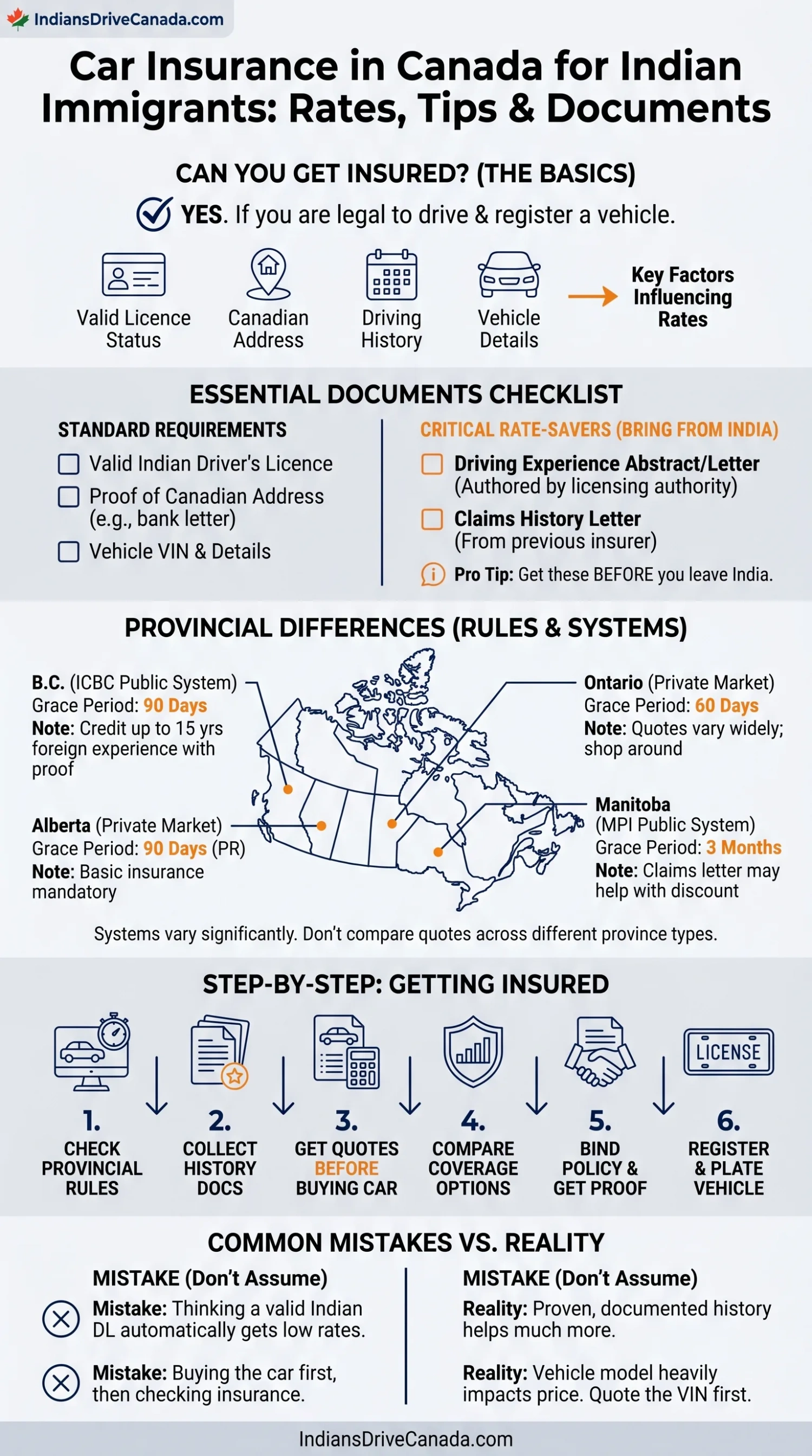
For an Indian newcomer buying car insurance in Canada, the useful comparison is not simply the annual premium. A quote also depends on the driver record, postal code, vehicle, listed drivers, deductibles, liability limit, and optional coverage. In Ontario, policies entered into on or after July 1, 2026 also need careful accident-benefit comparison because medical, rehabilitation, and attendant care remain mandatory while other accident benefits are optional.
Before choosing a car or policy, collect the same information for every insurer and make the quotes comparable.
| Compare on every quote | Why it matters |
|---|---|
| Exact vehicle or VIN | Trim, repair cost, theft risk, and vehicle details can change the premium |
| Third-party liability limit | A cheaper quote may use a lower limit |
| Deductibles and vehicle-damage coverage | Collision and other optional coverage can change both protection and price |
| Accident benefits in Ontario | Optional selections can make two otherwise similar quotes different |
| Foreign driving and claims history | Documented history may affect how an insurer rates a newcomer |
The province also changes the insurance system itself. Ontario and Alberta use private markets, while B.C., Manitoba, Saskatchewan, and Québec combine public and private elements in different ways.
Start with a comparable quote, not the lowest premium
There is no single newcomer rate. The premium changes with location, vehicle, driving record, documented history, coverage limits, and optional protection.
Ontario is the easiest place to anchor expectations because the regulator publishes an average. FSRA’s latest published average shows Ontario private passenger vehicles at $2,164 per year as of October 2025. For the GTA, the published average was $2,810. That does not mean you will pay those exact numbers. Your own premium can differ because of your location, vehicle, driving record, coverage, insurer, and other rating information.
Private-market provinces such as Ontario and Alberta often show wide quote differences between insurers. Public or mixed systems work differently. In B.C., ICBC handles basic insurance, then you can add optional coverage. Manitoba’s Basic Autopac includes personal injury, all-perils, and third-party liability. Saskatchewan’s plate insurance includes basic liability, injury, and vehicle damage. Québec has a public injury plan through SAAQ, while vehicle owners must also carry private civil liability insurance.
Ontario accident-benefit change effective July 1, 2026: Ontario’s auto insurance rules now make medical, rehabilitation, and attendant care benefits the mandatory accident-benefit portion for new policies entered into on or after July 1, 2026. Other accident benefits are optional, including income replacement, non-earner, caregiver, lost educational expenses, expenses of visitors, damage to personal items, death and funeral benefits, dependant care, housekeeping and home maintenance, and indexation. Optional benefits and available limits can affect both the protection provided and the premium. FSRA explains the current optional accident-benefit choices here.
For Indian newcomers shopping for their first Ontario policy, this makes quote comparison more important. Do not compare two quotes by price alone. Check whether both quotes include the same optional accident benefits and the same limits. A lower premium may partly reflect fewer optional benefits rather than simply a better price for identical coverage.
For example, one quote may include income replacement or death and funeral benefits while another leaves those benefits out. If the coverage selections are different, the two premiums are not directly comparable. Ask the broker or insurer to show which accident benefits are included, which are optional, and what changes when an option is removed.
Existing Ontario policyholders should not assume that all pre-July accident-benefit coverage disappeared automatically on July 1, 2026. FSRA’s transition rules distinguish between existing policies, renewals, and changes requested by the customer. Insurers were not required to add the new OPCF 47R endorsement immediately to every policy that took effect before July 1. FSRA also states that expiring policies continue to renew with their pre-July 2026 coverages and limits until the consumer agrees in writing to make changes. Customers can review available options with their insurer or broker before renewal as well.
What usually pushes the price up?
- Living in a higher-cost postal code
- Little or no Canadian insurance history
- Not being able to prove foreign driving experience
- Buying a higher-risk or higher-value car
- Choosing collision and other optional vehicle-damage coverage on a financed vehicle
- Past claims, tickets, or gaps in insurance history
The first quote is often not the best quote, and in Ontario the regulator advises consumers to shop around and compare both the price and the coverage being offered.
Documents that can affect a newcomer quote
Bring the standard identification and vehicle information, then add foreign driving and claims records that can support the history you want the insurer to consider.
Quote file to prepare before contacting insurers
| Document | Why it matters | Helpful note |
|---|---|---|
| Valid Indian driver’s licence | Shows legal driving status and licence class | If not in English, ask whether translation or an IDP is needed in your province |
| Provincial licence or exchange appointment record | Shows where you are in the local licensing process | Needed early in some provinces for better pricing or full registration |
| Proof of address in Canada | Postal code affects rates | Lease, utility bill, bank letter, or provincial ID may help |
| Vehicle details | Insurers need the VIN, year, make, model, and use | Have the listing or ownership paper ready |
| Driving experience letter or abstract | Can support experience credit | Very useful in B.C. and often worth trying elsewhere |
| Claims history letter | May support discounts or a cleaner rating picture | Very clear benefit in Manitoba, and useful for quote comparisons in other provinces |
Which foreign-history papers help the most?
British Columbia is clear on this. ICBC says driving experience is one of the main factors in premiums, credits up to 15 years of non-B.C. driving experience, and wants a driver’s abstract or letter of experience from the licensing authority that issued your first non-learner licence. ICBC also lists what the document must show, including original issue date, your identity details, and an approved translation if the document is not in English.
Manitoba is just as direct. MPI says a claim history letter may help you get a premium discount and lists what the letter must include, such as policy dates, all listed drivers, insurer contact details, and claim details.
- Indian licence
- Letter of experience or driving abstract from the licensing authority
- Claims history letter from your insurer
- Passport, permit, PR card, or other ID if the province asks for it
- Translation from an approved translator where required
Get your Indian licence history and claims letter before you leave India if possible. It is much easier than chasing paperwork after you land.
Provincial insurance systems change what the quote includes
A premium from one province should not be compared directly with another province until you know how basic coverage is packaged there.
| Province | How long Indian DL is usually usable after moving | Insurance setup | What newcomers should know | Key link |
|---|---|---|---|---|
| Ontario | 60 days | Private market | Third-party liability and uninsured automobile coverage remain part of the standard policy. DCPD is included but may be declined. For new policies entered into on or after July 1, 2026, medical, rehabilitation, and attendant care are the mandatory accident benefits; other accident benefits are optional. | FSRA |
| British Columbia | 90 days | ICBC basic + optional add-ons | 30 days to register, license, and insure your vehicle; proof of driving experience can reduce premiums | ICBC |
| Alberta | 90 days for permanent residents | Private market | Basic insurance is required by law; DCPD applies for not-at-fault vehicle damage in many cases. Care-First changes the injury-benefit and claims system from January 1, 2027. | Alberta.ca |
|
Alberta: 2026 vs January 1, 2027: In 2026, qualifying good drivers have renewal rate increases capped at 7.5%. On January 1, 2027, Alberta’s privately delivered Care-First system begins. It expands medical, rehabilitation, and income-support benefits for people injured in collisions and limits injury lawsuits in most cases. The 2027 rate rules also change: insurers cannot raise average rates by more than 5%, while eligible average drivers have renewal increases capped at 10% unless circumstances such as a new at-fault accident, conviction, driver, vehicle, or coverage change remove the protection. Alberta Care-First and auto insurance reform provide the current transition details.
|
||||
| Manitoba | 3 months | MPI public system | Basic Autopac includes injury, all-perils, and liability; claim history letter can help with discount | MPI |
| Saskatchewan | 90 days | SGI plate insurance + optional add-ons | Basic plate insurance includes liability, injury, and vehicle damage; liability starts at $200,000 | SGI |
| Québec | 6 months | Public injury plan + private liability/property insurance | SAAQ covers bodily injury; private civil liability insurance of at least $50,000 is required for vehicle owners | SAAQ |
Ontario’s standard auto policy page now separates the accident benefits that remain mandatory from those that became optional on July 1, 2026. Alberta’s collision and insurance page explains the current DCPD property-damage system, while Care-First changes the injury-benefit and claims model on January 1, 2027. B.C., Manitoba, and Saskatchewan package basic coverage differently, so a low-looking number in one province may cover something different than a low-looking number in another.
A friend in Winnipeg or Regina may be paying for a public-system package that is not comparable to a private-market quote in Toronto or Calgary.
Licence status and eligibility to insure a vehicle
Indian immigrants can generally buy car insurance when they can legally drive in the province and meet that province’s vehicle registration and insurance requirements. Insurers care most about your licence status, address, vehicle, driving history, claims history, and the coverage you choose.
That means a permanent resident, work permit holder, or student may all be able to get insured, but the province decides how long a foreign licence can be used after arrival and when you must switch to a local licence. Ontario gives most new residents 60 days to use a valid foreign licence before switching. British Columbia gives new residents 90 days to switch to a B.C. licence and 30 days to register, license, and insure a vehicle after arriving. Alberta gives permanent residents 90 days to exchange their licence. Manitoba allows up to three months. Québec allows a foreign licence for 6 months for new residents.
If you are not buying a car yet and only plan to drive someone else’s vehicle, do not assume you are covered. In many provinces, the vehicle owner’s policy matters, and some insurers want every regular driver listed properly.
Reports from Indian immigrants in Ontario forums often mention the same pricing issue: a valid Indian licence establishes licensing status, while proof of driving and claims history can matter when previous history is being reviewed.
Ask the insurer or broker one direct question before anything else: “Can you price me using my foreign driving experience if I bring supporting documents?”
From quote to bound policy: buying sequence
Use the same sequence for each vehicle you are seriously considering:
- Check your licence window in your province. Do this first, online, before you shop. It takes 10 minutes and costs nothing. Ontario, B.C., Alberta, Manitoba, Saskatchewan, and Québec all set different newcomer timelines.
- Collect your history documents. Set aside 1 to 3 days for this if the papers are already available. Gather your Indian licence, licence history or abstract, claims history letter, passport or permit documents, and Canadian address proof. Translation costs vary if a province wants approved English documents.
- Get quotes before you buy the car, if you can. Use the VIN or exact model details. Set aside 30 to 60 minutes. Quotes are free. In Ontario, FSRA tells consumers to get several quotes and ask for discounts.
- Compare coverage before comparing the final premium. Check liability limits, deductibles, collision and other optional vehicle-damage coverage, rental coverage, and any optional accident benefits. For Ontario quotes issued under the post-July 1, 2026 rules, make sure you know whether income replacement, non-earner, death and funeral, dependant care, caregiver, and other optional accident benefits are included or excluded. Two quotes with different benefit selections are not equivalent.
- Bind the policy and get proof of insurance. This can often happen the same day by phone or online. You usually pay the full premium or the first installment, depending on the provider and province.
- Register and plate the vehicle. Time and cost depend on province. In B.C., new residents have 30 days to register, license, and insure after arrival. In Saskatchewan and Manitoba, registration and basic insurance are closely tied.
If you are still deciding whether to buy a car, run quotes on two or three vehicle options first. A cheaper car to buy can still cost more to insure.
Ask for a quote on the exact trim level and VIN when possible. A small model change can alter the premium.
Quote mistakes that distort the comparison
Several ordinary assumptions can raise the premium or leave a policy with less coverage than the buyer expected.
Items to check before accepting a quote
- Thinking a valid Indian licence automatically earns a low premium. It may help, but documented driving history helps more.
- Skipping the claims history letter. Manitoba openly says it may help with a premium discount. Other markets may still use it during quote discussions.
- Buying the first quote because the car purchase is urgent. Ontario’s regulator advises consumers to shop around because quotes can vary between insurers.
- Comparing Ontario quotes only by price. Since July 1, 2026, optional accident-benefit selections can differ. A cheaper quote may include fewer benefits, so compare the actual coverage and limits before deciding.
- Choosing the lowest liability limit without thinking about out-of-province driving. B.C., Manitoba, and Saskatchewan all show that basic limits can be modest for larger claims.
- Not listing regular drivers properly. If a spouse, sibling, or roommate uses the car often, disclose that clearly.
- Assuming student life means low insurance. The postal code, vehicle type, and driver history often matter more.
Based on reports from Indian immigrants in Ontario forums, many newcomers also underestimate how much a clean, provable driving history can matter when the first Canadian quote is built. The insurer may not ask for every helpful document on the first call. You may need to raise it yourself.
Saving a little on the premium by hiding regular use, a second driver, or commute details can create claim trouble later.
Questions to settle before choosing a policy
Ask the insurer or broker these before you decide
- “I have 8 years of driving in India. Will Canada count it?”
- “I am on a work permit. Can I still insure a car in my name?”
- “Why is my Ontario quote much higher than my cousin’s quote in Winnipeg?”
- “Should I buy the car first and then look for insurance?”
- “Why are two Ontario quotes different even when the cars and drivers are the same?”
Indian driving years are most useful to the quote discussion when they can be supported with a licence history or claims letter. Your permit category does not remove the need to follow the province’s driving and registration rules. Ontario and Alberta are private markets, while Manitoba and Saskatchewan use public basic systems, so prices are not directly comparable. Buying the car first can also leave you stuck with a model that costs more to insure than expected.
For Ontario policies under the rules effective July 1, 2026, two quotes can also differ because the selected accident benefits are not the same. Ask each insurer or broker for a breakdown of the optional benefits and limits before deciding which quote is cheaper.
In Ontario, FSRA says eligible consumers should be offered quotes or renewals under the take-all-comers rule. That matters for newcomers because less than one year of Canadian insurance history should not be a quiet reason to block a quote.
Save every quote email and ask each broker what they did with your foreign driving history and which optional benefits are included, so you can compare the replies rather than only the premiums.