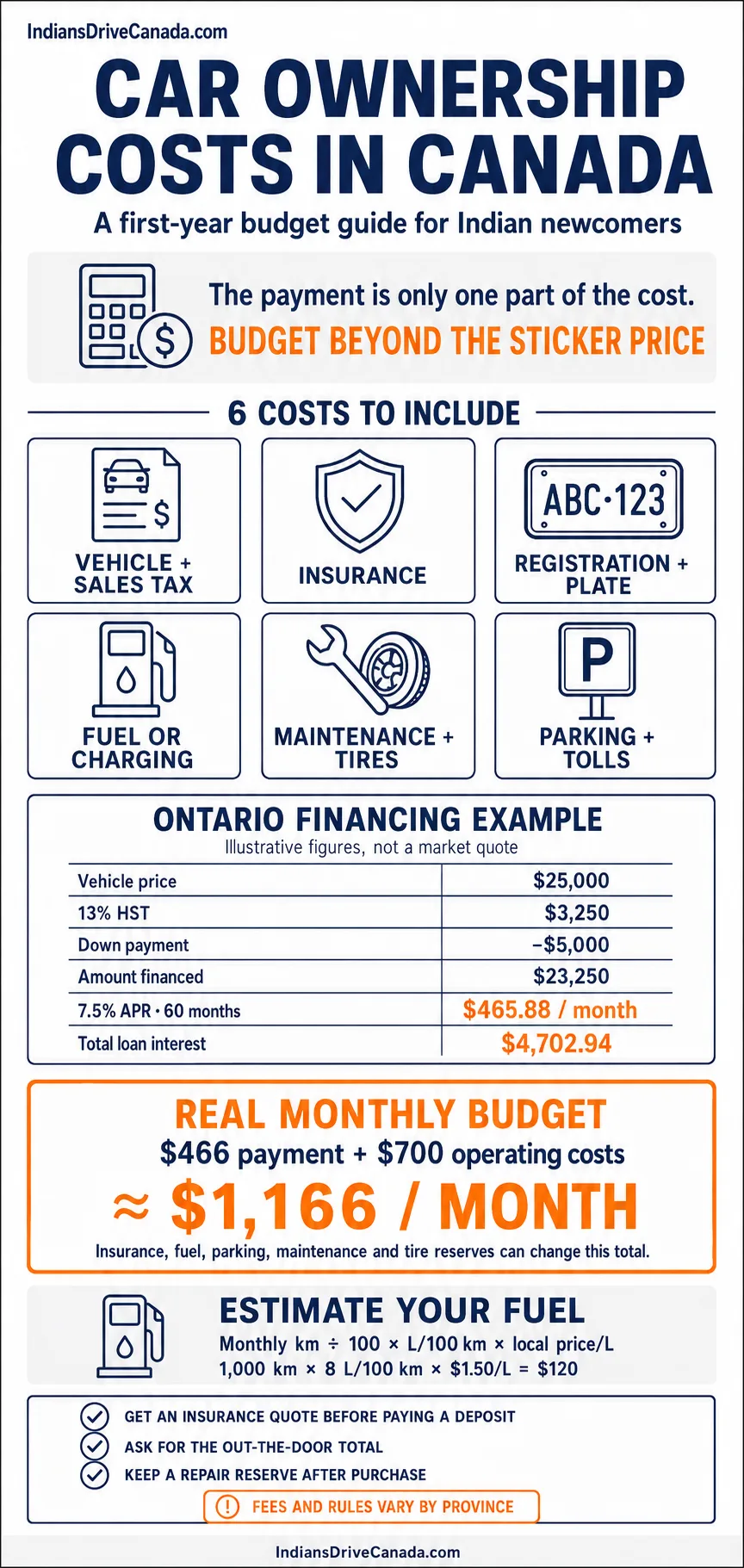
Do not judge car affordability by the loan payment alone. An Indian newcomer should calculate the cash needed to collect the vehicle, the full cost of the first 12 months, and the likely cost after the first winter and one-time newcomer expenses are over.
The result can change sharply with the province, postal code, accepted driving history, insurance coverage, financing terms, parking arrangement and annual distance. Two people buying the same vehicle may therefore face very different ownership costs.
Price the first year before choosing the car
The advertised price is only the starting point. The first-year budget may also contain purchase tax, registration, insurance, financing interest, parking, fuel, winter equipment, inspection and immediate maintenance.
Separating these costs by when they are paid makes the decision easier. It also prevents a low biweekly payment from hiding a costly loan or an expensive first winter.
| Cost layer | What belongs in it | When it affects you |
|---|---|---|
| Drive-away cash | Down payment, taxes paid in cash, registration, inspection, first insurance payment, immediate repairs and winter equipment | Before or shortly after delivery |
| Fixed ownership costs | Loan or lease payment, insurance, home parking, registration renewals and some subscription services | Even when the vehicle is rarely driven |
| Distance-based costs | Fuel or charging, maintenance, tire wear, tolls and kilometre-related depreciation | Increase as annual driving rises |
| Irregular costs | Repairs, battery replacement, seasonal tire changes, towing, deductibles and unexpected damage | Not monthly, but still part of ownership |
Cash flow and ownership cost are not identical. Part of each loan payment reduces the principal balance and may become vehicle equity. Interest, depreciation, insurance, fuel, repairs and fees are costs that do not create the same equity.
Use three separate totals:
Put your Indian driving record into the budget
Driving experience acquired in India may affect the Canadian licensing path and may also be considered during insurance pricing. These are two separate decisions.
A provincial licensing authority may recognize part of a person’s previous driving experience without requiring an insurer to give a particular discount. An insurer may also ask for records that are different from the documents accepted at a licensing office.
| Record | Possible use | What it does not guarantee |
|---|---|---|
| Original Indian driving licence | Shows the licence class and current validity | Automatic licence exchange or an insurance discount |
| Driving licence extract | May show the first issue date, licence status and class history | Acceptance if the province requires a different authentication format |
| Authentication letter | Confirms that the licence is genuine and was issued by the stated authority | Recognition of every year of experience |
| Claims or no-claim letter | May support an insurer’s review of prior insurance history | The same treatment by every insurer |
| Previous policy schedules | May support dates, insured vehicles and policy continuity | Transfer of Indian coverage into a Canadian policy |
| Certified translation | Allows a record to be reviewed when it is not in an accepted language | Replacement of an original or officially authenticated record |
Ontario’s experience-credit rule changed on July 1, 2026
For applicants from jurisdictions without a direct licence-exchange agreement, Ontario now allows credit for up to 12 months of foreign driving experience when the applicant presents an original valid foreign licence and the required authentication document. The authentication record must come from the foreign government or issuing agency, confirm that the licence is authentic, and be written in English or French.[Experience document]
The change does not mean that an applicant receives a full Ontario G licence without testing. It also does not require an insurer to treat the Ontario experience credit as a specific number of claim-free insurance years.
Records worth obtaining before leaving India
- The original valid driving licence
- An official extract showing the first issue date, current status and vehicle class
- An authentication letter when the destination province asks for one
- English or French versions that meet the province’s translation rules
- Previous motor insurance policy schedules
- A claims-history or no-claim record from the former insurer
- Copies of renewed or replaced licences when the original issue date is not visible
- Records showing consistent spelling of the name used on the passport and licence
Do not treat a no-claim letter as a licence-authentication letter. One concerns insurance history; the other confirms the status or authenticity of the driving licence. A licensing authority, broker and insurer may each ask for a different record.
Licence deadlines can create early costs
The following periods apply to people who have taken up residence in the province. Visitor, full-time student and other temporary-status rules can be different, so the user’s legal status must be checked before applying the table.
| Province | General new-resident period | Budget effect |
|---|---|---|
| Ontario | Up to 60 days with a valid foreign licence after becoming a resident[Resident deadline] | Tests, document preparation and licence fees may arrive soon after settlement |
| British Columbia | 90 days to switch to a B.C. licence after moving to the province[B.C. deadline] | Driving-experience records should be prepared before the transition period ends |
| Alberta | 90 days after becoming an Alberta resident[Alberta deadline] | A non-reciprocal licence may involve testing and registry costs |
| Québec | Up to six consecutive months for a new resident driving an eligible vehicle with a valid foreign licence[Québec deadline] | The licensing process should still be started early enough to avoid a gap in driving authority |
The province can change the cost more than the vehicle
A Canada-wide ownership estimate can hide the expenses that matter most. Sales tax, insurance structure, registration, winter rules, fuel pricing and parking conditions are provincial or local.
| Province | Cost structure to check | Where the budget can move |
|---|---|---|
| Ontario | HST or private-sale RST, private insurance, urban parking, toll roads and optional coverage choices | Postal code, vehicle theft and repair profile, commute distance, parking and selected insurance benefits |
| British Columbia | PST rules, mandatory Basic Autoplan, optional coverage and winter-route equipment | Metro Vancouver parking, declared vehicle use, optional insurance and mountain-route travel |
| Alberta | Federal GST on dealer transactions, private insurance, registry services and cold-weather equipment | Longer driving distances, fuel consumption, battery condition, winter tires and vehicle size |
| Québec | GST/QST treatment, public bodily-injury plan, private civil liability coverage and mandatory winter tires | Registration charges, Montréal parking, winter-tire ownership and private property-damage coverage |
Ontario: insurance and parking can dominate the monthly total
Ontario uses private automobile insurers. The premium can change with driving history, licence duration, previous accidents, convictions, vehicle type, location and use. A compact vehicle with a higher theft or claims profile may cost more to insure than a larger model with a different claims record.
For a private used-vehicle purchase, Ontario buyers generally pay 13% Retail Sales Tax on the purchase price or the vehicle’s wholesale value, whichever is greater.[Private-sale tax]
A person living in the Greater Toronto Area should also price home parking, workplace parking, station parking and toll-road use before deciding that a vehicle fits the monthly budget.
British Columbia: insurance and vehicle use are connected
Basic Autoplan is mandatory for vehicles in British Columbia. Collision and other optional protection for vehicle damage or non-collision losses can be purchased separately.[B.C. insurance]
The address and declared use on the policy must match the real situation. A move, a new commute or a change in work use can require an insurance update. A newcomer comparing Vancouver, Surrey, Burnaby or a smaller community should therefore use an address-specific quote rather than a province-wide estimate.
British Columbia also applies PST to vehicles, with rates and valuation rules that can depend on the transaction and vehicle value. The province’s vehicle tax bulletin should be checked before comparing a dealer purchase with a private sale.[Vehicle tax]
Alberta: lower purchase tax does not remove operating costs
A vehicle delivered in Alberta by a GST/HST-registered dealer generally attracts the federal 5% GST rather than HST. The federal place-of-supply rules still matter when the vehicle is delivered or registered in another province.[Dealer tax]
Alberta requires basic automobile insurance containing accident benefits and third-party liability. Collision and other optional vehicle-damage coverage are additional rather than legally mandatory.[Alberta insurance]
A family choosing a larger SUV because of winter conditions should compare the higher fuel use, tire price, insurance quote and replacement cost with a smaller all-wheel-drive vehicle. Alberta’s long urban and intercity distances can reduce the advantage created by a lower purchase-tax burden.
Scheduled Alberta change: Alberta’s Care-First automobile insurance system is scheduled to start on January 1, 2027. It should not be used as the description of a policy purchased in 2026.[Scheduled change]
Québec: winter tires belong in the purchase budget
Québec’s automobile insurance system separates bodily injury protection under the public plan from property-damage civil liability coverage purchased from a private insurer. Vehicle owners must hold the required private civil liability policy.[Québec insurance]
A low-cost used car should not be evaluated without winter tires, seasonal installation, storage and likely first-year maintenance. Montréal street-parking rules and snow-removal restrictions can also create costs that do not appear in the vehicle advertisement.
Québec registration rebate: September 2026–August 2027. For eligible passenger vehicles with a registration renewal due from September 1, 2026 through August 31, 2027, Québec will apply a temporary rebate of up to CAD $50. Eligible vehicles include gasoline, diesel, hybrid, plug-in hybrid, methanol, ethanol, compressed-natural-gas and propane passenger vehicles. Fully electric and hydrogen fuel-cell vehicles, motorcycles and mopeds, motor homes and commercial vehicles are excluded. The rebate is applied once per eligible vehicle registered to an individual, and the amount is already reflected on the renewal notice when the vehicle qualifies.[Temporary rebate] This is a temporary reduction for the stated renewal period, not a permanent decrease in Québec registration costs.
Build the drive-away amount
The amount financed and the amount needed in cash are separate. A buyer may finance taxes and dealer charges but still need cash for insurance, registration, winter equipment, inspection or repairs.
Dealer transaction
A dealer quotation should show more than a monthly payment. Ask for a written breakdown containing:
- Vehicle selling price
- Sales tax
- Registration and licence charges
- Dealer or administration charges
- Financing charges that are not included in the stated interest rate
- Warranty, protection package or service-contract cost
- Winter tires, wheels or accessories
- Trade-in value and any tax treatment
- Down payment
- Final amount financed
GST or HST generally applies when a vehicle is purchased from a registered dealer. The applicable treatment can depend on the place of delivery and registration.[GST/HST rule]
Optional products can enter the loan quietly. A warranty, theft device, paint treatment, tire package or loan-protection product may appear small when divided across 60, 72 or 84 months. Compare its full price and the interest charged on that price.
Private transaction
A private sale may have a lower advertised price, but the buyer may need to arrange more of the transaction independently. The budget can include:
Do not assume that tax will be calculated only on the handwritten sale price. Ontario, for example, generally compares the sale price with the wholesale value for private purchases. British Columbia also has valuation and PST rules for privately acquired vehicles.
The drive-away formula
Drive-away cash = down payment + taxes not financed + registration + inspection + first insurance payment + immediate repair fund + winter setup + parking deposit or permit.
The calculation should be completed before placing a non-refundable deposit. A car that fits the loan approval may still exceed the cash available for delivery and the first month.
Quote insurance before comparing monthly payments
Insurance should be priced while comparing vehicles, not after signing the purchase agreement. The exact model, trim, model year and intended use can change the result.
Ontario’s regulator lists driving record, previous accidents, length of time licensed, driver training and vehicle type among the information that can affect the premium.[Rating factors]
Prepare one consistent driver profile
Use the same facts for every quote:
- Current Canadian licence class
- Date first licensed in Canada
- Previous driving experience and available proof
- Claims and convictions
- Home address
- Work or school address
- Estimated annual kilometres
- Commute distance
- Business, delivery or rideshare use
- All licensed household members who may drive the vehicle
- Winter-tire use
Changing the facts between brokers makes the quotations difficult to compare. It can also cause a later policy correction if the insurer receives different information during underwriting.
Quote more than one vehicle
Request quotations for at least three realistic options:
Where possible, provide the exact vehicle identification number. A quote based only on a broad model name may not capture the engine, trim or installed equipment.
Compare coverage, not only premium
| Policy field | What to record | Why it changes the comparison |
|---|---|---|
| Total annual premium | Full-year amount before instalment fees | A low monthly figure may include a different payment schedule |
| Payment charge | Fee or interest for monthly instalments | Paying monthly can cost more than paying annually |
| Liability limit | Selected third-party liability protection | Quotes with different limits are not equal |
| Collision deductible | Amount paid by the policyholder before coverage responds | A higher deductible can reduce premium but raises claim-time cash needs |
| Non-collision coverage deductible | Deductible for covered non-collision loss | Theft, glass and weather protection may differ |
| Rental vehicle coverage | Limit and duration | A repair can create temporary transport costs |
| Accident benefits | Mandatory and selected optional benefits | Lower premium may reflect lower optional protection |
Ontario accident-benefit choices changed on July 1, 2026
For new Ontario policies beginning on or after July 1, 2026, medical, rehabilitation and attendant-care benefits remain mandatory. Other statutory accident benefits, including income-replacement coverage, are optional choices.[Coverage change]
A lower quotation may therefore reflect a different benefit selection rather than a better price for the same policy. A newcomer without employer health benefits, paid sick leave or other income protection should understand what has been removed before accepting a cheaper option.
Do not ask for “the cheapest legal policy” without reviewing the result. Legally permitted minimum choices may leave a household carrying more medical, income, rental-car or vehicle-replacement risk.
Finance the total transaction, not the sticker price
A newcomer with a short Canadian credit history may be offered a higher rate, a larger down-payment requirement or a longer term. Approval does not show that the loan is affordable.
Record every loan input
- Vehicle selling price
- Taxes and fees added to the loan
- Down payment
- Trade-in credit and any unpaid trade-in balance
- Annual percentage rate
- Loan term in months
- Monthly or biweekly payment
- Total of all scheduled payments
- Total borrowing cost
- Optional products financed with the vehicle
Amount financed = vehicle price + financed taxes + financed fees + financed products − down payment − net trade-in credit.
Total borrowing cost = total scheduled loan payments − amount financed.
A low biweekly payment can hide three things
Convert every offer to a monthly equivalent and compare the total paid over the complete term. A biweekly payment is made 26 times per year, not 24.
Match the loan to the expected time in Canada
A seven- or eight-year loan can become difficult when a work permit, study plan, employment location or family situation may change sooner. Selling during the early years can leave a balance that is higher than the vehicle’s market value.
Before choosing a term, compare:
- The expected length of stay in the province
- The remaining validity of temporary status documents
- The likelihood of moving to another city or country
- The amount of emergency savings left after the down payment
- The expected vehicle value after two, three and four years
Measure fuel, parking and distance together
Fuel cost cannot be estimated from vehicle type alone. Annual kilometres, city driving, highway driving, winter use, idling and fuel grade all affect the result.
Annual fuel cost = annual kilometres ÷ 100 × combined fuel consumption in L/100 km × local fuel price per litre.
Natural Resources Canada publishes model-specific fuel-consumption figures for current light-duty vehicles. The 2026 Fuel Consumption Guide can be used to compare vehicles on a consistent basis.[Fuel rating]
Official ratings are comparison tools. Real consumption can be higher because of cold temperatures, traffic, short trips, cargo, tire pressure, driving speed and extended heating or defrosting.
Use a local fuel price
Do not insert a single permanent “Canadian gas price” into the budget. Statistics Canada publishes monthly retail gasoline prices for Canada and selected cities, allowing the calculation to use the latest completed month for the destination city or province.[Fuel price data]
Parking can exceed fuel savings
A fuel-efficient car does not solve a high parking bill. Record each parking location separately:
For a commuter driving relatively few kilometres, parking and insurance may cost more than fuel. In that situation, choosing a hybrid solely for fuel savings may not recover the higher purchase price quickly.
Add route-specific expenses
Include toll roads, bridges, ferries and paid airport trips only when they are part of the expected driving pattern. Occasional discretionary trips should not be mixed with the cost of the required work or school commute.
Treat the first Canadian winter as a purchase cost
The first winter may create a group of expenses within a short period. The budget should include more than the price of four tires.
| Item | Possible first-year cost | Recurring cost |
|---|---|---|
| Winter tires | Purchase of four suitable tires | Replacement after wear or age |
| Separate wheels | Steel or alloy wheel set | Repair or replacement if damaged |
| Tire installation | First mounting and balancing | Seasonal changeovers |
| Tire storage | First storage period | Usually charged each season |
| Battery | Testing or replacement if weak | Future replacement based on condition |
| Winter supplies | Brush, scraper, washer fluid, shovel and emergency kit | Consumables and replacement items |
| Salt protection | Initial rust treatment or underbody service | Washing and repeat treatment where chosen |
Québec has a dated winter-tire requirement
Motor vehicles registered in Québec must be equipped with qualifying winter tires from December 1 to March 15. The rule applies to registered vehicles, including rental vehicles, with stated exemptions. A driver who does not comply can face a fine of CAD $200 to CAD $300.[Winter tire rule]
For a Québec buyer, winter tires should therefore be treated as part of the initial vehicle package rather than an optional future upgrade.
British Columbia uses designated routes and seasonal dates
Winter tires or chains are required on most designated British Columbia routes from October 1 to April 30. On selected highways outside mountain-pass or high-snowfall areas, the requirement ends on March 31. Regulatory signs identify the routes.[B.C. winter routes]
A Metro Vancouver driver who plans to travel into mountain regions should not build the budget only around urban conditions.
Ontario winter tires can affect insurance pricing
Ontario private-passenger automobile insurers must offer a winter-tire discount when the qualification requirements are met. The amount and documentation should be confirmed with the insurer.[Insurance discount]
Ask whether the quotation already includes the winter-tire discount, the installation dates required by the insurer, and whether proof of purchase or installation is needed.
Protect the used-car budget from the first 90 days
A lower purchase price can be cancelled by repairs that arrive immediately after registration. Keep a separate reserve rather than spending the entire available amount on the vehicle.
Use four different checks
| Check | Question answered | What it may not reveal |
|---|---|---|
| Ownership record | Is the seller recorded as the owner? | Mechanical condition |
| Lien search | Is a registered financial claim attached to the vehicle? | Unreported damage or poor maintenance |
| Vehicle history report | Are there reported claims, status changes or registration events? | Every repair or incident |
| Independent mechanical inspection | What is the current condition of major systems? | Future failure with certainty |
A safety certificate is not a warranty
Ontario states that a Safety Standards Certificate is not a warranty or guarantee of the vehicle’s condition.[Safety certificate]
A vehicle can meet the inspection standard at the time of inspection and still have worn components, cosmetic damage, maintenance needs or future repair risk. A buyer should not replace a pre-purchase inspection with the certificate.
Check the lien before paying
British Columbia warns that a vehicle with an unpaid lien can be repossessed from the buyer. The province lists methods for obtaining a Personal Property Registry lien search.[Lien check]
Alberta also advises private buyers to obtain a Personal Property Registry lien search using the vehicle identification number, arrange a safety inspection and complete a standard bill of sale.[Private-sale checks]
Do not transfer the full payment before matching the seller, VIN and ownership documents. A low price does not compensate for missing registration, an unresolved lien or a seller whose identity does not match the ownership record.
Create a first-90-day reserve
The reserve should reflect the vehicle’s age and inspection findings. Possible early expenses include:
- Engine oil and filters
- Transmission, brake or coolant service
- Brake pads and rotors
- Battery replacement
- Wipers and washer system repairs
- Wheel alignment
- All-season or winter tires
- Suspension components
- Heating, defrosting or air-conditioning repairs
- Keys, remotes or security equipment
If the seller cannot provide maintenance records, the catch-up budget should be larger. The absence of records does not prove poor maintenance, but it reduces the buyer’s ability to plan.
Compare loan balance with resale value
Depreciation does not appear as a monthly invoice, but it affects the real cost of ownership and the ability to sell the vehicle.
Track two numbers at the end of each year:
Estimated negative equity = loan payout balance − estimated sale value.
If the result is positive, the owner may need to pay that difference before selling or add it to another loan.
Negative equity risk is higher when the loan has a small down payment, a long term, financed optional products or a high interest rate. It also matters when the buyer may leave Canada, move to a province where the vehicle is less suitable, or change employment during the loan.
Electric vehicles need a different cost test
An electric vehicle should not be selected only because a purchase incentive is available. The comparison must include home charging, public charging, insurance, winter range, tires, parking access and resale plans.
Canada’s Electric Vehicle Affordability Program applies to eligible purchases and leases from February 16, 2026. Eligible battery-electric and fuel-cell vehicles can receive up to CAD $5,000, while eligible plug-in hybrids can receive up to CAD $2,500. The program has vehicle, transaction-value and other eligibility conditions, and the vehicle list should be checked before signing.[EV incentive]
| Cost area | Question |
|---|---|
| Home charging | Is an assigned charger available, and what installation or monthly charge applies? |
| Public charging | How often will paid fast charging replace lower-cost home charging? |
| Parking | Can charging access be maintained if the renter changes buildings? |
| Winter travel | Does the planned route leave enough charging margin in cold weather? |
| Insurance | How does the exact EV quotation compare with the petrol or hybrid alternative? |
| Purchase incentive | Is the exact vehicle and transaction eligible on the delivery date? |
| Resale | Will the expected ownership period be long enough to recover the higher purchase cost? |
A worked first-year budget
The following Ontario example demonstrates the calculation method. It is not a market average, insurance quotation or recommended loan. Each input is an illustrative amount that should be replaced with the buyer’s real quotation.
Vehicle and financing inputs
| Input | Example amount |
|---|---|
| Vehicle price | CAD $18,000 |
| Ontario tax at 13% | CAD $2,340 |
| Financed transaction charge | CAD $250 |
| Down payment | CAD $2,700 |
| Amount financed | CAD $17,890 |
| Illustrative annual percentage rate | 8.49% |
| Term | 60 months |
| Calculated monthly payment | Approximately CAD $366.95 |
| Total of 60 payments | Approximately CAD $22,017 |
| Total borrowing cost | Approximately CAD $4,127 |
First 12 months of cash outflow
| Cost | Assumption | First-year amount |
|---|---|---|
| Down payment | Paid at purchase | CAD $2,700 |
| Loan payments | 12 × CAD $366.95 | Approximately CAD $4,403 |
| Insurance | Illustrative quote of CAD $300 per month | CAD $3,600 |
| Fuel | 14,000 km, 7.2 L/100 km, CAD $1.60 per litre | Approximately CAD $1,613 |
| Parking | CAD $100 per month | CAD $1,200 |
| Maintenance reserve | Monthly amount retained for service and wear | CAD $1,200 |
| First winter setup | Tires, wheels or related equipment | CAD $1,300 |
| Inspection and registration items | Illustrative combined cash allowance | CAD $300 |
| First-year cash outflow | Before unexpected repairs and depreciation | Approximately CAD $16,316 |
The CAD $366.95 payment represents only about 27% of this example’s average monthly first-year cash outflow. Insurance, down payment, winter equipment, fuel, parking and maintenance create the rest.
During the first 12 payments, approximately CAD $1,404 would be interest and approximately CAD $3,000 would reduce the loan principal. This is why cash outflow should not be treated as identical to economic cost.
The example excludes depreciation and unexpected repairs. It also assumes that every quoted input remains unchanged for the year. A real calculation should add a contingency amount and compare the projected resale value with the remaining loan.
Decide whether the car replaces enough other spending
Car ownership can provide access to work, childcare, education, healthcare and areas with limited public transport. The financial test should still compare ownership with the realistic alternative rather than with zero transportation cost.
| Cost area | Car ownership | Without owning a car |
|---|---|---|
| Daily commute | Loan, fuel, parking and maintenance | Transit pass, commuter rail or carpool contribution |
| Late or early shifts | Vehicle operating cost | Rideshare or taxi |
| Weekend travel | Fuel, tolls and wear | Rental car or car-sharing service |
| Family trips | Larger vehicle may increase all-year costs | Occasional larger rental vehicle |
| Unexpected travel | Vehicle available but fixed costs continue | Higher per-trip cost but no annual ownership commitment |
Calculate the annual alternative
Annual no-car transport cost = transit passes + rideshare trips + car-share charges + rental vehicles + delivery charges + carpool contributions.
Ownership difference = annual car cash outflow − annual no-car transport cost.
Time, reliability, accessibility and family needs can be considered separately. Giving time a forced dollar value may make the calculation look more precise than it is.
Your ownership-cost worksheet
| Budget field | Figure to obtain | Where it comes from |
|---|---|---|
| Vehicle price | Written sale price | Dealer offer or signed private-sale agreement |
| Tax | Province-specific amount | Dealer breakdown or registration authority |
| Drive-away cash | Total required before delivery | Sale agreement, insurer and registry |
| Insurance | Annual premium and instalment charge | Quote for the exact vehicle and driver profile |
| Loan | APR, term, total paid and payout rules | Credit agreement |
| Fuel or charging | Annual distance × consumption × local price | Commute plan and official consumption data |
| Parking | Home, work and permit charges | Landlord, employer and municipality |
| Winter setup | Tires, wheels, installation and storage | Retailer quotations and provincial rules |
| Maintenance reserve | Monthly amount retained | Vehicle condition and inspection findings |
| Repair contingency | Cash available beyond routine maintenance | Household emergency budget |
| Resale risk | Estimated value minus loan payout | Loan statement and current vehicle market |
| No-car alternative | Annual realistic transport cost | Transit, rideshare, rental and car-share prices |
Keep the insurance quotation, loan disclosure, inspection report, vehicle history, lien result and sale agreement together. If one figure changes before delivery, recalculate the first-year total rather than adjusting only the monthly payment.