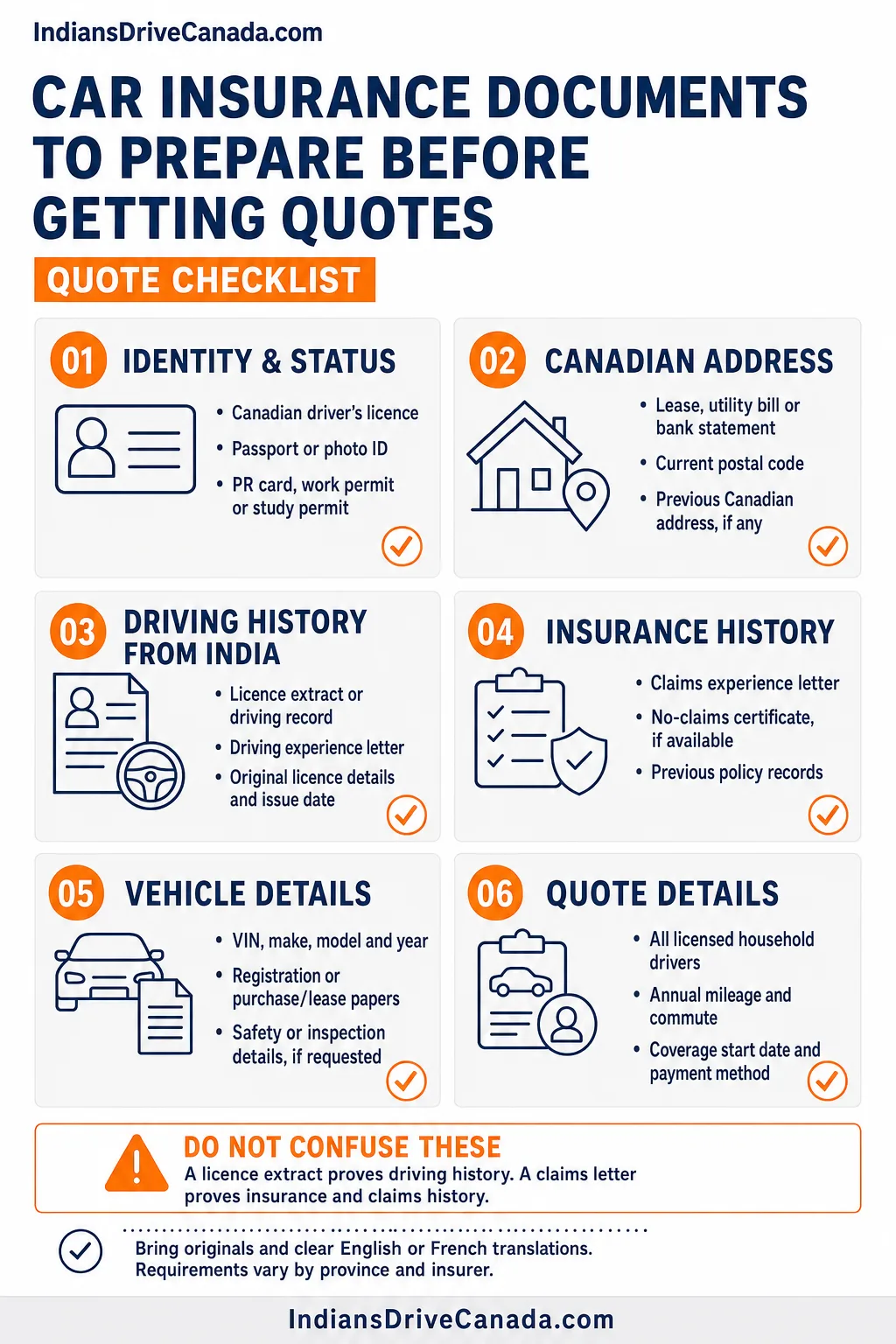
Prepare two separate files before requesting car insurance quotes in Canada. The first should contain the information needed to calculate a price: your licence details, vehicle information, address, driving use, household drivers, accidents and convictions. The second should contain documents that may support or verify your Indian driving and insurance history.
A broker may be able to provide an initial estimate without seeing every document. That does not mean the insurer has accepted your foreign experience. Ask which records were considered, how many years were entered and whether the price can change after verification.
Start with two different files, not one document pile
An insurance quote request, a foreign driving-experience review and the final purchase of a policy are related processes, but they do not always require the same evidence.
For example, an insurer may initially ask you to state when you were first licensed, how many kilometres you expect to drive and whether you have had any claims. It may later request records supporting those answers. Keeping the information file separate from the proof file makes it easier to see what has been declared and what has actually been verified.
| File section | What belongs in it | What it is used for |
|---|---|---|
| Quote information | Driver, address, vehicle, usage, claims and household details | Calculating and comparing prices |
| Foreign history evidence | Indian licence record, insurance letters, policies and claim records | Reviewing statements about previous experience |
| Policy completion records | Canadian licence, registration, purchase or lease details and payment information | Finalizing coverage for the correct driver and vehicle |
A quote is not the same as document acceptance. A price based on information entered during a phone call or online form may remain subject to document review. Ask whether the premium is final, estimated or conditional.
The quote data insurers need before pricing
Insurers price the combination of the driver, vehicle, location, expected use and selected coverage. In Ontario, FSRA advises consumers to prepare information about themselves, their vehicle, driving record, other drivers and existing insurance arrangements before contacting an insurance representative.[Quote information]
Driver details
- Full legal name and date of birth
- Current Canadian driver’s licence number, class and issue dates, if already licensed in Canada
- Indian driving licence number, issuing state or territory and licence class
- Date first licensed in India
- Date first licensed in Canada, if applicable
- Current licence status, including learner, intermediate or full-privilege status
- Driver-training information when relevant to the quote
- Previous suspensions, cancellations or licence restrictions
Do not combine your first Indian licence date with your Canadian licence date. Record both separately. This allows the broker to see your declared total history without incorrectly presenting all of it as Canadian experience.
Accidents, claims and driving convictions
Prepare accurate dates and details rather than relying on memory during several quote calls. Ontario’s FSRA quote worksheet provides space for accidents and claims from the previous six years and traffic violations from the previous three years. The worksheet is an Ontario consumer-preparation tool, not a rule establishing the review period used by every province or insurer.[History worksheet]
Your master record should distinguish between:
Do not omit a claim because it occurred in India. Answer the question as asked and tell the broker which country the record comes from. Inaccurate or incomplete information can affect the premium, policy validity or a later claim decision. FSRA states that incorrect or incomplete information may lead to cancellation or leave the policyholder without protection.[Disclosure duty]
Vehicle information
If you have selected a vehicle, collect the exact details from the vehicle, purchase paperwork or dealer rather than guessing from an advertisement.
- Vehicle identification number, or VIN
- Model year, make, model and trim
- New or used status
- Purchase, finance or lease arrangement
- Expected purchase or delivery date
- Registered owner or proposed registered owner
- Any modifications or non-standard equipment
- Anti-theft or tracking equipment
- Winter tire use when the insurer asks about it
A trim-level difference can change the vehicle’s equipment, repair cost or theft profile. Use the VIN whenever possible instead of requesting a final quote for a broadly described vehicle such as “Honda CR-V” or “Toyota Corolla.”
How and where the car will be used
- Expected annual kilometres
- One-way distance to work or school
- Number of commuting days per week
- Personal, commuting or business use
- Food delivery, courier or ride-hailing use
- Normal overnight parking address
- Garage, driveway, private lot or street parking
- Regular travel outside the province or Canada
Use a reasonable estimate supported by your actual routine. A temporary office schedule, remote-working arrangement or expected move should be explained rather than hidden. Update the insurer if your use changes after the policy starts.
Every person who may drive the vehicle
Prepare information for licensed household members and anyone expected to use the car regularly. The insurer, agent or broker should decide how each person must be listed.
- Full name and date of birth
- Driver’s licence number and class
- Relationship to the registered owner
- Principal, occasional or possible use of the vehicle
- Existing vehicle or insurance arrangement
- Accidents, claims, convictions and suspensions
Do not list a more experienced family member as the principal driver merely to obtain a lower price when someone else will actually use the vehicle most often.
Separate the Indian licence record from insurance history
Two Indian records are especially useful, but they prove different things. A driving licence record supports licensing history. An insurance experience letter supports previous insurance history.
| Record | What it may establish | What it normally does not establish |
|---|---|---|
| Indian driving licence record | First licensed date, licence class, status and issuing authority | Continuous insurance coverage or claims-free periods |
| Insurance experience letter | Policy periods, insured status and claim history | The licence class or licensing credit granted by a province |
| No Claim Bonus certificate | An Indian policy’s NCB status or discount | A complete Canadian-format driver or insurance history |
The Indian driving licence record
The strongest record is normally issued by the government licensing authority responsible for the licence, such as the relevant Regional Transport Office or state licensing authority. Requirements differ by province, so request a record containing enough detail to answer both identity and experience questions.
Useful fields on a driving licence record
- Driver’s full name
- Date of birth
- Driving licence number
- Date the first non-learner licence was issued
- Current issue and expiry dates
- Licence classes or vehicle categories held
- Current licence status
- Name and contact details of the issuing authority
- Issue date of the record
- Signature, letterhead, seal or another official verification feature
A renewed Indian licence card may display only the latest issue date. When that date does not show the beginning of your driving history, request a record that states the original first-licensed date.
The insurance experience letter
Request an experience or claims-history letter from each Indian insurer that covered you during the period you want reviewed. A single letter cannot normally prove years insured by unrelated companies unless the issuer is specifically able to report those records.
Ask the insurer to include
- Your full name as shown on the policy
- Policy number or numbers
- Exact start and end dates of coverage
- Vehicle registration or identifying details
- Your role as policyholder, named insured or listed driver
- Claim dates and claim status
- A clear claims-free statement when no claims were recorded
- Cancellation information, where applicable
- Company letterhead and the issue date
- Name, position and signature of the authorized representative
- A telephone number or email address that can be independently checked
If the car was insured in a parent’s, spouse’s, employer’s or company’s name, ask whether the record can identify you as a listed or regular driver. A policy schedule showing only the vehicle owner may not establish your own insured experience.
Use precise language when requesting records. “Driving experience letter” may be interpreted as either a licensing record or an insurance letter. State whether you need proof from the licensing authority or proof from the insurance company.
An Indian NCB certificate is supporting evidence, not a Canadian rating code
In Indian motor insurance, a No Claim Bonus is linked to claim-free experience and applies to the Own Damage premium, not the Liability premium. IRDAI’s current policyholder guidance states that NCB starts at 20% under prevailing norms and can rise progressively to a maximum of 50% after successive claim-free years.[NCB scope]
This can be useful supporting evidence, but it should not be treated as a direct instruction to a Canadian insurer. A document that only says “50% NCB” may not show:
Include the NCB certificate with old policy schedules and a detailed claims-history or experience letter. Ask the Canadian insurer whether it accepts any of those records and how they affect the quote. Do not describe an Indian NCB percentage as a guaranteed Canadian discount.
Collect records before leaving India
Records are usually easier to obtain while you still have access to the issuing RTO, insurer, agent, registered phone number and Indian address. Begin with the records that cannot be recreated from a Canadian account.
Preserve the original licence record
Keep the original Indian driving licence and clear scans of both sides. If an older licence shows an earlier issue date or a previous licence number, retain a copy of that record as well.
Request the licensing history from the issuer
Ask for a record that states the original licensed date, classes held and current status. Check that names, dates and licence numbers are readable before accepting it.
Contact every relevant insurer
Request detailed experience letters, previous policy schedules, NCB records and claim closure documents. Do not wait until a Canadian broker asks for a format that may take weeks to obtain.
Save an unedited digital archive
Keep colour scans of the original documents in a protected folder. Do not crop official headers, alter dates, combine pages in a misleading way or edit a record to resolve a mismatch.
Do not rely on older advice directing every applicant to the High Commission of India for driving licence authentication. The High Commission’s service page states that authentication of Indian driving licences has been discontinued.[Service status] Obtain the record from the original licensing authority and then check the document rules of your Canadian province.
Check names and dates before sending anything
Indian and Canadian records may display names differently. Initials, middle names, a father’s name, surname order or a name changed after marriage can prevent an insurer or licensing office from matching records automatically.
| Field | What to compare | Action if different |
|---|---|---|
| Full name | Passport, Indian licence, insurance letter and Canadian licence | Collect the legal name-change or identity-continuity record |
| Date of birth | All identity, licensing and insurance records | Request correction from the issuer |
| Licence number | Current card, old card and licensing extract | Ask the issuer to link old and new numbers |
| First licensed date | Licence card and licensing history | Obtain a record showing the original issue date |
| Policyholder name | Experience letter and policy schedules | Ask the insurer to state your role on the policy |
| Policy periods | Experience letter, renewals and NCB records | Explain gaps and obtain missing schedules |
A short written explanation can help organize a legitimate difference, but it does not replace an official correction or supporting document. Do not digitally change the spelling, issue date or licence number on a record.
Explain gaps instead of trying to hide them
A period without an individual motor policy does not automatically mean that the underlying explanation is negative. You may have sold the vehicle, moved abroad, stopped driving, used an employer’s car or driven under another household member’s policy.
Prepare a simple timeline showing:
- When each policy began and ended
- Which vehicle was insured
- Who held the policy
- Your role under the policy
- Why a gap occurred
- Whether you continued to hold a valid licence
Only state what you can accurately support. A gap in insurance, a gap in vehicle ownership and a gap in holding a driver’s licence are three different facts.
Licensing credit and insurance rating are separate decisions
A provincial licensing authority decides how foreign experience affects your Canadian licence process. An insurer or public insurance system decides how the information affects an insurance price. A record accepted for one purpose is not automatically accepted for the other.
Ontario: the July 2026 licensing change is not an insurance guarantee
India does not have a direct passenger-vehicle licence exchange agreement with Ontario. Effective July 1, 2026, an applicant from a jurisdiction without an exchange agreement can receive a maximum of 12 months of foreign driving-experience credit by presenting an original, valid foreign licence and an authentication document that meets Ontario’s conditions.[Ontario licence credit]
For Ontario passenger-vehicle licensing, DriveTest states that the authentication record must be original, dated within the previous six months and contain specified licence details, including the first licensed date, date of birth, classes, status and expiry date.[Ontario record format]
The 12-month limit concerns Ontario licensing credit. It does not establish how many years a private insurer will consider, whether an Indian insurance letter will be accepted or how an individual premium will be calculated. Ask the insurer those questions separately.
British Columbia: licence history has a direct insurance role
ICBC states that it can credit up to 15 years of non-B.C. driving experience when acceptable proof shows the original date the driver received a non-learner licence. For new B.C. residents, ICBC says previous insurance proof is not required for this purpose; the driver’s licence history is the record it requests.[B.C. experience credit]
An ICBC driver licence record or letter of experience must be original, or a licensing-body-approved and stamped copy. It must come from a verifiable licensing body and include identity, licence class and original issue-date information. If the document is not in English, ICBC requires translation through an ICBC-approved translator and requires the original or approved copy to be presented with the translation.[B.C. document format]
India is not listed among the countries from which additional experience records may be submitted later by email or fax. ICBC directs people with records from countries outside that list to present them in person at a driver licensing office.[B.C. submission route]
For another province, ask four precise questions
Do not assume that an Ontario or B.C. document rule applies elsewhere. Before ordering translations or couriering an original record, ask the provincial licensing authority or insurer:
- Which authority must issue the driving history?
- Must the record be original, sealed, recent or sent directly?
- Which translator or certification standard is accepted?
- Is the record used for licensing, insurance pricing or both?
Also ask the insurer whether it wants an Indian insurance experience letter in addition to the provincial driving record. The answer may differ among insurers even within the same province.
Prepare address proof without misrepresenting where the car lives
The insurer will need the address connected with the risk, including where the vehicle is normally kept overnight. The mailing address and normal parking address should not be treated as interchangeable when they are different.
Have a suitable address record available if requested, such as:
- A Canadian driver’s licence showing the current address
- A lease or tenancy record
- A utility or service statement
- A bank statement with unnecessary financial details concealed when permitted
- A vehicle registration record after registration is completed
- Another address document accepted by the insurer
Tell the broker when you are in temporary accommodation, staying with relatives or expecting to move. Do not use another postal code merely because it produces a lower online price.
Protect sensitive identifiers during the quote process
Do not send every immigration, banking or identity document simply because you are assembling an insurance file. Ask what is required, why it is needed and whether a less sensitive record can perform the same task.
Do not use your SIN as general identification
The Government of Canada states that a Social Insurance Number is confidential and should be provided only when legally required. It also states that a SIN confirmation letter or card is not an identity document.[SIN protection]
A normal quote file should not automatically include:
Ontario quotes should not depend on credit information
In Ontario, auto insurers and their agents or brokers cannot require consent to collect and use credit information before providing an auto insurance quote or offering a renewal. FSRA also states that credit information cannot be used when responding to quote requests, processing auto insurance applications or renewing policies.[Credit information]
Before uploading a record: confirm the company, agent or broker; use its secure upload method; ask whether unnecessary fields may be concealed; and keep a list of the files sent.
Build one master quote sheet
A master sheet prevents small inconsistencies between quote requests. Every insurer should receive the same factual driver, vehicle and usage information unless a question is worded differently.
Driver section
- Full legal name and date of birth
- Canadian licence number, class and issue dates
- Indian licence number and first licensed date
- Accidents, claims, convictions and suspensions
- Previous policy cancellations or payment problems
- Driver-training details
Household section
- Other licensed household members
- Who will drive the vehicle
- How often each person will use it
- Each person’s licence and driving history
Vehicle and use section
- VIN, year, make, model and trim
- Owner, finance or lease information
- Annual distance and commuting distance
- Business, delivery or ride-hailing use
- Normal overnight parking address
- Requested policy start date
Foreign document status
- Indian licence available
- Official driving record available
- Insurance experience letters available
- Previous policy schedules available
- NCB record available
- Claim records available
- Translation completed or required
- Name or date mismatch resolved
Ask how the Indian history was entered
Do not stop after asking whether the insurer “accepts foreign experience.” That answer may refer to a document being placed on file without explaining whether it changed the rating calculation.
Ask the broker or insurer:
- Did the quote include any driving experience from India?
- How many foreign years were entered?
- Was only my Canadian first-licensed date used?
- Was my Indian licence record accepted?
- Do you also require an insurance experience letter?
- Does the NCB certificate provide any useful supporting information?
- Must a record be sent directly by its issuer?
- Is manual underwriting review available?
- Can the premium change after document verification?
- Will a later Canadian licence-class change alter the policy?
Record the response beside the quote reference number. A verbal statement that “everything is included” is less useful than a clear description of the years and documents actually entered.
Keep coverage choices identical when comparing prices
A lower price is not necessarily a better quote when the liability limit, deductibles, collision protection, accident benefits or endorsements differ.
| Comparison item | Quote A | Quote B | Quote C |
|---|---|---|---|
| Indian experience considered | |||
| Foreign years entered | |||
| Annual premium | |||
| Total instalment cost and fees | |||
| Third-party liability limit | |||
| Collision deductible | |||
| Non-collision damage deductible | |||
| Accident benefits selected | |||
| Rental or loss-of-use coverage | |||
| Document review pending | |||
| Premium may change after review |
Ontario coverage changed on July 1, 2026. For a new Ontario policy purchased on or after that date, medical, rehabilitation and attendant care benefits remain mandatory, while other accident benefits, including income replacement, are optional.[Ontario coverage rule] Two Ontario quotes may therefore contain different accident-benefit selections even when the vehicle and driver are the same.
When a foreign document is rejected
Ask for the precise reason rather than replacing the document blindly. The problem may be the issuer, format, age, translation, missing field or inability to connect the record to you.
| Reason given | What to ask | Possible next record |
|---|---|---|
| First licensed date missing | Which date and licence stage must be shown? | Original licensing history from the issuing authority |
| Issuer cannot be verified | What issuer details or delivery method are accepted? | Record with authority contact details or direct delivery |
| Only an NCB percentage is shown | Do you need exact policy and claim dates? | Detailed insurance experience letter |
| Name does not match | Which supporting identity record is accepted? | Name-change record or corrected issuer document |
| Translation is not accepted | Which translator or certification standard is required? | New translation from an accepted provider |
| Copy or email printout is rejected | Must the original be presented or sent directly? | Original, stamped copy or direct issuer record |
| Driver role is unclear | Must the letter identify me as policyholder or listed driver? | Revised insurer letter or policy endorsement |
Ask whether the quote can receive a manual review and whether another type of record is acceptable. Do not alter the rejected document or create a replacement statement that appears to have been issued by the authority or insurer.
Quote packet checklist
Indian licensing records
- Original Indian driving licence
- Clear front and back copies
- Previous licence copy when it shows earlier history
- Official driving licence record or extract
- Original first-licensed date
- Licence classes and current status
- Verifiable issuing authority details
Indian insurance records
- Experience letter from each relevant insurer
- Exact policy start and end dates
- Your role under each policy
- Claims-free statement or claim details
- Previous policy schedules
- NCB certificate or renewal record
- Claim closure documents where applicable
- Cancellation reason where a policy was cancelled
Canadian and vehicle records
- Canadian driver’s licence, if issued
- Current licence class and issue dates
- Current residential and parking address
- VIN and exact vehicle trim
- Purchase, finance or lease details
- Expected policy start date
- Household and occasional driver information
- Annual distance, commute and business-use estimates
Final document quality check
- Names and dates of birth match
- Old and current licence numbers are connected
- The original first-licensed date is visible
- Policy periods are complete
- Your role under each policy is stated
- Issuer contact information can be checked
- The document is recent enough for its intended use
- The translation meets the receiving authority’s rule
- No document has been edited or misleadingly altered
- Sensitive identifiers are not being shared without a defined need