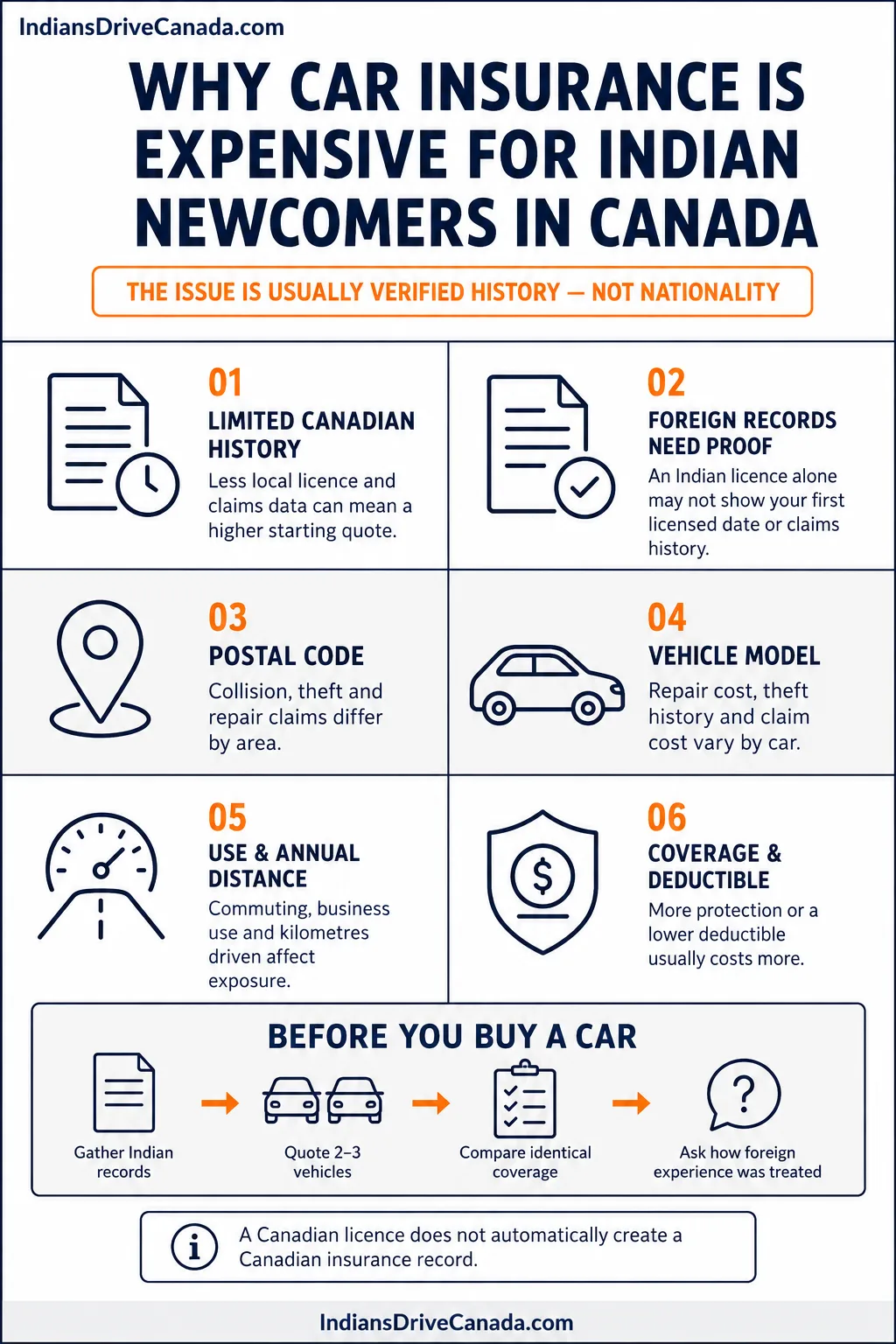
Indian newcomers are not charged more simply because they are Indian. A high car insurance quote usually appears when Canadian licensing or insurance records do not show the driver’s full experience from India. The price can rise further because of the postal code, vehicle, annual distance, commuting use, listed drivers, coverage choices and the insurer’s own rating model.
The most useful question is not, “Why am I being treated differently?” It is, “How many years of driving experience and claims-free history were actually entered into this quote?”
A person may have driven safely in India for ten years and still receive a quote that resembles one for a newly licensed Canadian driver. The insurer may not be able to see the original licence date, may not accept the document supplied, or may have no record showing that the person was insured and claims-free during those years.
These are record-transfer problems, not proof that the driver lacks skill. They also do not produce the same result in every province. British Columbia, Manitoba and Saskatchewan publish specific ways to use foreign driving or claims records, while Ontario and Alberta connect the issue more closely to the provincial licensing record and the insurer’s own rating process.
The price problem begins with a record mismatch
Three different records can describe the same driver. They may overlap, but they do not prove the same thing.
| Record | What it can show | What it may not show |
|---|---|---|
| Licence history | Original issue date, licence class, validity and licensing status | Whether the driver carried insurance or made claims |
| Insurance or claims history | Policy dates, listed drivers, claims and at-fault information | The full period for which the person held a driver’s licence |
| Canadian driving record | Canadian licence date, convictions, suspensions and reported incidents | Older Indian experience unless it was accepted and entered correctly |
An Indian driving licence can establish that a person was authorized to drive. It does not automatically establish that the person was the named policyholder, a listed driver or claims-free for the same period. A no-claim certificate can support insurance history, but it may not prove the original date on which the driver first became licensed.
Licence credit and insurance credit are not the same decision. A provincial licensing authority may accept foreign experience for a licensing stage or road-test path. An insurer may still need that experience to appear in the provincial record, and may separately ask for insurance or claims documents.
How years of experience disappear between India and the quote
The Indian record shows a recent renewal date
A renewed licence may display the latest issue or renewal date rather than the first date the person was licensed. Without an extract or official history, several earlier years can be invisible to the Canadian reviewer.
The licensing office accepts fewer years than expected
The province may require an original record, an authentication letter, a specific issuing authority, an approved translation or a document that identifies the original non-learner licence date. A document that is useful in one province may not meet another province’s format rules.
The provincial record and the insurance quote do not match
The licence office may recognize the experience, but the quote may still be prepared before the updated record is available or before the insurer has entered the credited years. This is why the applicant should ask for the exact number of years used in the rating calculation.
The licence history is accepted but the claims history is missing
The insurer may know that the person held a licence for many years but have no Canadian-verifiable evidence of previous insurance, listed-driver status or claims. The result can differ by province and insurer.
The transfer can be viewed as a narrowing chain:
A problem at any point can make an experienced driver look newer on paper.
Ontario: the licence record and the quote should be checked separately
Ontario changed its foreign-experience process on July 1, 2026. For a licence from a country without a direct exchange agreement, Ontario says an applicant can obtain credit for up to one year of driving experience by presenting a valid original foreign licence and an authentication document from the foreign government or agency that issued it. The authentication document must confirm that the licence is genuine and be written in English or French.[Experience credit]
This licensing credit does not by itself state what every insurer must charge. Ontario’s Financial Services Regulatory Authority says insurers are expected to recognize Ministry of Transportation-verified foreign driving experience in rating and underwriting as soon as practicable.[Insurance treatment]
Do not assume that passing an Ontario test automatically fixes the insurance record. Ask the broker or insurer how many foreign-experience years appear in the quote. If the answer is zero or does not match the Ministry of Transportation record, request a corrected quote after the record has been reviewed.
What else can raise an Ontario quote
FSRA lists the vehicle, driving record, place of residence, annual distance, commuting use, coverage purchased and the insurance company as factors that can affect the price.[Rate inputs] This means full credit for Indian experience can improve one part of the profile while a high-theft vehicle, urban postal code or long daily commute keeps the total premium high.
Credit history is not the explanation in Ontario
A newcomer may assume the quote is high because there is no Canadian credit file. Ontario’s regulator states that insurers are prohibited from using credit history or credit rating to set the cost of auto insurance premiums.[Credit rule] This statement applies to Ontario auto insurance and should not be treated as a Canada-wide rule for every province or every insurance product.
British Columbia can credit licence history without an Indian claims letter
ICBC separates driving experience from previous insurance proof. For new British Columbia residents, ICBC says it can credit up to 15 years of non-B.C. driving experience, and previous insurance proof is not required for this purpose. The evidence normally needs to show the original date on which the person received a full, non-learner licence.[B.C. experience]
An acceptable record or letter should identify the licensing body, driver, date of birth, licence number or other identifier, licence class and original issue date. ICBC also describes original-document and translation requirements for records used to prove experience.[Document format]
A British Columbia result should not be copied to Ontario or Alberta. ICBC runs the province’s basic vehicle insurance system and publishes its own experience-credit rules. Private insurers in other provinces may use different records and rating methods.
Manitoba and Saskatchewan give claims history a clearer role
Manitoba
Manitoba Public Insurance tells new residents to obtain a claim history letter from the previous insurer. The letter may help the driver receive a premium discount and should identify the policyholder, policy number, coverage dates, listed drivers, insurer contact information and any claims.[Claims letter]
MPI also says a person must obtain a Manitoba driver’s licence before buying Autopac insurance to qualify for a premium discount based on the record.[Manitoba discount]
Saskatchewan
SGI distinguishes a driver abstract from claims history. The abstract supports driving-experience assessment, while a claims experience letter can be used to determine placement in the Safe Driver Recognition program and possible insurance discounts.[Saskatchewan records]
A claims letter for Saskatchewan should come from the previous insurer and show the driver’s name, policy dates and at-fault incidents, or state that there were none. The document is not interchangeable with a licence extract because the two records answer different questions.
Alberta licensing credit can affect how the driver is classified
India is not listed among Alberta’s direct reciprocal exchange jurisdictions on the provincial exchange page. A person arriving with an Indian licence generally follows the non-reciprocal process: knowledge test, surrender of licences, review for the Graduated Driver Licensing exemption and a road test if eligible. Alberta says accepted previous experience can exempt the applicant from part or all of the normal graduated-licensing waiting period.[Alberta licensing]
This is a licensing rule, not a promise of a particular insurance discount. It matters because the licence class, credited experience and probationary status may form part of the information supplied when a quote is prepared. The applicant should ask the insurer which Alberta licence status and how many years of experience were used.
Build a document pack before leaving India
The strongest file contains evidence for both licensing history and insurance history. Do not rely on one document to perform both jobs.
Licence and experience records
- Current original Indian driving licence
- Official driving licence extract or letter of experience showing the first issue date
- Licence class and current validity status
- Old licence number and new licence number where a renewal changed the number
- Issuing RTO or licensing authority name and contact details
- Authentication letter where the destination province requires one
- Translation prepared through the method accepted by the destination province
Insurance and claims records
- Letter on the previous insurer’s letterhead
- Policyholder name and policy number
- Start and end dates for each policy period
- Your name as a policyholder or listed driver
- Claims, dates of loss and at-fault information, or a clear statement that no claims were recorded
- Insurer contact details and the date the letter was issued
Check continuity before travelling. If the current licence only shows a recent renewal date, obtain a record that connects it to the first licence date. If the insurance was in a parent’s, spouse’s or employer’s name, ask whether the insurer can identify you as a listed driver for the relevant policy period.
A document should not be altered to make it fit a Canadian requirement. If a field is missing, request a corrected or more detailed record from the issuing authority or insurer. False dates, addresses, driver status or claims information can lead to cancellation, denied claims or difficulty obtaining coverage later.
An International Driving Permit does not prove insurance history
An International Driving Permit is generally a multilingual companion to a valid driving licence. It can help a police officer or licensing office understand the licence, but it is not a claims report and does not prove that the holder was insured for a certain number of years.
It should not replace an official licence extract when the province asks for the original issue date, and it should not replace an insurer letter when the insurance system asks for claims or policy history.
Why full experience credit may not produce a low premium
Driving experience is only one part of the price. A quote may remain high after the record is corrected because several other inputs are expensive.
| Quote input | How it can affect the price | What to verify |
|---|---|---|
| Postal code | Claim frequency, traffic density, theft and repair costs can vary by area | The exact residential address is entered |
| Vehicle | Parts, theft exposure, repair time, sensors and claim costs differ by model | Quote uses the exact trim or VIN |
| Annual distance | More kilometres can mean more exposure to loss | Annual estimate is realistic |
| Commute | Regular travel to work or school may be rated differently from pleasure use | Use type and one-way distance are correct |
| Listed drivers | The experience and record of people who use the car can affect the policy | Principal and occasional drivers are classified honestly |
| Coverage and deductible | Broader protection and lower deductibles usually cost more | Both quotes include the same protection |
| Insurer | Private insurers can price the same profile differently | Compare more than one market channel |
A low purchase price does not mean low insurance
A used car can be affordable to buy and expensive to insure. The insurer is concerned with the expected cost of future claims, not only the price paid to the seller.
A model may have costly replacement parts, a high theft exposure, expensive cameras or radar units, long repair delays or a history of large claims. A financed or leased vehicle may also require collision and comprehensive coverage under the finance agreement, reducing the buyer’s ability to remove those protections.
Ontario theft pricing is being re-evaluated. FSRA says auto theft in Ontario peaked in 2023 and the improving trend continued into 2025. Insurers are expected, as soon as practicable before January 1, 2027, to use recent theft claims data and reassess whether make, model, model-year and territory combinations previously treated as high risk still show elevated theft exposure.[Theft pricing]
This does not mean a theft surcharge or premium will automatically fall. A vehicle that historically carried a high-theft surcharge should not be assumed to remain in the same risk position indefinitely, but the insurer’s current data and rating approach still control the quote.
Do not buy the vehicle before obtaining an insurance quote for the exact VIN. A quote based only on the make and model may change when the trim, engine, theft rating, finance requirements and vehicle use are entered.
The principal driver must be the person who actually uses the car most
Some households try to place the most experienced family member as the principal driver because that person receives a lower quote. That information must match the real use of the vehicle.
If a newly licensed spouse, student or adult child will use the car most often, listing another person as the principal driver can be treated as misrepresentation. The correct way to reduce the cost is to compare vehicles, coverage and insurers while accurately listing all household drivers.
Compare quotes only after making the inputs identical
Two totals are not comparable when one quote includes eight credited years and the other includes none, or when one has broader protection and a lower deductible.
| Field | Quote A | Quote B |
|---|---|---|
| Credited driving years | Confirm | Confirm |
| Claims history used | Confirm | Confirm |
| Exact vehicle or VIN | Match | Match |
| Postal code | Match | Match |
| Annual kilometres | Match | Match |
| Commute use | Match | Match |
| Listed drivers | Match | Match |
| Liability limit | Match | Match |
| Collision and comprehensive | Match | Match |
| Deductibles | Match | Match |
Ontario policies issued after July 1, 2026 need a coverage check
For a new Ontario policy purchased on or after July 1, 2026, medical, rehabilitation and attendant care benefits remain mandatory, while other accident benefits such as income replacement are optional.[Coverage change]
A lower quote may therefore reflect fewer optional benefits rather than a better price for equivalent coverage. Compare the benefit selection, liability limit, deductibles and physical-damage coverage before choosing the lowest total.
Ask for the coverage summary in writing. “Cheaper” and “same coverage” are not interchangeable. This is especially relevant when one quote was prepared before July 1, 2026 and another was prepared under the new options.
Use the right order before buying your first car
- Confirm the licensing path for the province where you live.
- Submit the Indian licence history and any required authentication or translation.
- Confirm the number of foreign-experience years entered in the provincial record.
- Collect an insurer or claims history letter if the province or insurer can use it.
- Choose two or three possible vehicles rather than committing to one.
- Request quotes with the same address, drivers, use, annual distance, coverage and deductibles.
- Obtain the final quote using the exact VIN.
- Review finance or lease insurance requirements before signing the purchase agreement.
This order protects the buyer from discovering an unaffordable premium after the purchase or finance documents have already been signed.
Questions that reveal what the insurer actually priced
- How many years of foreign driving experience were credited?
- Is that experience verified in the provincial driver record or entered separately?
- Did the quote use my licence history, claims history or both?
- Am I rated as newly licensed, probationary or fully licensed?
- Which person is listed as the principal driver?
- Are all licensed household members classified correctly?
- What annual distance and commute distance were entered?
- Is the quote based on pleasure use, commuting, business use or delivery work?
- Does the vehicle have a theft-related surcharge or anti-theft requirement?
- Which accident benefits and optional protections are included?
- Will the quote be recalculated after my foreign experience is added or corrected?
When the quote shows no foreign experience
Identify which record is missing
Ask whether the problem is the original licence date, the provincial driver record, the insurer’s own system, the claims letter or your status as a listed driver on the former policy.
Request the document standard in writing
Ask what issuing body, date range, signature, contact information, translation and delivery method are accepted. “The document is not valid” is not enough detail to correct the problem.
Correct the provincial record first where required
If the insurer relies on the provincial licence record, submit the proper evidence to the licensing authority and wait until the accepted experience is visible before requesting a revised quote.
Request a new quote with the corrected years
Do not assume the previous quote updates itself. Ask for a new written summary showing the credited experience and the same coverage inputs used in the earlier version.
Escalate a record or handling dispute through the proper channel
Start with the broker, agent or insurer representative. If the issue is not resolved, use the insurer’s complaint process and then the complaint or ombudsman route available in the province. A pricing disagreement is different from a factual record error, so describe the exact date or field that is wrong.
Three drivers can receive very different results
Experienced driver with complete records
The driver has a valid Indian licence, an official extract showing the first issue date, a clear insurer letter and a Canadian provincial record that reflects the accepted experience. The quote can still be high, but the driver can check the vehicle, territory, use and coverage instead of wondering whether the missing record caused the full difference.
Experienced driver with only a renewed licence
The driver has many years behind the wheel, but the card shows a recent issue date and there is no official record linking it to the first licence. The Canadian system may credit fewer years until better evidence is supplied. This driver is at the greatest risk of being priced as much newer than the real experience suggests.
Fully documented driver choosing an expensive-to-insure vehicle
The experience and claims history are accepted, but the selected vehicle has costly repairs or theft exposure, the address is in a higher-cost territory and the finance agreement requires broad physical-damage coverage. The premium remains high for reasons unrelated to the person’s Indian record.
Ways to lower the cost without creating a claim problem
- Correct missing foreign driving experience before comparing final quotes.
- Provide a claims or insurance history letter where it can be considered.
- Compare several vehicles before purchasing and use the exact VIN for the final quote.
- Request quotes through more than one available insurer or distribution channel.
- Use accurate annual kilometres, commute distance and vehicle use.
- Review whether a higher deductible is affordable rather than selecting it only to reduce the premium.
- Ask about approved anti-theft measures, winter-tire discounts or usage-based programs where available.
- Compare the same coverage and optional benefits.
- Shop again at renewal after building Canadian insurance and driving history.
Do not use a false address, hide a household driver, understate delivery or business use, or list the wrong principal driver. A lower premium obtained through incorrect information can create a much larger financial problem when a claim is reviewed.