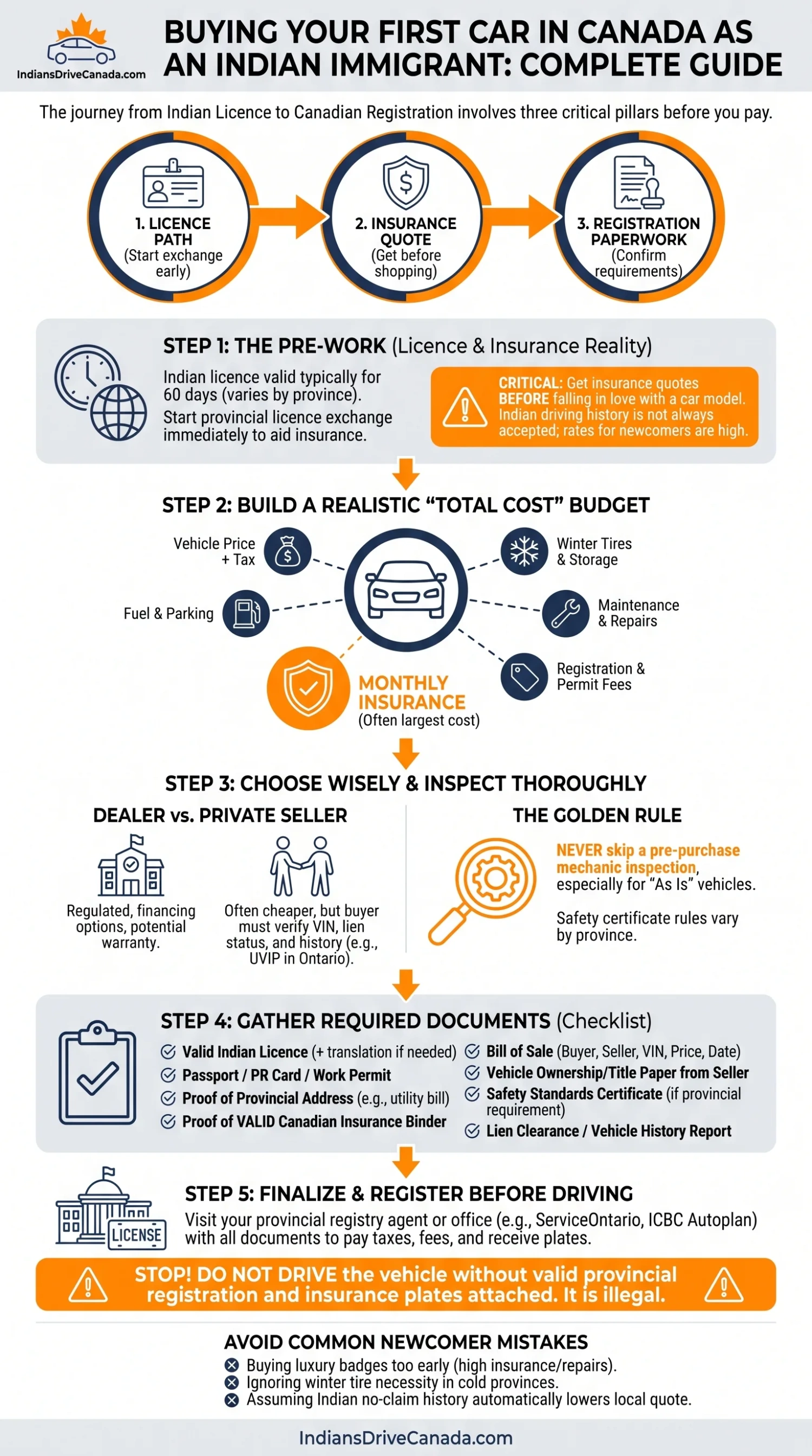
Buying your first car in Canada as an Indian immigrant is safer when the decisions are made in the right order: confirm that you can insure and register the vehicle, collect quotes for the exact cars you are considering, calculate the full first-year cost, and only then negotiate the purchase.
A valid purchase contract does not by itself give you the right to drive. Ownership, driver licensing, insurance, registration and financing are separate matters. Confirm each one for your province before paying a deposit.
Decide whether a car fits your first months in Canada
A car can make work, childcare and winter travel much easier, but buying immediately after arrival can lock you into the wrong vehicle, city or loan. The decision should reflect the life you are setting up, not only the price of the car.
Buying now may make sense when
- Your workplace is outside a practical transit route or your shifts begin before transit starts.
- Your family needs one vehicle for childcare, school, medical appointments or shared commuting.
- You have settled in the province where you expect to remain and can register the car there.
- You have already obtained realistic insurance quotes for the vehicles on your shortlist.
- You can pay the deposit, tax, registration, winter preparation and initial repairs without using your full emergency fund.
Waiting may protect your budget when
Use a two-week test before buying: record every trip for work, groceries, family duties and appointments. Add the cost and time of transit, taxis, rentals and car sharing. This gives you a real comparison with ownership instead of a guess based on one difficult journey.
Separate buying, driving, insurance and registration
A permanent resident, work permit holder, international student or visitor may be able to enter a purchase agreement, but that does not settle whether the vehicle can be registered, insured or driven in the intended province. The result depends on provincial residency rules, acceptable identification, licence status and the insurer or lender’s requirements.
| Decision | What controls it | What to confirm before a deposit |
|---|---|---|
| Signing the purchase | The seller’s contract and provincial consumer law | Your legal name, address, payment terms and written cancellation conditions |
| Driving the vehicle | Your valid licence and the province’s rules for foreign or new-resident drivers | Whether your current licence is valid for the planned pickup and driving date |
| Insuring the vehicle | The provincial insurance system and insurer underwriting | Whether a policy can be issued in your name for the exact vehicle and use |
| Registering ownership | The provincial registration authority | Accepted identification, address proof, ownership papers, inspection and tax |
| Financing | The lender’s credit and eligibility review | Rate, term, down payment, status-document requirements and total obligation |
Do not plan to drive home using the seller’s insurance or plates unless the provincial authority and insurer have confirmed a lawful transfer arrangement. The safe order is to settle insurance and registration before the vehicle moves.
Build the budget around the first year, not the advertised price
The amount displayed in an advertisement is only the starting point. A first-time buyer may need cash for tax, registration, insurance, winter tires and repairs before the first regular loan payment is due.
| Cost group | Include | Why it can change the decision |
|---|---|---|
| Before pickup | Deposit, down payment, tax, registration, plates, dealer charges and insurance activation | This is the cash needed to complete the purchase, not the monthly payment. |
| Road-ready work | Inspection, immediate service, brakes, battery, tires, second key and missing equipment | A lower-priced used car may need several items at once. |
| Monthly ownership | Loan, insurance, fuel or charging, parking, tolls and a maintenance reserve | Insurance and parking can reverse the apparent price advantage between two cars. |
| Seasonal ownership | Winter tires, wheels, installation, storage, washer fluid and cold-weather servicing | These costs often arrive soon after a summer or autumn purchase. |
| Risk reserve | Insurance deductible, towing, rental transport and unplanned repairs | Using every dollar as a down payment leaves no room for the first problem. |
A practical first-year calculation
Cash needed before pickup
Down payment + tax + registration and plates + dealer charges + insurance deposit + immediate repairs + winter tire package
True monthly ownership cost
Loan payment + monthly insurance + fuel or charging + parking + tolls + maintenance reserve
First-year ownership cost
Cash paid before pickup + 12 months of ownership costs
Keep the purchase price, amount financed and total cost of borrowing separate. The Financial Consumer Agency of Canada car-financing information explains that a longer term can reduce the regular payment while increasing the total interest paid.
Prepare Indian driving records before requesting insurance
Your Indian licence and driving history may affect licensing or insurance, but there is no single Canada-wide rule for accepting them. A provincial licensing authority may use a document for driving-experience credit while an insurer applies a separate underwriting policy.
Records worth preparing
- Original Indian driving licence: keep the physical licence in readable condition.
- Driving record or licence extract: it should identify you, show the original licence issue date, licence class, current status and issuing authority.
- Claims history letter: ask the previous insurer to state the covered period and claims history and to identify the insured person clearly.
- Translation: arrange one only under the receiving province or insurer’s stated rules. A translation, authentication and driving extract are not the same document.
- Name-linking documents: carry supporting legal documents if the name on the licence differs from the passport or Canadian records.
British Columbia may credit up to 15 years of non-B.C. driving experience when acceptable proof shows the original date you received your licence. Manitoba asks newcomers seeking Driver Safety Rating credit to provide both an original claims-experience letter and driver abstract that meet its document rules. These examples do not create a national entitlement; ask the authority or insurer that will make your decision.
Do not alter dates, translate a document yourself when an approved translation is required, or describe yourself as claim-free when the letter does not support that statement. A mismatch can delay licensing, change an insurance quote or cause a policy problem after a claim.
Confirm that the vehicle can be insured before you choose it
Insurance should be priced before the deposit, not after the contract. Obtain quotes for the exact year, make, model and trim. Use the VIN when available because two cars with similar names can have different equipment, repair costs and theft experience.
Use the same information for every quote
- Full legal name, Canadian address and current licence status
- All household members who may drive the vehicle
- Annual distance and one-way commuting distance
- Personal, commuting, delivery, ride-hailing or business use
- Parking location and whether the vehicle is financed or leased
- The same liability limits, deductibles and optional coverages for each comparison
Compare the annual premium and the protection included. A cheaper quote may have a higher deductible or fewer optional benefits. Foreign driving and claims records may be considered differently by different insurers in provinces with private insurance markets.
Ontario policies changed on July 1, 2026
For a new Ontario auto policy purchased on or after July 1, 2026, medical, rehabilitation and attendant-care benefits remain mandatory. Other accident benefits, including income replacement, are optional. Compare quotes using the same selected benefits rather than comparing only the final premium.
Review the current categories on the Financial Services Regulatory Authority of Ontario standard policy page before accepting or removing optional protection.
Choose the purchase route before choosing the car
Cash, financing and leasing solve different problems. The lowest regular payment is not always the least expensive route, especially for a newcomer whose job, city or immigration plans may change.
| Route | Can suit | Check closely |
|---|---|---|
| Cash used car | A buyer who can retain an emergency and repair reserve after paying | Mechanical condition, rust, lien status, safety work and lack of warranty |
| Financed used car | A buyer who needs reliable transport without paying the full price immediately | Higher interest, vehicle age limits, loan length and repair costs while still owing money |
| Financed new car | A buyer planning to keep the car for many years and valuing full warranty coverage | Depreciation, insurance, tax, add-ons and the total obligation |
| Lease | A driver with stable annual kilometres and a clear plan for the full lease term | Kilometre limits, wear charges, insurance, early exit and end-of-term obligations |
| Certified pre-owned | A buyer seeking a used vehicle with a defined inspection and warranty program | Who backs the program, what was inspected, exclusions and remaining warranty time |
Do not use the full savings balance as the down payment
A larger down payment can reduce borrowing, but the remaining cash matters. Keep enough for insurance deductibles, seasonal tires, a battery, brakes and temporary transport if the vehicle needs repair.
Finance the total obligation, not the monthly payment
A newcomer with a short Canadian credit file may be offered a higher rate, a larger down payment or a shorter list of eligible vehicles. Approval standards differ by lender, and a dealership may send the application to a bank, credit union, manufacturer’s finance company or independent finance company.
1. Ask your bank or credit union first
Request a pre-approval or an explanation of the amount, rate and term available to you. This creates a comparison point before dealership financing is discussed.
2. Negotiate the vehicle price separately
Keep the vehicle price, trade-in, add-ons, interest rate and down payment on separate lines. Combining them into one regular payment makes it harder to see where the cost changed.
3. Compare the same loan amount and term
For each offer, record the annual percentage rate, payment frequency, number of payments, borrowing cost and total amount payable. Confirm whether early payments are allowed and whether any optional product has been financed.
4. Test the loan against a change in plans
Check how much you may still owe after 24 and 36 months. A long loan can leave the balance above the vehicle’s resale value, making a move, job change or early sale expensive.
The Financial Consumer Agency of Canada describes loans of 72 months or more as long-term car loans and warns that they raise the total cost and extend the period in which the borrower may owe more than the car is worth. Review the federal information on long-term car-loan risk before accepting a six-, seven- or eight-year term.
Select a vehicle for your actual Canadian use
A vehicle should fit the commute, parking space, family equipment and winter route. Buying a larger vehicle only because snow exists can add fuel, tire and insurance cost without solving the real travel need.
| Vehicle type | Often works well for | Check before deciding |
|---|---|---|
| Compact sedan | City commuting, lower fuel use and limited parking space | Rear-seat access, cargo opening, winter clearance and insurance |
| Hatchback | Urban driving with flexible cargo space | Stroller or luggage fit, rear visibility and road noise |
| Compact SUV | Family use, easier entry and a taller cargo area | Fuel, tire size, insurance and whether all-wheel drive is truly needed |
| Hybrid | Frequent city driving without relying on home charging | Battery condition, warranty, cold-weather consumption and repair history |
| Battery electric | Drivers with dependable home or workplace charging and predictable daily distance | Charging access, winter range, insurance, tire cost and long-trip charging |
| Minivan or three-row SUV | Families that regularly use the extra seats or cargo volume | Parking, fuel, tire replacement and whether the third row fits normal use |
Electric-vehicle incentive rules in effect in 2026
Canada’s Electric Vehicle Affordability Program began on February 16, 2026. Eligible new battery-electric and fuel-cell vehicles can receive up to CAD 5,000, while eligible plug-in hybrids can receive up to CAD 2,500. The vehicle, transaction and program conditions must all be met; a model appearing electric does not make every transaction eligible.
Check the current vehicle list, incentive amount and transaction-value rules on the Transport Canada Electric Vehicle Affordability Program page before negotiating the final price. Also check any separate provincial program because federal and provincial rules are not interchangeable.
For an apartment or condominium, obtain written confirmation that charging is available to your parking space and understand billing, access hours and installation approval. Nearby public chargers are not always a practical replacement for dependable overnight charging.
Budget for winter traction instead of relying on AWD
All-wheel drive can help a vehicle begin moving, but it does not replace the grip needed for braking and steering. Transport Canada recommends matching winter tires on all four wheels for cold, snowy or icy conditions.
- Price four winter tires before choosing a trim with large or uncommon wheel sizes.
- Ask whether a used winter set includes compatible wheels and working tire-pressure sensors.
- Check tread condition and tire age rather than accepting the words “winter tires included.”
- Add installation, seasonal changeover and storage to the ownership budget.
- Confirm the law for the routes you will drive, not only the city where you live.
Quebec requires four compliant winter tires from December 1 through March 15 for most vehicles registered in the province. British Columbia requires winter tires or chains on most designated routes from October 1 to April 30, with some routes ending March 31. Other provinces may rely mainly on safety advice or insurance incentives. Check the rule that applies to your province and route before winter travel.
Inspect a used car in a fixed order
A vehicle-history report, safety certificate and mechanic’s inspection answer different questions. None should be treated as a substitute for the others.
Confirm the seller and ownership
Compare the seller’s identification with the registration or ownership document. A private seller should be able to show why the vehicle is registered in that person’s name. Be cautious when a person repeatedly sells vehicles while presenting each sale as private.
Match the VIN everywhere
Compare the VIN at the windshield, driver-door label, registration, bill of sale, vehicle-history report and finance paperwork. Stop if a character differs or a VIN plate appears disturbed.
Check registration history, branding and theft status
Review provincial records for branding such as salvage, rebuilt or irreparable. Search the VIN through the Canadian Police Information Centre public stolen-vehicle search. A result showing no stolen record does not prove clear ownership or clear liens.
Run the correct lien search
A lien can remain attached to a vehicle when the seller still owes money. Use the personal-property or provincial vehicle search appropriate to the jurisdiction. Do not rely on a promise that the loan will be cleared after full payment.
Arrange an independent pre-purchase inspection
Use a repair facility that is independent of the seller. Ask for written findings on structure, rust, brakes, tires, suspension, leaks, cooling, battery, charging system, warning codes, heating, air conditioning and safety equipment. For a hybrid or electric vehicle, ask whether the facility can assess the high-voltage system and available battery data.
Check open safety recalls
Search Transport Canada’s recall information and use the manufacturer’s VIN lookup when available. Confirm whether any open repair can be completed and whether parts are available before taking delivery.
A provincial safety certificate normally confirms that listed minimum safety standards were met at the time of inspection. It is not a warranty on the engine, transmission, future reliability or remaining life of wear items. Ontario states this distinction directly in its Safety Standards Certificate information.
Use the test drive to reproduce your normal trips
Arrange to see the car before the engine has been warmed. A cold start can reveal battery weakness, smoke, warning lights or noises that disappear after the vehicle reaches operating temperature.
- Start the engine and observe all warning lights before and after startup.
- Test the heater, defroster, air conditioning, wipers, washers, windows, locks and cameras.
- Drive on a rough surface and listen for suspension noise.
- Check steering at low speed and during a full turn.
- Use a safe road to assess acceleration, braking and highway stability.
- Reverse into a normal parking space and test visibility.
- Bring the child seat, stroller, work equipment or luggage that must fit regularly.
- Record the odometer reading and compare it with the sale documents.
Do not continue the deal merely because travel time was invested in viewing the car. A seller who refuses a reasonable independent inspection has removed one of the buyer’s main safeguards.
Dealer and private sales require different controls
Buying from a registered dealer
A dealer may arrange financing, registration, warranties and trade-ins, but the contract can also contain optional products that raise the amount financed. Ask for a written, itemized price before discussing payment size.
- Vehicle price shown in the advertisement
- Freight or delivery where applicable
- Administration or documentation charges
- Accessories and protection products
- Extended warranty
- Loan or payment-protection products
- Registration and tax
- Finance charges and total amount payable
Dealer advertising rules differ by province. Alberta requires an AMVIC-licensed seller’s advertised price to include the fees and charges the seller intends to collect, apart from GST and financing costs. Ontario buyers should also know that there is generally no cooling-off period after signing a vehicle purchase or lease contract with a registered dealer.
Do not sign a worksheet, deposit form or purchase agreement until every promised repair, included tire set, delivery date, finance condition and cancellation condition appears in writing. Verbal promises are difficult to enforce.
Buying from a private seller
A private sale may cost less, but the buyer usually carries more responsibility for ownership checks, lien searches, inspection, tax and transfer paperwork.
- Meet the registered owner and compare identification.
- Confirm the province-specific ownership document and bill-of-sale requirements.
- Run a lien search before releasing payment.
- Arrange an independent inspection.
- Write the purchase price, VIN, odometer, included items and conditions on the bill of sale.
- Complete the transfer and insurance at the provincial office, registry or authorized agent.
Do not pay a deposit without written exit conditions
A deposit can become difficult to recover after a contract is signed. “Refundable” should not be assumed. The document should say what happens if financing is declined, the vehicle fails an inspection, a lien appears, insurance is unavailable or the seller cannot deliver on time.
Terms to put in writing before paying
- The buyer’s and seller’s legal names
- The vehicle’s year, make, model and VIN
- The deposit amount and payment method
- Whether it is refundable and the exact conditions
- The inspection deadline and who chooses the facility
- The finance-approval condition, if financing is not final
- The required lien release or lender confirmation
- Repairs, accessories, tires and keys included
- The final delivery date
Ontario’s motor-vehicle regulator states that there is no general cooling-off period after a purchase or lease contract is signed. Alberta’s regulator advises buyers to use a written sales agreement before paying a deposit and to state whether the money is refundable. Treat the signed document as a commitment, not a temporary reservation.
Province-specific transfer points
Vehicle transfer, tax, inspection and insurance are provincial matters. The table identifies the office and one private-sale issue to confirm before money changes hands. Dealer transactions may follow a different process.
| Province | Office or authorized channel | Private-sale point to confirm |
|---|---|---|
| Ontario | ServiceOntario | Register within 6 days; obtain the Used Vehicle Information Package and confirm safety requirements. |
| British Columbia | ICBC Autoplan broker | Complete the original Transfer/Tax form and register within 10 days. |
| Alberta | Registry agent | Bring proof of ownership and insurance; obtain a Vehicle Information Report and a separate lien search. |
| Manitoba | Autopac agent or MPI service channel | Prepare the bill of sale, signed Transfer of Ownership Document and valid inspection document when required. |
| Saskatchewan | SGI motor licence issuer | Confirm PST, VIN status and whether an inspection is required for a vehicle entering Saskatchewan. |
| Quebec | SAAQ service outlet or eligible SAAQclic transfer | QST is collected at registration and may be based on the greater of the agreed price or estimated value. |
| New Brunswick | Service New Brunswick | Confirm registration documents, inspection status, insurance and the applicable vehicle tax. |
| Nova Scotia | Access Nova Scotia or Registry of Motor Vehicles | Confirm the signed ownership document, inspection position and tax value used for the transfer. |
| Prince Edward Island | Access PEI | The buyer generally transfers registration within 7 days and presents the permit, bill of sale, inspection and insurance card. |
| Newfoundland and Labrador | Motor Registration Division or eligible online service | The buyer generally transfers within 10 days and provides insurance and a valid inspection document. |
A low price written on a private bill of sale may not control the tax calculation. Ontario, British Columbia, Manitoba, Saskatchewan, Quebec and several Atlantic provinces use valuation rules or minimum taxable values in some private transfers. Check the provincial calculation before agreeing on the amount of cash needed at registration.
Complete insurance and registration before pickup
Do not assume that a signed bill of sale or the seller’s plates allow you to drive home. Set the policy start date and time, complete the transfer or obtain the correct temporary authority, and confirm which plates remain with the seller.
Finalize the VIN and sale conditions
Give the insurer the exact VIN and confirm the listed drivers, vehicle use, coverage and deductible.
Activate insurance for the correct time
The policy should begin before the vehicle is driven. Keep proof of insurance in the form accepted by the province.
Complete ownership and registration
Bring the original documents required by the province. Pay tax and registration through the authorized office or agent rather than handing an unexplained amount to a private seller.
Inspect the car again at delivery
Match the VIN and odometer, confirm promised repairs, test both keys and check that the included tires, charging cable, manuals and service records are present.
Buying decisions that create avoidable cost
Choosing the car before getting insurance quotes
A cheaper vehicle can become the more expensive choice when its premium, deductible or theft risk is higher. Quote at least three exact vehicles with matching coverage.
Using an Indian driving record as if acceptance were guaranteed
Bring the documents, but wait for the provincial authority or insurer to confirm how they will be used. A licence extract, driver abstract and claims letter can serve different purposes.
Treating a safety certificate as a mechanical warranty
A vehicle may meet minimum safety standards and still need expensive engine, transmission, battery, air-conditioning or rust repairs.
Buying an SUV only for snow
Vehicle size and all-wheel drive do not replace proper winter tires, sensible speed and braking distance. Compare the same route in a smaller vehicle fitted with suitable tires.
Accepting add-ons because they are presented as mandatory
Ask whether each warranty, protection package, insurance product, anti-theft device or service plan is required by law, required by the lender, or optional. Request the price before and after financing.
Assuming the deposit can be returned
Refund terms should appear in writing before payment. A finance application that is still pending does not automatically make every signed vehicle contract conditional.
Three realistic first-car paths
A new worker renting in the Greater Toronto Area
Parking and insurance may matter more than fuel. The buyer should quote a compact sedan, hatchback and compact SUV before visiting a dealer, compare Ontario’s optional accident benefits after July 1, 2026, and include winter tires and monthly parking in the first-year total.
A family settling in Calgary
Child-seat access, cargo room and commute distance may support a compact SUV or larger hatchback, but the choice should be tested against fuel, tire and insurance costs. A private purchase should include an Alberta Vehicle Information Report, a separate personal-property lien search and an independent inspection.
A shift worker moving to Winnipeg
Reliable cold starts, battery condition, cabin heat and winter tires may carry more value than cosmetic features. Before setting the budget, the buyer can ask Manitoba Public Insurance whether original Indian driving and claims documents qualify for any Driver Safety Rating credit.
Documents to collect on delivery day
- Completed bill of sale or purchase agreement
- Ownership or transfer document required by the province
- Tax and registration receipt
- Finance agreement and disclosure of borrowing cost
- Inspection or safety document where applicable
- Warranty and optional-product contracts
- Lien release or lender confirmation where applicable
- Vehicle-history and service records supplied with the sale
- All keys, wheel-lock key, manuals and included accessories
- Winter tire set, wheels or charging cable if written into the deal
Never sign a blank or incomplete form. The price, VIN, trade-in amount, loan rate, term, optional products and delivery conditions should be filled in before the signature is added.
Set up the car during the first 30 days
- Confirm that the registration, plate and insurance documents show the correct vehicle and address.
- Register with the manufacturer or use its VIN service for recall notices.
- Complete any maintenance identified during the pre-purchase inspection.
- Test the spare tire or repair kit, jack, wheel-lock key and roadside-assistance contact.
- Learn the parking restrictions at home and work before leaving the vehicle overnight.
- Prepare winter tires, washer fluid, scraper, snow brush, gloves, charging cable and emergency supplies before cold weather.
- Update the insurer before adding a household driver or starting delivery, ride-hailing or business use.
Official pages to check before money changes hands
Program rules, forms, taxes and insurance options can change. The details on this page were checked against the linked official pages on July 27, 2026. Recheck the pages that apply to your province and transaction before signing or paying.