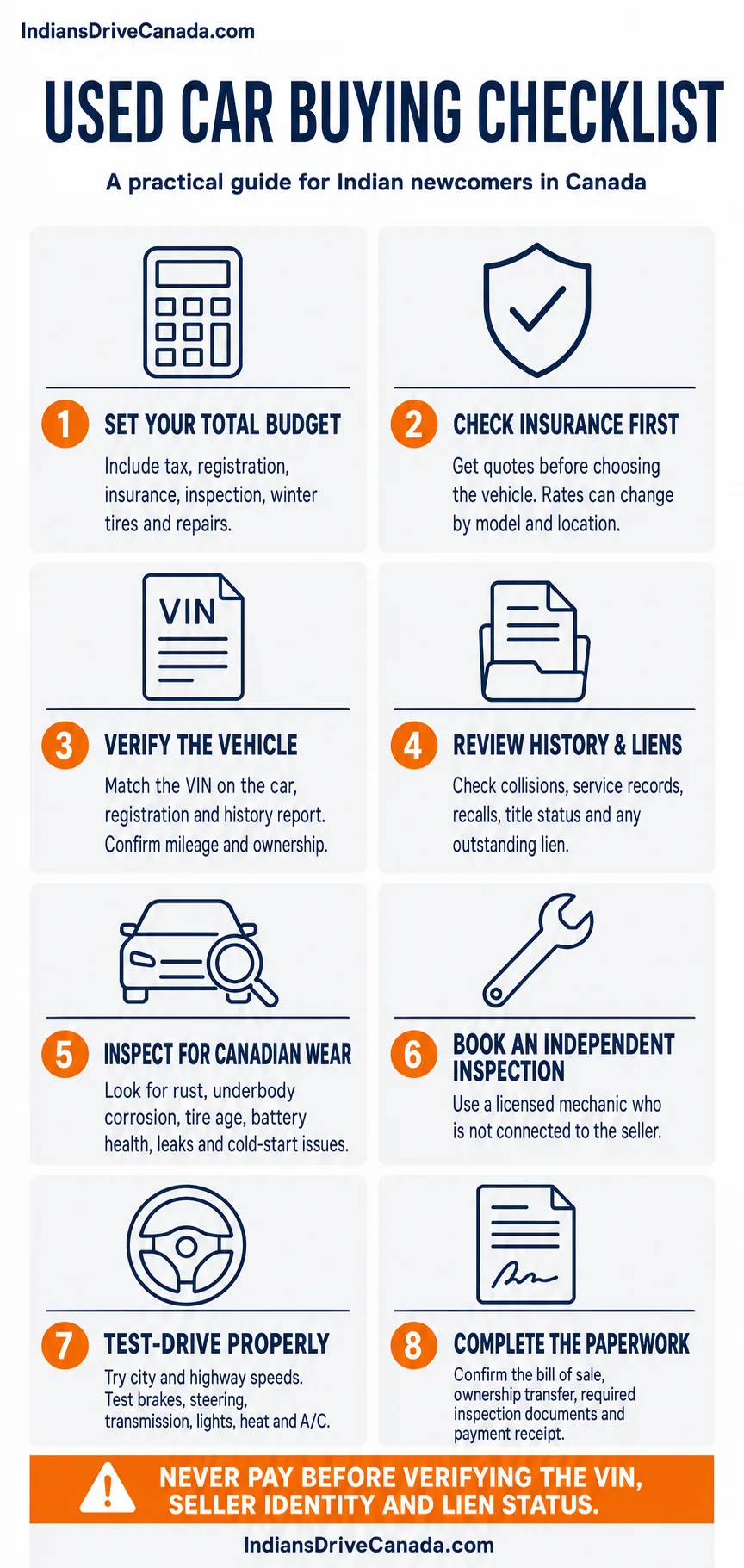
✅ Use this used car buying checklist for Indian immigrants in Canada before paying a deposit: set an all-in budget, get an insurance quote, match the VIN to the ownership papers, search for liens and history, arrange an independent inspection, test-drive the car, and complete the provincial transfer before driving away.
A used car can make work, college, childcare, and winter travel easier after moving to Canada. The purchase price, however, is only one part of the decision. Insurance, sales tax, registration, repairs, winter tires, fuel, parking, and loan interest can change an affordable listing into an expensive monthly commitment.
The paperwork also differs by province. Ontario private sales normally involve a Used Vehicle Information Package. British Columbia uses ICBC and an Autoplan broker. Alberta buyers use a bill of sale and a registry agent. Quebec handles eligible private transfers through SAAQclic or an SAAQ service outlet.
Your immigration category does not replace provincial vehicle rules. A PR holder, worker, or student still needs the correct licence, insurance, ownership transfer, and registration for the province. As of June 2026, confirm the final requirements and fees with the provincial authority before paying or collecting the vehicle.
What Should You Decide Before Viewing A Car?
ℹ️ Start with the way you will use the car, not the model in the advertisement.
Decide your maximum purchase price and maximum monthly ownership cost. Leave money for the first service and repairs that an inspection may uncover. A low listing price is not useful if the car needs tires, brakes, suspension work, and a battery during the first month.
Check that your licence status allows you to drive and test the vehicle in your province. Ask the seller how the test drive will be insured. Do not assume the seller’s policy automatically covers every driver or every situation.
Pro tip: Write down three non-negotiable needs and a firm all-in budget before opening listings.
How Much Should You Budget Beyond The Sale Price?
Build the budget before choosing a vehicle. Insurance can vary by postal code, driver profile, annual distance, coverage, and vehicle. Obtain quotes using the exact year, make, model, trim, and VIN when possible. For newcomer-specific preparation, review car insurance in Canada for Indian newcomers before committing to a car.
| Cost | What To Confirm | When To Check |
|---|---|---|
| Insurance | Quote for the exact car, drivers, address, and use | Before any non-refundable deposit |
| Sales tax | Provincial calculation and taxable value | Before setting the cash budget |
| Registration | Transfer, plate, permit, and inspection fees | On the provincial authority page |
| Immediate work | Tires, brakes, fluids, battery, glass, and rust repair | After the independent inspection |
| Regular use | Fuel or charging, parking, maintenance, and seasonal tires | Before comparing models |
| Financing | Rate, term, total borrowing cost, fees, and early-payment terms | Before signing the credit agreement |
⚠️ A smaller monthly payment can come from a longer loan term. Compare the total amount payable, not only the payment shown by the seller or lender.
Watch out: Do not choose the car first and ask for insurance pricing after signing.
Should You Buy From A Dealer Or A Private Seller?
A licensed dealer may provide clearer sales paperwork and province-specific consumer protections. The price may include dealer costs, financing charges, add-ons, or warranties. Ask for the complete price in writing and read every line before signing.
A private sale may cost less, but the buyer usually carries more responsibility for ownership, lien, history, inspection, and transfer checks. Confirm that the seller’s photo ID matches the registered owner’s name. If another person is selling the vehicle, ask the provincial authority which authorization is required.
| Question | Licensed Dealer | Private Seller |
|---|---|---|
| Seller status | Verify the dealer with the provincial regulator | Match ID, ownership, and VIN |
| Price | Request the full written price and optional items | Agree on price after inspection and lien checks |
| Protection | Varies by province and contract | Usually fewer statutory protections |
| Transfer | Dealer may arrange some registration steps | Buyer and seller complete provincial documents |
Do not rely on a verbal promise that a repair, tire set, warranty, or refund will be provided later. Put agreed terms in the signed contract or bill of sale. In Ontario, vehicle contracts generally have no cooling-off period, so a signed dealer contract can be binding.
Pro tip: Verify the business licence directly through the provincial motor-vehicle sales regulator.
What Should You Ask Before Visiting The Seller?
A short call can prevent a wasted journey. Ask for the VIN, exact trim, odometer reading, ownership status, maintenance records, accident information, vehicle branding, outstanding loan status, number of keys, tire sets, and reason for sale.
- Confirm that the seller is the registered owner.
- Ask whether the vehicle has a lien or unpaid finance balance.
- Request service invoices rather than a general claim that it was maintained.
- Ask whether warning lights are on or were recently cleared.
- Confirm whether the car is being sold certified, inspected, or as-is.
- Ask whether the seller permits an inspection at a mechanic you select.
- Check whether both summer and winter tires are included and measure their condition.
- Ask whether any recall repairs remain open.
Be cautious if the seller refuses to share the VIN, will not allow an independent inspection, pressures you to pay immediately, or asks for payment to a different person. A history report does not replace an inspection, and an inspection does not prove that the vehicle is free of liens.
💡 Send your questions in writing. The replies create a clear record of what the seller represented before the sale.
Watch out: A safety certificate confirms a defined minimum standard; it is not a warranty for future reliability.
How Do You Verify The VIN, History, Lien, And Recalls?
Read the VIN from the vehicle itself. Common locations include the lower windshield and the driver’s door area. Match it character by character with the registration, bill of sale, history report, inspection document, and insurance quote. Stop if the number appears altered or does not match.
Order the province’s ownership or vehicle-information record where available. Obtain a separate lien search through the correct provincial registry. A lien can give a creditor a claim against the vehicle even after it changes hands. Ask for written proof that any loan has been discharged, then confirm the release through the proper registry.
Review the history for registration changes, collision claims, vehicle branding, odometer entries, commercial use, and movement between provinces or countries. Compare recorded kilometres with service invoices and physical wear. An unusually clean interior does not prove a low odometer.
Search Transport Canada’s recall information and use the manufacturer’s VIN lookup. Ask an authorized dealer whether open recall work exists and whether it can be completed before purchase.
⚠️ Do not treat one report as a complete answer. Use the provincial record, lien search, history report, physical VIN check, recall lookup, and mechanical inspection together.
Pro tip: Take clear photos of the VIN and odometer so you can compare every document without retyping.
What Should An Independent Inspection And Test Drive Cover?
Choose a licensed repair facility or qualified mechanic who does not work for the seller. Ask for a written pre-purchase inspection report and repair estimate. The mechanic should review the brakes, tires, steering, suspension, leaks, battery and charging system, cooling system, exhaust, warning lights, body structure, rust, and signs of previous repair.
Cold starts can reveal battery, smoke, noise, and idle problems. Ask the seller not to warm the vehicle before you arrive. During the drive, test low-speed turns, braking, acceleration, highway behaviour where lawful, transmission shifts, climate controls, cameras, windows, locks, and dashboard functions.
Canadian winters deserve a separate check. Confirm tire type, tread, manufacture date, and wheel condition. Look for corrosion underneath and around brake or fuel lines. Test the heater, defrosters, heated mirrors, washer system, and block heater if fitted. Winter equipment rules differ by province and route, so verify the rules where the car will be registered and driven.
If the seller says the vehicle passed a government-required safety inspection, still consider your own inspection. A provincial certificate may cover roadworthiness at a point in time, not the remaining life of major components.
Watch out: Walk away if the seller will not permit a reasonable independent inspection.
What Order Should You Follow Before Paying?
1. Set The Full Budget
🧾 Include tax, registration, inspection, insurance, immediate repairs, tires, parking, and financing. Keep a repair reserve after the purchase.
2. Shortlist The Exact Vehicle
🚗 Compare reliability, fuel use, safety features, parts availability, and insurance quotes. Use the VIN when the insurer requests it.
3. Verify The Seller And Records
📄 Match the seller’s ID, ownership record, VIN, odometer, and sale documents. Search the lien registry, history, brand, and recalls.
4. Inspect And Test The Car
🧪 Arrange your own pre-purchase inspection. Test-drive only when your licence and the vehicle’s insurance allow it.
5. Agree On Written Terms
🧾 Record the VIN, price, odometer, included items, known conditions, payment method, and transfer date. Read deposit and cancellation terms before paying.
6. Activate Insurance And Complete The Transfer
📍 Arrange coverage for the correct start time. Take the required original documents to the provincial registry, service outlet, or authorized broker.
7. Keep The Final Records
🗓️ Retain the bill of sale, inspection, lien result, payment record, registration, insurance, and warranty documents. Register your contact details with the manufacturer for recall notices.
Pro tip: Complete payment and ownership transfer in a traceable sequence that both parties understand.
How Do Purchase Rules Differ By Province?
Vehicle ownership, tax, inspection, plates, and transfer rules are provincial. The examples below cover four common newcomer destinations. They are not interchangeable. Check the authority for the province where you will register the car.
| Province | Main Transfer Point | Buyer Should Prepare |
|---|---|---|
| Ontario | ServiceOntario; registration is required within 6 days | UVIP, bill of sale, permit transfer, insurance, ID/licence, and Safety Standards Certificate if applicable |
| British Columbia | Autoplan broker; register with ICBC within 10 days | Seller’s signed original registration, completed APV9T Transfer/Tax Form, insurance, fees, and taxes |
| Alberta | Registry agent | Standard bill of sale, proof of insurance, ID, and inspection documents if applicable |
| Quebec | Eligible transfers through SAAQclic or an SAAQ service outlet | Buyer and seller details, actual odometer reading, payment method, QST, registration, and required inspection documents |
ℹ️ Ontario says a Safety Standards Certificate is not a warranty. Quebec does not require a mechanical inspection for every ordinary in-province private sale, but certain vehicle statuses and situations do require one. Alberta and British Columbia also apply extra inspection rules in specified cases.
Do not move plates or drive home based on a rule remembered from another province. Ask the local authority or authorized broker what you need for transport, temporary operation, insurance, tax, and registration.
Watch out: Transfer deadlines and plate rules can differ even between neighbouring provinces.
Which Documents Should You Prepare?
📄 Prepare the documents required for your province and sale type:
- Accepted government-issued photo identification
- Valid driver’s licence or other identity document accepted by the registry
- Proof of insurance showing the correct vehicle and policy start time
- Original ownership or vehicle registration document from the seller
- Completed provincial transfer or tax form, where required
- Signed bill of sale with buyer, seller, VIN, price, date, and signatures
- Actual odometer reading
- UVIP in an applicable Ontario private sale
- Safety or mechanical inspection certificate when required
- Lien-search result and written lien-release evidence
- Dealer contract, warranty terms, and financing agreement when applicable
Your passport, permit, or immigration record may be useful as accepted identity in some processes, but requirements vary. Check the registry’s accepted identification list before visiting. A private seller does not normally need copies of every immigration document you hold.
Keep originals secure and give copies only when the official process or contract calls for them. Check names, addresses, VIN, odometer, price, and dates before signing. Correct errors while both parties are present.
Pro tip: Place the required originals and payment method in one folder before the transfer appointment.
Check The Official Source Before You Act
🔗 As of June 2026, these official pages provide the applicable transfer and recall instructions. Check them again before the sale because forms, fees, tax rules, and service options can change.
What Do Newcomers Often Misread Before Buying A Car?
A calm purchase leaves time for verification. Pressure from a seller, fear of losing the vehicle, or a small discount should not replace the VIN, lien, inspection, contract, insurance, and transfer checks.
Pro tip: Be willing to leave the sale when documents, ownership, or inspection results do not make sense.
Common Questions Newcomers Ask Before They Buy
Can I Buy A Car Before Receiving A Full Canadian Licence?
Ownership, registration, insurance, and legal driving eligibility are separate questions. Ask your provincial registry and insurer what identification and licence status they accept before paying.
Can My Indian Driving History Lower The Insurance Price?
Some insurers may review foreign driving or claims records, but their evidence rules differ. Ask what original record, date range, translation, or insurer letter they accept before ordering documents from India.
Is A Cheap Older Car Better For A Newcomer?
Not always. Compare insurance, condition, fuel use, repair availability, rust, safety features, and first-year work. The lower purchase price may come with higher repair spending.
Should I Pay A Deposit To Hold The Vehicle?
Pay only after understanding whether the deposit is refundable and what conditions apply. Put the amount, VIN, deadline, inspection condition, and refund terms in writing.
Frequently Asked Questions
What Is The Most Important Check When Buying A Used Car In Canada?
No single check is enough. Match the VIN and ownership, search for liens, review history and recalls, arrange an independent inspection, obtain insurance pricing, and complete the provincial transfer.
Do I Need A Mechanic To Inspect A Used Car?
An independent pre-purchase inspection is strongly recommended. It can identify present repair needs that a history report or provincial safety document may not reveal.
Can I Drive A Used Car Home Immediately After Buying It?
Only when provincial registration, plate, permit, licence, and insurance requirements are met. Do not assume the seller’s plates or insurance remain available to you.
Do I Need A Canadian Credit History To Buy A Used Car?
You can buy with your own funds without a credit application. Financing approval, rate, deposit, and documents depend on the lender, so compare the total borrowing cost before signing.
What Happens If A Used Car Has A Lien?
A creditor may retain a legal claim connected to the vehicle. Do not rely only on the seller’s promise; obtain the proper registry search and verified discharge evidence before completing the purchase.
Is A Vehicle History Report Enough To Buy A Used Car?
No. It may show reported events, but it cannot confirm every repair, lien, or present mechanical fault. Combine it with provincial records, a lien search, VIN checks, recall research, and an inspection.
Do Students And Work Permit Holders Follow Different Car-Buying Rules?
The core provincial transfer and registration rules generally apply to every buyer. Accepted identification, licence eligibility, insurance, financing, and the time you expect to remain in Canada can affect the practical decision.