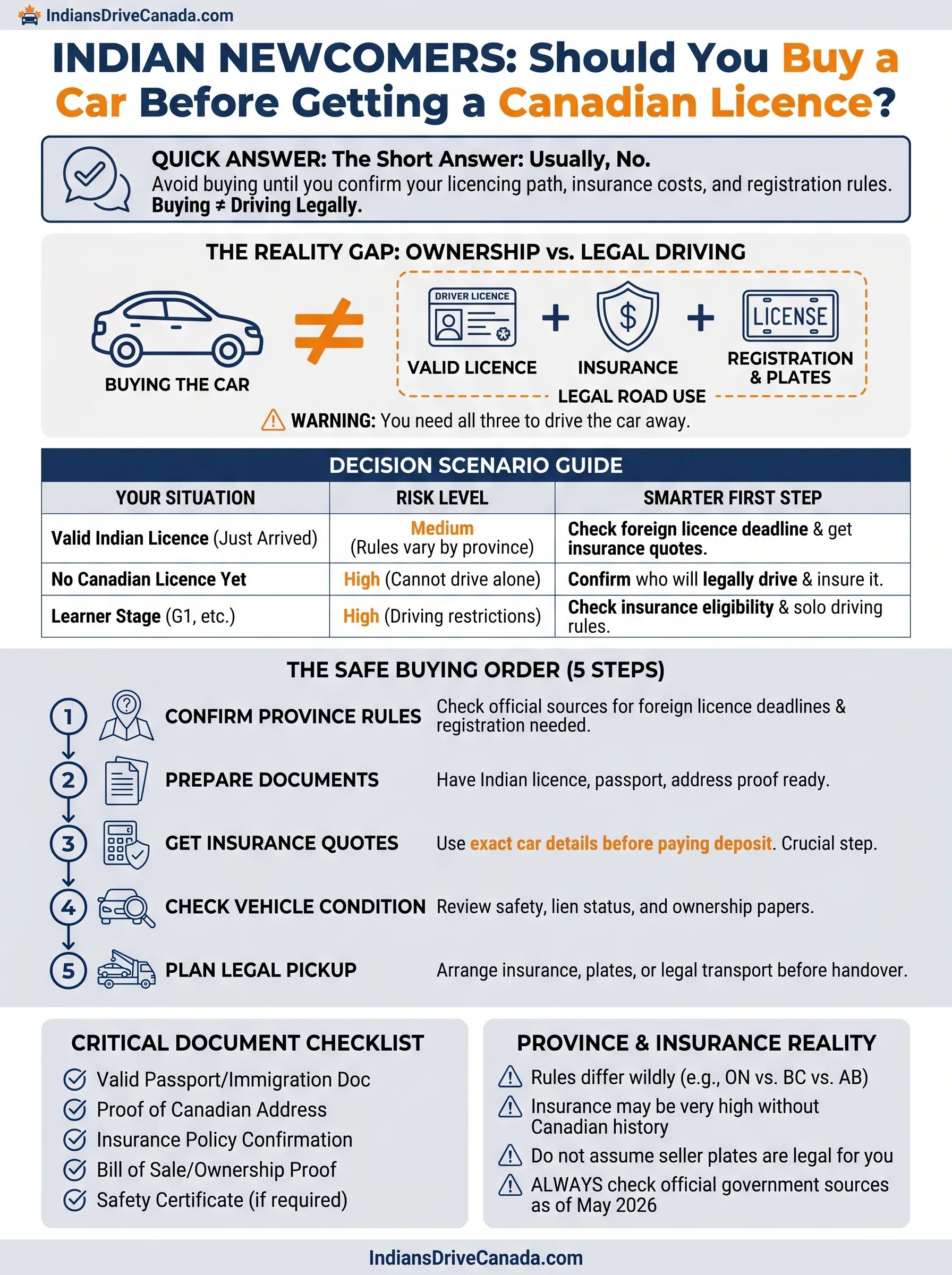
Most Indian newcomers should confirm their provincial licence path and obtain an insurance quote before buying a car. A person may be able to purchase or register a vehicle without already holding that province’s driver’s licence, but ownership does not create permission to drive. The car may also start generating insurance, financing, parking and depreciation costs while the buyer is still restricted from using it alone.
Buying before the Canadian driver’s licence can make sense when the Indian licence remains legally usable, insurance for the exact vehicle is confirmed, and the car is needed immediately for work or family transport. Otherwise, waiting until the licence level and driving-experience credit are known usually produces a safer purchase decision.
Four separate permissions must line up
The decision is not simply whether a newcomer is allowed to pay for a car. Four separate matters determine whether the purchase will provide usable transport.
| Matter | What it establishes | What it does not establish |
|---|---|---|
| Purchase and ownership | The bill of sale or purchase contract identifies the buyer and the vehicle. | It does not authorize the buyer to drive the vehicle. |
| Registration | The province records the vehicle and its registered owner. | It does not replace a valid driver’s licence. |
| Insurance | A policy covers the vehicle, declared drivers and selected risks under its terms. | It does not make an unlicensed or restricted driver legally eligible to drive. |
| Driving authority | A valid foreign or provincial licence permits the holder to drive within the conditions that apply to that licence. | It does not guarantee affordable insurance or successful vehicle registration. |
A provincial driver’s licence is not always the only identification accepted for vehicle registration. Ontario, for example, accepts either a driver’s licence or an eligible identity document showing the person’s legal name, date of birth and signature. Proof of insurance is still required before registration.[Registration rule]
This can make ownership possible before an Ontario licence is issued, but it does not change whether the owner is legally permitted to drive.
The foreign-licence deadline can determine whether the car is usable
Each province controls how long a new resident may use a valid foreign licence. The period is not a Canada-wide allowance, and the rules for new residents may differ from those for visitors, students or other temporary residents.
| Province | General new-resident period | Typical issue for an Indian licence holder | Effect on buying early |
|---|---|---|---|
| Ontario | A valid foreign licence may generally be used for 60 days after becoming an Ontario resident.[Resident deadline] | An Indian licence is not a straight-exchange licence. Testing and Ontario’s experience-credit rules must be considered. | The 60-day period can expire before a road test or insurance issue is resolved. |
| British Columbia | A new resident generally has 90 days to obtain a B.C. licence.[B.C. licence route] | Applicants whose licences are not from an exchange jurisdiction normally need a knowledge test and road test. | Proof of previous experience can affect both the licence level and the insurance calculation. |
| Alberta | A person living permanently in Alberta must generally change the licence within 90 days of becoming a resident.[Alberta licence route] | An Indian licence follows Alberta’s non-reciprocal route, which includes a knowledge test, document review and road test. | The applicant may temporarily hold a supervised Class 7 licence while experience documents are reviewed. |
| Québec | A new resident may generally drive with a valid foreign licence for up to six consecutive months.[Québec licence window] | A licence from a jurisdiction without an exchange agreement normally requires knowledge and road testing. | The longer initial period may help, but the road-test result can immediately change driving authority. |
Do not calculate the deadline only from the date of arrival in Canada. The relevant date may be when the person became a resident of the province. A visitor, international student, temporary worker and permanent resident may not always be treated in the same way.
Confirm the rule for the person’s actual status before relying on an Indian licence to collect or drive a newly purchased car.
Ontario’s July 2026 change affects the purchase sequence
Effective July 1, 2026, Ontario applicants from countries without a licence-exchange agreement can receive credit for up to one year of previous driving experience by presenting a valid original foreign licence and an authentication document. The authentication document must come from the foreign government or issuing agency, confirm that the licence is genuine, and be written in English or French.[Experience credit]
This credit can shorten part of Ontario’s graduated licensing timetable, but it does not turn an Indian licence into an automatic full G licence. The applicant must still meet the testing and eligibility rules that apply to a non-exchange jurisdiction.
Ontario insurance practices are in a transition period. FSRA states that MTO-recognized foreign experience is valid for personal auto insurance rating. Insurers are expected to use MTO-verified foreign experience in their rating and underwriting practices as soon as practicable before January 1, 2027.[Insurance transition]
This does not promise that every insurer will immediately produce the same price. A newcomer should ask whether the verified experience already appears on the Ontario motor vehicle record and how the selected insurer will use it.
When buying before the Ontario licence may work
- The Indian licence is valid and the 60-day resident period has not expired.
- The applicant has already started the Ontario licensing process.
- The foreign licence and authentication document have been reviewed or are ready for submission.
- An insurer has confirmed coverage for the exact vehicle under the buyer’s real licence status.
- The car is needed immediately rather than being purchased only because its advertised price appears low.
When waiting is usually safer in Ontario
British Columbia links the licence record and insurance calculation
B.C. requires a new resident to provide driver-licence history. An applicant who cannot prove more than two years of full, non-learner experience may enter the Graduated Licensing Program. ICBC also says it can credit up to 15 years of previous driving experience for insurance purposes when acceptable evidence shows the original licensing date.[B.C. experience]
ICBC states that previous insurance records are not required solely to receive this experience credit. The driver-licence history is the main record. New B.C. residents may also have their premiums adjusted during their first three years of driving in the province even when earlier experience is recognized.
What an ICBC experience record must show
An original driver record or letter of experience used for a Graduated Licensing Program exemption must come from a verifiable licensing authority and include:
- The driver’s name and date of birth
- The licence number or another unique identifier
- The class or classes of licence held
- The date the licence was originally issued
- The licensing authority’s name, address and telephone number
- An approved translation when the record is not in English
For an Indian record, an emailed copy carried by the applicant should not be assumed to satisfy the in-person original-document requirement.
Buying before the B.C. licence is more defensible when the driver is still within the 90-day period, ICBC has accepted the experience documents, and an Autoplan estimate has been prepared for the actual vehicle and declared drivers. Waiting is usually better when the buyer may receive a restricted novice licence or when the experience record is still under verification.
Alberta applicants may temporarily be limited to supervised driving
For a licence from a country without an Alberta exchange agreement, the applicant must pass a Class 7 knowledge test, surrender the foreign licences held, and submit residence, legal-status and experience documents. The file is then reviewed for the Graduated Driver Licensing exemption process.[Class 7 review]
While the file is under review, the person may drive only under Class 7 conditions with an eligible supervising driver. Alberta instructs applicants to return to a registry office after 10 business days to check the decision. An accepted exemption can provide access to the Class 5 road test without the normal learner waiting period, but it does not remove the road test itself.
A Class 7 licence will not solve a plan to commute alone. Buying a car while the applicant can drive only with a qualifying supervisor may leave the vehicle unavailable for the purpose that justified the purchase.
Alberta vehicle registration requires proof of ownership, valid insurance in the name of the person requesting registration, and acceptable identification.[Alberta registration] This means the registration question should be checked separately from the driver’s Class 7 or Class 5 eligibility.
Québec has a longer window but a sharper road-test consequence
The six-month foreign-licence period can make an early purchase appear easier in Québec. The driver may have more time to use a valid Indian licence while completing the SAAQ process, provided the licence authorizes the correct vehicle class and the person remains eligible under the new-resident rule.
However, SAAQ warns that an applicant who fails the road test is no longer authorized to drive with the foreign licence.[Road-test consequence] The applicant may then need a learner’s licence and an eligible accompanying driver.
Do not base the purchase on the assumption that the Indian licence will remain usable after an unsuccessful road test. Arrange alternative transport and a qualified driver before attending the test in a personally owned vehicle.
For a vehicle bought from a Québec dealer, registration can be completed using a driver’s licence or another official photo identity document. The vehicle must also have private civil-liability insurance with at least CAD 50,000 of coverage.[Québec registration]
Situations where buying before the provincial licence may be reasonable
| Situation | Purchase position | Condition that must be resolved first |
|---|---|---|
| Confirmed job requires immediate travel | Buying early may be reasonable. | The buyer must be legally able to drive alone and must have insurance for the exact vehicle. |
| Valid Indian licence and provincial deadline has not expired | A conditional purchase may work. | The provincial licence application should already be underway, with enough time for tests and document review. |
| Licensed spouse will genuinely be the principal driver | A family purchase may be practical. | The policy must reflect who will actually drive the car most often. |
| Only a learner licence will be available | Waiting is usually safer. | The vehicle will not provide independent transport until supervision restrictions end. |
| Road test is booked soon | Waiting can reduce uncertainty. | The licence level and insurance record may be clearer after the test. |
| Address, job location or province may change | Delay the purchase. | Parking, commute, registration and insurance costs may change after relocation. |
| Vehicle was selected before an insurance estimate | Do not commit yet. | Obtain a quote using the actual vehicle identification number or exact model details. |
Documents from India should be prepared before car shopping
A newcomer should not assume that the plastic Indian driving licence alone proves every year of experience. The licence may show a recent renewal date rather than the original licensing date, and provinces may require a separate record from the issuing authority.
Licence and experience records
- Original valid Indian driving licence: needed to show the licence held and the authorized vehicle category.
- Driving extract or licence-history record: should identify the original issue date, current status, licence class and issuing authority.
- Authentication letter: required for Ontario’s post-July 1, 2026 foreign-experience credit when the licence comes from a non-exchange jurisdiction.
- Translation: may be required when the licence or supporting record does not meet the province’s language and format rules.
- Name-matching documents: useful when the name on the Indian licence differs from the passport, immigration document or Canadian identity record.
Records an insurer may ask to review
- Previous claims-history or no-claims letter
- Past insurance policy documents
- Driver record showing convictions or suspensions
- Proof of the date the first full, non-learner licence was issued
These insurance records are not accepted in the same way by every insurer or province. A claims letter should not be described as a replacement for an authority-issued driver-licence history.
Obtain the official experience record before attending a licensing office that may require surrender of the Indian licence. Keep clear copies for personal records, but do not assume a copy will replace an original document where the province requires the original.
The insurance estimate should be tied to the actual vehicle
A general estimate for a newcomer is not enough to judge whether a particular car is affordable. The postal code, vehicle model, model year, repair cost, theft record, annual distance, use of the vehicle and listed drivers can all change the price or the insurer’s conditions.
Before paying a deposit, provide the broker or insurer with the exact vehicle identification number when available and ask:
- Can coverage begin while the buyer is driving on a valid Indian licence?
- Which foreign driving-experience documents will be accepted?
- Does the experience need to appear on the provincial driver record first?
- Who will be recorded as the principal driver?
- Which household members must be listed?
- Will the premium change after the provincial licence is issued?
- What happens if the road test is delayed or unsuccessful?
- Does the vehicle require an anti-theft device, tracking system or added charge?
- Will financing require collision and comprehensive coverage?
- Can the policy be cancelled or changed if the licensing result makes the car unusable?
Do not name another family member as the principal driver only to obtain a lower quote. The application must describe who will actually drive the vehicle most often. A spouse can be the principal driver when that reflects the real use of the car, not merely because the buyer has not yet received a Canadian licence.
A parked car can become an expensive waiting room
The purchase price is only one part of the early-buying decision. Payments and ownership costs can begin before the car provides independent transport.
Calculate the cost of waiting for driving eligibility
Monthly waiting cost = finance or lease payment + insurance + parking + estimated depreciation + storage or basic maintenance
Total cost before regular use = monthly waiting cost × expected waiting months + registration, inspection and preparation expenses
Compare that result with the cost of public transit, taxi, rideshare, car-share or short-term rental during the same period.
The calculation should include costs that are easy to overlook:
A discounted vehicle is not a saving when months of fixed costs exceed the discount.
Use the licence decision to narrow the vehicle search
1. Identify the rule for the actual status
Confirm whether the buyer is treated as a new resident, student, visitor or another temporary resident. Record the date on which the provincial foreign-licence period began.
2. Submit the Indian experience evidence
Complete the driving-history, authentication and translation work before assuming that several years of Indian experience will reduce a waiting period or insurance price.
3. Determine the licence level likely to be issued
Find out whether the next stage is a full licence, novice licence or supervised learner licence. The answer determines whether the car can provide independent transport.
4. Compare several vehicles through insurance
Request estimates for more than one model. A slightly more expensive vehicle may have a lower total cost when insurance, repair exposure and lender requirements are included.
5. Inspect the purchase before accepting the financial commitment
For a used vehicle, confirm ownership documents, lien status, required safety inspection and the condition of the vehicle. Keep the licensing issue separate from the mechanical and ownership checks.
6. Pay the deposit after the insurance path is confirmed
Ask for the deposit and cancellation conditions in writing. Do not rely on a verbal statement that insurance or registration “should be fine.”
Assumptions that can leave the car unusable
| Assumption | What can go wrong | Better action |
|---|---|---|
| “The dealer sold the car to me, so I can drive it.” | A sale contract does not create driving authority. | Confirm the licence status, registration and insurance separately. |
| “My Indian licence will become a full Canadian licence.” | India is not treated as a straight-exchange jurisdiction in the provinces covered here. | Check the knowledge test, road test and experience-credit route for the province. |
| “An international driving permit extends my resident deadline.” | An IDP is normally used with the underlying licence and does not automatically cancel a provincial resident deadline. | Follow the resident rule published by the provincial licensing authority. |
| “The cheapest used car will have the lowest total cost.” | Insurance, inspection, repair and financing costs may be higher. | Compare the total ownership cost for several vehicles. |
| “I need to buy a car for the road test.” | The car may generate months of costs before or after the test. | Compare driving-school test-vehicle services and other legal arrangements first. |
| “My insurance price will automatically fall after I submit an Indian record.” | The record may need provincial verification, and insurer treatment can vary. | Ask for a revised written estimate after the accepted experience appears in the relevant system. |
The three confirmations to obtain before signing
An early purchase is most defensible when all three statements are true:
- Driving authority: the buyer is legally permitted to drive the car now, or a genuinely licensed principal driver will use it.
- Insurance availability: an insurer has confirmed coverage for the exact vehicle, actual drivers and intended use.
- Near-term usefulness: the vehicle will be used soon enough to justify the financing, insurance, parking and depreciation that begin at purchase.
When one of these remains uncertain, the safer next step is usually to complete the licence or document decision before committing to the vehicle.