Canadian Parking Test Guide for Indian Drivers
Canada does not use one national parking-test script. The manoeuvres you may be asked to perform depend on...
Canadian Road Test Checklist for Indian Drivers
Indian driving experience can make vehicle control feel familiar, but a Canadian road test measures whether that experience...
G1 Practice Test for Indians in Canada — 200 Questions (2026)
This Ontario G1 practice test for Indian newcomers contains 200 original study questions: five mock tests, each with...
G1 Test Tips for Indian Immigrants: What’s Different From India’s Rules
The most useful G1 test tips for Indian immigrants begin with one adjustment: replace left-side traffic habits with...
G2 Road Test Tips for Indians in Ontario: Common Mistakes to Avoid
Preparing for the Ontario G2 road test can feel unfamiliar even when you have driven for years in...
5 articles in Driving Tests Canada Indians
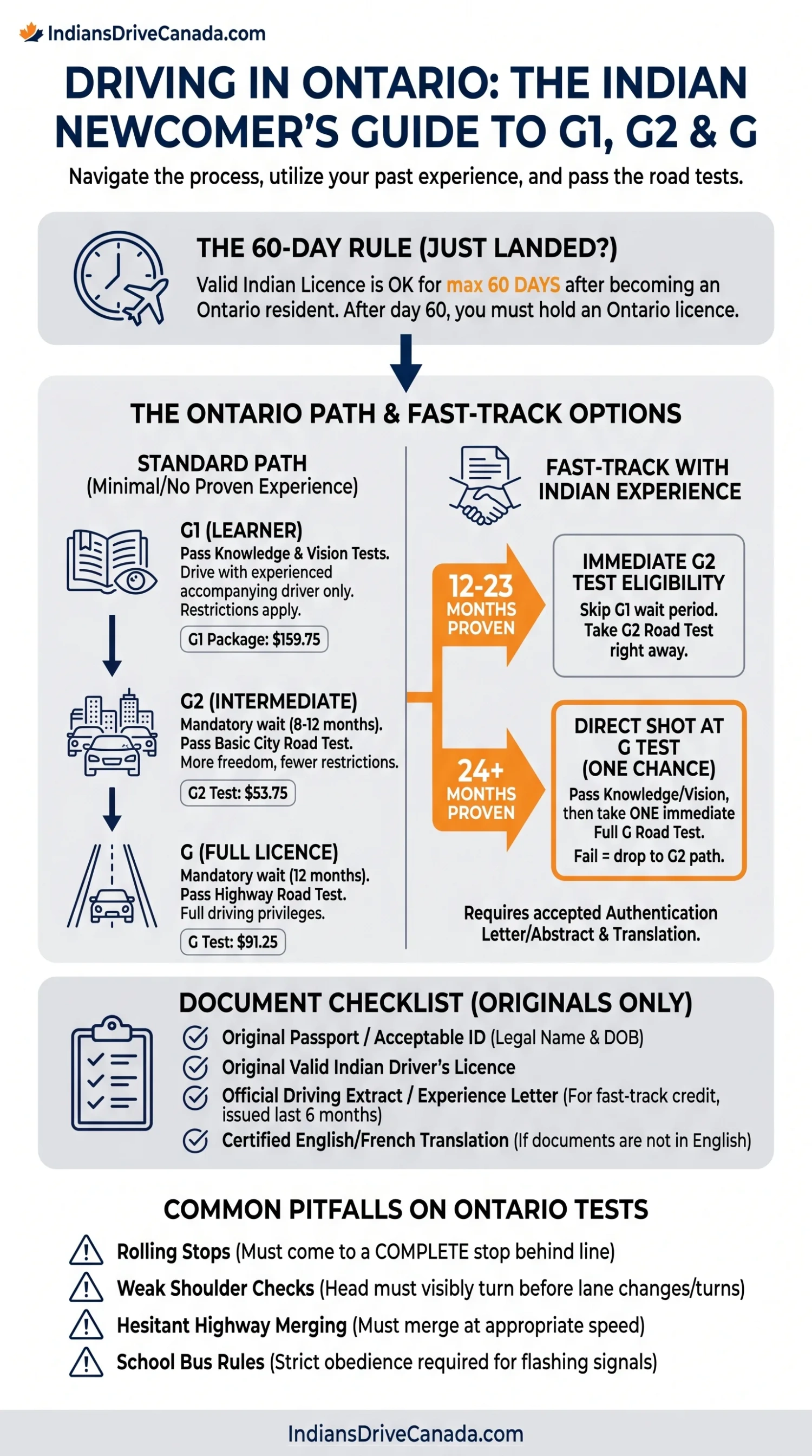
For an Indian licence holder settling in Ontario, the test path now has a fixed order: application and knowledge requirements, G2 road test, at least 12 months at G2, then the G road test. Foreign driving experience can change when you become eligible for G2, but it cannot remove the G2 stage or shorten the mandatory G2-to-G waiting period.
| Ontario stage | What happens | Effect of accepted Indian driving experience |
|---|---|---|
| Application, vision, and knowledge | Identity and licence documents are reviewed; vision and knowledge requirements are completed | Experience documents can support the amount of credit entered on the Ontario record |
| G2 eligibility | Road test for everyday driving skills | Up to 12 months of accepted foreign experience can reduce the wait; 12 months allows immediate G2 eligibility |
| G2 holding period | Ontario driving experience before the full G test | Foreign experience cannot reduce the minimum 12-month wait |
| G road test | Advanced road and highway skills | Required after the G2 holding period |
Before testing: Ontario’s 60-day foreign-licence window
A valid Indian licence can be used only for a short period after you become an Ontario resident. Ontario says a valid licence from another country can be used for up to 60 days. After that, you need to apply for an Ontario driver’s licence. If you are settling in Ontario as a PR, worker or student and plan to stay, do not treat your Indian licence as a long-term solution.
For Indian newcomers, the first thing to understand is that G1, G2 and G are Ontario terms. Your Indian licence does not convert straight into a full Ontario G because India is not on Ontario’s direct exchange list. You still enter the Ontario system, but previous driving experience can reduce the waiting period before your G2 road test.
Ontario now credits no more than 12 months of eligible foreign driving experience for Class G applicants from non-reciprocal jurisdictions. If Ontario accepts the full 12 months, you can take the G2 road test without an additional G1 waiting period. If less than 12 months is accepted, that amount reduces the normal wait before G2. Experience beyond 12 months gives no additional Class G licensing credit.
Only eligible experience within the previous three years can be credited under the current rule. If your licence itself does not prove all the experience you are claiming, Ontario may require an acceptable authentication document.
If you are only visiting Ontario for a short period, the rules are different. This page is for newcomers who are moving and becoming residents, not short-term visitors.
Start your Ontario application early in your first month, not near day 60, so you have time to fix document or translation issues.
Ontario test stages for Indian licence holders
Ontario’s passenger-car system has three stages. G1 is the learner stage, G2 is the intermediate stage, and G is the full licence. For a driver starting without recognized foreign experience, the usual waiting period before G2 is 12 months. An approved beginner driver education course can reduce that first wait to 8 months. After receiving G2, you normally need at least 12 months of driving experience before taking the G road test.
The test sequence is:
- Study for the G1 knowledge test. Use the Official MTO Driver’s Handbook. The test covers road signs and rules.
- Go to a DriveTest centre and apply. Bring original acceptable identity documents, your valid Indian licence, and any documents needed to support your foreign driving experience. You will also take a vision test.
- Pass the knowledge test and obtain G1 status. With G1, you must follow Ontario’s learner restrictions, including the accompanying-driver requirements.
- Have your foreign experience credited. If Ontario accepts less than 12 months, the accepted amount reduces the waiting period before G2. If Ontario accepts at least 12 months, the credit is capped at 12 months and you may take the G2 road test immediately.
- Pass the G2 road test. This test checks everyday driving skills such as turns, stops, lane changes, parking, observation and vehicle control.
- Hold G2 for at least 12 months. Previous Indian driving experience cannot be used to shorten this waiting period.
- Take the G road test. The G test includes more advanced driving skills and a highway component. Passing it gives you a full Class G licence.
| Ontario fee | Official amount |
|---|---|
| G1 licence package | $159.75 |
| Extra knowledge test attempt | $16.00 |
| G2 road test | $53.75 |
| G road test | $91.25 |
| Five-year licence | $90.00 |
The G1 package includes the knowledge test, one G2 road test and a five-year licence. Additional tests or services can create extra charges depending on your situation. The old fixed $106 foreign licence application amount is no longer listed as a separate Class G service on the current DriveTest fee table. Check the official DriveTest fee page before applying because fees can change.
The G2 test focuses on basic road-driving skills. The G test assesses more advanced driving and includes a highway component. DriveTest currently states that you must practise for at least one year after obtaining G2 before qualifying for the G road test.
If your road-test car does not meet safety rules, DriveTest can mark the test out of order and you may lose time and money.
Where foreign driving experience changes the schedule
The benefit is limited to the period before G2. Ontario can give up to 12 months of foreign driving-experience credit to a Class G applicant from a jurisdiction without an exchange agreement.
If Ontario accepts 12 months of your Indian driving experience, you may take the G2 road test immediately after meeting the applicable application, vision and knowledge-test requirements. You cannot use additional Indian experience to skip G2 or move directly to the G road test.
If Ontario accepts less than 12 months, the credited amount reduces the normal G1 waiting period. For example, six months of accepted foreign experience generally leaves six more months before you become eligible for the G2 road test under the normal 12-month route.
After you pass G2, everyone following this non-reciprocal Class G route must wait at least 12 months before attempting the G road test. Your Indian driving history does not reduce that second waiting period.
| Accepted foreign driving experience | What Ontario allows | Tests still needed |
|---|---|---|
| 0 to 11 months | Accepted experience reduces the applicable wait before G2 | G2, then at least 12 months before G |
| 12 months | Immediate G2 road test eligibility | G2, then at least 12 months before G |
| More than 12 months | Credit remains capped at 12 months; no direct G eligibility | G2, then at least 12 months before G |
If your current foreign licence does not prove all the experience you are claiming, an authentication letter may be needed. Ontario states that an acceptable letter used to establish the additional period should be issued within the previous six months by the embassy, consulate or licensing agency and be in English or French. Only eligible foreign experience from within the previous three years can be credited, up to the 12-month maximum.
Indian drivers can no longer use 24 or more months of foreign experience to bypass the G2 stage and attempt the full G road test immediately.
If your Indian licence or experience letter is not in English or French, arrange any required translation before your Ontario appointment.
DriveTest documents that can affect eligibility
Document gaps can delay the application even when the driving history itself is genuine. DriveTest asks for original documents when you apply. If the names on your papers do not match exactly, you may also need documents linking the different names.
- Original acceptable ID showing your legal name and full date of birth
- Your original valid Indian licence
- Driver abstract or authentication letter, when needed to establish the experience you want credited
- English or French translation, where Ontario’s translation rules require one
- Corrective lenses, if you use them, for the vision test
| Document | Why it matters | Common problem |
|---|---|---|
| Passport or accepted identity document | Proves legal name and date of birth | Name mismatch with licence |
| Indian driving licence | Starts your foreign experience review | Expired, digital-only or damaged card |
| RTO abstract or authentication letter | Can help establish previous experience that the current card does not show | Too old, missing licence-history details or not accepted as authentication |
| Translation | Makes documents usable when a translation is required | Translation does not meet Ontario requirements |
DriveTest may retain some supporting experience documents and translations, so keep copies for your records before your visit. Remember that even a document proving many years of Indian driving cannot produce more than 12 months of Class G foreign-experience credit under the rule effective July 1, 2026.
DriveTest offers computerized G1 knowledge tests in multiple languages, including Hindi, Punjabi, Urdu, Bengali and Tamil. This can help if you are more comfortable reading road-rule questions in one of those languages.
Original documents matter, and weak copies can turn a same-day plan into a repeat visit.
How the test system differs outside Ontario
G1 and G2 are Ontario terms only. Other provinces have their own names, grace periods and testing rules. Advice from a friend in Vancouver or Calgary can therefore be misleading for a newcomer in Mississauga or Brampton. Your Indian licence may remain usable for a short period after you move, but the province where you live decides what happens next.
| Province | How long an Indian licence is usually valid after you move | Test required for most Indian licence holders | Official link |
|---|---|---|---|
| Ontario | 60 days | Yes; foreign Class G experience can reduce the wait before G2 by up to 12 months | DriveTest |
| British Columbia | 90 days | Usually yes; accepted previous experience can affect your B.C. licensing path | ICBC |
| Alberta | 90 days for new residents | Usually yes for non-reciprocal jurisdictions | Alberta.ca |
| Québec | 6 months | Rules depend on reciprocity; India is not on the standard reciprocal list | SAAQ |
| Manitoba | 3 months | Yes for non-reciprocal countries | MPI |
| Saskatchewan | 90 days | Usually yes unless an exchange or other applicable rule changes your path | SGI |
| Nova Scotia | 180 days from the day you become a resident | Yes; India is not on the listed-country exchange table, so vision, knowledge and road tests are required | Nova Scotia |
| Prince Edward Island | Up to 4 months after becoming a resident | Yes; the non-reciprocal route requires a written knowledge test, the Novice Driver Course for Newcomers (NDCN) and a driving test | Prince Edward Island |
For the province-specific process, see Indian driving licence rules in Nova Scotia and Indian driving licence rules in Prince Edward Island.
British Columbia online knowledge tests from June 2026
British Columbia added an online option for passenger-vehicle and motorcycle learner knowledge tests on June 9, 2026. ICBC now allows eligible applicants to take Class 5 and 7 passenger-vehicle knowledge tests, as well as Class 6 and 8 motorcycle knowledge tests, either online or in person.
The online test uses the same test questions and requires an 80% passing score. ICBC lists a 45-minute testing period and a $15 test fee. Eligible B.C. residents can take it without booking an appointment, provided they meet the online testing requirements.
Punjabi is one of the languages available for the online knowledge test. Other listed languages include English, Arabic, Croatian, French, Farsi, Traditional Chinese, Simplified Chinese, Russian, Spanish, Ukrainian and Vietnamese.
ICBC online knowledge test information
How the current B.C. GLP rule works
The current rule does not remove every B.C. road test. It replaces the second road test previously used to exit the Graduated Licensing Program for eligible Class 7 Novice drivers.
Since October 19, 2026, ICBC has used a Driving Record Assessment for eligible Class 7 Novice drivers progressing to Class 5. Drivers under 25 generally need at least 24 months of safe driving, reduced to 18 months if they completed an approved GLP course during the learner phase. Drivers aged 25 or older generally need at least 12 months of safe driving.
The assessment also looks for specified problems on the driving record. ICBC states that applicants must not have qualifying prohibitions or suspensions during the required period and must meet the rules concerning excessive-speed and electronic-device convictions.
After an eligible driver upgrades, the Class 5 licence receives restriction 55, requiring zero blood alcohol and zero blood drug content while driving for 12 months. If a prohibition or suspension occurs during that period, ICBC says the 12-month restriction period restarts after the licence is reinstated.
This matters to Indian newcomers whose B.C. licensing path places them in the Class 7 Novice stage. It should not be read as a rule that automatically converts every Indian licence to Class 5 without testing.
ICBC Graduated Licensing Program changes
If you are taking a road test in Ontario, stay focused on Ontario rules. If you are licensing in B.C., check whether your application puts you into the Class 7 process and whether you meet the current Driving Record Assessment requirements.
If you may move provinces later, keep copies of your old licence history and insurance history because both can be useful again.
Driving habits examiners mark closely
Experienced drivers can still lose marks when familiar habits do not match the local test standard. That is especially true in the Ontario G2 and G tests, where the examiner wants visible, rule-based driving rather than fast problem-solving.
- Rolling stops: A full stop means the vehicle stops fully behind the line, not a slow crawl.
- 4-way stop order: The first vehicle to stop goes first. If two arrive together, the vehicle on the right usually has priority.
- Shoulder checks: Examiners want a clear head movement before lane changes, merges and many turns.
- School bus rules: Ontario expects strict obedience when a stopped school bus shows its signals.
- Highway merging: On the full G test, timid merging can hurt you almost as much as aggressive merging.
- Winter readiness: In snowy provinces, poor spacing and late braking create easy mistakes.
Many Indian drivers are used to making fast adjustments in dense traffic. That real-world experience helps in Canada too, but the test format rewards calm, visible decisions. The examiner must see that you checked mirrors, scanned intersections, stayed in the correct lane and followed posted rules even when the road looks empty.
The official Ontario testing material continues to expect full stops, proper lane discipline, clear observation checks and safe highway driving. One or two refresher lessons with an Ontario instructor can therefore be useful even for an experienced driver.
Do not let confidence from years of driving in India turn into casual habits during the test, because small observation mistakes can add up.
Before you book: questions to settle
Before booking, confirm whether your paperwork will be accepted, how much foreign experience Ontario will recognize, and which test you are currently eligible to take.
Questions to resolve before the appointment:
- Can years of Indian driving still let me go directly to the full G road test?
- Will DriveTest accept my RTO extract or authentication letter?
- Do I need to surrender my Indian licence when I apply?
- Should I book inside the GTA or try another Ontario test centre?
For the first question, the current answer is no. Since July 1, 2026, Indian Class G applicants cannot use 24 or more months of foreign experience to skip directly to the G road test. Ontario can recognize no more than 12 months for the G1-to-G2 part of the process. After G2, the minimum 12-month wait before G still applies.
An RTO record or authentication document can still matter because Ontario must be able to verify the experience you want credited. The current foreign licence, supporting documents and any required translation should meet DriveTest’s document rules.
Booking availability can differ by test centre, so applicants often compare available dates across Ontario rather than waiting for one location.
If you want the full 12 months of foreign-experience credit, make sure your documents actually establish the period Ontario is being asked to recognize.