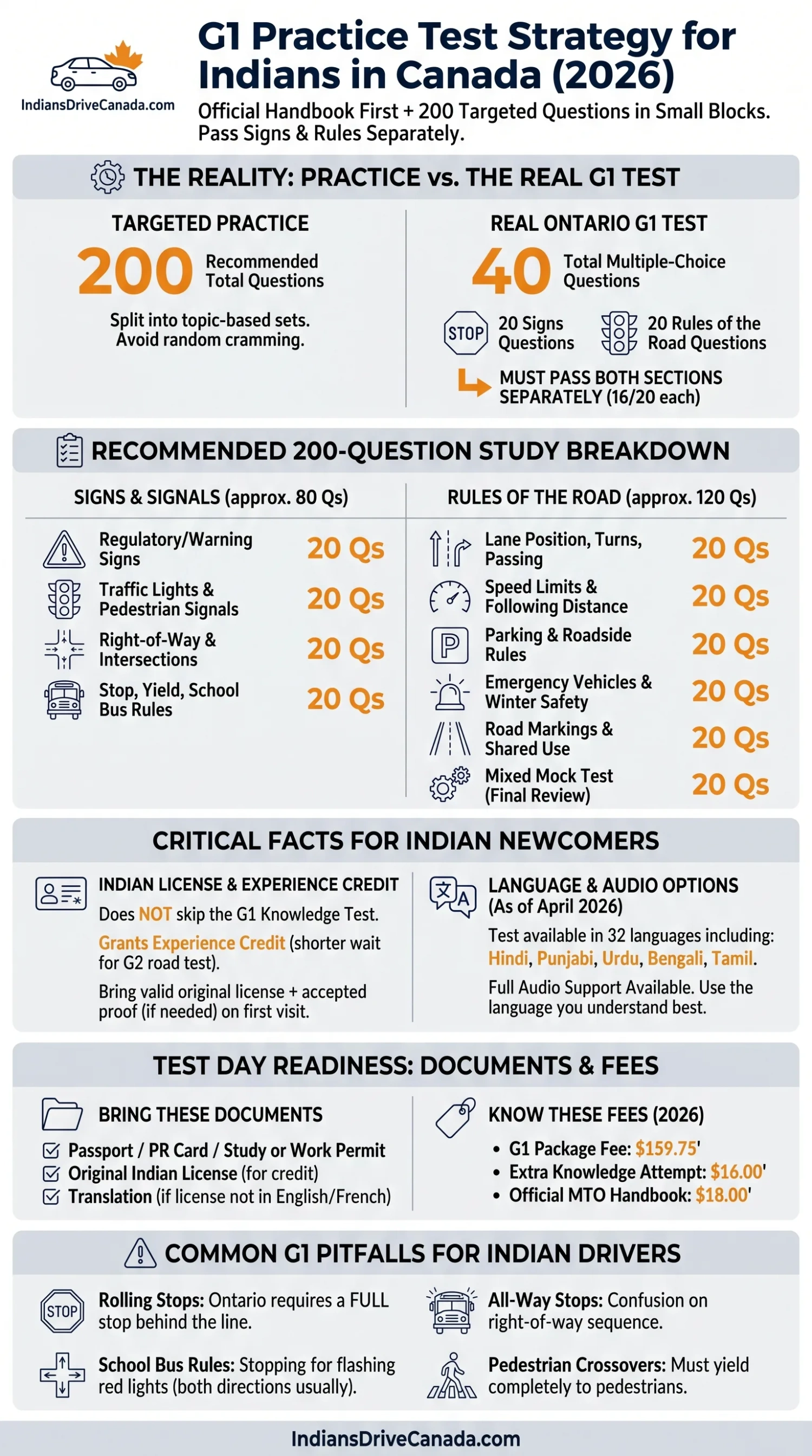
This Ontario G1 practice test for Indian newcomers contains 200 original study questions: five mock tests, each with 20 road-sign questions and 20 rules-of-the-road questions. The questions are based on topics covered in the Official MTO Driver’s Handbook, checked on October 25, 2026.
Use a target of at least 16 correct answers out of 20 in each section. DriveTest states that a knowledge test requires a score of at least 80% and that, when a test is retaken within one year, only sections that did not meet MTO standards need to be retaken.
These are not official DriveTest questions. They are independently written practice questions. The official test can use different wording, answer order and scenarios. Study the handbook instead of memorizing only the answer letters on this page.
How the 200 questions are divided
Each mock test keeps road signs and road rules separate. This makes it easier to see whether a high score in one area is hiding a weak area in the other.
| Mock test | Road signs | Road rules | Main focus |
|---|---|---|---|
| Test 1 | 20 | 20 | Core signs, G1 conditions and basic right-of-way |
| Test 2 | 20 | 20 | Warning signs, intersections, turns and lane changes |
| Test 3 | 20 | 20 | Work zones, school buses, streetcars and shared roads |
| Test 4 | 20 | 20 | Signals, highways, parking and railway crossings |
| Test 5 | 20 | 20 | Pavement markings, winter driving, emergencies and 2026 licence rules |
Indian licence holders and the July 1, 2026 Ontario change
India does not have a direct passenger-vehicle licence exchange agreement with Ontario. An Indian licence holder normally enters Ontario’s graduated licensing process and completes the required vision, knowledge and road tests. A new Ontario resident may use a valid foreign driver’s licence for up to 60 days after moving to the province; after that, an Ontario licence is required.
Rule in effect from July 1, 2026: an eligible driver from a jurisdiction without an exchange agreement may receive up to 12 months of verified foreign driving-experience credit. Only eligible experience from the previous three years can be credited. The driver must still complete both the G2 and G road tests, and credited experience cannot reduce the mandatory 12-month waiting period between those two road tests.
The credit is not automatic. DriveTest requires an original, valid foreign licence and may require additional evidence to confirm licence status and driving experience. If more experience is being claimed than the licence itself shows, an acceptable letter of authentication or driver’s abstract issued within the previous six months may be required. A licence or supporting document that is not in English or French may also require an accepted translation. Check the Ontario foreign-licence rules and the foreign driving-experience credit requirements before relying on an Indian driving record, authentication letter or translation.
Road terms that can change the meaning of a test question
The wording is often as important as the traffic rule. These terms appear repeatedly in Ontario road material.
| Term | Plain-English meaning | Where it appears |
|---|---|---|
| Yield | Let another road user go first; stop if needed | Merging and intersections |
| Right-of-way | The legal priority to proceed | Turns, crossings and intersections |
| Curb | The raised edge beside a roadway | Parking and turning |
| Shoulder | The area beside the normal travel lane | Breakdowns and emergencies |
| Median | A physical strip or barrier separating opposing traffic | School-bus and divided-road questions |
| Blind spot | An area not visible in the mirrors | Lane changes and passing |
| Pedestrian crossover | A marked crossing where drivers must stop and yield as required | Pedestrian questions |
| Hydroplaning | Loss of tire contact caused by water on the road | Rain and emergency control |
| Black ice | A thin layer of ice that may be hard to see | Winter-driving questions |
Ontario driving situations worth studying separately
Scoring the mock tests
Choose an answer before opening the answer panel. Count road signs and road rules separately. A useful readiness target is 16/20 or better in both sections on more than one test, without checking notes.
Ontario G1 Practice Test 1: Core Signs and Basic Road Rules
Core regulatory signs, right-of-way and G1 licence conditions. Record the two section scores separately.
Road Signs: Questions 1–20
Question 1. Regulatory sign
A red, eight-sided sign appears at an intersection. What must you do?
- Slow down and continue if no vehicle is visible
- Come to a complete stop and proceed only when safe
- Yield only to vehicles on your right
- Stop only when pedestrians are present
Answer and explanation
Correct answer: B — Come to a complete stop and proceed only when safe
An octagonal red sign is a stop sign. Stop at the marked stop line, crosswalk, sidewalk edge, or intersection edge, in that order.
Question 2. Regulatory sign
What does an upside-down triangular sign with a red border mean?
- No entry
- Yield the right-of-way and stop if necessary
- Railway crossing
- School zone
Answer and explanation
Correct answer: B — Yield the right-of-way and stop if necessary
The yield sign tells you to let traffic in or close to the intersection go first and to stop when required.
Question 3. Regulatory sign
A symbol is shown inside a red circle with a diagonal line through it. What does this design mean?
- The activity is recommended
- The activity is allowed during daylight
- The activity is prohibited
- The road is closed only to trucks
Answer and explanation
Correct answer: C — The activity is prohibited
A red circle with a diagonal line marks an action that is not allowed.
Question 4. Regulatory sign
A traffic movement is shown inside a green circle. What does the green circle usually mean?
- The movement is permitted or required
- The movement is prohibited
- The road is slippery
- The sign applies only to buses
Answer and explanation
Correct answer: A — The movement is permitted or required
A green circle indicates that the movement shown is allowed or must be followed.
Question 5. Regulatory sign
A white rectangular sign shows “Maximum 60.” What does the number represent?
- The recommended speed in good weather
- The minimum speed
- The maximum legal speed in kilometres per hour
- The distance to the next town
Answer and explanation
Correct answer: C — The maximum legal speed in kilometres per hour
A maximum-speed sign states the highest legal speed in kilometres per hour under normal conditions.
Question 6. Regulatory sign
What does a red sign with a horizontal white bar across the centre mean?
- Do not enter this road from your direction
- Stop only for oncoming traffic
- Road closed after dark
- One-way traffic ends
Answer and explanation
Correct answer: A — Do not enter this road from your direction
The do-not-enter sign means vehicles must not enter from that direction.
Question 7. Regulatory sign
A rectangular sign has a white arrow pointing in one direction on a black background. What does it tell you?
- Traffic may travel only in the arrow’s direction
- A sharp curve begins
- Passing is allowed
- The road becomes two-way
Answer and explanation
Correct answer: A — Traffic may travel only in the arrow’s direction
A one-way sign shows the only permitted direction of travel.
Question 8. Regulatory sign
A sign shows a right-turn arrow crossed by a red circle and slash beside a red-light symbol. What does it mean?
- Right turns are allowed after slowing
- Do not turn right while facing a red light
- Right turns are required
- Right turns are allowed only for buses
Answer and explanation
Correct answer: B — Do not turn right while facing a red light
The sign removes the usual option to turn right on red at that intersection.
Question 9. Regulatory sign
A black arrow bends around an obstacle with the words “Keep Right.” What must you do?
- Pass the obstacle on its right side
- Turn right at the next street
- Move to the left lane
- Stop beside the obstacle
Answer and explanation
Correct answer: A — Pass the obstacle on its right side
Keep-right signs direct traffic to pass to the right of an island, median, or obstruction.
Question 10. Regulatory sign
A white sign reads “Do Not Pass.” What action is prohibited?
- Passing another vehicle in the signed area
- Changing lanes to the right
- Driving below the speed limit
- Stopping on the shoulder
Answer and explanation
Correct answer: A — Passing another vehicle in the signed area
The sign marks an area where overtaking another vehicle is not allowed.
Question 11. Regulatory sign
What is the message of a “Slower Traffic Keep Right” sign?
- All traffic must use the right shoulder
- Drivers travelling slower than surrounding traffic should use the right lane
- Trucks must stop
- The left lane is closed
Answer and explanation
Correct answer: B — Drivers travelling slower than surrounding traffic should use the right lane
Slower vehicles should stay right so faster traffic can pass on the left where lawful and safe.
Question 12. Regulatory sign
A sign marks a pedestrian crossover. What should a driver be prepared to do?
- Sound the horn and continue
- Stop and yield to pedestrians using the crossover
- Pass any stopped vehicle
- Drive through before pedestrians reach the centre
Answer and explanation
Correct answer: B — Stop and yield to pedestrians using the crossover
Drivers must stop and yield until pedestrians have completely crossed the roadway and are safely clear.
Question 13. Regulatory sign
A school-zone speed sign has flashing lights. When does the posted lower speed normally apply?
- At all times, even when the lights are off
- Only while the lights are flashing or as the sign states
- Only on weekends
- Only when a school bus is visible
Answer and explanation
Correct answer: B — Only while the lights are flashing or as the sign states
Follow the times, flashing signals, or conditions stated on the school-zone sign.
Question 14. Railway sign
A large red-and-white X-shaped sign stands beside railway tracks. What does it identify?
- A hospital entrance
- A railway crossing
- A no-stopping zone
- A divided highway
Answer and explanation
Correct answer: B — A railway crossing
The crossbuck identifies a railway crossing. Slow down, look both ways, and be prepared to stop.
Question 15. Lane-use sign
Overhead arrows show that the left lane must turn left, the centre lane may go left or straight, and the right lane must turn right. What controls your movement?
- Your destination only
- The lane-use arrows
- The vehicle behind you
- The colour of your vehicle
Answer and explanation
Correct answer: B — The lane-use arrows
Lane-use signs and arrows tell drivers which movements are permitted from each lane.
Question 16. Lane-use sign
A centre lane is marked with left-turn arrows pointing in both directions. What is the lane for?
- Passing traffic
- Two-way left turns
- Parking
- Emergency vehicles only
Answer and explanation
Correct answer: B — Two-way left turns
A two-way left-turn lane is shared by traffic from both directions for left turns, not for passing or through travel.
Question 17. Lane-use sign
A lane sign shows a diamond symbol and an occupancy requirement. What does it identify?
- A truck inspection lane
- A high-occupancy vehicle lane
- A toll-free shoulder
- A bicycle-only lane
Answer and explanation
Correct answer: B — A high-occupancy vehicle lane
The diamond marks an HOV lane. Drivers must meet the posted occupancy or exemption rules.
Question 18. Information sign
A sign shows a bicycle on a green route marker. What does it mean?
- Bicycles are prohibited
- The road is an official bicycle route
- Only bicycles may use the entire road
- A bicycle shop is ahead
Answer and explanation
Correct answer: B — The road is an official bicycle route
The sign identifies an official bicycle route and reminds drivers to watch for cyclists.
Question 19. Regulatory sign
A white sign displays a truck symbol with a directional arrow. What does it indicate?
- A designated truck route
- A truck repair shop
- Trucks are prohibited
- A steep hill
Answer and explanation
Correct answer: A — A designated truck route
The sign directs truck traffic along an approved truck route.
Question 20. School bus sign
A sign warns drivers to stop for a school bus when its signals are flashing on a multi-lane road without a median. Who must obey it?
- Only traffic behind the bus
- Traffic approaching from both directions
- Only trucks
- Only vehicles in the curb lane
Answer and explanation
Correct answer: B — Traffic approaching from both directions
Without a physical median, drivers approaching a stopped school bus from either direction must stop when its red signals flash or stop arm is active.
Rules of the Road: Questions 21–40
Question 21. Right-of-way
Before entering a public road from a private driveway, what must you do?
- Yield to vehicles and pedestrians on the public road
- Enter first because you are on the right
- Sound the horn and proceed
- Stop only if a sign is posted
Answer and explanation
Correct answer: A — Yield to vehicles and pedestrians on the public road
Traffic already using the public road and pedestrians crossing the driveway have the right-of-way.
Question 22. Right-of-way
Two vehicles reach an uncontrolled intersection at about the same time. Which driver should normally yield?
- The driver on the left yields to the driver on the right
- The driver on the right yields to the driver on the left
- The larger vehicle yields
- The faster vehicle yields
Answer and explanation
Correct answer: A — The driver on the left yields to the driver on the right
At an uncontrolled intersection, yield to the vehicle approaching from your right when arrival is simultaneous.
Question 23. Right-of-way
At a four-way stop, one vehicle arrives clearly before the others. Who goes first?
- The vehicle that stopped first
- The vehicle on the widest road
- The vehicle turning left
- The largest vehicle
Answer and explanation
Correct answer: A — The vehicle that stopped first
The first vehicle to make a complete stop normally has the right-of-way.
Question 24. Right-of-way
Two vehicles stop at a four-way stop at the same time. One is on the other driver’s right. Who should proceed first?
- The vehicle on the right
- The vehicle on the left
- The vehicle turning left
- Whichever driver flashes headlights
Answer and explanation
Correct answer: A — The vehicle on the right
When arrival is simultaneous, the driver on the left yields to the driver on the right.
Question 25. Turning
You are turning left at an intersection while an oncoming vehicle is going straight. Who has priority?
- The oncoming vehicle
- The left-turning vehicle
- The vehicle with more passengers
- The vehicle nearest the centre line
Answer and explanation
Correct answer: A — The oncoming vehicle
A driver turning left must yield to oncoming traffic close enough to be a hazard.
Question 26. Pedestrians
A steady green light faces you, but pedestrians are crossing the road you want to turn into. What must you do?
- Yield to the pedestrians
- Turn before they reach your lane
- Sound the horn
- Proceed because the light is green
Answer and explanation
Correct answer: A — Yield to the pedestrians
A green light does not remove the duty to yield to pedestrians during a turn.
Question 27. Traffic lights
You face a red light and want to turn right. No sign prohibits the turn. What is required first?
- Come to a complete stop, then yield and turn only when safe
- Slow to 10 km/h
- Honk and turn
- Move into the crosswalk before stopping
Answer and explanation
Correct answer: A — Come to a complete stop, then yield and turn only when safe
A right turn on red is normally allowed only after a full stop and after yielding to pedestrians and traffic.
Question 28. Traffic control
A police officer directs you through a red light. What should you do?
- Follow the officer’s direction
- Obey the traffic light instead
- Wait for the light to turn green
- Turn around
Answer and explanation
Correct answer: A — Follow the officer’s direction
Directions from a police officer or authorized traffic controller take priority over signs and signals.
Question 29. Licensing
What is the minimum age to apply for an Ontario Class G1 licence?
- 16
- 15
- 17
- 18
Answer and explanation
Correct answer: A — 16
Applicants for a G1 licence must be at least 16 years old.
Question 30. Licensing
What tests must a new G1 applicant pass at the licensing stage?
- A vision test and a knowledge test
- A highway road test only
- A medical exam and a parking test
- A vehicle inspection only
Answer and explanation
Correct answer: A — A vision test and a knowledge test
A G1 applicant must meet the vision standard and pass the knowledge test.
Question 31. G1 condition
What blood-alcohol level must a G1 driver maintain while driving?
- Zero
- Below 0.05
- Below 0.08
- Any level if accompanied
Answer and explanation
Correct answer: A — Zero
Ontario’s zero-alcohol rule applies to G1 and G2 drivers.
Question 32. G1 condition
Where must the qualified accompanying driver sit when supervising a G1 driver?
- In the front passenger seat
- Anywhere in the vehicle
- In the rear seat
- In another vehicle
Answer and explanation
Correct answer: A — In the front passenger seat
The accompanying driver must sit beside the G1 driver in the front seat.
Question 33. G1 condition
How much licensed driving experience must a qualified accompanying driver normally have?
- At least four years
- At least one year
- At least two years
- No minimum
Answer and explanation
Correct answer: A — At least four years
The supervising driver must normally have held an eligible licence for at least four years.
Question 34. G1 condition
What is the highest permitted blood-alcohol concentration for an accompanying driver who is 22 or older?
- Less than 0.05
- Less than 0.08
- Zero in every case
- Less than 0.10
Answer and explanation
Correct answer: A — Less than 0.05
The accompanying driver must have a blood-alcohol concentration below 0.05. If the accompanying driver is 21 or under, the required blood-alcohol level is zero.
Question 35. G1 condition
During which hours may a G1 driver not drive?
- Midnight to 5 a.m.
- 10 p.m. to 6 a.m.
- Sunset to sunrise
- Noon to 3 p.m.
Answer and explanation
Correct answer: A — Midnight to 5 a.m.
A G1 driver may not drive between midnight and 5 a.m.
Question 36. G1 condition
May a G1 driver use a restricted 400-series highway while supervised only by a qualified family member?
- No
- Yes, at any time
- Yes, only in daylight
- Yes, with hazard lights on
Answer and explanation
Correct answer: A — No
G1 drivers are barred from designated 400-series highways and specified high-speed expressways unless the accompanying driver is an Ontario-certified driving instructor.
Question 37. G1 condition
What seatbelt rule applies to passengers in a vehicle driven by a G1 licence holder?
- There must be a working seatbelt for every passenger
- Only front passengers need belts
- Rear passengers may share belts
- Seatbelts are optional below 50 km/h
Answer and explanation
Correct answer: A — There must be a working seatbelt for every passenger
Novice drivers must not carry more passengers than there are working seatbelts.
Question 38. G1 condition
Who may be the only front-seat passenger while a G1 driver is driving?
- The qualified accompanying driver
- Any adult
- A second learner
- A child in a booster seat
Answer and explanation
Correct answer: A — The qualified accompanying driver
The accompanying driver occupies the seat beside the G1 driver; other passengers must use available rear seats and seatbelts.
Question 39. Licensing
A G1 driver completes an approved beginner driver education course. When may the G2 road test normally be taken?
- After eight months
- Immediately
- After six months
- After two years
Answer and explanation
Correct answer: A — After eight months
Approved beginner driver education can reduce the usual G1 waiting period from 12 months to eight months.
Question 40. Licensing
Without an approved beginner driver education course or credited experience, what is the usual G1 waiting period before the G2 test?
- 12 months
- 3 months
- 6 months
- 24 months
Answer and explanation
Correct answer: A — 12 months
The usual wait is 12 months before attempting the G2 road test.
Test 1 target: Aim for at least 16/20 in Road Signs and 16/20 in Rules of the Road. Re-read the explanation for any answer you guessed, including guesses that happened to be correct.
Ontario G1 Practice Test 2: Intersections, Turns and Warning Signs
Road hazards, turns, lane changes, passing and roundabouts. Track signs and rules as separate scores.
Road Signs: Questions 41–60
Question 41. Warning sign
A yellow diamond sign shows a traffic signal. What should you expect?
- A traffic-light-controlled intersection ahead
- A railway crossing
- A school bus stop
- A one-way street
Answer and explanation
Correct answer: A — A traffic-light-controlled intersection ahead
The sign warns that traffic lights are ahead, so reduce speed and prepare to stop.
Question 42. Warning sign
A yellow diamond sign contains a small red octagon. What is ahead?
- A stop sign
- A hospital
- A road closure
- A yield sign
Answer and explanation
Correct answer: A — A stop sign
The stop-ahead warning gives advance notice of a stop sign.
Question 43. Warning sign
A yellow diamond sign contains an upside-down triangle. What is ahead?
- A yield sign
- A school crossing
- A steep hill
- A pedestrian crossover
Answer and explanation
Correct answer: A — A yield sign
The symbol warns that a yield sign is ahead.
Question 44. Warning sign
A yellow sign shows several alternating bends. What does it warn about?
- A winding road
- A divided highway
- A roundabout
- A narrow bridge
Answer and explanation
Correct answer: A — A winding road
The winding-road sign warns of a series of curves ahead.
Question 45. Warning sign
A yellow sign shows an arrow bending sharply to the right. What should you do?
- Expect a sharp right curve and reduce speed
- Turn right immediately
- Move onto the shoulder
- Pass the vehicle ahead
Answer and explanation
Correct answer: A — Expect a sharp right curve and reduce speed
The sign warns of a sharp curve; adjust speed before entering it.
Question 46. Warning sign
A yellow sign shows one curve followed by a curve in the opposite direction. What lies ahead?
- A reverse curve
- A two-way left-turn lane
- A roundabout
- A detour
Answer and explanation
Correct answer: A — A reverse curve
The reverse-curve sign warns of two bends in opposite directions.
Question 47. Warning sign
A yellow sign shows the two road edges moving closer together. What does it mean?
- The road narrows ahead
- A median begins
- Passing is required
- A freeway begins
Answer and explanation
Correct answer: A — The road narrows ahead
The road-narrows sign warns that the available roadway becomes narrower.
Question 48. Warning sign
A yellow sign shows the sides of a bridge narrowing. What should you expect?
- A narrow bridge ahead
- A ferry terminal
- A tunnel with no height limit
- A truck lane
Answer and explanation
Correct answer: A — A narrow bridge ahead
The narrow-bridge sign warns that the bridge is narrower than the approach road.
Question 49. Warning sign
A yellow sign shows two arrows separated by a divider that begins. What does it mean?
- Divided highway begins
- Divided highway ends
- Two-way traffic ends
- Passing lane begins
Answer and explanation
Correct answer: A — Divided highway begins
The sign warns that opposing traffic will soon be separated by a median or barrier.
Question 50. Warning sign
A yellow sign shows two arrows coming together after a divider. What does it warn?
- Divided highway ends
- A freeway begins
- One-way traffic begins
- A passing lane opens
Answer and explanation
Correct answer: A — Divided highway ends
The sign warns that traffic will soon travel in opposite directions on an undivided road.
Question 51. Warning sign
A yellow sign shows one traffic line joining another from the side. What does it mean?
- Merging traffic ahead
- Railway tracks ahead
- A hidden driveway
- A mandatory turn
Answer and explanation
Correct answer: A — Merging traffic ahead
The merge sign warns that two traffic streams will join.
Question 52. Warning sign
A yellow sign shows a side road entering near a bend where the intersection may be hard to see. What is the warning?
- A hidden intersection ahead
- A hospital entrance
- A parking area
- A truck route
Answer and explanation
Correct answer: A — A hidden intersection ahead
The sign warns that an intersection may not be visible until you are close to it.
Question 53. Warning sign
A yellow sign shows a short line joining the main road from the right. What does it mean?
- A side road enters from the right
- The right lane ends
- Keep right
- A right turn is prohibited
Answer and explanation
Correct answer: A — A side road enters from the right
The side-road sign warns of traffic entering from the indicated side.
Question 54. Warning sign
A yellow diamond contains a black cross. What is ahead?
- A crossroad intersection
- A railway crossing
- A hospital
- A four-way stop
Answer and explanation
Correct answer: A — A crossroad intersection
The cross symbol warns that another road crosses the one you are travelling on.
Question 55. Warning sign
A yellow sign shows a truck descending a steep slope. What should you expect?
- A steep hill ahead
- A truck route
- A weigh station
- A road closure
Answer and explanation
Correct answer: A — A steep hill ahead
The steep-hill sign warns drivers to control speed and choose an appropriate gear.
Question 56. Warning sign
A yellow sign shows a raised hump. What does it warn about?
- A bump or uneven pavement
- A tunnel
- A railway track
- A median
Answer and explanation
Correct answer: A — A bump or uneven pavement
Reduce speed for a bump or uneven surface so you keep control.
Question 57. Warning sign
A yellow sign shows a car with wavy skid marks. What does it mean?
- The road may be slippery when wet
- A car wash is ahead
- Passing is permitted
- A winding road begins
Answer and explanation
Correct answer: A — The road may be slippery when wet
The slippery-when-wet sign warns that traction may be reduced.
Question 58. Warning sign
A yellow sign shows rocks falling from a cliff. What is the hazard?
- Falling or fallen rock
- Loose gravel only
- A quarry entrance
- A steep downhill grade
Answer and explanation
Correct answer: A — Falling or fallen rock
Watch for rock on the roadway and avoid sudden steering.
Question 59. Warning sign
A yellow sign shows a deer. What should a driver expect?
- Wildlife may cross the road
- A zoo entrance
- Hunting is allowed
- Farm vehicles have priority
Answer and explanation
Correct answer: A — Wildlife may cross the road
The sign marks an area where deer or other wildlife may enter the roadway.
Question 60. Warning sign
A yellow sign shows a tractor. What does it warn about?
- Slow-moving farm machinery may use or cross the road
- Only tractors may use the road
- A truck inspection station
- A steep hill
Answer and explanation
Correct answer: A — Slow-moving farm machinery may use or cross the road
Be ready for farm machinery moving slowly or entering the roadway.
Rules of the Road: Questions 61–80
Question 61. Turning
When turning right, where should you normally begin and end the turn?
- Close to the right side of the road
- From the centre lane into any lane
- From the shoulder
- From the left lane
Answer and explanation
Correct answer: A — Close to the right side of the road
Unless signs or markings say otherwise, keep the right turn close to the right curb or road edge.
Question 62. Lane change
Before changing lanes, what sequence gives the best check?
- Mirrors, signal, blind-spot check, then move when safe
- Signal and move immediately
- Honk, brake, then move
- Check only the rear-view mirror
Answer and explanation
Correct answer: A — Mirrors, signal, blind-spot check, then move when safe
Mirrors do not show every area, so a shoulder check is needed before moving sideways.
Question 63. Lane change
Why must you check a blind spot before changing lanes?
- A vehicle or cyclist may be outside your mirrors’ view
- It confirms the speed limit
- It activates the turn signal
- It checks tire pressure
Answer and explanation
Correct answer: A — A vehicle or cyclist may be outside your mirrors’ view
Blind spots can hide road users beside the vehicle.
Question 64. Signalling
When should you signal a turn or lane change?
- Early enough to warn others, but not so early that the signal is misleading
- Only after beginning the movement
- Only when another vehicle is close
- After completing the turn
Answer and explanation
Correct answer: A — Early enough to warn others, but not so early that the signal is misleading
A clear, timely signal lets other road users understand your intention.
Question 65. Hand signal
What does a left arm extended straight out of the driver’s window mean?
- Left turn
- Right turn
- Stop
- Hazard ahead
Answer and explanation
Correct answer: A — Left turn
The standard hand signal for a left turn is the left arm held straight out.
Question 66. Hand signal
What does a left arm bent upward at the elbow mean?
- Right turn
- Left turn
- Slowing or stopping
- Passing
Answer and explanation
Correct answer: A — Right turn
An upward-bent left arm signals a right turn.
Question 67. Hand signal
What does a left arm bent downward at the elbow mean?
- Slowing or stopping
- Right turn
- Left turn
- U-turn
Answer and explanation
Correct answer: A — Slowing or stopping
A downward-bent left arm signals slowing or stopping.
Question 68. Freeway
You miss your freeway exit. What should you do?
- Continue to the next exit
- Reverse on the shoulder
- Make a U-turn through the median
- Stop in the travel lane
Answer and explanation
Correct answer: A — Continue to the next exit
Never reverse or turn around on a freeway; use the next exit.
Question 69. Freeway
When entering a freeway, what speed should you aim for on the acceleration lane?
- A speed close to the traffic already on the freeway, without exceeding the limit
- A very low speed
- The maximum your vehicle can reach
- Exactly 50 km/h
Answer and explanation
Correct answer: A — A speed close to the traffic already on the freeway, without exceeding the limit
Matching traffic speed helps you merge without forcing other drivers to brake sharply.
Question 70. Freeway
Who has the right-of-way when you merge from an entrance ramp onto a freeway?
- Traffic already on the freeway
- The merging vehicle
- The vehicle with the turn signal on
- The larger vehicle
Answer and explanation
Correct answer: A — Traffic already on the freeway
The entering driver must find a safe gap and yield to freeway traffic.
Question 71. Freeway
Where should you normally reduce speed when leaving a freeway?
- In the deceleration lane after entering the exit lane
- In the through lane before the exit
- On the shoulder
- Only after stopping
Answer and explanation
Correct answer: A — In the deceleration lane after entering the exit lane
Move into the exit lane first, then slow on the deceleration ramp.
Question 72. Lane use
What is the purpose of the left lane on a multi-lane road under normal conditions?
- Passing or preparing for a left turn
- Continuous slow driving
- Parking
- Stopping to check directions
Answer and explanation
Correct answer: A — Passing or preparing for a left turn
Keep right except when passing, turning left, or when lane conditions require otherwise.
Question 73. Passing
A driver is overtaking your vehicle. What should you do?
- Keep a steady speed and allow the driver to pass
- Speed up
- Move left
- Sound the horn continuously
Answer and explanation
Correct answer: A — Keep a steady speed and allow the driver to pass
Do not race an overtaking vehicle; maintain a predictable course and speed.
Question 74. Passing
When is passing on the right permitted?
- Only when it can be done safely and the roadway provides a lawful lane or paved shoulder where the law permits its use
- Any time the vehicle ahead is slow
- On any shoulder
- At every intersection
Answer and explanation
Correct answer: A — Only when it can be done safely and the roadway provides a lawful lane or paved shoulder where the law permits its use
Ontario permits passing on the right in specific situations, including on multi-lane or one-way roads and, when safe, when overtaking a left-turning vehicle. A right shoulder may be used for that purpose only when it is paved and the conditions allow it.
Question 75. Passing
Where should you avoid passing because sight distance is limited?
- Near the crest of a hill or on a curve
- On a straight road with a clear broken line
- On a multi-lane one-way road
- When the road is dry
Answer and explanation
Correct answer: A — Near the crest of a hill or on a curve
Hills and curves may hide oncoming traffic.
Question 76. Turning
Before making a U-turn, what must be true?
- The movement is legal and you can see far enough in both directions to turn safely
- The road must have a stop sign
- A passenger must guide you
- You must use the shoulder
Answer and explanation
Correct answer: A — The movement is legal and you can see far enough in both directions to turn safely
Do not make a U-turn where signs prohibit it or where visibility and traffic make it unsafe.
Question 77. Roundabout
At a roundabout, who has the right-of-way?
- Traffic already circulating in the roundabout
- Traffic entering the roundabout
- Vehicles turning left
- The fastest vehicle
Answer and explanation
Correct answer: A — Traffic already circulating in the roundabout
Yield at the entry and enter only when a safe gap is available.
Question 78. Roundabout
Which direction does traffic move around an Ontario roundabout?
- Counter-clockwise
- Clockwise
- Either direction
- Straight through the centre
Answer and explanation
Correct answer: A — Counter-clockwise
Ontario roundabouts direct traffic counter-clockwise around the central island.
Question 79. Roundabout
When should you signal in a roundabout?
- Signal right before the exit you plan to take
- Signal left for the entire trip
- Never signal
- Use hazard lights
Answer and explanation
Correct answer: A — Signal right before the exit you plan to take
A right signal tells others that you are leaving the roundabout.
Question 80. Turning
You are waiting to turn left and the light turns red while you are already in the intersection. What should you do?
- Complete the turn when oncoming traffic has stopped and it is safe
- Reverse behind the stop line
- Remain in the intersection
- Turn off the engine
Answer and explanation
Correct answer: A — Complete the turn when oncoming traffic has stopped and it is safe
Clear the intersection safely rather than backing up or blocking cross traffic.
Test 2 check: Keep both section scores at 16/20 or higher. Revisit any turn, merge, passing or warning-sign item that you answered by guesswork.
Ontario G1 Practice Test 3: School Buses, Streetcars and Shared Roads
Temporary signs and interaction with other road users. Score the sign and rule sections independently.
Road Signs: Questions 81–100
Question 81. Warning sign
A yellow sign shows a snowmobile. What does it mean?
- Snowmobiles may cross the road
- Winter tires are mandatory
- The road is closed in winter
- A ski area is ahead
Answer and explanation
Correct answer: A — Snowmobiles may cross the road
The sign warns of a snowmobile crossing.
Question 82. Warning sign
A fluorescent yellow-green sign shows two children walking. What should you expect?
- A school crossing or school area
- A playground parking lot
- A pedestrian-only street
- A bus terminal
Answer and explanation
Correct answer: A — A school crossing or school area
School-area signs warn drivers to reduce speed and watch closely for children.
Question 83. Warning sign
A sign shows a person running after a ball. What area may be ahead?
- A playground
- A railway crossing
- A construction zone
- A hospital
Answer and explanation
Correct answer: A — A playground
The playground warning means children may enter the road unexpectedly.
Question 84. Warning sign
A yellow sign shows a bicycle crossing the road. What does it warn?
- Cyclists may cross ahead
- Bicycles are prohibited
- A bicycle-only road begins
- A bicycle shop is ahead
Answer and explanation
Correct answer: A — Cyclists may cross ahead
Watch for cyclists entering or crossing the roadway.
Question 85. Warning sign
A yellow sign shows a walking person. What is ahead?
- A pedestrian crossing area
- A school bus stop only
- A no-walking zone
- A sidewalk ends
Answer and explanation
Correct answer: A — A pedestrian crossing area
The sign warns that pedestrians may cross the road ahead.
Question 86. Railway warning
A yellow circular sign displays a black X and the letters “RR.” What does it mean?
- A railway crossing is ahead
- A roundabout is ahead
- A restricted road begins
- A rest area is ahead
Answer and explanation
Correct answer: A — A railway crossing is ahead
The advance railway warning tells drivers to slow down, look, listen, and prepare to stop.
Question 87. Warning sign
A yellow sign shows a low bridge with a height number. What does the number tell you?
- The maximum available clearance
- The bridge length
- The distance to the bridge
- The speed limit
Answer and explanation
Correct answer: A — The maximum available clearance
Tall vehicles must compare their height with the posted clearance before proceeding.
Question 88. Warning sign
A yellow sign shows a truck entering from the right. What should you expect?
- A truck entrance on the right
- Trucks must turn right
- A truck route ends
- A weigh station on the left
Answer and explanation
Correct answer: A — A truck entrance on the right
Large vehicles may enter or cross the roadway from the indicated side.
Question 89. Object marker
A large black-and-yellow checkerboard marker faces you at the end of a road. What does it mean?
- The road does not continue straight; turn left or right
- A railway crossing is closed
- Passing is allowed
- A school area begins
Answer and explanation
Correct answer: A — The road does not continue straight; turn left or right
A checkerboard marker warns of a sharp change in direction or the end of the road.
Question 90. Warning sign
A yellow sign shows a bridge section raised for a boat. What should you expect?
- An opening or swing bridge
- A narrow bridge only
- A tunnel
- A ferry lane
Answer and explanation
Correct answer: A — An opening or swing bridge
Be prepared to stop if the bridge is open or opening.
Question 91. Temporary sign
What colour and shape are most temporary-condition and construction warning signs?
- Orange diamonds
- Blue circles
- Green rectangles
- Red octagons
Answer and explanation
Correct answer: A — Orange diamonds
Orange diamond-shaped signs warn of temporary road work and changing conditions.
Question 92. Temporary sign
An orange diamond shows a worker digging. What does it mean?
- Road work ahead
- A pedestrian crossing
- A playground
- A farm entrance
Answer and explanation
Correct answer: A — Road work ahead
Reduce speed and watch for workers, equipment, and lane changes.
Question 93. Temporary sign
An orange sign shows a person holding a surveying instrument. What should you expect?
- A survey crew working near the road
- A photographer
- A crossing guard
- A police checkpoint
Answer and explanation
Correct answer: A — A survey crew working near the road
Survey crews may be close to traffic, so slow down and pass carefully.
Question 94. Temporary sign
An orange sign shows a flagperson holding a paddle. What must you do?
- Be ready to stop and follow the flagperson’s directions
- Ignore the sign if the road looks clear
- Move onto the shoulder
- Sound the horn before passing
Answer and explanation
Correct answer: A — Be ready to stop and follow the flagperson’s directions
A flagperson controls traffic in a work zone; their directions must be obeyed.
Question 95. Temporary sign
An orange sign says “Detour” with an arrow. What does it direct you to do?
- Follow the temporary route shown
- Enter a one-way street
- Use the shoulder
- Stop until the road reopens
Answer and explanation
Correct answer: A — Follow the temporary route shown
Detour signs guide traffic around a temporary closure or obstruction.
Question 96. Temporary sign
An orange board displays a flashing arrow pointing left. What should you do?
- Move left when safe because the lane or area ahead is closed
- Turn left at the next intersection
- Stop in your lane
- Pass on the right shoulder
Answer and explanation
Correct answer: A — Move left when safe because the lane or area ahead is closed
An arrow board directs traffic away from a closed lane or work area.
Question 97. Temporary sign
An orange sign says “Lane Ends.” What should a driver do?
- Prepare to merge safely before the lane ends
- Stop at the sign
- Drive on the shoulder
- Speed up and force entry
Answer and explanation
Correct answer: A — Prepare to merge safely before the lane ends
Check mirrors and blind spot, signal, and merge when a safe gap is available.
Question 98. Temporary sign
An orange sign warns of uneven pavement. What is the safest response?
- Reduce speed and keep firm control of the vehicle
- Brake hard on the uneven section
- Move into oncoming traffic
- Increase speed to cross quickly
Answer and explanation
Correct answer: A — Reduce speed and keep firm control of the vehicle
Uneven surfaces can affect steering and traction, so slow before reaching them.
Question 99. Temporary sign
An orange sign warns of loose material or fresh road treatment. What should you do?
- Slow down and leave more space
- Follow closely to avoid stones
- Use high beams
- Stop in the travel lane
Answer and explanation
Correct answer: A — Slow down and leave more space
Loose material can reduce traction and be thrown by tires.
Question 100. Temporary sign
An orange sign warns “Blasting Zone.” What instruction may accompany it?
- Turn off radio transmitters and follow posted directions
- Use the horn continuously
- Stop beside workers for instructions
- Increase speed
Answer and explanation
Correct answer: A — Turn off radio transmitters and follow posted directions
Blasting zones may have special posted instructions that drivers must follow.
Rules of the Road: Questions 101–120
Question 101. School bus
A school bus ahead activates overhead amber lights. What should you do?
- Slow down and prepare to stop
- Pass immediately
- Stop only after the stop arm appears
- Use the shoulder
Answer and explanation
Correct answer: A — Slow down and prepare to stop
Amber lights warn that the bus is preparing to stop for passengers.
Question 102. School bus
You approach a stopped school bus from behind. Its red lights flash and stop arm is out. How far back must you stop?
- At least 20 metres
- At least 5 metres
- At least 10 metres
- Exactly 30 metres
Answer and explanation
Correct answer: A — At least 20 metres
Drivers approaching from behind must stop at least 20 metres away.
Question 103. School bus
On an undivided two-way road, a school bus stops with red lights flashing. Who must stop?
- Traffic in both directions
- Only traffic behind the bus
- Only oncoming traffic
- Only vehicles in the same lane
Answer and explanation
Correct answer: A — Traffic in both directions
Without a median, both directions must stop for the bus.
Question 104. School bus
A school bus is stopped on the opposite side of a road separated by a physical median. Must you stop?
- No, if you are approaching from the opposite direction across the median
- Yes, always
- Only at night
- Only if children are visible
Answer and explanation
Correct answer: A — No, if you are approaching from the opposite direction across the median
On a divided roadway with a physical median, only traffic approaching from behind the bus must stop.
Question 105. School bus
When may you proceed after stopping for a school bus?
- After the bus moves and its red lights have stopped flashing and the stop arm is no longer active
- As soon as no child is visible
- After five seconds
- When the driver waves you through from behind the glass
Answer and explanation
Correct answer: A — After the bus moves and its red lights have stopped flashing and the stop arm is no longer active
Wait until the bus has moved and its warning signals have ended before continuing.
Question 106. Streetcar
A streetcar stops to load passengers where there is no safety island. Where should you stop?
- At least two metres behind the rear doors
- Beside the doors
- Directly behind the streetcar bumper
- In the oncoming lane
Answer and explanation
Correct answer: A — At least two metres behind the rear doors
Leave at least two metres so passengers can safely reach or leave the streetcar.
Question 107. Streetcar
When may you pass a stopped streetcar that is loading or unloading passengers without a safety island?
- After the doors close and passengers have cleared the road
- While passengers are stepping off
- Whenever the left lane is open
- Only after sounding the horn
Answer and explanation
Correct answer: A — After the doors close and passengers have cleared the road
Do not pass open streetcar doors where passengers cross the roadway.
Question 108. Cyclists
How much space must a driver leave when passing a cyclist where practical?
- At least one metre
- 25 centimetres
- No minimum distance
- Exactly three metres
Answer and explanation
Correct answer: A — At least one metre
Ontario’s one-metre passing law requires a minimum distance of one metre between the vehicle and cyclist where it is practical to provide that space.
Question 109. Cyclists
A cyclist signals and moves toward the centre before turning left. What should you do?
- Slow down and allow space for the cyclist to complete the turn
- Pass closely on the left
- Sound the horn and continue
- Force the cyclist to the curb
Answer and explanation
Correct answer: A — Slow down and allow space for the cyclist to complete the turn
Cyclists may need to leave the curb lane to turn or avoid hazards.
Question 110. Large vehicles
Why should you avoid driving beside a large truck for a long time?
- You may be in a large blind spot
- The truck always has priority
- Your speedometer may fail
- The truck lane is always ending
Answer and explanation
Correct answer: A — You may be in a large blind spot
Large vehicles have wide blind areas along their sides and rear.
Question 111. Large vehicles
A large truck begins a wide right turn. What should you do?
- Stay back and do not squeeze between the truck and the curb
- Pass on the right
- Move into the truck’s blind spot
- Honk and continue
Answer and explanation
Correct answer: A — Stay back and do not squeeze between the truck and the curb
Large vehicles may swing left before turning right and need extra space.
Question 112. Emergency vehicle
An emergency vehicle with siren and flashing lights approaches from behind. What should you do?
- Move safely to the right and stop
- Speed up
- Stop in your lane
- Turn left immediately
Answer and explanation
Correct answer: A — Move safely to the right and stop
Clear the roadway and remain stopped until the emergency vehicle has passed.
Question 113. Move over
You approach a stopped emergency vehicle with flashing red or red-and-blue lights in your direction of travel. What is required?
- Slow down, proceed cautiously, and move over one lane if safe on a multi-lane road
- Maintain speed
- Stop beside it
- Use high beams
Answer and explanation
Correct answer: A — Slow down, proceed cautiously, and move over one lane if safe on a multi-lane road
Ontario’s move-over rule protects roadside responders.
Question 114. Move over
The move-over rule also applies to which stopped vehicle displaying flashing amber lights?
- A tow truck
- Any parked private car
- A school bicycle
- A delivery van without warning lights
Answer and explanation
Correct answer: A — A tow truck
Drivers must slow down, pass with caution and, on a road with two or more lanes, move over when safe for a stopped tow truck displaying flashing amber lights.
Question 115. Pedestrians
A person using a white cane is waiting to cross. What should you assume?
- The person may be blind or have low vision and should be given extra time and space
- The person is directing traffic
- The road is closed
- The person must wait for all vehicles
Answer and explanation
Correct answer: A — The person may be blind or have low vision and should be given extra time and space
Yield and avoid creating noise or movement that could confuse the pedestrian.
Question 116. Pedestrians
At a pedestrian crossover, when may you continue?
- After pedestrians have completely crossed the roadway and are safely clear
- As soon as they leave your lane line
- After sounding the horn
- When another vehicle starts moving
Answer and explanation
Correct answer: A — After pedestrians have completely crossed the roadway and are safely clear
At pedestrian crossovers and school crossings with a crossing guard, drivers must wait until pedestrians have completely crossed before proceeding.
Question 117. Pedestrians
A vehicle ahead has stopped at a pedestrian crossover. May you pass it?
- No
- Yes, if the left lane is clear
- Yes, below 20 km/h
- Only with hazard lights
Answer and explanation
Correct answer: A — No
Do not pass a vehicle stopped at a pedestrian crossover. A pedestrian may be crossing where you cannot see them.
Question 118. Motorcycles
A motorcycle is ahead in your lane. What following position is safest?
- Leave extra space and treat it as a full-sized vehicle
- Share the lane beside it
- Follow closely to improve visibility
- Use high beams
Answer and explanation
Correct answer: A — Leave extra space and treat it as a full-sized vehicle
Motorcycles need the full lane and can stop or change position quickly.
Question 119. Slow-moving vehicle
A slow-moving vehicle displays an orange triangle with a red border. What should you expect?
- It normally travels at 40 km/h or less
- It must travel on the shoulder
- It is carrying hazardous material
- It has priority at every intersection
Answer and explanation
Correct answer: A — It normally travels at 40 km/h or less
The slow-moving-vehicle sign identifies a vehicle that cannot maintain normal highway speeds and is normally travelling at 40 km/h or less.
Question 120. Other road users
You meet a horse-drawn vehicle on a narrow road. What is the safest action?
- Slow down, leave generous space, and avoid unnecessary horn use
- Pass at full speed
- Follow closely
- Flash high beams repeatedly
Answer and explanation
Correct answer: A — Slow down, leave generous space, and avoid unnecessary horn use
Sudden noise or close passing may startle the animal.
Test 3 check: Aim for 16/20 or higher in each section. Review missed or guessed items on school buses, streetcars, work zones and other road users before moving on.
Ontario G1 Practice Test 4: Signals, Highways and Stopping Rules
Traffic signals, services, freeway use, parking and railway safety. Keep a separate score for each 20-question section.
Road Signs: Questions 121–140
Question 121. Information sign
A blue information sign with a white “H” usually points to what service?
- Hospital
- Hotel
- Highway patrol
- Helicopter pad only
Answer and explanation
Correct answer: A — Hospital
Blue service signs direct drivers to facilities such as hospitals.
Question 122. Information sign
A blue sign with an aircraft symbol indicates what?
- Airport
- No-fly zone
- Emergency detour
- Weather station
Answer and explanation
Correct answer: A — Airport
The aircraft symbol directs drivers toward an airport.
Question 123. Information sign
A blue sign with a tent symbol points to what?
- Camping facilities
- Construction camp
- School grounds
- Emergency shelter only
Answer and explanation
Correct answer: A — Camping facilities
The tent symbol identifies a campground or camping service.
Question 124. Information sign
A blue sign with a telephone handset means what is available nearby?
- A public telephone or communication service
- A police speed camera
- A cell-phone prohibition zone
- A radio station
Answer and explanation
Correct answer: A — A public telephone or communication service
Service signs use symbols to show facilities available near the route.
Question 125. Information sign
A blue sign with a fuel-pump symbol indicates what?
- Fuel service
- A hazardous-material route
- A truck inspection station
- No idling
Answer and explanation
Correct answer: A — Fuel service
The fuel-pump symbol directs drivers to a fuel station.
Question 126. Information sign
A blue sign with a fork and knife indicates what service?
- Food
- Hospital
- Accommodation
- Vehicle repair
Answer and explanation
Correct answer: A — Food
The fork-and-knife symbol points to food service.
Question 127. Information sign
A blue sign with a bed symbol indicates what?
- Accommodation
- Hospital emergency
- Driver rest is mandatory
- A residential speed zone
Answer and explanation
Correct answer: A — Accommodation
The bed symbol directs travellers to lodging.
Question 128. Information sign
A blue sign with a picnic table indicates what?
- A picnic area
- A construction break area
- A schoolyard
- A weigh station
Answer and explanation
Correct answer: A — A picnic area
The symbol identifies a nearby picnic facility.
Question 129. Direction sign
A numbered route shield appears on a direction sign. What does it identify?
- The highway or route number
- The speed limit
- The distance in metres
- The number of lanes
Answer and explanation
Correct answer: A — The highway or route number
Route markers help drivers follow the correct provincial or local road.
Question 130. Emergency response sign
A sign carries the letters “EDR” with directional arrows. What route is it?
- An Emergency Detour Route
- An electronic toll road
- An express delivery route
- An environmental driving restriction
Answer and explanation
Correct answer: A — An Emergency Detour Route
EDR signs guide traffic when a provincial highway is closed unexpectedly.
Question 131. Traffic light
What does a steady green traffic light allow you to do?
- Proceed or turn when legal after yielding to people and vehicles already in the intersection
- Drive without checking for pedestrians
- Turn left with automatic priority
- Ignore lane-use signs
Answer and explanation
Correct answer: A — Proceed or turn when legal after yielding to people and vehicles already in the intersection
Green permits movement, but drivers must still yield where required and obey signs.
Question 132. Traffic light
What does a steady yellow traffic light mean?
- The red light is about to appear; stop if you can do so safely
- Speed up in every case
- The intersection is closed
- Only right turns are allowed
Answer and explanation
Correct answer: A — The red light is about to appear; stop if you can do so safely
Do not enter if you can stop safely; otherwise proceed cautiously.
Question 133. Traffic light
Where should you stop for a steady red light when a stop line is marked?
- Before the stop line
- Inside the crosswalk
- After entering the intersection
- Beside the traffic signal
Answer and explanation
Correct answer: A — Before the stop line
Stop before the marked line. If none exists, use the crosswalk, sidewalk edge, or intersection edge.
Question 134. Traffic light
What must you do at a flashing red traffic light?
- Come to a complete stop and proceed only when safe
- Slow down without stopping
- Treat it as a green light
- Wait for a police officer
Answer and explanation
Correct answer: A — Come to a complete stop and proceed only when safe
A flashing red light is treated as a stop signal.
Question 135. Traffic light
What does a flashing yellow traffic light require?
- Approach and pass through with caution
- Come to a complete stop
- Turn around
- Yield only to vehicles on the right
Answer and explanation
Correct answer: A — Approach and pass through with caution
A flashing yellow light warns drivers to slow down and proceed carefully.
Question 136. Traffic light
Traffic signals are completely dark because of a power failure. How should you treat the intersection?
- Like an all-way stop, yielding to traffic already there and to vehicles on your right when arrivals are simultaneous
- Like a green light
- As closed to all traffic
- As a free-flow roundabout
Answer and explanation
Correct answer: A — Like an all-way stop, yielding to traffic already there and to vehicles on your right when arrivals are simultaneous
Use extra caution and follow all-way-stop right-of-way order.
Question 137. Traffic light
A green left-turn arrow appears with a red light. What may a driver in the left-turn lane do?
- Turn left in the arrow’s direction after checking the way is clear
- Go straight
- Turn right
- Make any movement
Answer and explanation
Correct answer: A — Turn left in the arrow’s direction after checking the way is clear
The green arrow permits the protected movement shown.
Question 138. Traffic light
A yellow left-turn arrow appears after a green arrow. What does it mean?
- The protected turn is ending; do not start if you can stop safely
- Left turns now have permanent priority
- All traffic must turn left
- The signal is broken
Answer and explanation
Correct answer: A — The protected turn is ending; do not start if you can stop safely
The yellow arrow warns that the protected phase is ending.
Question 139. Transit signal
A white vertical bar appears above a regular traffic signal while other traffic faces red. What is it?
- A transit priority signal
- A pedestrian signal
- A railway signal
- A lane-closure signal
Answer and explanation
Correct answer: A — A transit priority signal
The white bar gives the indicated public transit vehicle priority while conflicting traffic waits.
Question 140. Traffic light
A traffic signal shows a red light and a green arrow pointing right. What may you do?
- Turn right in the arrow’s direction after checking for road users
- Go straight
- Turn left
- Make a U-turn
Answer and explanation
Correct answer: A — Turn right in the arrow’s direction after checking for road users
The green arrow permits the movement shown even while other movements face red.
Rules of the Road: Questions 141–160
Question 141. Following distance
What is the minimum following distance recommended in ideal conditions?
- At least two seconds
- Half a second
- One car length at every speed
- Ten metres
Answer and explanation
Correct answer: A — At least two seconds
The two-second rule is a minimum in good conditions; add more space in poor weather.
Question 142. Following distance
When should you increase your following distance beyond two seconds?
- In bad weather, low visibility, or behind large vehicles and motorcycles
- Only on dry roads
- Only in city traffic
- Never
Answer and explanation
Correct answer: A — In bad weather, low visibility, or behind large vehicles and motorcycles
Reduced traction or visibility requires more stopping room.
Question 143. Following distance
A driver is following you too closely. What should you do?
- Increase the space ahead and let the driver pass when safe
- Brake suddenly
- Speed far above the limit
- Block every passing opportunity
Answer and explanation
Correct answer: A — Increase the space ahead and let the driver pass when safe
More space ahead gives you room to slow gradually and reduces rear-end risk.
Question 144. Parking
Where must you not park in relation to a fire hydrant?
- Within three metres
- Within one metre
- Within five metres
- Within ten metres
Answer and explanation
Correct answer: A — Within three metres
Keep at least three metres clear so emergency crews can reach the hydrant.
Question 145. Parking
How close may you park to the nearest rail of a railway crossing?
- Not within 15 metres
- Not within 3 metres
- Not within 5 metres
- Not within 50 metres
Answer and explanation
Correct answer: A — Not within 15 metres
Parking within 15 metres of the nearest rail can obstruct views and access.
Question 146. Parking
May you park on a sidewalk?
- No
- Yes, if pedestrians can pass
- Yes, at night
- Only with hazard lights
Answer and explanation
Correct answer: A — No
Sidewalks must remain clear for pedestrians.
Question 147. Parking
May you park in front of a public or private driveway?
- No
- Yes, for five minutes
- Yes, if the owner is absent
- Only on weekends
Answer and explanation
Correct answer: A — No
Blocking a driveway prevents lawful access.
Question 148. Parking
When parking downhill with a curb, which way should the front wheels point?
- Toward the curb
- Away from the curb
- Straight ahead
- Toward the centre line
Answer and explanation
Correct answer: A — Toward the curb
If the vehicle rolls, the curb helps stop it.
Question 149. Parking
When parking uphill with a curb, which way should the front wheels point?
- Away from the curb
- Toward the curb
- Straight ahead
- Toward the centre line regardless of curb
Answer and explanation
Correct answer: A — Away from the curb
Turn the wheels away so a backward roll brings the tire against the curb.
Question 150. Parking
When parking uphill without a curb, which way should the wheels normally point?
- Toward the right edge of the road
- Toward the centre line
- Straight ahead
- Any direction
Answer and explanation
Correct answer: A — Toward the right edge of the road
If the vehicle rolls backward, it should move away from traffic.
Question 151. Speed
A speed-limit sign shows 80 km/h, but heavy snow has reduced visibility. What speed should you use?
- A lower speed suitable for the conditions
- Exactly 80 km/h
- At least 80 km/h
- The speed of the fastest vehicle
Answer and explanation
Correct answer: A — A lower speed suitable for the conditions
The posted limit is a maximum, not a promise that the speed is safe in poor conditions.
Question 152. Documents
What documents must a driver normally be able to produce when requested by police?
- Driver’s licence, vehicle permit, and proof of insurance
- Passport only
- Purchase receipt only
- Health card and lease
Answer and explanation
Correct answer: A — Driver’s licence, vehicle permit, and proof of insurance
Drivers must carry or produce the required driving, vehicle, and insurance documents.
Question 153. Documents
Is there a general 24-hour grace period to produce required driving documents after a roadside request?
- No
- Yes, always
- Only for G1 drivers
- Only outside Toronto
Answer and explanation
Correct answer: A — No
Drivers should not rely on a claimed general 24-hour period for producing required documents.
Question 154. Vehicle
What must every motor vehicle driven on an Ontario road have?
- Valid registration, required insurance, and roadworthy equipment
- A winter tire certificate year-round
- A commercial permit
- A navigation system
Answer and explanation
Correct answer: A — Valid registration, required insurance, and roadworthy equipment
Owners and drivers are responsible for the vehicle’s required registration, insurance and safe operating condition.
Question 155. Seatbelts
Who is responsible for ensuring passengers under 16 are properly secured?
- The driver
- The youngest adult passenger
- The vehicle owner only
- Each child
Answer and explanation
Correct answer: A — The driver
The driver must ensure passengers under 16 use the proper seatbelt or child restraint.
Question 156. Traffic lights
A traffic light turns yellow as you approach. What should you do?
- Stop if you can do so safely; otherwise proceed with caution
- Accelerate in every case
- Reverse
- Stop inside the intersection
Answer and explanation
Correct answer: A — Stop if you can do so safely; otherwise proceed with caution
Yellow warns that red is coming.
Question 157. Stopping
At a stop sign with no stop line, crosswalk or sidewalk, where should you stop?
- At the edge of the intersection
- In the centre of the intersection
- Ten metres before the corner
- After completing the turn
Answer and explanation
Correct answer: A — At the edge of the intersection
If there is no stop line, crosswalk or sidewalk, stop at the edge of the intersection before proceeding when safe.
Question 158. Stopping
After making the required stop where the view is blocked, what may you do?
- Move forward slowly to a position where you can see, then proceed when safe
- Drive through without another check
- Reverse into traffic
- Sound the horn and go
Answer and explanation
Correct answer: A — Move forward slowly to a position where you can see, then proceed when safe
A second careful observation may be needed after the legal stop.
Question 159. Railway
At a railway crossing with flashing lights and a lowered gate, what must you do?
- Stop and wait until the signals stop and the gate is fully raised
- Drive around the gate if no train is visible
- Stop only for passenger trains
- Follow the vehicle ahead around the gate
Answer and explanation
Correct answer: A — Stop and wait until the signals stop and the gate is fully raised
Never drive around a lowered railway gate.
Question 160. Railway
Your vehicle is stopped on railway tracks because traffic ahead is blocked. What should have been done?
- Wait before the tracks until there is enough room to clear them completely
- Enter the crossing and use the horn
- Follow the vehicle ahead closely
- Stop with the front wheels past the tracks
Answer and explanation
Correct answer: A — Wait before the tracks until there is enough room to clear them completely
Do not enter a crossing unless the far side has enough space for your whole vehicle.
Test 4 check: A useful benchmark is 16/20 or higher in both sections. Review any uncertain answer on signals, parking, railway crossings or freeway rules.
Ontario G1 Practice Test 5: Mixed 2026 Exam Simulation
Pavement markings, emergencies, winter driving and foreign-licence rules. Treat the sign and rule sections as separate 20-question scores.
Road Signs: Questions 161–180
Question 161. Pedestrian signal
A pedestrian signal displays a white walking person. What does it mean for pedestrians?
- They may begin crossing if it is safe
- They must wait
- Only cyclists may cross
- They may cross diagonally
Answer and explanation
Correct answer: A — They may begin crossing if it is safe
The walk symbol permits pedestrians to start crossing while still watching for turning vehicles.
Question 162. Pedestrian signal
A pedestrian signal changes to a flashing orange hand. What should a pedestrian who has not started crossing do?
- Do not begin crossing
- Start running across
- Cross only halfway
- Ignore the signal
Answer and explanation
Correct answer: A — Do not begin crossing
The flashing hand means do not start. A pedestrian already in the crossing should finish safely.
Question 163. Pedestrian signal
What does a pedestrian countdown display show?
- The approximate time remaining to finish crossing
- The speed limit
- The number of vehicles waiting
- The time until the next bus
Answer and explanation
Correct answer: A — The approximate time remaining to finish crossing
The countdown helps pedestrians judge the remaining crossing time.
Question 164. Pedestrian signal
At an intersection without pedestrian signals, what may pedestrians facing a steady green light generally do?
- Cross while watching for turning traffic
- Never cross
- Cross only after the light turns yellow
- Cross diagonally
Answer and explanation
Correct answer: A — Cross while watching for turning traffic
Pedestrians may cross on green where no separate pedestrian signal controls them.
Question 165. Pavement marking
What do yellow pavement lines separate?
- Traffic moving in opposite directions
- Lanes moving in the same direction
- Parking spaces
- Bicycle lanes only
Answer and explanation
Correct answer: A — Traffic moving in opposite directions
Yellow lines divide opposing traffic streams.
Question 166. Pavement marking
What do white pavement lines usually separate?
- Traffic moving in the same direction
- Opposing traffic
- Railway tracks
- School zones
Answer and explanation
Correct answer: A — Traffic moving in the same direction
White lines separate lanes travelling in the same direction.
Question 167. Pavement marking
A broken yellow line is on the left side of your lane. What may you do?
- Pass if the way is clear and it is otherwise legal
- Never cross the line
- Park on the line
- Use the opposing lane continuously
Answer and explanation
Correct answer: A — Pass if the way is clear and it is otherwise legal
A broken line means you may pass if the way is clear and there is enough distance to complete the manoeuvre safely.
Question 168. Pavement marking
A solid yellow line is on the left side of your lane. What does it tell you?
- Passing is unsafe
- Passing is required
- The lane is one-way
- The shoulder is open
Answer and explanation
Correct answer: A — Passing is unsafe
The Ontario Driver’s Handbook states that a solid line at the left of your lane means it is unsafe to pass.
Question 169. Pavement marking
Double solid yellow lines separate opposing traffic. What should a driver do?
- Do not use the opposing lane to pass
- Use the space as a turning lane
- Drive between the lines
- Cross whenever traffic is light
Answer and explanation
Correct answer: A — Do not use the opposing lane to pass
Solid centre-line markings tell drivers that passing into opposing traffic is unsafe.
Question 170. Pavement marking
A white arrow painted in your lane points straight ahead only. What movement is allowed from that lane?
- Proceed straight only
- Turn left or right
- Make a U-turn
- Stop and park
Answer and explanation
Correct answer: A — Proceed straight only
Lane arrows limit travel to the direction shown.
Question 171. Pavement marking
What is the purpose of a thick white stop line across a lane?
- It marks where vehicles should stop
- It marks a parking space
- It separates opposing traffic
- It marks a bicycle route
Answer and explanation
Correct answer: A — It marks where vehicles should stop
Stop before the line when required by a sign, signal, or crossing.
Question 172. Pavement marking
What do parallel white crosswalk lines mark?
- An area where pedestrians cross
- A passing lane
- A truck loading zone
- A railway stop line
Answer and explanation
Correct answer: A — An area where pedestrians cross
Drivers must keep the crosswalk clear and yield as required.
Question 173. Pavement marking
Diagonal painted lines surround a traffic island or obstruction. What should you do?
- Keep out of the marked area and follow the travel lane
- Drive across it to shorten a turn
- Park there
- Use it as a passing lane
Answer and explanation
Correct answer: A — Keep out of the marked area and follow the travel lane
Painted islands guide traffic away from hazards or channel vehicles into the proper path.
Question 174. Pavement marking
A centre lane has left-turn arrows in both directions. Which use is correct?
- Enter it shortly before making a left turn
- Use it for passing
- Travel in it for several blocks
- Park in it
Answer and explanation
Correct answer: A — Enter it shortly before making a left turn
The shared centre lane is for left turns from either direction, not through travel.
Question 175. Pavement marking
A white diamond is painted in a lane. What should you check?
- Whether the lane has HOV or other reserved-use rules
- Whether passing is mandatory
- Whether the lane is a railway crossing
- Whether the road becomes gravel
Answer and explanation
Correct answer: A — Whether the lane has HOV or other reserved-use rules
The diamond marks a reserved lane; nearby signs state who may use it.
Question 176. Pavement marking
A bicycle symbol and solid lane lines appear beside the curb. What does the marking identify?
- A bicycle lane
- A motorcycle parking lane
- A pedestrian-only lane
- A truck lane
Answer and explanation
Correct answer: A — A bicycle lane
Drivers should keep out of a bicycle lane except where markings and law permit crossing for a turn.
Question 177. Pavement marking
A bicycle symbol with two chevrons is painted in a regular traffic lane. What does it remind drivers?
- Cyclists may share the lane
- Cyclists must use the sidewalk
- Cars may park over the symbol
- The road is closed to bicycles
Answer and explanation
Correct answer: A — Cyclists may share the lane
Shared-lane markings remind road users to expect and accommodate cyclists.
Question 178. Pavement marking
A large white X is painted before railway tracks. What does it warn?
- A railway crossing is ahead
- A road ends
- A hospital entrance
- An HOV lane begins
Answer and explanation
Correct answer: A — A railway crossing is ahead
The pavement X provides advance warning of railway tracks.
Question 179. Pavement marking
A wide striped buffer separates an HOV lane from regular lanes. When may you cross it?
- Only at a designated entry or exit area marked by broken lines
- Whenever traffic is slow
- To pass a truck
- At any point after signalling
Answer and explanation
Correct answer: A — Only at a designated entry or exit area marked by broken lines
It is illegal and unsafe to cross an HOV striped buffer zone. Enter and leave only at the designated access points.
Question 180. Lane-control signal
A lane-control signal above your lane shows a red X. What does it mean?
- The lane is closed to traffic
- The lane is open
- Only buses may use it
- You must stop under the signal
Answer and explanation
Correct answer: A — The lane is closed to traffic
A red X means do not drive in that lane; move to an open lane safely.
Rules of the Road: Questions 181–200
Question 181. Winter driving
What is black ice?
- A thin, hard-to-see layer of ice that can make the road very slippery
- Dark asphalt that is warm
- Loose gravel
- Road salt residue
Answer and explanation
Correct answer: A — A thin, hard-to-see layer of ice that can make the road very slippery
Black ice often blends with the road surface and is common on bridges and shaded areas.
Question 182. Skid
Your vehicle begins to skid. What should you generally do first?
- Ease off the accelerator and steer where you want to go
- Brake as hard as possible
- Turn sharply away from the skid
- Accelerate
Answer and explanation
Correct answer: A — Ease off the accelerator and steer where you want to go
Smooth inputs help tires regain traction; sudden braking or steering can worsen the skid.
Question 183. Rain
Your vehicle starts to hydroplane. What is the best response?
- Ease off the accelerator and keep steering steady
- Brake hard
- Turn sharply
- Accelerate through the water
Answer and explanation
Correct answer: A — Ease off the accelerator and keep steering steady
Hydroplaning means the tires have lost contact with the road; smooth deceleration helps restore grip.
Question 184. Visibility
When should low-beam headlights be used instead of high beams?
- In fog, heavy rain, or snow
- Only on dry rural roads
- Whenever parked
- Only at noon
Answer and explanation
Correct answer: A — In fog, heavy rain, or snow
High beams reflect from moisture and can make visibility worse.
Question 185. Night driving
An oncoming driver’s headlights dazzle you at night. Where should you look?
- Toward the right edge of your lane while maintaining control
- Directly at the headlights
- At the rear-view mirror
- Down at the dashboard
Answer and explanation
Correct answer: A — Toward the right edge of your lane while maintaining control
Use the right edge as a guide and avoid staring into glare.
Question 186. Emergency
A tire blows out while you are driving. What should you do?
- Hold the steering wheel firmly, ease off the accelerator, and slow gradually
- Brake hard immediately
- Turn sharply onto the shoulder
- Accelerate
Answer and explanation
Correct answer: A — Hold the steering wheel firmly, ease off the accelerator, and slow gradually
Keep control first, then move off the road when the vehicle has slowed.
Question 187. Emergency
Your brakes fail while driving. What is a sensible response?
- Try the brake pedal, shift to a lower gear, and use the parking brake carefully if needed
- Turn off the ignition immediately and lock the steering
- Accelerate
- Jump from the vehicle
Answer and explanation
Correct answer: A — Try the brake pedal, shift to a lower gear, and use the parking brake carefully if needed
Use the available braking methods progressively while keeping control and steering toward a safer area.
Question 188. Emergency
Your accelerator sticks. What should you do?
- Shift to neutral, brake, steer to a safe place, and switch off the engine after control is secured
- Reach down and pull the pedal while moving
- Turn the ignition to the steering-lock position
- Accelerate harder
Answer and explanation
Correct answer: A — Shift to neutral, brake, steer to a safe place, and switch off the engine after control is secured
Neutral disconnects engine power from the wheels; avoid locking the steering.
Question 189. Emergency
Your right wheels drop off the paved roadway. What should you do?
- Grip the wheel, ease off the accelerator, slow down, and return gradually when safe
- Steer sharply back immediately
- Brake hard while turning
- Accelerate on the shoulder
Answer and explanation
Correct answer: A — Grip the wheel, ease off the accelerator, slow down, and return gradually when safe
A sudden steering correction can cause loss of control.
Question 190. Breakdown
If your vehicle breaks down on a freeway, where should you move if possible?
- As far off the travelled roadway as possible
- The centre lane
- The left shoulder unless directed
- An entrance ramp
Answer and explanation
Correct answer: A — As far off the travelled roadway as possible
Move away from live lanes, use warning signals, and seek help.
Question 191. Fatigue
Why is driving while very tired unsafe?
- Fatigue slows reactions and may cause brief sleep episodes
- It improves concentration
- It affects only new drivers
- It matters only at night
Answer and explanation
Correct answer: A — Fatigue slows reactions and may cause brief sleep episodes
Fatigue can impair judgment and reaction time and may cause microsleeps.
Question 192. Distracted driving
May a G1 driver use a hand-held phone while stopped at a red light?
- No
- Yes, because the vehicle is stopped
- Yes, for messages under one minute
- Only if the phone is below the window
Answer and explanation
Correct answer: A — No
Ontario’s hand-held-device ban applies while driving, including while stopped in traffic or at a red light.
Question 193. Impairment
What should you do before driving after taking medication?
- Check whether it can affect alertness or driving and follow medical directions
- Assume non-prescription medicine is always safe
- Drink coffee to cancel the effect
- Drive faster to shorten the trip
Answer and explanation
Correct answer: A — Check whether it can affect alertness or driving and follow medical directions
Prescription and non-prescription medicines can impair driving.
Question 194. Impaired driving
What alcohol rule applies to all novice drivers, regardless of age?
- Zero blood-alcohol concentration
- Below 0.05
- Below 0.08
- One drink per hour
Answer and explanation
Correct answer: A — Zero blood-alcohol concentration
G1 and G2 drivers must have no alcohol in their system while driving.
Question 195. Novice sanctions
A novice driver is convicted of breaking a novice licence condition. What may result?
- A novice-driver escalating sanction, including suspension
- No consequence if no collision occurred
- Only a parking ticket
- Automatic full G status
Answer and explanation
Correct answer: A — A novice-driver escalating sanction, including suspension
Ontario applies escalating sanctions to novice-condition violations and certain serious offences.
Question 196. Demerit points
What happens when a driver accumulates demerit points?
- The points are added to the driving record and may lead to warnings, interviews, or suspension
- The points lower insurance only
- The points disappear after one week
- The licence automatically becomes full G
Answer and explanation
Correct answer: A — The points are added to the driving record and may lead to warnings, interviews, or suspension
Consequences depend on licence class and the number of active points.
Question 197. Foreign licence
An Indian licence holder moves to Ontario. Is India part of Ontario’s direct passenger-vehicle licence exchange list?
- No
- Yes, for all Indian licences
- Yes, but only for students
- Yes, only in Toronto
Answer and explanation
Correct answer: A — No
India is not on Ontario’s passenger-vehicle exchange list. Indian licence holders normally enter Ontario’s graduated licensing and testing process rather than receiving a direct Class G exchange.
Question 198. 2026 foreign experience
From July 1, 2026, what is the maximum non-reciprocal foreign driving-experience credit available to eligible Class G applicants?
- 12 months
- 24 months
- 6 months
- 36 months
Answer and explanation
Correct answer: A — 12 months
Ontario’s July 1, 2026 change caps credited Class G driving experience from non-exchange jurisdictions at 12 months. The eligible experience must fall within the previous three years.
Question 199. 2026 foreign experience
Does the July 1, 2026 foreign-experience credit allow an Indian licence holder to skip both Ontario road tests?
- No
- Yes
- Only if the Indian licence is more than five years old
- Only for permanent residents
Answer and explanation
Correct answer: A — No
Applicants from non-exchange jurisdictions must still complete the G2 and G road tests.
Question 200. 2026 foreign experience
Can credited foreign experience reduce the mandatory wait between the G2 and G road tests under the July 1, 2026 rule?
- No
- Yes, to zero
- Yes, to three months
- Only for work permit holders
Answer and explanation
Correct answer: A — No
The verified credit may reduce the wait before the G2 road test, but it cannot shorten the required 12-month waiting period between the G2 and G road tests.
Test 5 check: Finish with at least 16/20 in each section, then review every missed or guessed answer before using this set as a readiness check.
G1 test-day details checked for October 2026
DriveTest states that knowledge tests typically take about 20 to 30 minutes, although the tests are not timed and must simply be completed before the office closes. Knowledge tests at DriveTest Centres are available without an appointment. DriveTest recommends arriving at least one hour before closing so there is enough time to register and finish the test. Check the selected centre before travelling because service arrangements can vary.
| Item | Listed fee | What it covers |
|---|---|---|
| Class G1 licence package | C$159.75 | Knowledge test, Class G2 road test and five-year licence fee |
| Extra knowledge-test attempt | C$16.00 | Each additional attempt |
Fees can change. Confirm the amount on the current DriveTest fees page before payment.
Language options
Class G1 knowledge tests are offered in 32 languages. DriveTest lists the same 32 languages for computerized G1 tests and paper versions. Computerized testing kiosks also have an audio function. A verbal knowledge test or interpreter accommodation requires advance arrangements, and interpreters must meet DriveTest requirements. Confirm the language, test format and any accommodation through the DriveTest language and interpreter options before visiting a centre.
What to take to the centre
- Original, valid identity documents that show legal name and date of birth
- Corrective lenses if they are needed for the vision test
- The original, valid Indian driving licence if claiming foreign driving experience
- Any accepted translation, authentication letter or driving record required for the foreign-experience claim
- A payment method accepted by the centre
Most identity documents must be original and valid. Copies, including certified copies, are not accepted unless the DriveTest document list specifically allows them. As of May 11, 2026, Class G and Class M applicants must also declare that Ontario is their primary place of residence and that their presence in Canada is legal. Review the acceptable identity documents before travelling.
Driving conditions after passing G1
- Maintain zero blood-alcohol concentration while driving.
- Drive with a qualified accompanying driver seated beside you.
- The accompanying driver must normally have at least four years of licensed driving experience and a blood-alcohol concentration below 0.05; an accompanying driver aged 21 or under must have zero blood alcohol.
- Do not drive between midnight and 5 a.m.
- Do not use designated 400-series highways or specified high-speed expressways unless the accompanying driver is an Ontario-certified driving instructor.
- Carry only as many passengers as there are working seatbelts, and make sure passengers are properly belted.
- Complete the required waiting period before the G2 road test unless an approved beginner driver education course or verified foreign experience reduces that earlier waiting period.
The conditions are explained on Ontario’s G1, G2 and G licensing rules. A foreign-experience credit does not turn a G1 licence into a full licence. Under the rules effective July 1, 2026, a driver from a non-exchange jurisdiction who receives 12 months of credited experience may become eligible to take the G2 road test immediately, but must still wait at least 12 months after obtaining G2 before taking the G road test.