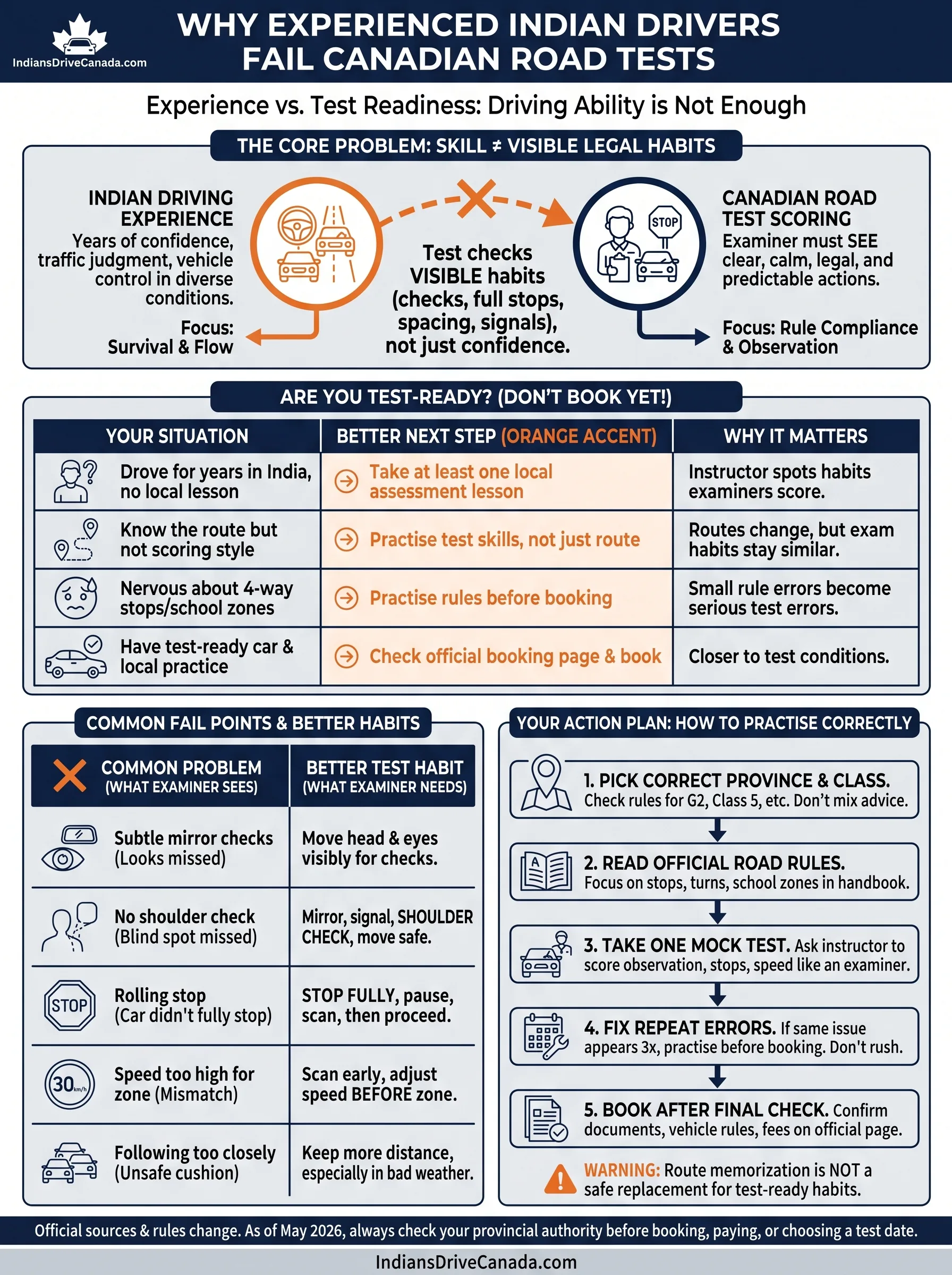
✅ Quick answer: Experienced Indian drivers fail Canadian road tests when years of driving do not match the way Canadian examiners score observation, full stops, lane position, speed control, right-of-way, mirror checks, shoulder checks, and vehicle readiness. Practise the local test style before booking, even if you drove safely in India for many years.
You may already be confident behind the wheel. You may have driven in Delhi, Mumbai, Bengaluru, Punjab, Gujarat, Hyderabad, or many different Indian road conditions. That experience can help with vehicle control, traffic judgment, and confidence.
But a Canadian road test is not only about whether you can drive. It checks whether you can follow provincial road rules in a visible, calm, legal, and predictable way. The examiner must see your checks, stops, spacing, signals, speed choices, and lane decisions.
This is where many experienced drivers get surprised. They may handle the car well, but lose marks for rolling through stop signs, checking mirrors too subtly, entering intersections too late, driving too close, missing school zone speed limits, or not preparing the vehicle correctly before the test.
For a wider path through licences, booking, and test types, use the main page on Canadian driving tests for Indian newcomers before choosing your next step. As of May 2026, provincial test rules and booking steps should still be checked on the official provincial source before you pay, practise, or visit a test centre.
Should You Book the Road Test Right Away?
Do not book only because you have many years of Indian driving experience. Book when your driving looks test-ready under Canadian scoring. That means the examiner can clearly see safe habits, not just feel that you are confident.
ℹ️ Use this simple decision check: If you still need to think about stop-sign rules, school zones, lane changes, shoulder checks, parking rules, or right-of-way at 4-way stops, spend more time practising before booking.
| Your Situation | Better Next Step | Why It Matters |
|---|---|---|
| You drove for years in India but never took a Canadian lesson | Take at least one local road test assessment lesson | A local instructor can spot habits that examiners score. |
| You know the route but not the scoring style | Practise test skills, not only the route | Routes change, but exam habits stay similar. |
| You are nervous about 4-way stops or school zones | Practise those rules before booking | Small rule errors can become serious test errors. |
| You have a test-ready car and local practice | Check the official booking page and book | You are closer to test conditions. |
Pro tip: Confidence helps, but visible Canadian road-test habits help more.
Why Indian Driving Experience May Not Match Canadian Test Scoring
Indian driving experience can be useful. It may give you strong awareness, car control, and comfort in traffic. But Canadian examiners look for specific actions that show legal and predictable driving.
For example, a driver may know that a lane is clear. On the test, that is not enough. The examiner needs to see mirror checks, signal timing, shoulder checks, lane position, speed control, and smooth movement.
The same issue appears at stop signs. In some real-world driving situations, drivers slow down and continue when the way looks clear. On a Canadian road test, a full legal stop must be clear. The car should stop fully before moving again when required.
⚠️ Watch the difference between skill and test proof: You may be a safe driver, but the examiner can only score what is shown during the test. Quiet habits, late checks, or casual stops can look unsafe from the passenger seat.
Province also matters. Ontario, British Columbia, Alberta, Manitoba, Saskatchewan, Quebec, and other provinces each use their own licensing authority and test process. The basic safety ideas are similar, but booking, vehicle rules, waiting periods, documents, and test expectations can vary.
Watch out: Do not rely only on advice from friends who tested in another province or another year.
What Experienced Drivers Often Lose Marks For
Most failures are not caused by one dramatic mistake. Many happen because small habits add up. A driver may turn well, park well, and handle traffic, but still lose marks through weak observation or unclear rule-following.
| Common Problem | What The Examiner May See | Better Test Habit |
|---|---|---|
| Subtle mirror checks | The check may look missed | Move your eyes and head enough to make the check visible. |
| No shoulder check before lane changes | Blind spot was not checked | Mirror, signal, shoulder check, then move when safe. |
| Rolling stop | The car did not fully stop | Stop fully, pause briefly, scan, then proceed. |
| Speed too high for school or community zones | Speed choice does not match the sign | Scan signs early and adjust before the zone begins. |
| Late signal | Other road users do not get enough warning | Signal early enough, but not so early that it misleads. |
| Following too closely | Space cushion looks unsafe | Keep more distance, especially in rain, snow, or traffic. |
💡 Practical test habit: Drive a little more clearly than you would in casual daily driving. Do not exaggerate, but make your safety checks easy to notice.
Pro tip: Practise with someone who understands the local test, not only with someone who says you drive well.
How Should You Practise Before Booking?
Experienced drivers often need correction practice, not beginner practice. The goal is not to relearn how to drive from zero. The goal is to adjust habits to Canadian road-test expectations.
Practise in the same type of area where your test may happen. Include residential streets, business roads, school zones, lane changes, uncontrolled intersections, parking areas, highway ramps if your test type includes them, and busy left turns.
📍 Step 1: Pick the correct province and test class.
Check whether you are preparing for G2, G, Class 5, Class 7, or another passenger vehicle road test. Do not mix advice from different systems.
📄 Step 2: Read the official road rules.
Use the provincial handbook or licensing authority page. Focus on stop signs, turns, parking, right-of-way, school buses, school zones, lane changes, and highway merging.
🧪 Step 3: Take one mock test.
Ask a licensed local instructor to score your driving like an examiner. Tell them you want direct feedback on observation, stops, lane position, and speed.
🗓️ Step 4: Fix only the repeat errors.
If the same issue appears three times, practise that exact skill before booking. Do not rush into a paid test with known repeat mistakes.
🧾 Step 5: Book only after checking documents, vehicle, and fee rules.
Use the official booking page for your province. Confirm the fee, cancellation rule, ID requirement, and vehicle rules before paying.
Watch out: Route memorization is not a safe replacement for test-ready habits.
Which Driving Habits Need The Most Attention?
Many experienced drivers fail because their habits are normal in daily traffic, but not ideal for a formal road test. The test rewards calm, clear, rule-based driving. It does not reward aggressive confidence.
⚠️ Do not copy impatient local drivers: Some drivers on the road may roll stops, speed, or change lanes late. Their habits are not road-test standards.
Practise these habits until they feel natural. During the test, avoid explaining your driving unless the examiner asks a question. Listen, confirm calmly if needed, and drive as instructed.
Pro tip: A calm, predictable driver is easier for an examiner to trust.
What Documents And Vehicle Checks Should You Prepare?
A strong driver can still lose the test appointment before leaving the parking lot. If your ID, licence, booking, vehicle insurance, lights, tires, or safety items do not meet the test centre’s rules, the test may be cancelled.
📄 Documents and items to check before test day:
- Valid provincial learner or novice licence, if required for your test
- Accepted identity document, if your province asks for it
- Road test booking confirmation
- Glasses or contact lenses, if your licence requires them
- Vehicle registration or ownership document, if requested
- Valid insurance proof for the test vehicle
- Permission letter if using a vehicle that requires written authorization
- Payment method for any fee due at the office
| Vehicle Item | What To Check | Why It Matters |
|---|---|---|
| Brake lights and signals | All lights work before you leave home | Faulty lights can make the vehicle unsafe for testing. |
| Tires | Enough tread and safe condition | Unsafe tires may cause cancellation. |
| Windshield and mirrors | Clear view with no unsafe damage | The examiner needs safe visibility. |
| Seatbelts | Working and not damaged | Safety equipment must work for the test. |
| Fuel or charge | Enough for the full test | Low fuel or low charge can create test risk. |
Watch out: A borrowed car should be checked twice, especially lights, insurance, registration, and permission rules.
How Do Provincial Road Test Rules Differ?
Canada does not use one single road test authority for all provinces. Each province manages its own licensing process. This matters for Indian newcomers because advice that worked in Ontario may not match British Columbia, Alberta, Manitoba, Saskatchewan, or Quebec.
Ontario uses DriveTest for many testing services. British Columbia uses ICBC. Alberta road tests involve registry agents for many passenger vehicle tests. Manitoba uses MPI. Other provinces have their own systems.
| Province | Official Source | What To Confirm |
|---|---|---|
| Ontario | DriveTest and Ontario MTO | G2 or G test type, booking, wait rules, test result rules, handbook topics |
| British Columbia | ICBC | Accepted ID, insured vehicle, road test appointment rules, vehicle safety checks |
| Alberta | Alberta.ca and registry agents | Eligibility, booking method, fee set by registry, examiner scoring rules |
| Manitoba | MPI | Check-in time, supervising driver rule, retest wait period, vehicle check |
ℹ️ As of May 2026: Ontario DriveTest says road tests assess safe driving skills, rules of the road, and safe driving practices. ICBC says road test applicants should bring accepted ID, payment, and a safe, reliable, insured vehicle. Alberta says unsafe driving or breaking traffic laws can lead to an automatic fail.
Pro tip: Always prepare for the province where you will test, not the province where your friend tested.
What Indian Newcomers Often Misread Before A Road Test
This section is not about blaming Indian drivers. It is about avoiding small misunderstandings that can hurt otherwise strong drivers during a Canadian test.
💡 Small adjustment: Treat the test like a safety demonstration. Show the examiner what you are checking and why your movement is safe.
Watch out: Do not let pride in past experience stop you from taking local feedback.
Common Questions Newcomers Ask Before They Book
Can I pass if I have driven in India for many years?
Yes, but past experience alone does not guarantee a pass. You still need to show Canadian road rules, visible observation, full stops, safe lane changes, and test-ready speed control.
Should I take driving lessons even if I am experienced?
One or two local assessment lessons can help a lot. Ask the instructor to focus on test scoring, not beginner car control.
Is it enough to practise the test route?
No. Route practice can help with local roads, but examiners score driving habits. You should be ready for signs, traffic, lane changes, parking, and turns even if the route changes.
What if I fail the first road test?
Read the score or feedback carefully. Fix the repeat mistakes before booking again. Check the official provincial rule for retest waiting periods and fees.
Pro tip: A failed test is useful if you use the feedback before the next booking.
Check The Official Source Before You Act
🔗 Official source check: As of May 2026, use the official provincial source before booking, paying, or choosing a test date. Rules, fees, test content, waiting periods, cancellation rules, and vehicle requirements can change.
Use community advice only as background. Use official pages for booking rules, test requirements, fees, documents, and retest rules. If a friend, video, or forum says something different from the official source, follow the official source.
Watch out: Do not pay third-party sites or follow unofficial booking links unless your province clearly directs you there.
Frequently Asked Questions
Why do experienced Indian drivers fail Canadian road tests?
They often fail because their driving habits do not match Canadian road-test scoring. Common issues include weak shoulder checks, rolling stops, late signals, speed errors, poor lane position, and unclear right-of-way decisions.
Can Indian driving experience help with a Canadian road test?
Yes. It can help with confidence, traffic awareness, and vehicle control. But you still need to adapt to provincial rules, examiner expectations, and visible safety checks.
Do I need lessons before a Canadian road test if I already drive well?
You may not need many lessons, but at least one local assessment lesson is smart. It can reveal habits that feel normal to you but may lose marks during the test.
How long should I practise before booking the road test?
There is no single number of days that fits everyone. Practise until you can drive safely under local rules without repeat errors in stops, observation, lane changes, speed, parking, and right-of-way.
Is the Canadian road test harder than driving in India?
It is different, not simply harder. Indian roads may require strong traffic awareness, while Canadian road tests require clear legal habits, visible checks, predictable movements, and strict rule-following.
Can I fail for driving too slowly?
Yes, if your speed is too slow without a safe reason and affects traffic flow. You should drive near the posted limit when conditions are safe, and slow down for weather, traffic, signs, pedestrians, or hazards.
What should I do after failing a road test?
Review the examiner feedback and practise the exact weak areas. Check your province’s retest waiting period and fee rules before booking again.