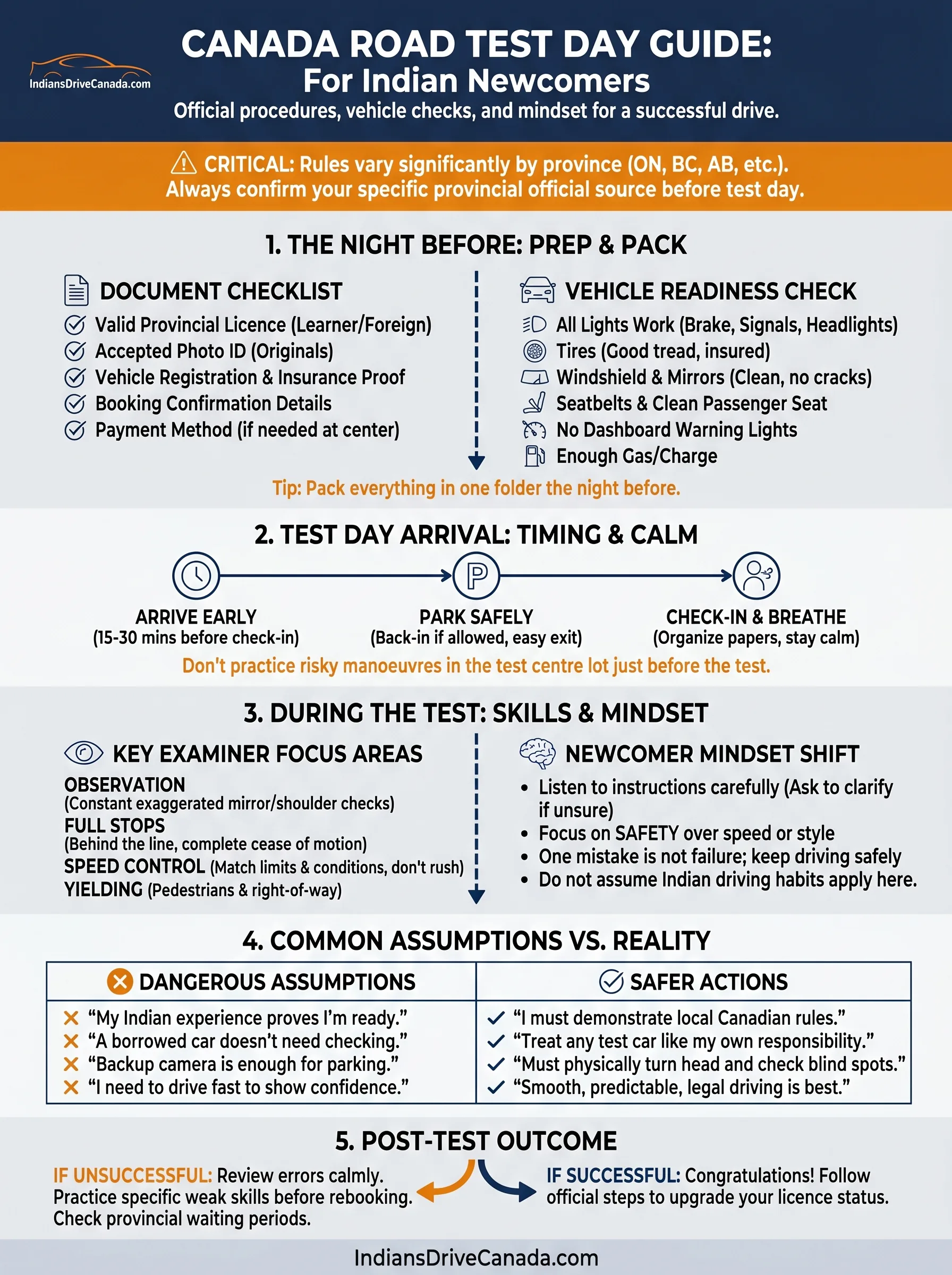
✅ Quick answer: A road test day guide for Indian newcomers in Canada should start with four checks: your licence eligibility, accepted ID, a test-ready insured vehicle, and the exact provincial appointment rules. Bring original documents, arrive early, avoid last-minute vehicle issues, and confirm the official road test page before leaving home.
You may already know how to drive well, but a Canadian road test can still feel unfamiliar on the day of the appointment. The examiner is not checking only whether you can move the car. They are watching how you observe, signal, stop, choose speed, position the vehicle, follow road signs, and react to normal traffic.
For many Indian newcomers, the confusing part is not only the driving. It is knowing what to bring, whether the car is acceptable, how early to arrive, whether a supervising driver is needed, and what happens if the test is cancelled before it even starts.
This page helps you prepare for the road test appointment itself. It covers documents, vehicle checks, arrival timing, common test-day mistakes, and the official provincial sources you should confirm before you go. For the larger testing pathway, use driving tests in Canada for Indian newcomers as your next planning step.
⚠️ Check before you travel: Road test rules are provincial. Ontario, British Columbia, Alberta, Manitoba, Saskatchewan, and Quebec do not use the exact same booking system, licence classes, arrival rules, or document checks.
What Should You Check Before Road Test Day?
Before you think about parking practice or highway driving, confirm that you are actually eligible for the road test you booked. A valid appointment does not always mean you are fully ready to be tested. The testing office may still check your licence status, waiting period, documents, payment, vehicle condition, and booking details.
Your first task is to identify the province that controls your test. In Ontario, road tests are handled through DriveTest. In British Columbia, ICBC manages road tests. Alberta uses a provincial road test system with licensed examiners. Manitoba uses MPI. Saskatchewan uses SGI. Quebec uses SAAQ.
Then check the test type. A G2 test in Ontario is not the same as a full G test. A Class 7 road test in British Columbia is not the same as a Class 5 road test. A newcomer with foreign driving history may also have a different path from a brand-new driver.
ℹ️ Before test day, confirm: your licence class, appointment time, test centre location, vehicle requirements, ID requirements, payment method, cancellation rule, and whether your province needs any driving history document or licence exchange step first.
Pro tip: Do not rely on a friend’s old test-day experience unless it matches your province, licence class, and date.
Can You Drive To The Test Centre Yourself?
This depends on your current licence status. Some learners cannot legally drive alone. Some newcomers can drive for a limited period on a valid foreign licence, but the rules depend on the province and residency status. Some applicants need a supervising driver to come with them.
Do not assume that your Indian driving licence lets you drive alone to the test centre on test day. If you are already in a provincial learner stage, your licence restrictions matter more than your past driving experience. If your licence requires an accompanying driver, arrange one before the appointment.
Also plan how you will get home if you do not pass. Some official pages warn applicants to make travel plans in case they are not allowed to drive away after an unsuccessful test. This is especially useful if you are using a borrowed car, instructor car, or family vehicle.
| Your Situation | What To Check | Safer Action |
|---|---|---|
| You have a learner licence | Whether you can drive alone | Bring a qualified accompanying driver if required |
| You have an Indian licence | Foreign licence rules in your province | Confirm local rules before driving to the centre |
| You are using an instructor car | Booking time, pickup plan, and vehicle documents | Confirm the instructor’s arrival time one day before |
| You are borrowing a car | Insurance, registration, plate, lights, tires, and permission | Check the car before the appointment day |
Watch out: A test can become stressful before it starts if your travel plan depends on driving alone when your licence does not allow it.
What Documents Should You Bring?
Bring original documents unless your provincial authority clearly accepts another format. Photocopies, screenshots, expired cards, mismatched names, or missing confirmations can slow down the check-in process. If your name appears differently across your passport, immigration document, licence, or address proof, check the provincial ID rules before test day.
The exact document list depends on the province. For example, ICBC states that road test applicants should bring accepted identification and a safe, reliable, insured vehicle. Manitoba road test information refers to a valid licence and vehicle registration certificate. Ontario DriveTest uses appointment and licence information through its road test booking system.
📄 Documents To Prepare Before You Go
- 📄 Valid provincial licence or learner licence for the test class
- 📄 Appointment confirmation or booking email, if issued
- 📄 Accepted identity documents required by the province
- 📄 Vehicle registration certificate, if required in your province
- 📄 Proof that the vehicle is insured and legally plated
- 📄 Indian licence or driving record only if the province asks for it in your licence process
- 📄 Translation or approved translator document, if your province requires it for non-English documents
- 🧾 Payment method accepted by the testing authority
If you are unsure whether a document is needed, do not guess. Check the official road test page and the accepted ID page for your province. Some provinces separate road test booking rules from ID rules, so you may need to check more than one official page.
Pro tip: Pack your documents the night before and keep them in one folder, not inside several bags or phone screenshots.
Is Your Vehicle Ready For The Road Test?
The car must be safe, legal, and suitable for the test. A good driver can still lose the appointment if the vehicle does not pass the basic check. Examiners may look at signals, brake lights, horn, tires, mirrors, windshield, seatbelts, licence plate, registration, insurance, and passenger safety.
If you are using a friend’s car, do a full check before test day. If you are using a driving school car, confirm that the instructor has the correct test time and location. If you are using a rental or shared vehicle, check whether the province allows it and whether extra authorization is needed.
| Vehicle Item | Why It Matters | What To Do Before Test Day |
|---|---|---|
| Turn signals and brake lights | The examiner may check them before leaving | Ask someone to stand outside and confirm all lights work |
| Insurance and registration | The vehicle must be legal for road use | Keep proof in the vehicle or bring the required certificate |
| Tires and windshield | Poor condition can make the vehicle unsafe | Check tire condition, cracks, visibility, and washer fluid |
| Seatbelts and passenger seat | The examiner needs a safe seat | Check seatbelt, seat adjustment, and headrest |
| Dashboard warning lights | Safety warnings can lead to problems | Fix warning lights before the appointment |
| Clean windows and mirrors | Observation is part of the test | Clean all windows, mirrors, and cameras before leaving |
⚠️ Do not wait until the parking lot: If a brake light, signal, tire, registration paper, or insurance document causes a problem, the test may be cancelled and the fee may not be fully protected.
Watch out: A borrowed car should be checked like a test vehicle, not like a normal ride to the store.
How Early Should You Arrive?
Arrive early enough to park, check in, calm down, organize documents, and adjust the vehicle. The safe arrival time depends on the province and test centre. Some official sources give a specific check-in time. Others tell you to arrive at the appointment or check-in time shown in your booking.
For a newcomer, arriving early is not only about punctuality. It gives you time to find the correct entrance, understand the parking layout, avoid rushing, use the washroom, place your documents in order, and adjust the seat and mirrors before the examiner comes.
💡 Simple timing plan: Reach the area early, park safely, check the test centre entrance, and be ready before your official check-in time. Do not practise risky last-minute manoeuvres in the test centre parking lot.
If your test is in winter, rain, or a busy city area, add more travel time. Snow, roadwork, traffic, parking confusion, or a wrong entrance can create avoidable pressure. If you are using a driving school vehicle, confirm the pickup time in writing.
Pro tip: Test-day calm often starts with leaving home early, not with extra practice in the final ten minutes.
What Order Should You Follow On Test Day?
Road test day should feel like a checklist, not a rush. The more steps you settle before leaving home, the easier it is to focus on safe driving during the actual test.
🗓️ Step 1: Confirm The Appointment
Check the date, time, test centre, licence class, and cancellation rule. Use the official booking system or confirmation email. Do this the day before and again before leaving home.
📄 Step 2: Pack Your Documents
Bring your licence, accepted ID, appointment details, vehicle papers, and payment method. If your province has extra ID or translation rules, follow the official list.
🚗 Step 3: Check The Vehicle
Test the lights, signals, horn, tires, windshield, mirrors, seatbelts, licence plate, and registration. Do not use a car with obvious safety problems.
📍 Step 4: Arrive And Check In
Park safely, bring your documents inside if required, and follow the centre’s check-in process. Keep your phone away unless you need it for appointment details before the test.
🧪 Step 5: Listen Before You Drive
The examiner may explain instructions before the test. Ask for clarification if you did not hear the instruction. Do not argue, guess, or over-explain your driving history.
🧾 Step 6: Review The Result Calmly
If you pass, follow the licensing office’s next step. If you do not pass, review the errors, check the waiting period, and book again only after targeted practice.
Watch out: The goal is not to look fast or confident. The goal is to show safe, legal, predictable driving.
What Driving Skills Matter Most During The Test?
The examiner wants to see that you can drive safely in ordinary Canadian traffic. Smooth steering helps, but observation and decision-making matter just as much. A test route may include intersections, lane changes, turns, parking, speed changes, school zones, stop signs, traffic lights, and residential streets.
Indian newcomers may find some habits different from home. Canadian examiners expect clear shoulder checks, full stops, correct lane position, safe following distance, speed control, and careful right-of-way decisions. If you use a backup camera, still turn your head and check around the vehicle. The camera does not replace observation.
ℹ️ Examiner instructions: If you are not sure what the examiner said, ask politely before making the move. A short clarification is safer than guessing late.
Pro tip: Practise the local test area, but do not memorize only one route. The examiner can choose a different path.
What Newcomers Often Misread Before A Road Test
Many test-day problems come from small assumptions. These are not about nationality or driving ability. They are about learning a new licensing system, a new testing style, and local road expectations.
| Assumption | Why It Can Cause Trouble | Better Action |
|---|---|---|
| “My Indian licence proves I am ready.” | The test checks Canadian rules and local driving habits. | Practise with the provincial handbook and local road signs. |
| “The car looks fine.” | A small light or document issue can cancel the test. | Do a full vehicle check the day before. |
| “I can explain my mistake.” | The examiner scores what happens on the road. | Stay calm, correct safely, and continue driving. |
| “The route will be the same as practice.” | Routes can change based on traffic and examiner choice. | Practise skills, not only turns from memory. |
| “Camera parking is enough.” | Observation is still part of safe vehicle control. | Use mirrors, shoulder checks, and direct observation. |
⚠️ Test behaviour matters: Do not use your phone, argue with the examiner, ignore instructions, roll through stop signs, or take unsafe gaps because you feel pressure from traffic behind you.
Watch out: A small unsafe action can matter more than ten minutes of otherwise smooth driving.
How Should You Handle Stress During The Test?
Feeling nervous is normal. The examiner sees nervous applicants every day. What matters is whether stress changes your driving decisions. Take a few seconds to breathe before starting. Adjust your seat, mirrors, steering position, and seatbelt before you move.
Drive at a safe legal speed. Do not drive too slowly only because you are nervous. Very slow driving can create new risks if traffic conditions do not require it. At the same time, do not rush turns, lane changes, or parking corrections.
If you make a small mistake, keep driving safely. One error does not always mean failure. A risky correction can make the situation worse. For example, if you miss a turn, wait for the examiner’s next instruction instead of making a sudden move.
💡 Calm test habit: Say the instruction back quietly in your mind, check mirrors, check blind spots when needed, signal, and then move. Slow the decision down without blocking traffic.
Pro tip: The examiner is not looking for perfect style. They are looking for safe judgement.
What Happens If The Road Test Is Cancelled Or You Do Not Pass?
A road test can end in three ways: you pass, you do not pass, or the test is cancelled before or during the appointment. Cancellation can happen because of vehicle condition, missing documents, late arrival, weather, licence restrictions, or other safety concerns.
If you do not pass, ask how to access or understand your test result. Some provinces offer road test result downloads or feedback sheets. Use the result to practise specific skills before booking again. Do not rebook too quickly if the issue was observation, speed choice, or right-of-way decisions.
Waiting periods and rebooking rules vary by province. Fees, refunds, and cancellation deadlines also vary. For example, Ontario DriveTest has specific payment and cancellation policies, while Manitoba lists waiting periods and extra instruction rules after multiple failed attempts. Always check the official provincial page before paying again.
ℹ️ After an unsuccessful test: Focus on the marked errors, not on the route. A new appointment may use different roads, but the same weak skill can appear again.
Watch out: Booking another test without fixing the reason for the first result can waste time and money.
Check The Official Source Before You Act
🔗 As of May 2026, road test rules should be checked on the official provincial source before your appointment. Use the links below for booking, test-day requirements, vehicle rules, accepted ID, and cancellation details. Rules can change by province, licence class, and applicant situation.
| Province | Official Source | What To Check |
|---|---|---|
| Ontario | DriveTest road test booking | Booking, payment, vehicle requirements, appointment details, and test result access |
| Ontario | Ontario MTO driver’s handbook | Road test skills, safe driving rules, signs, and fraud warnings |
| British Columbia | ICBC road test appointment preparation | Accepted ID, payment, insured vehicle, plate details, and appointment preparation |
| Alberta | Alberta driver’s road test | Eligibility, booking, vehicle requirements, and road test process |
| Manitoba | MPI Class 5 road test | Check-in, documents, vehicle requirements, test parts, and retest rules |
| Saskatchewan | SGI before the examination | Booking, ID, appointment reminders, and examination preparation |
| Quebec | SAAQ knowledge and road test appointments | SAAQclic appointment steps, account access, road test booking, and special situations |
Pro tip: Save the official source link for your province on your phone, but keep your real documents ready in paper or card form.
Common Questions Newcomers Ask Before Test Day
ℹ️ These questions are common because road test rules differ across Canada. Treat the answers as planning help, then confirm your province’s official rule before the appointment.
Can I Use My Own Car For The Road Test?
Usually, you can use your own, borrowed, rented, or driving school vehicle if it meets the province’s rules. The car must be safe, insured, registered, and suitable for the test class. Check your province’s vehicle requirements before test day.
Do I Need My Indian Licence On Road Test Day?
You may need it if your road test is part of a foreign licence exchange or driving history process. If you already hold a provincial learner or test licence, the provincial document may be the main item. Bring your Indian licence only when it is relevant and accepted in your case.
Can A Friend Come With Me?
A friend may be able to drive you to the test centre or wait outside, but they usually cannot sit in the vehicle during the road test. If your licence requires a supervising driver, make sure that person meets the provincial rule.
Should I Book The Earliest Available Test Slot?
Not always. Choose a date that gives you enough time to fix weak skills, arrange the vehicle, and prepare documents. A later well-prepared test can be better than a fast booking with missing items.
Frequently Asked Questions
Can I Take A Canadian Road Test With An Indian Licence?
It depends on the province and your licence exchange path. Some newcomers must pass a knowledge test first, then book a road test. Check the official provincial licensing authority before assuming your Indian licence alone is enough.
Do I Need A Driving Extract From India On Road Test Day?
A driving extract may help in some foreign driving experience or licence exchange situations. It is not a universal road test day document across Canada. Confirm whether your province accepts or requests it before arranging the test.
How Early Should I Arrive For My Road Test?
Follow the check-in time shown by your provincial testing authority. As a practical plan, arrive early enough to park, check in, organize documents, and settle before the examiner calls you. Bad weather or a new test centre location needs extra travel time.
What Happens If My Car Fails The Vehicle Check?
The test may be cancelled if the vehicle is not safe, legal, insured, or suitable for the test. Fees and rebooking rules depend on the province. Check lights, signals, tires, mirrors, registration, and insurance before the appointment day.
Can I Use A Backup Camera During The Road Test?
A backup camera may be allowed in many vehicles, but it should not replace direct observation. Use mirrors, shoulder checks, and window checks when reversing or parking. The examiner needs to see safe awareness, not only screen use.
Can Students Or Work Permit Holders Book A Road Test?
Many temporary residents can enter the licensing process, but the documents and eligibility rules vary by province. Your study permit, work permit, address proof, ID, and licence history may matter. Check the official provincial source before booking.
What Should I Do If I Fail The First Road Test?
Review the result, identify the exact weak skills, and practise before rebooking. Do not focus only on the test route. Waiting periods, fees, and extra training rules vary by province, so confirm the official retest rule before paying again.