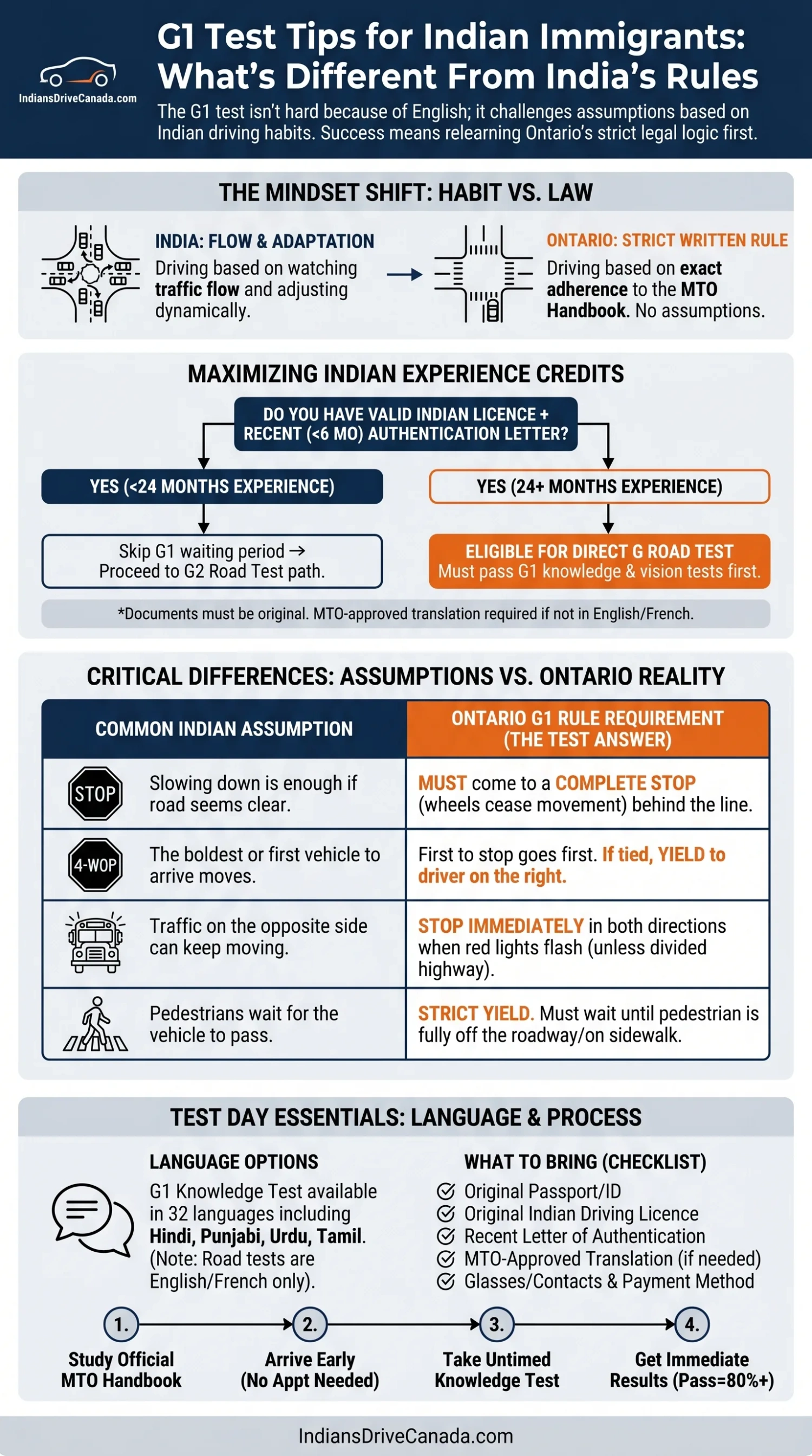
The most useful G1 test tips for Indian immigrants begin with one adjustment: replace left-side traffic habits with Ontario’s right-side road logic. The challenge is often not learning what a stop sign means, but applying a familiar rule from the opposite side of the road.
In India, normal traffic keeps left and overtaking is generally performed on the right. In Ontario, normal traffic keeps right and most passing is performed on the left. That reversal changes how you read turns, lane positions, roundabouts, parked vehicles and emergency situations.
Driving experience from India still helps with observation, vehicle control and hazard awareness. The safer study method is to identify which habits transfer to Ontario and which ones must be reversed. Memorizing random practice questions without making that distinction can leave the same left-right error hidden until test day.
How the Ontario G1 knowledge test is administered
The test checks knowledge of road signs and Ontario’s rules of the road. Questions are created by the Ontario Ministry of Transportation and are drawn from the subjects covered in the Official MTO Driver’s Handbook.
| Test feature | What to expect | Practical meaning |
|---|---|---|
| Format | Multiple-choice questions | Read every word before selecting an answer. A familiar road scene may use a different Ontario rule. |
| Sections | Usually two or three, including signs and rules of the road | Do not study signs alone. Right-of-way, stopping and road-user rules need equal attention. |
| Time | No fixed time limit before the office closes | Use the available time to redraw the road direction mentally when a question feels reversed. |
| Passing standard | At least 80% total, with sections meeting MTO standards | A strong signs result does not make up for an unsuccessful rules section. |
| Result | Marked at the DriveTest Centre | You receive the result immediately. |
| Retest | Available after paying the applicable retest fee | If you retest within one year, DriveTest says you only repeat sections that did not meet the required standard. |
Do not measure readiness only by practice-test scores. Review why each wrong answer occurred. A left-right reversal, an unknown Ontario rule and a misunderstood English term need different fixes.
The India-to-Ontario road-side reset
India’s official learner-test material is built around left-hand traffic. Test wording and local road conditions can vary between Indian states, but the side-of-road reversal remains the central Ontario comparison. Ontario’s handbook tells drivers to keep to the right side of the road or the right-hand lane unless they are passing or preparing to turn left. The table below converts that road-side change into the decisions most likely to appear in a G1 question.
| Situation | Habit from Indian roads | Ontario test rule | Memory cue |
|---|---|---|---|
| Normal road position | Keep left | Keep right unless passing or preparing for a left turn | Driver side near the centre line; passenger side near the curb |
| Normal passing side | Pass on the right | Most passing is done on the left | Left lane passes; right lane carries normal traffic |
| Near-side turn | Left turn | Right turn | A right turn normally begins and ends close to the right edge |
| Turn crossing opposing traffic | Right turn | Left turn | An Ontario left turn must yield to approaching traffic and pedestrians |
| Roundabout flow | Left-side traffic habits may lead you to expect the opposite circulation | Travel counter-clockwise and keep to the right of the central island | Look left before entering; signal right when exiting |
| Parking direction | Curb-side orientation follows left-hand traffic | Park on the right side in the direction of traffic unless signs permit otherwise | The parked vehicle should face the same direction as nearby traffic |
Rebuild turns as lane movements
Do not answer a turn question from the word right or left alone. Picture the starting lane, the traffic you cross and the lane you enter.
- Right turn: signal, move into the right-hand lane when safe, check ahead and both sides, check the right blind spot for cyclists, then enter the right-hand lane of the new road.
- Left turn: move to the far-left lane in your direction, yield to approaching vehicles and pedestrians, then complete the turn into the proper lane.
- Multi-lane turn: follow lane arrows and keep the lane position you entered from. Do not drift into a neighbouring lane during the turn.
- Roundabout: choose the correct lane before entering. Do not enter from the right lane when intending to turn left, and do not change lanes inside the roundabout.
A turn signal does not create right-of-way. It tells other road users what you intend to do. You still have to wait until the path is clear.
A stop answer begins with zero movement
Ontario’s handbook uses complete stop. Slowing to walking speed, pausing after the stop line or rolling while checking traffic is not the required first action.
Where the vehicle must stop
- Stop at the marked stop line.
- If there is no stop line, stop at the crosswalk, whether it is marked or unmarked.
- If there is no crosswalk, stop at the edge of the sidewalk.
- If there is no sidewalk, stop at the edge of the intersection.
After the complete stop, you may move forward carefully to improve your view when traffic conditions allow. The test distinction is between the required first stop and the later observation movement.
| Signal | Required response |
|---|---|
| Steady red | Come to a complete stop and wait. A permitted turn may be made only after stopping and yielding. |
| Flashing red | Come to a complete stop, then proceed only when safe. |
| Steady yellow | Stop if you can do so safely; otherwise proceed with caution. |
| Flashing yellow | Approach and move through with caution. It does not require the same automatic stop as flashing red. |
| Traffic lights not working | Treat the intersection like an all-way stop, yield to vehicles already in it and to a vehicle entering from your right. |
Right-of-way questions are solved by sequence
Right-of-way is not awarded to the larger vehicle, the faster vehicle or the driver who begins moving first. G1 questions expect the legal order to be applied before anyone enters the conflict area.
All-way stop
- The first vehicle to come to a complete stop goes first.
- If two vehicles stop at the same time, the driver on the left yields to the driver on the right.
- A driver turning left must still yield to an approaching vehicle that is going straight when their movements conflict.
- If another driver gives up the right-of-way, move only after making sure every path is safe.
Uncontrolled intersection
At an intersection without signs or traffic lights, yield to a vehicle that arrived before you. If vehicles arrive from different roads at the same time, the driver on the left yields to the vehicle on the right.
Entering from a driveway or private road
The vehicle entering the public road yields to road traffic and to pedestrians using the sidewalk. A clear vehicle lane is not enough if a pedestrian or cyclist is crossing your path.
Useful test method: identify the control first—traffic light, stop sign, yield sign or no control. Then identify arrival order. Only after that should you consider who is turning.
Right on red is permission, not priority
Ontario generally permits a right turn while facing a red light unless a sign prohibits it. The turn is optional. A driver may wait for green when the view is blocked or the movement is not safe.
- Come to a complete stop in the proper stopping position.
- Check for a sign prohibiting a right turn on red.
- Yield to pedestrians and people using mobility devices.
- Check the right blind spot for cyclists approaching from behind.
- Yield to traffic using the road you are entering.
- Turn into the right-hand lane only when the path is clear.
Ontario also permits a left turn on red when moving from a one-way road to another one-way road, after a complete stop and after yielding. This narrower rule is easy to miss because a general statement such as “left on red is never allowed” would be incorrect.
Do not follow the vehicle ahead through a red-light turn. Each driver must make a separate complete stop and a separate safety check.
School bus questions depend on a physical median
Lane count does not decide whether opposing traffic must stop. The deciding feature is a median: a physical raised, lowered, earth or paved strip separating the two directions of travel.
| Road situation | Driver behind the bus | Driver approaching from the opposite direction |
|---|---|---|
| No physical median | Stop at least 20 metres behind when the upper red lights are flashing or the stop arm is active | Stop at a safe distance |
| Physical median separates directions | Stop when travelling in the same direction as the bus | Not required to stop |
| Amber lights flashing | Slow down and prepare to stop | Slow down and prepare to stop unless separated on the opposite side of a median |
Remain stopped until the bus starts moving, the overhead red lights stop flashing and the stop arm is no longer active. The rule applies on city streets and highways, at any posted speed, and is not limited to the hours when you expect children to travel.
A painted centre line is not a median. A wide road with several lanes but no physical separating strip still requires traffic in both directions to stop for the bus.
A pedestrian crossover is not just painted lines
Ontario distinguishes a pedestrian crossover from an ordinary crosswalk at an intersection. A pedestrian crossover may use signs, pavement markings, overhead yellow lights and push buttons. Drivers and cyclists must yield and wait until pedestrians have crossed and are safely on the sidewalk.
- Stop before the crossover line.
- Do not move as soon as the pedestrian clears only your lane.
- Do not pass another vehicle within 30 metres of a pedestrian crossover.
- At a school crossing, remain stopped until the pedestrians and the crossing guard have cleared the entire roadway.
- Before turning right, check the right-side path and blind spot for cyclists as well as pedestrians.
A vehicle stopped before a crossover may be blocking your view of a pedestrian. Treat the stopped vehicle as a warning, not as an invitation to pass.
Ontario situations worth studying separately
Streetcars and passengers entering the roadway
Streetcar rules are especially relevant in Toronto. When passengers board or leave a streetcar directly from the roadway, stop at least two metres behind the rear doors. Wait until passengers are safely clear and the doors close before moving. Where a passenger safety island or protected boarding area separates passengers from traffic, follow the signs and pass only with care.
Approaching emergency vehicles
When an emergency vehicle approaches with flashing red or red-and-blue lights, or with a siren or bell, bring your vehicle to a stop as near as practical to the right-hand curb or road edge. Keep clear of intersections and do not stop on a shoulder that the emergency vehicle may use.
If you are already in an intersection, clear it by proceeding straight when safe, then pull over and stop. Do not begin or complete a turn that places you across the emergency vehicle’s path.
Stopped emergency vehicles and tow trucks
When approaching a stopped emergency vehicle with red or red-and-blue lights, or a tow truck with amber lights, in your direction of travel, reduce speed and pass with caution. On a road with at least two lanes in your direction, move into a lane away from the stopped vehicle when it is safe to do so.
Blue lights on snow-removal vehicles
Flashing blue lights can identify snow-removal vehicles on Ontario roads. A plow may be wider than it appears because a wing can extend to its right. On freeways, several plows may operate in a staggered formation. Do not try to pass between them.
| What you see | Likely meaning | Driver response |
|---|---|---|
| Red or red-and-blue lights approaching | Emergency vehicle responding | Move to the proper road edge and stop clear of intersections |
| Red or red-and-blue lights stopped ahead | Emergency vehicle at roadside | Slow down, pass cautiously and move over when safe |
| Amber lights on a stopped tow truck | Roadside recovery work | Slow down, pass cautiously and move over when safe |
| Blue lights on a wide slow vehicle | Snow-removal vehicle | Increase space, expect reduced visibility and do not pass through a plow formation |
| Green flashing light on a personal vehicle | May be a volunteer firefighter or medical responder | Yield as a courtesy when safe; it is not the same legal command as an emergency vehicle’s red lights and siren |
Learn Ontario signs by family, shape and colour
Trying to memorize every sign as a separate picture is slow and fragile. Start with the sign family, then learn the individual symbol. Shape and colour often reveal the type of instruction before the wording is read.
| Visual pattern | Meaning | Examples to practise |
|---|---|---|
| Red octagon | Complete stop | Stop position and all-way stop order |
| White triangle with red border | Yield | Roundabout entrance and merging traffic |
| White rectangular regulatory sign | A legal movement, limit or restriction | Speed limits, lane use, parking and turn restrictions |
| Green circle | The displayed movement is permitted or required | Lane-direction and movement signs |
| Red circle with slash | The displayed movement is prohibited | No U-turn, no right turn and prohibited vehicle movements |
| Yellow diamond | Warning of a road condition or hazard ahead | Lane ending, curves, hidden intersections and divided highway changes |
| Orange diamond | Temporary road or construction condition | Lane shifts, workers, reduced speed and temporary traffic control |
| Fluorescent yellow-green five-sided sign | School zone warning | Children, school crossings and reduced-speed areas where posted |
Give extra attention to signs that have no everyday equivalent in your previous driving area: community safety zones, pedestrian crossovers, school bus stopping warnings on roads without a median, HOV lane entry restrictions, snowmobile crossings and divided-highway-begins or divided-highway-ends signs.
Choose a test language without losing road vocabulary
Computerized G1 tests are offered in 32 languages. Languages commonly used by applicants from India include Bengali, Hindi, Punjabi, Tamil and Urdu. English is not required if one of the available languages lets you understand the rule more accurately.
The road itself will still use English and French signs, lane messages and public instructions. A useful study method is to learn the rule in the language you understand best, then connect it to the English road term.
| Term | Plain meaning |
|---|---|
| Yield | Let another road user go first; stop if needed |
| Right-of-way | The legal order in which road users may proceed |
| Median | A physical strip or barrier separating opposite directions of traffic |
| Shoulder | The road area beside the normal travel lanes |
| Pedestrian crossover | A designated crossing with specific signs and markings where drivers must wait for pedestrians to clear |
| Blind spot | An area not visible in the mirrors that must be checked by looking over the shoulder |
| Merge | Join another stream of traffic at a safe speed and gap |
| Lane ends | The marked lane stops ahead and traffic must move into another lane safely |
Computerized knowledge-test kiosks have an audio function and allow questions to be skipped or repeated. Tell the DriveTest agent before entering the test room if you want to use the audio option. A regular computerized audio test does not require an appointment.
Study differences before taking mixed practice tests
Session 1: Reverse the road map
Practise keep-right positioning, left-side passing, Ontario right and left turns, one-way streets and counter-clockwise roundabouts. Draw arrows until the movement feels automatic.
Session 2: Stop position and signal colour
Separate complete stops from caution signals. Practise the stopping hierarchy: line, crosswalk, sidewalk edge, intersection edge.
Session 3: Who moves first
Work through all-way stops, uncontrolled intersections, left turns, driveways and traffic-light failures. State the control and arrival order before choosing an answer.
Session 4: Protected road users
Study pedestrian crossovers, school crossing guards, cyclists beside right-turning vehicles, school buses and streetcar passengers.
Session 5: Ontario weather and roadside response
Review snowplow lights, black ice, emergency vehicles, stopped tow trucks, railway crossings and low-visibility driving.
Session 6: Signs by family
Group signs as regulatory, warning, temporary or information signs. Then practise the individual symbols within each group.
Session 7: Mixed questions and error labels
Take mixed practice questions and mark every wrong answer as one of three types: unknown rule, left-right reversal or language misunderstanding. Restudy the cause rather than memorizing the answer choice.
Eight scenarios that reveal whether the rule is understood
| Scenario | Correct response | Reason |
|---|---|---|
| The light is red and no sign prohibits a right turn | Stop completely, yield and turn only if clear | Red permits the turn only after the full stop and safety checks |
| Two vehicles stop together at an all-way stop | The driver on the left yields to the driver on the right | Arrival order is equal, so the right-side rule decides |
| A school bus flashes red lights on a four-lane road with only painted centre lines | Traffic in both directions stops | Painted lines do not create a physical median |
| A school bus is across a raised median from your vehicle | Opposing traffic does not have to stop | The physical median creates the Ontario exception |
| A pedestrian has cleared your lane but remains inside the crossover | Remain stopped | The pedestrian must cross and reach safety before traffic proceeds |
| An ambulance approaches while you wait to turn left inside an intersection | Proceed straight when safe, clear the intersection, then pull over and stop | Do not block the intersection or turn across the emergency route |
| You enter a two-lane roundabout from the left lane | Maintain the left lane position and signal right before exiting | Ontario tells drivers not to change lanes inside the roundabout |
| Several blue-light snowplows are staggered across a freeway | Stay back and do not pass between them | The formation is clearing all lanes and may throw a ridge of snow between vehicles |
Passing the test does not remove G1 restrictions
An Indian full driving licence or years of previous driving do not cancel the conditions attached to an Ontario G1 licence. Once Ontario issues the G1, driving must follow the G1 conditions.
- Maintain a zero blood-alcohol level while driving.
- Make sure every passenger uses a working seat belt.
- Do not drive between midnight and 5 a.m.
- Drive with a fully licensed accompanying driver who has at least four years of driving experience.
- The accompanying driver must sit in the front passenger seat and have a blood-alcohol level below 0.05; if that driver is 21 or younger, the level must be zero.
- Do not drive on 400-series highways or named high-speed expressways unless the accompanying driver is an Ontario-licensed driving instructor.
Foreign driving experience and Ontario licence privileges are separate. Experience may affect when a road test can be attempted, but it does not grant full-licence driving rights while the person holds a G1.
Indian licence experience under the July 2026 Ontario rule
India is not included in Ontario’s published list of jurisdictions with a direct passenger-vehicle licence exchange agreement. Indian licence holders therefore enter the foreign-licence process for a jurisdiction without an exchange agreement.
Rule in effect from July 1, 2026: Ontario allows a maximum of 12 months of verified foreign driving-experience credit for applicants from jurisdictions without an exchange agreement. Applicants must still complete the vision test, G1 knowledge test, G2 road test and G road test.
- An original, valid foreign driver’s licence can support up to 12 months of credit, depending on the dates and information shown.
- If the licence does not show all the experience being claimed, DriveTest may require an acceptable authentication letter issued within the previous six months.
- The licence and supporting document must be in English or French or accompanied by a translation from a qualified translator accepted by MTO.
- With 12 months of credited experience, an applicant may be eligible to attempt the G2 road test immediately after obtaining the G1.
- A driver from a non-exchange jurisdiction must then wait at least 12 months after passing the G2 test before attempting the G test. Foreign experience does not reduce that G2-to-G waiting period.
Documents are assessed by DriveTest at the time of application. Do not assume that holding an Indian licence automatically produces the full 12-month credit; the credit depends on acceptable original documents and the experience that can be verified.
Prepare for the DriveTest visit
Items to check before leaving home
- Bring original, valid identity documents accepted by DriveTest. Photocopies are not a substitute for documents that must be original.
- Bring glasses or contact lenses if they are required for the vision test.
- Bring the original Indian driving licence if requesting foreign-experience credit.
- Bring any required translation or authentication document when the foreign licence does not meet the language or experience-proof requirements.
- Choose the knowledge-test language before registration and ask for kiosk audio before entering the test room if needed.
- Arrive at least one hour before the centre closes. Knowledge tests are normally first-come, first-served and office capacity can limit late arrivals.
Starting May 11, 2026, Class G applicants must declare that Ontario is their primary place of residence and that their presence in Canada is legal. A tourist visiting Ontario does not qualify as an Ontario resident applying through the regular Class G process.
Before travelling, check the selected DriveTest Centre’s operating hours and service-disruption notice. A knowledge test usually does not require an appointment, but foreign-licence services and guaranteed service arrangements can differ by location.
Official pages to check before the test
Rules and procedures were checked against official Ontario and DriveTest information on July 27, 2026. Use the pages below to confirm any change before applying or paying a fee.