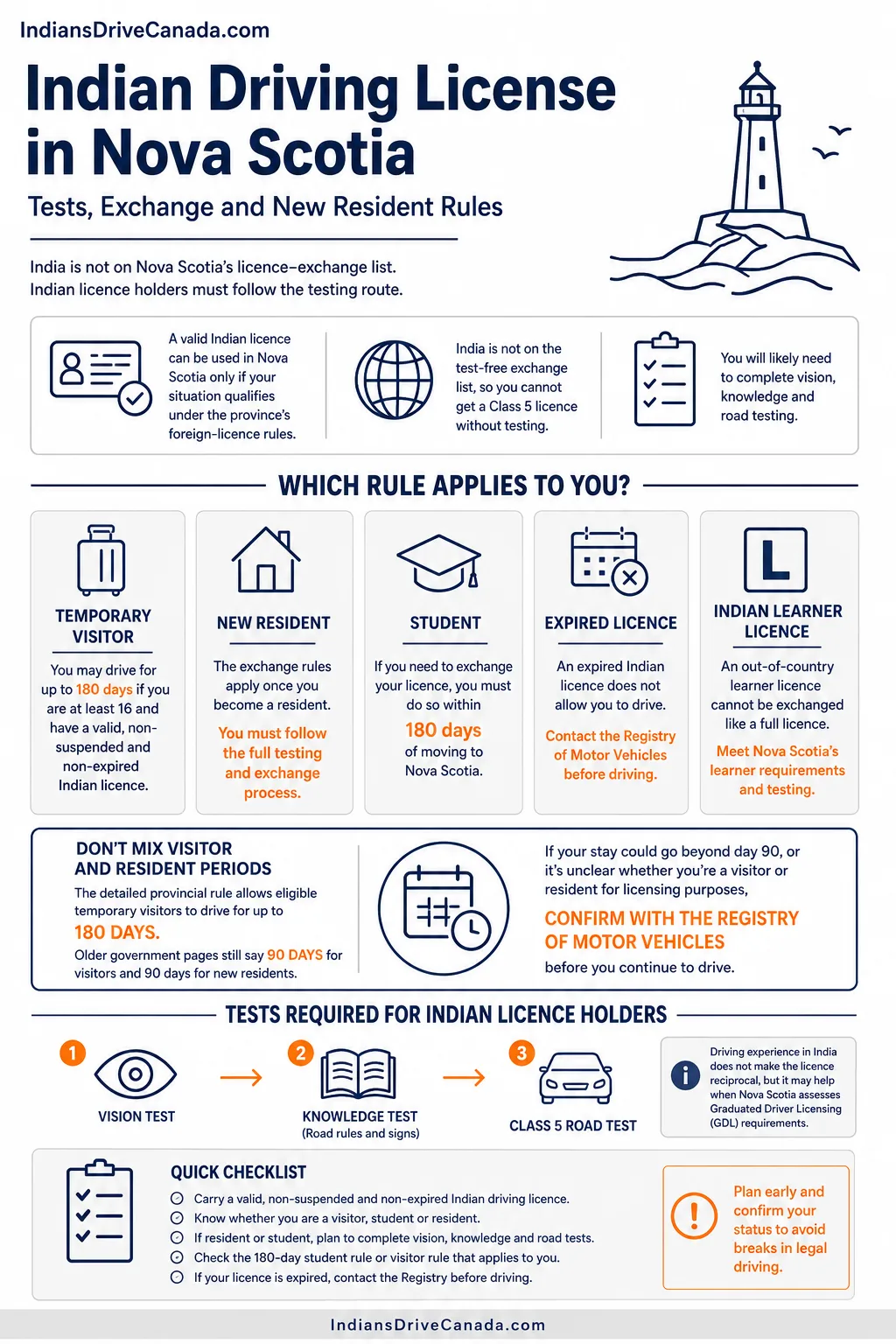
A valid Indian driving licence can be used in Nova Scotia only while the province’s foreign-licence rules still apply to your situation. India is not on Nova Scotia’s listed-country licence-exchange table, so an Indian passenger-vehicle licence does not qualify for a test-free swap to a Class 5 licence. A holder of a valid Indian licence who needs a Nova Scotia licence normally has to complete vision, knowledge and road testing.[Exchange rule]
The main distinction is your status in Nova Scotia. A temporary visitor, a person becoming a Nova Scotia resident and a college or university student should not calculate their driving period in the same way. The validity of the Indian licence also matters: an expired licence cannot be used to drive simply because a provincial transition period has not ended.
Which Nova Scotia rule applies to your situation?
| Situation | What the Nova Scotia rules mean | Likely next action |
|---|---|---|
| Temporary visitor with a valid Indian licence | The detailed provincial exchange page permits eligible temporary visitors to drive for up to 180 days. | Confirm that visitor treatment still applies before relying on the foreign licence for a long stay. |
| Person becoming a Nova Scotia resident | The licence-exchange rules apply once the person’s Nova Scotia circumstances bring them into the resident licensing process. | Begin the testing and exchange route rather than assuming the visitor period applies. |
| College or university student | A student who needs to exchange must do so within 180 days of moving to Nova Scotia. | Use the student rule, then follow the out-of-country testing route that applies to the Indian licence. |
| Expired Indian licence | An expired foreign licence does not provide permission to drive. | Contact the Registry of Motor Vehicles about the expired-licence route before driving. |
| Indian learner licence | An out-of-country learner licence cannot be exchanged like a full licence. | Meet Nova Scotia’s learner requirements, including required testing. |
Temporary visitor and resident periods should not be mixed
Nova Scotia’s detailed licence-exchange service says a temporary visitor who is at least 16 and holds a valid, non-suspended and non-expired licence may drive for up to 180 days without exchanging it. The same page separately describes people becoming residents and students, so the 180-day visitor wording should not be treated as an automatic allowance for everyone who has moved to the province.[Visitor rule]
Nova Scotia currently has conflicting government wording online. The detailed exchange service states up to 180 days for an eligible temporary visitor, while older Registry of Motor Vehicles pages still state 90 days for visitors and 90 days for a person becoming a resident.[Rule conflict] If your stay could extend beyond day 90, or it is unclear whether Nova Scotia considers you a visitor or a resident for licensing purposes, confirm the applicable deadline with the Registry of Motor Vehicles before continuing to drive.
India is outside Nova Scotia’s test-free exchange list
Nova Scotia gives a simplified exchange to licences from specified countries and classes. For example, qualifying passenger licences from countries such as Australia, France, Germany, Ireland, Japan, South Korea and the United Kingdom can be exchanged after the required vision check. India is not in the province’s listed-country table.
For a valid Indian passenger-vehicle licence, the relevant category is therefore a licence from a country or class not on the list. Nova Scotia requires the applicant to pass:
Years of driving in India do not turn the Indian licence into a reciprocal licence. Previous experience can still matter when Nova Scotia determines whether the Graduated Driver Licensing program applies, but it does not remove the full-testing requirement for India.[Driving history]
When Nova Scotia’s resident licensing process becomes relevant
The current exchange service says a person becoming a Nova Scotia resident can exchange an out-of-province licence when one of these situations applies:
These criteria matter more than simply looking at the date on a work permit, study permit or permanent resident card. Immigration status and provincial driver-licensing status are related to different administrative questions. A person should not assume that becoming a permanent resident starts a fresh foreign-licence driving period, or that holding a work permit automatically makes the visitor rule applicable.
The broader distinction between immigration status and provincial driving permission is covered separately in driving in Canada as an Indian student, worker or permanent resident.
The testing route for a valid Indian licence
Pass the vision test
The vision test is completed in person at an Access Nova Scotia or Registry of Motor Vehicles location. Nova Scotia does not charge a fee for the vision test. If the knowledge test is taken online, an in-person visit is still necessary for the vision portion.[Vision test]
Complete the knowledge test
The foreign-licence process uses a two-part multiple-choice knowledge test covering rules of the road and highway signs. The test can be taken in English or French online where that option is available, or in person at Access Nova Scotia or the Registry of Motor Vehicles. The province also provides an oral-examination arrangement in exceptional circumstances.
If an applicant does not speak English or French and needs interpretation for an in-person appointment, Nova Scotia instructs the applicant to arrange an interpreter. Study should be based on the Nova Scotia Driver’s Handbook rather than practice questions alone.
Nova Scotia’s current Class 7 knowledge-test page describes the standard two-part test as 20 multiple-choice questions on road rules and 20 on road signs, with at least 16 correct answers required in each part.[Knowledge test] The foreign-licence exchange page confirms the same two subject areas but does not separately restate the number of questions for an exchange applicant.
Get the Nova Scotia master number and book the road test
After the required testing is entered into the Nova Scotia system, the applicant receives a Nova Scotia master number. A person using the non-listed-country route can book the road test online with the master number and the expiry date of the out-of-country licence. The valid Indian licence must be brought to the road test.
Pass the Class 5 road test
For an ordinary passenger vehicle, the Class 5 road test is scheduled for 30 minutes and the published road-test fee is $52.54 including HST.[Road test]
If the road test is unsuccessful, the foreign-licence exchange instructions require a two-week wait before taking another road test. A new road-test receipt and appointment are required. The separate booking page says an unsuccessful or incomplete candidate must wait until the next day before booking another test; that booking rule does not remove the two-week retest interval stated for the foreign-licence exchange route.
The road-test vehicle is part of the application
Access Nova Scotia does not provide the vehicle for the road test. The applicant must arrange a suitable vehicle and bring the documents Nova Scotia requires for that vehicle.
Bring these items for a Class 5 road test
- A valid Indian or other valid out-of-country driver’s licence
- Proof of motor vehicle liability insurance for the test vehicle
- A valid vehicle permit or temporary permit
- Proof of a valid motor vehicle inspection
- Any driver-training certificate that applies to the booking
The vehicle is also subject to a safety check before the test even when it already has a valid motor vehicle inspection.[Vehicle documents]
Borrowing a family member’s vehicle does not remove the document requirements. Check the insurance, permit and motor vehicle inspection before the appointment rather than discovering a missing or expired document at the test location.
More detailed vehicle preparation and test-day checks are available in the Canadian road test checklist for Indian drivers.
Translation and IDP serve different purposes
If the Indian driving licence is printed in English or French, Nova Scotia does not require a certified translation merely because the licence was issued in India. If relevant licence information is in another language, a certified English or French translation is required for the exchange.
Nova Scotia lists the following translation providers:
The translation must be accompanied by the original licence and a true copy carrying the translator’s official stamp or credentials. Nova Scotia specifically states that an International Driving Permit cannot be used as the translation for a driver’s licence exchange.[Translation rule]
An IDP can have a separate role when travelling with an Indian licence, but it does not convert the licence into a Nova Scotia licence, remove the tests or replace the province’s certified-translation requirement. The distinction is covered further in the Indian International Driving Permit requirements for Canada.
Indian driving experience can affect GDL treatment, not the exchange agreement
Nova Scotia’s exchange page does not publish a rule saying that a particular number of years on an Indian licence guarantees a regular Class 5 licence after the road test. Instead, it says that the current licence class and how long the applicant has held the licence may determine whether the applicant needs to enter the Graduated Driver Licensing program.
A separate Registry examination page states that the normal 12-month learner waiting period has an exception for a person who previously held an equivalent driver’s licence in another jurisdiction, including another country.[Waiting period]
Full testing does not automatically mean the applicant is treated as someone who has never held a licence. It means India is outside Nova Scotia’s test-free exchange list. The Registry can still consider the class and history of the foreign licence when determining the Nova Scotia licensing stage.
The current exchange instructions do not publish a separate India-specific rule requiring a driving extract, RTO letter or authentication document to receive experience credit. An applicant should therefore not assume that an Ontario-style DL Extract process applies in Nova Scotia. If the current Indian card does not clearly show the history needed for a GDL decision, ask the Registry of Motor Vehicles what supporting record it will accept before ordering or translating additional documents.
Students have a separate 180-day exchange rule
A student attending college or university in Nova Scotia must exchange the current licence within 180 days of moving to Nova Scotia to continue driving.[Student rule]
Student status does not put India on the listed-country exchange table. A student with an Indian licence still follows the applicable out-of-country testing route.
There is, however, a student-specific fee option. A full-time student may be eligible for a reduced licence fee and may be able to keep the expiry date from the current licence by bringing a letter from the Dean, or equivalent official, stating that the person is a full-time student at a Nova Scotia educational institution.
For a full-time student application
- Keep the current Indian licence valid while it is being used.
- Do not treat the study permit expiry date as the provincial driving deadline.
- Prepare the additional proof of identity required for the licence application.
- Ask the educational institution for the full-time student letter if seeking the student fee arrangement.
- Allow time for the required tests before the 180-day exchange period ends.
An expired Indian licence follows a different route
Nova Scotia states that a person with an expired driver’s licence is not permitted to drive under the temporary foreign-licence allowance.[Expired licence]
The additional information on the exchange service describes a route in which an expired-licence applicant may pass the vision and knowledge tests and receive a Restricted Class 5 licence with Condition 46. That restriction requires a supervising driver. After the road test is passed, the restriction can be removed.
The out-of-country section of the same provincial service also tells applicants with an expired licence to contact the province to explore the options available. For an expired Indian licence, it is therefore safer to have the Registry identify the applicable route before paying for tests or assuming that the valid-licence sequence applies unchanged.
An Indian learner licence is not treated as a full foreign licence
Nova Scotia does not exchange a learner licence issued outside Canada through the ordinary foreign-licence route. The applicant must meet the standard Nova Scotia learner requirements, including vision and knowledge testing. Previous possession of an Indian learner permit should not be presented as equivalent to a full passenger-vehicle licence.
Identification for the exchange is separate from the Indian licence
The foreign-licence exchange instructions require the current driver’s licence plus additional proof of identity. Nova Scotia maintains its own identification lists for Registry of Motor Vehicles transactions. A valid foreign passport appears among the accepted primary identity documents, but the complete combination required depends on which identification documents are presented.[Identity requirement]
Do not assume that the Indian licence alone satisfies every identity requirement. Check the Registry identification combinations before going to Access Nova Scotia, especially if the name shown on the licence differs from the passport or another document.
After the road test is passed
After completing the required road test, the exchange is finished in person at Access Nova Scotia or a Registry of Motor Vehicles location. The applicant completes the application, discloses medical conditions that may affect safe driving, presents the current foreign licence and required identity documents, and pays the applicable licence fee.
The office captures the applicant’s photo and signature. Nova Scotia then issues a 30-day temporary driver’s licence, and the physical Nova Scotia card is expected to arrive by mail in about two weeks.[Licence issue]
The province’s published regular Class 5 licence fee is $80.15.[Licence fee] A student’s payable amount can differ if the full-time student fee provision applies, and additional costs arise if a test has to be repeated.
Do not assume the physical Indian licence will necessarily be returned after the exchange. An older Registry page states that an out-of-province licence must be surrendered when applying for a Nova Scotia licence. The current detailed page expressly repeats surrender for listed-country exchanges but does not use the same wording in its non-listed-country checklist. If retaining the original Indian card matters, confirm how it will be handled before completing the exchange rather than relying on an assumption.
A typical route for an experienced driver moving from India
Consider a driver who moves from India to Halifax with a current full passenger-vehicle licence and several years of driving history. The Indian licence does not qualify for Nova Scotia’s test-free listed-country exchange. The driver first needs to determine which provincial status and foreign-licence period applies, then complete the required vision and knowledge tests.
After receiving the Nova Scotia master number, the driver can arrange a suitable road-test vehicle, book the Class 5 test and bring the valid Indian licence on the test date. Previous driving history may affect GDL treatment, but it does not remove the road test. After passing, the driver completes the exchange at Access Nova Scotia or the Registry of Motor Vehicles and receives the temporary Nova Scotia licence while the card is mailed.
The practical sequence is therefore:
- Confirm whether the visitor, resident or student rule applies.
- Make sure the Indian licence is still valid.
- Complete the vision test.
- Pass the required knowledge test.
- Obtain the Nova Scotia master number.
- Arrange an eligible, documented road-test vehicle.
- Pass the Class 5 road test.
- Complete the in-person licence exchange.