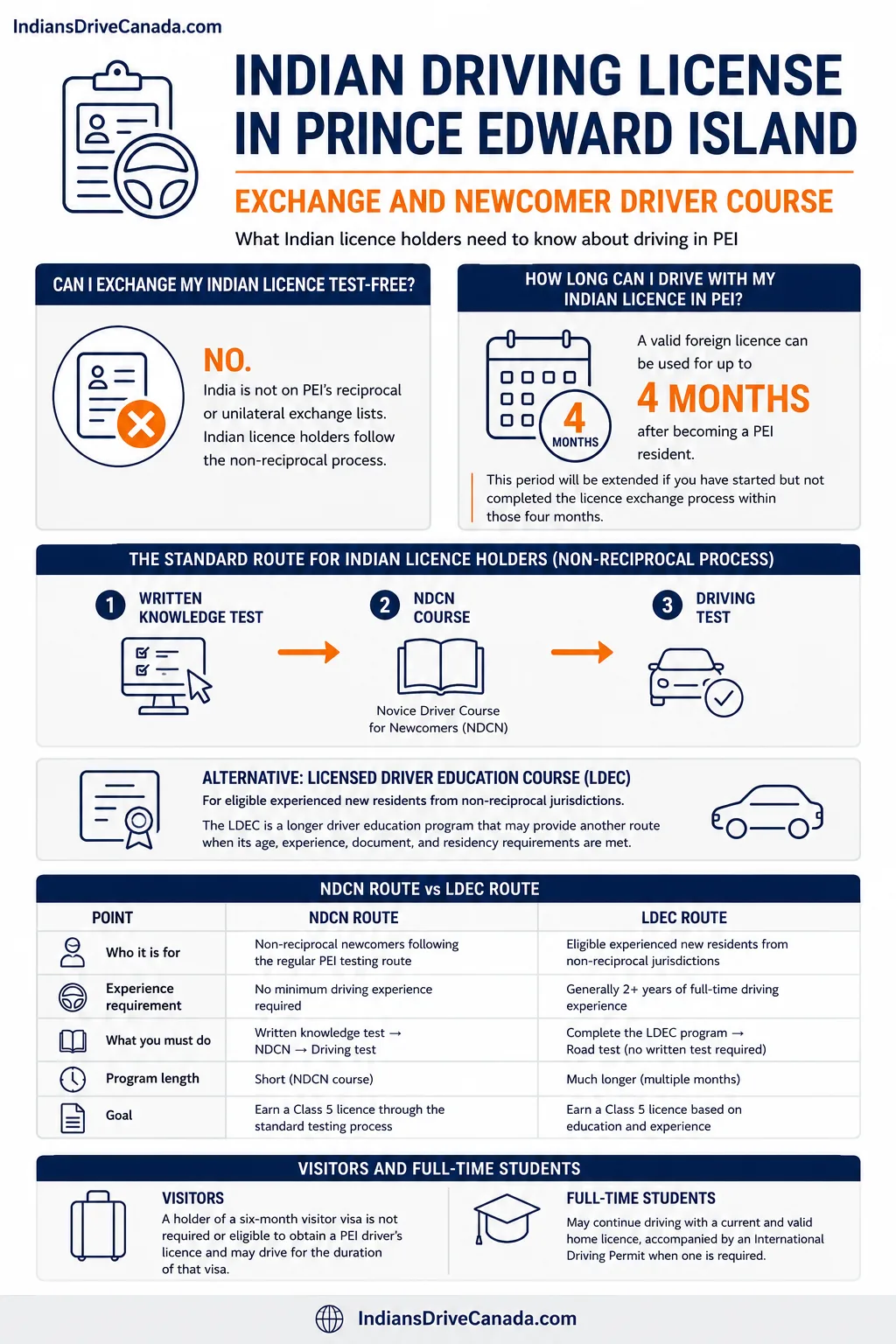
An Indian driving licence does not qualify for a test-free direct exchange in Prince Edward Island. India does not appear on PEI’s reciprocal or unilateral exchange lists, so a new resident with an Indian licence normally follows the non-reciprocal process: a written knowledge test, the Novice Driver Course for Newcomers (NDCN), and a driving test. PEI also offers a separate Licensed Driver Education Course (LDEC) route for certain experienced newcomers. [Exchange rule]
A valid foreign licence can generally be used for up to four months after becoming a PEI resident. PEI states that this period will be extended when the driver has started but not completed the licence exchange process within those four months. [Resident deadline]
Exchange does not mean a card-for-card swap for an Indian licence
PEI uses the term non-reciprocal licence exchange for applicants from countries without a qualifying exchange arrangement. For an Indian licence holder, that wording should not be read as an exchange without testing.
The practical difference is simple: drivers from qualifying reciprocal or unilateral jurisdictions can meet the applicable exchange conditions without the usual written and road tests. India is not on either published list. An Indian licence can still be used in the PEI licensing process, but the applicant follows the non-reciprocal requirements unless another PEI program changes the route.
Direct test-free exchange: No.
Standard Indian-licence route: written knowledge test → NDCN → driving test.
Experienced-newcomer alternative: the LDEC may provide another route when its age, experience, document and residency requirements are met.
The four-month period is tied to PEI residency
The four-month rule applies after becoming a resident of Prince Edward Island. It should not automatically be calculated from the day someone first arrived in Canada. A person may enter Canada, live elsewhere first, and become a PEI resident later.
The foreign licence also needs to remain valid while it is being used. Waiting until the end of the four-month period can create an avoidable timing problem because the NDCN route includes a minimum waiting period after the knowledge exam.
PEI specifically allows an extension of the four-month period when the licence exchange process was started but remains incomplete within that period. That should not be treated as permission to postpone starting the process until the deadline. The applicant’s actual licensing status and driving authority should be confirmed with Highway Safety if the exchange remains unfinished.
Visitors and full-time students are not automatically treated as new residents
A person in PEI temporarily may fall under a different rule. PEI says a holder of a six-month visitor visa is not required or eligible to obtain a PEI driver’s licence and may drive for the duration of that visa. A full-time university or college student may also continue driving with a current and valid home licence, accompanied by an International Driving Permit when one is required. [Temporary status]
These exceptions matter because immigration status and PEI residency are not interchangeable concepts. Someone who has actually established PEI residency should not rely on a visitor or student exception without confirming that it still applies to their situation.
There are two very different routes for non-reciprocal newcomers
The standard NDCN route and the LDEC route should not be treated as two names for the same program. One is a short newcomer course within the normal non-reciprocal testing process. The other is a much longer driver-education program designed to recognize qualifying previous experience.
| Point | NDCN route | LDEC route |
|---|---|---|
| Who it is for | Non-reciprocal newcomers following the regular PEI testing route | Eligible experienced new residents from non-reciprocal jurisdictions |
| Experience threshold | No separate two-year LDEC threshold | Minimum two years of driving experience must be proven |
| Course length | Approximately four hours | At least 41 hours |
| Knowledge testing | Rules of the Road knowledge exam must be passed before NDCN can be booked | Required written and driving examinations are provided through the licensed driving-school process |
| Driving test | Required in the non-reciprocal process | Delivered as part of the approved school program |
| Licensing result | Applicant is placed at the appropriate stage of PEI’s Graduated Driver Licensing Program after completing the requirements | Successful completion can lead to an unrestricted Class 5 licence when all program requirements are met |
The published LDEC conditions and outcomes are set out by PEI Highway Safety. [Experience route]
The standard route starts with the knowledge exam, not the newcomer course
1. Have the foreign-licence application and documents reviewed
A non-reciprocal applicant may be asked to provide documents needed to establish identity, immigration status, PEI residence and licence authenticity. Highway Safety can require additional evidence where a foreign licence does not have security features that can be adequately verified.
2. Pass the Rules of the Road knowledge exam
The knowledge exam comes before the NDCN. Passing it is one of the requirements for registering for the newcomer course.
3. Obtain the PEI Photo Identification Card
PEI mails the Photo ID card after successful completion of the Rules of the Road knowledge exam. The card must be brought to the NDCN; a participant without it will not be admitted to the course.
4. Complete the NDCN after the required wait
The NDCN cannot be booked before the knowledge exam has been passed. PEI also applies a minimum 30-day waiting period for the course so that class arrangements can be made and the participant has time to receive the identification card. [Course timing]
5. Complete the required driving test
Passing the driving test remains part of PEI’s non-reciprocal process. The resulting licence stage depends on how the applicant is assessed under PEI’s licensing system rather than on the number of years claimed on the Indian licence alone.
The NDCN is short, but its booking rules can shape the whole timeline
The Novice Driver Course for Newcomers is approximately four hours and may be delivered in one or two sessions depending on location. The published registration charge is $100 plus HST, for a total of $115. PEI also lists a $20 fee for the Photo Identification Card required for the course. [Course details]
The 30-day minimum wait is especially relevant to a new resident who is still using an Indian licence during the four-month resident period. The course is not something that can normally be booked first and followed by the knowledge exam later.
What PEI covers in the newcomer course
The NDCN is focused on rules and conditions that affect driving in PEI rather than on basic vehicle operation alone. Its published topics include:
PEI describes the NDCN as mandatory for non-reciprocal licence exchanges unless an applicable exemption applies, such as completion of an approved PEI driver-education program. [NDCN requirement]
The LDEC can change the route for an experienced Indian licence holder
The Licensed Driver Education Course is designed for experienced new residents coming from jurisdictions without a PEI reciprocity agreement. Instead of simply claiming previous experience, the applicant goes through a Highway Safety validation process and completes an approved driving-school program.
PEI lists the following conditions for taking the LDEC:
- Be a new PEI resident over the age of 19.
- Come from a non-reciprocity country.
- Meet Highway Safety’s vision standards.
- Have at least two years of driving experience.
- Hold a valid Class 5-equivalent licence from the country of origin.
- Present acceptable supporting documentation.
The LDEC is optional. An experienced newcomer who does not want to enrol can still use the regular route involving document validation, written and vision testing, the NDCN and the road test. [LDEC eligibility]
For LDEC, two years of experience has to be supported by the documents
Documents PEI lists for the Highway Safety appointment
- A valid photo driver’s licence from the home jurisdiction
- A valid passport
- Immigration documents showing legal status and length of stay in Canada
- Two documents showing the current residential address in Prince Edward Island
- A certified translation of the driver’s licence if it is not in English or French
PEI also states that documents required for the LDEC eligibility process must be originals rather than copies. [Required documents]
One detail deserves special attention with an Indian licence that has been renewed or reissued. PEI’s published LDEC document list says that the date of issue on the valid home-jurisdiction licence must be at least two years before the LDEC application. [Experience evidence]
A driver may have been licensed in India for many years while the present card shows a much newer issue date because it was renewed or reissued. The PEI LDEC page does not state that every older RTO record, driving extract or experience letter will automatically replace the published issue-date condition. In that situation, the safest next step is to have the participating driving school and Highway Safety assess the documents before paying for the course or assuming that the two-year requirement has been accepted.
This is also why driving-experience credit and direct licence exchange should be kept separate. Proving a long driving history may affect eligibility for the LDEC. It does not turn an Indian licence into a reciprocal licence.
What happens after Highway Safety approves the LDEC application
The process changes once Highway Safety confirms eligibility.
Receive a 90-day PEI Photographic Identification Card
The applicant completes the application for the card, pays the published $20 fee and receives the identification card by mail.
Complete at least 41 hours of driver education
The LDEC requires a minimum of 41 hours covering classroom instruction, in-car observation and in-car driver training. The licensed driving school also provides the required written and driving examinations. [Training requirement]
Keep both completion documents
After successful completion, the driving school provides a Certificate of Completion and a test slip identified by PEI as pink in colour. Both are needed for the final licensing transaction.
Complete the Class 5 transaction at Access PEI
PEI requires the completion certificate, pink test slip, country-of-origin driver’s licence, 90-day PEI Photo ID and the applicable licensing fee. The country-of-origin licence and the PEI Photo ID are surrendered at this stage. [Class 5 process]
Do not assume every licensed driving school offers LDEC
PEI publishes a Table A list of schools licensed to provide driver instruction and the Graduated Driver Licensing program. The province also states that some of those schools have been certified for programs such as the LDEC. Being listed in Table A therefore does not by itself establish that a school offers the experienced-newcomer course. [School eligibility]
When contacting a school, ask specifically whether it is certified to deliver the Licensed Driver Education Course for a non-reciprocal foreign-licence holder. The school should also explain its course fee, document process and how the Highway Safety validation appointment is arranged.
If two years cannot be proven, the licence process does not stop
Someone with less than two years of driving experience, or someone who cannot prove the required period, is not automatically prevented from obtaining a PEI licence. What changes is access to the LDEC experience route.
PEI says these applicants can still complete the required examinations and NDCN and then be placed at the appropriate stage of the Graduated Driver Licensing Program. [GDL placement]
| Situation | What to check first |
|---|---|
| New PEI resident with an Indian licence | Non-reciprocal licensing process |
| Less than two years of experience | Knowledge exam, NDCN and testing route |
| Two or more years that meet LDEC evidence requirements | LDEC eligibility through an approved participating driving school |
| Experienced driver who does not want LDEC | Regular NDCN and testing route remains available |
| Long driving history but recently reissued Indian card | Ask Highway Safety how the published LDEC issue-date condition applies before enrolling |
| Six-month visitor visa holder | Check the visitor exception before applying for a PEI licence |
| Full-time PEI university or college student | Check the student foreign-licence rule before starting an exchange |
The road-test vehicle is part of the standard-route preparation
A driver following the regular non-reciprocal route must also plan for the practical exam. PEI requires the candidate to supply a vehicle for the road test. The vehicle must have a valid inspection, insurance and registration, and Highway Safety conducts a pre-trip safety check before the examination. [Road-test vehicle]
General Class 7 waiting-period rules shown on PEI’s beginner-driver examination page should not automatically be applied to every foreign-licence applicant. A non-reciprocal newcomer can be placed at a licensing stage based on the process and experience assessment that applies to that applicant. The Highway Safety decision should therefore be established before assuming a beginner-driver timeline.
Five assumptions that can send the PEI application down the wrong route
| Assumption | Better action |
|---|---|
| “Exchange” means no tests. | Check whether the country is reciprocal, unilateral or non-reciprocal. India falls under the non-reciprocal route. |
| NDCN can be booked before the knowledge test. | Pass the Rules of the Road exam first, then account for the minimum 30-day NDCN wait. |
| Two years claimed means LDEC is guaranteed. | Have Highway Safety validate the licence and supporting documents before relying on the LDEC route. |
| Every PEI driving school offers LDEC. | Confirm that the school is certified for LDEC, not merely listed as a licensed driver-training school. |
| An IDP creates an exchange right. | Treat an International Driving Permit as a document used with the underlying valid licence where applicable; it does not make India a reciprocal jurisdiction. |