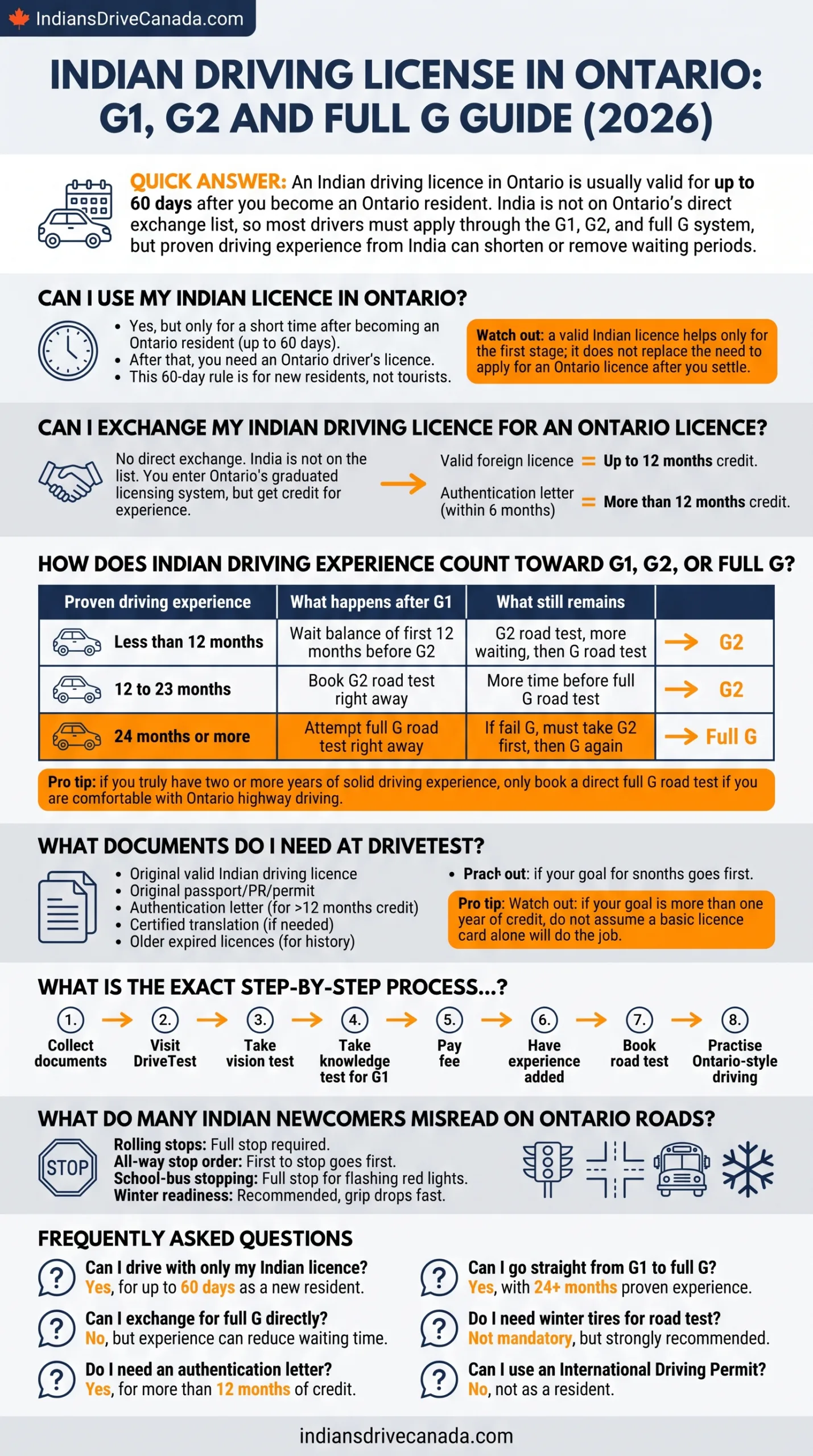
An Indian driving licence cannot be directly exchanged for an Ontario G licence. India does not have a reciprocal passenger-vehicle licence exchange agreement with Ontario.
For applications made in Ontario, the province recognizes no more than 12 months of eligible foreign driving experience. An applicant credited with 12 months can take the G2 road test without an additional G1 waiting period. After passing the G2 road test, the driver must wait at least 12 months before taking the Full G road test.
The direct G1-to-G route no longer applies to Indian licence holders. Even a driver with many years of verified driving experience in India must pass the G2 road test, hold a G2 licence for at least 12 months, and then pass the G road test.
An Indian licence can still be used as evidence of previous driving experience, but the result depends on the experience Ontario accepts from the original licence and any supporting authentication document. The number of years a person has driven in India does not automatically become the number of years entered on the Ontario driving record.
The Class G process covered here applies to cars, vans and small trucks. Indian motorcycle and commercial-vehicle licences follow different Ontario rules.
Your Ontario route depends on accepted experience
DriveTest decides how much foreign experience is credited after reviewing the original licence, identity documents and any supporting evidence. The maximum Class G credit for a licence from a non-exchange country is 12 months.
| Experience accepted by DriveTest | G2 eligibility | Full G eligibility |
|---|---|---|
| No experience credit | Normally after 12 months as a G1 driver, or after 8 months with an approved Beginner Driver Education course | At least 12 months after passing the G2 road test |
| Less than 12 months | The normal G1 period is reduced by the accepted experience | At least 12 months after passing the G2 road test |
| 12 months | The G2 road test may be taken immediately after the G1 knowledge and vision requirements are completed | At least 12 months after passing the G2 road test |
| More than 12 months in India | No more than 12 months can be credited, so the G2 test may be taken immediately if the full credit is accepted | The extra experience does not shorten the mandatory G2-to-G period |
Only eligible experience from the previous three years is considered, up to the 12-month limit. A licence first issued many years ago does not by itself guarantee that the maximum credit will be entered.
Can you drive in Ontario with your Indian licence?
The answer changes according to whether Ontario has become your main place of residence or you are only visiting.
| Situation | General Ontario rule |
|---|---|
| New Ontario resident | A valid foreign licence may generally be used for 60 days after moving to Ontario and becoming a resident |
| Visitor staying less than 3 months | A valid Indian licence may be used, subject to insurance, vehicle and Ontario traffic requirements |
| Visitor staying more than 3 months | An International Driving Permit obtained in India must accompany the valid Indian licence |
| Person already issued an Ontario licence | The Ontario licence must be used when driving in Ontario; the Indian licence is no longer an alternative licence for local driving |
The 60-day resident period begins when the person moves to Ontario and becomes a resident. It should not automatically be calculated from the date of entry into Canada if the person lived elsewhere before settling in Ontario.
An International Driving Permit does not extend a new Ontario resident’s 60-day foreign-licence period. It is a supporting document for a visitor and is not a replacement for the original Indian licence.
Permanent residents, students and work permit holders
Permanent residence does not create a direct licence exchange. The same applies to a work permit or study permit. The licensing route is determined by Ontario residence, the jurisdiction that issued the licence, the licence class, accepted documents and credited driving experience.
Since May 11, 2026, a person applying for a Class G licence must declare that:
A tourist visiting Ontario is not eligible to apply for an Ontario driver’s licence. A student or temporary worker who has made Ontario their primary residence may apply if the required identity and legal-presence conditions are met.
Why the Indian licence is not directly exchanged
Ontario has reciprocal agreements with selected countries and jurisdictions. Drivers arriving from an exchange jurisdiction may qualify to replace their licence without completing every graduated-licensing stage.
India is not included in that passenger-vehicle exchange list. An Indian licence holder therefore enters Ontario’s graduated licensing system and must complete:
- Identity and document review
- Vision screening
- G1 knowledge test
- G2 road test
- A minimum 12-month G2 period
- Full G road test
Foreign experience changes the timing of the first road test. It does not remove either road test and cannot reduce the mandatory waiting period between G2 and Full G.
| Previous route often associated with foreign experience | Current route for an Indian Class G applicant |
|---|---|
| Use two or more years of foreign experience to attempt the Full G road test directly | Complete the G2 road test first |
| Apply more than 12 months of foreign experience to graduated licensing | Receive no more than 12 months of Class G credit |
| Use foreign experience to reduce the wait after G2 | Wait at least 12 months after passing G2 |
| Complete only the road test assigned according to foreign experience | Complete both the G2 and G road tests |
Documents to prepare before visiting DriveTest
Core application documents
- An original, valid Indian driving licence
- Original acceptable identification showing legal name and full date of birth
- A recent authentication letter or driver abstract when additional experience must be proved
- An English or French translation from an MTO-recognized translator when required
- Documents linking different names when the licence and identity documents do not match
The original Indian driving licence
The licence must be valid and presented in its original form. A photograph, ordinary photocopy, scanned copy or screenshot should not be treated as a replacement for the original card.
The card is more useful when it clearly displays:
An Indian licence that does not display both an issue date and expiry date may still be reviewed for up to 12 months of credit, but the final amount remains subject to DriveTest’s document assessment.
Authentication letter or driver abstract
A recently renewed Indian licence may show only the date of the new card. That date can make a long driving history appear much shorter. A suitable authentication document can establish the earlier licensing date.
The document may be called a driving extract, driver abstract, licence particulars, driving history or authentication letter. Names differ between Indian licensing authorities. The document’s contents and issuing authority matter more than its title.
An acceptable document should be issued within the previous six months and contain:
- The date the document was issued
- The date the driver was first licensed
- The driver’s full name or licence number
- Date of birth
- Licence class or classes
- Current licence status
- Licence expiry date
- Official letterhead, logo, emblem or coat of arms
- An original signature, seal or stamp when issued as a physical document
The document must come from the licensing authority or from a consulate, embassy or high commission representing the issuing jurisdiction. An electronic abstract may be accepted when it comes from the licensing authority and contains the required official features. A printed copy must be presented to DriveTest.
A letter from an insurance company does not replace an authentication document for Ontario licensing credit. Records from third-party licence verification websites are also not accepted as proof of foreign driving experience.
When the authentication document changes the result
Suppose the current Indian licence was issued six months before the Ontario application, but the driver has held a full Indian licence for several years. Without acceptable supporting evidence, the visible six-month period may be the only period that can be established from the card.
With an accepted authentication document showing at least 12 months of eligible experience, the driver may receive the maximum 12-month credit and become eligible for the G2 road test after completing the G1 knowledge and vision requirements.
Translation requirements
The licence and supporting documents must be in English or French. If information appears in another language, an English or French translation from an MTO-recognized translator is required.
A card containing a few English labels should not automatically be assumed to meet the requirement if material licence information remains in another language. The translation must be presented with the original document.
If an embassy, consulate or high commission supplies an acceptable authentication letter in English or French together with the original licence, DriveTest states that a separate licence translation may not be required.
Keep copies of every driving history, authentication and translation document before the DriveTest visit. Original supporting documents and translations related to foreign experience may be retained, and DriveTest does not provide copying or fax services.
Name differences between Indian and Canadian documents
A variation between the passport, immigration document and driving licence can delay the application. Examples include an omitted surname, initials instead of a full name, a middle name appearing on only one document or a surname changed after marriage.
Bring original documents that connect the names, such as an accepted marriage certificate, legal name-change document, divorce certificate or court order. The appointment name should match the identification presented at the centre.
What happens during the first DriveTest visit
An application with foreign driving experience can be made at a DriveTest Centre. Walk-in service is available, while selected centres also provide appointments for foreign-licence applications. Locations offering appointment service may give priority to booked applicants, and walk-in waits can be longer.
1. Application and identity review
Present the original Indian licence, acceptable identification, supporting experience evidence and any required translations. Complete the application forms and declare the amount of previous driving experience.
2. Experience-credit assessment
DriveTest reviews the licence dates and supporting evidence. The accepted amount determines when the G2 road test can be taken. No more than 12 months can be credited toward the Class G route.
3. Residence and legal-presence declarations
Confirm that Ontario is the primary place of residence and that the applicant is legally present in Canada.
4. Vision screening
The screening is completed at the centre. Bring glasses or contact lenses used for driving. A licence condition may be added when corrective lenses are required.
5. G1 knowledge test
Pass the test on Ontario traffic signs and rules of the road. Results are provided at the centre.
6. Ontario record and G1 document
After the application, vision and knowledge requirements are completed, a temporary Ontario licence document is issued. The credited experience and road-test eligibility date should be checked before leaving.
If proof of additional experience was not available during the first application, DriveTest allows a driver to return later with acceptable documents so that more eligible experience can be added to the record, up to the 12-month maximum.
The G1 knowledge test
The G1 knowledge test checks Ontario traffic signs and rules of the road. It is multiple choice, normally divided into two or three sections and usually takes about 20 to 30 minutes. The test is not timed, but it must be completed before the centre closes.
A score of at least 80 percent is required. If only part of the test does not meet the passing standard, the unsuccessful section can normally be repeated within the one-year validity period of the test results. Each extra attempt requires another fee.
Languages useful to Indian applicants
The computerized Class G1 test is available in 32 languages. Options include:
Computer kiosks can provide audio support. Availability can depend on the centre and test format. A person needing a verbal test or an interpreter accommodation should arrange it with DriveTest rather than bringing an unapproved interpreter on the day.
What to study
Preparation should be based on the current Official MTO Driver’s Handbook. Private practice tests can be useful for repetition, but they are not the official examination and may contain outdated wording.
Study should cover:
- Regulatory, warning and information signs
- Right-of-way at controlled and uncontrolled intersections
- Four-way stops
- School buses and school zones
- Emergency vehicles and move-over duties
- Pedestrian crossings
- Lane markings and lane changes
- Speed, following distance and stopping distance
- Alcohol and novice-driver restrictions
- Winter conditions and reduced visibility
G1 knowledge test is the written or computerized test used to obtain the G1 licence. The G2 road test is also called the G1 exit test. The Full G road test may be called the G2 exit or highway test.
Calculating the wait before the G2 road test
The normal G1 period is 12 months. Completion of an MTO-approved Beginner Driver Education course can reduce the standard period to eight months.
Foreign experience can also reduce the G1 period. The official eligibility date entered on the Ontario driver record should be used when foreign credit and an approved course are combined.
| Accepted foreign experience | Typical remaining G1 period without BDE | Next step |
|---|---|---|
| 0 months | 12 months | Practice under G1 conditions and take the G2 test when eligible |
| 4 months | About 8 months | Confirm the recorded eligibility date |
| 6 months | About 6 months | Use the remaining period for Ontario-specific practice |
| 10 months | About 2 months | Book only after the Ontario record shows eligibility |
| 12 months | No additional G1 wait | Take the G2 road test after completing the application, vision and knowledge requirements |
Road-test appointment availability is separate from legal eligibility. A driver may be eligible on one date but find the next available appointment later.
G1 rules still apply to experienced Indian drivers
Ontario treats a person holding G1 as a novice driver even when foreign experience has been credited. The credit can change the wait before the G2 test, but it does not remove G1 driving restrictions.
- Maintain a zero blood-alcohol level.
- Do not drive alone.
- Have a qualified accompanying driver in the front passenger seat.
- Do not drive between midnight and 5 a.m.
- Make sure every occupant has a working seatbelt.
- Do not drive on restricted 400-series highways and high-speed expressways unless accompanied by an Ontario-licensed driving instructor.
The accompanying driver must hold a valid Class G or higher licence and have at least four years of driving experience. That person must be the only other occupant in the front seat. The accompanying driver’s blood-alcohol concentration must be below 0.05; it must be zero if the person is 21 or younger.
Driving alone with a G1 licence is not permitted because the driver previously drove independently in India. The restrictions are attached to the Ontario licence class, not the driver’s personal estimate of experience.
Preparing for the G2 road test
The G2 road test is the first road test in Ontario’s graduated system. It usually takes about 20 minutes and assesses basic vehicle control, observation, turns, lane use, intersections, stopping, parking and responses to normal city traffic.
The examiner is assessing whether the driver applies Ontario rules consistently. A driver can be comfortable operating a vehicle and still need practice with local observation routines, lane positioning and right-of-way rules.
Driving habits to adapt for Ontario testing
- Stop fully before the stop line, crosswalk or edge of the intersection.
- Check mirrors and the blind spot before changing lanes or moving away from the curb.
- Make head movements visible enough to show that traffic checks were completed.
- Enter the correct lane after turning.
- Use the mirror, signal and blind-spot sequence before lane changes.
- Observe posted speed limits even when surrounding traffic is moving faster.
- Yield fully to pedestrians where Ontario law requires it.
- Know the order of movement at four-way stops.
- Leave safe space beside cyclists and parked vehicles.
- Respond correctly to school buses and emergency vehicles.
These are not assumptions about how every person drives in India. They are areas where Ontario rules, road layout or examination expectations may differ from a driver’s previous environment.
The test vehicle
DriveTest does not supply a passenger vehicle for the road test. The applicant must bring a suitable vehicle that is legally permitted on the road and safe to operate.
Before the appointment, check:
- Licence plates and vehicle permit
- Insurance coverage
- Brake lights and turn signals
- Headlights and hazard lights
- Horn
- Windshield, mirrors and wipers
- Tires
- Seatbelts
- Doors and parking brake
- Fuel or battery charge
A mechanical or legal problem can cause the test to be declared out of order. Borrowed, driving-school and rental vehicles must be permitted for road-test use by the owner, rental company or insurer.
What changes after passing G2
A G2 driver can drive without an accompanying driver and can use Ontario roads, including 400-series highways. The driver must still follow novice-driver conditions.
Night passenger limits for drivers aged 19 or younger
During the first six months of G2, a driver aged 19 or younger may generally carry only one passenger aged 19 or younger between midnight and 5 a.m. After six months, the limit generally becomes three passengers aged 19 or younger during those hours.
Exceptions can apply when a fully licensed driver with at least four years of experience is in the front passenger seat or when the passengers are immediate family members.
A G2 licence gives broad independent driving privileges, but it is still a novice licence. A rental company, insurer, employer, delivery platform or rideshare company may impose its own eligibility rules beyond the minimum legal driving privilege.
The 12-month period between G2 and Full G
The rule introduced on July 1, 2026 makes this period unavoidable for drivers from non-exchange jurisdictions. Foreign experience cannot be applied after G2 to shorten it.
A driver with one year of accepted experience and a driver with fifteen years of experience in India follow the same minimum timeline after passing G2:
G2 road test passed
The driver receives G2 privileges and begins the mandatory holding period.
At least 12 months of G2 experience
The period can be used for freeway merging, lane changes, night driving, winter conditions, unfamiliar intersections and independent decision-making.
Full G road test
The road test can be taken after the eligibility date shown on the Ontario record and after sufficient highway practice.
The five-year graduated-licensing expiry also matters. A driver who does not complete the process within the permitted licence period may need to requalify or restart, depending on the licence status and timing.
Preparing for the Full G road test
The Full G test assesses more independent driving and includes major-road and expressway tasks. The driver must manage speed, space, observation and decisions without relying on constant examiner instruction.
Tested areas can include:
- Entering an expressway
- Accelerating to an appropriate merging speed
- Choosing a safe gap
- Checking mirrors and blind spots
- Maintaining speed and following distance
- Changing lanes safely
- Leaving the expressway
- Turns, curves and intersections
- Driving through business areas
Highway driving declaration
Before the test, the applicant must declare recent freeway or high-speed highway experience. The form asks how many times the driver used a freeway or a highway with a speed limit of at least 80 km/h during the previous three months. It also asks about the average length of those trips.
If the examiner determines that the applicant does not have enough highway experience for the test, the appointment can be declared out of order. Part of the prepaid fee may be lost.
Do not enter false highway-experience information to preserve a road-test appointment. Arrange legal practice with enough time to become comfortable with acceleration lanes, merging speed, blind-spot checks and highway exits.
G1, G2 and Full G compared
| Rule or privilege | G1 | G2 | Full G |
|---|---|---|---|
| Drive alone | No | Yes | Yes |
| Qualified accompanying driver | Required | Not required | Not required |
| 400-series highway | Only with an Ontario-licensed driving instructor on restricted highways | Permitted | Permitted |
| Midnight to 5 a.m. | Driving prohibited | Permitted, with youth passenger limits where applicable | Permitted |
| Alcohol limit | Zero | Zero | General Ontario rules apply, with zero alcohol still required for drivers aged 21 or younger and certain driver categories |
| Passenger capacity | Every occupant needs a working seatbelt | No more passengers than working seatbelts, plus youth night limits where applicable | No more passengers than legally available seating and restraints |
| Next licence stage | Pass G2 road test | Wait at least 12 months and pass G road test | No graduated stage remaining |
Current Ontario licensing and test fees
DriveTest fees are set by the Ontario Ministry of Transportation. The following amounts were checked on July 27, 2026 and can change.
| Service | Fee | What it covers |
|---|---|---|
| Class G1 licence package | CAD 159.75 | Knowledge test, first G2 road test and five-year licence |
| Foreign licence application for a non-exchange jurisdiction | CAD 106.00 plus applicable road-test fees | Five-year licence and knowledge test for the foreign-application category described by DriveTest |
| Extra knowledge-test attempt | CAD 16.00 | Each additional attempt |
| G2 road test | CAD 53.75 | Individual G2 road-test fee |
| Full G road test | CAD 91.25 | Individual Class G road-test fee |
| Five-year licence | CAD 90.00 | Licence component when not already included in a package |
| Printed MTO Driver’s Handbook | CAD 18.00 | Official printed handbook; DriveTest lists this as cash only |
The G1 package and foreign-application fee are different billing routes. Package components should not be added twice. The amount due is determined when DriveTest processes the application and reviews the foreign-experience documents.
Other possible expenses include:
India-to-Ontario driving adjustments
Previous driving experience remains useful, but Ontario testing requires local rules to be applied in a visible and repeatable way.
| Driving situation | Ontario practice |
|---|---|
| Side of the road | Drive on the right; most vehicles have the steering wheel on the left |
| Right turn on red | Stop fully first, check for a prohibition sign and yield before turning |
| Four-way stop | Vehicles generally proceed in arrival order; when arrival is simultaneous, yield rules apply |
| Pedestrian crossing | Yield according to the type of crossing and wait until the legal crossing requirement is satisfied |
| School bus | Recognize flashing amber and red lights and know when traffic in each direction must stop |
| Emergency vehicle | Move safely to the right and stop when required; follow move-over rules for stopped emergency vehicles |
| Highway merging | Use the acceleration lane to approach traffic speed and merge into a safe gap |
| Winter surface | Increase following distance and adjust steering, braking and speed for snow, slush and ice |
| Blind-spot observation | Use mirrors and a shoulder check before lateral movement |
Errors that can change the licensing timeline
| Risky assumption | Safer action |
|---|---|
| Two years of Indian experience still permits a direct Full G test | Plan for both the G2 and G road tests under the rule effective July 1, 2026 |
| A recently renewed card proves the original licensing date | Obtain a recent authentication document when the earlier date is not visible |
| A DigiLocker image or phone screenshot will replace the original licence | Bring the original, valid physical licence unless DriveTest has confirmed another accepted form for the case |
| An insurance letter proves licensing experience | Use evidence issued by the licensing authority, consulate, embassy or high commission |
| Extra Indian experience can shorten the wait after G2 | Calculate Full G eligibility from the date the G2 road test was passed |
| The Indian licence can still be used after G1 is issued | Follow the restrictions attached to the Ontario licence |
| A road-test booking proves legal eligibility | Check the eligibility date recorded by DriveTest before paying or attending |
| All Indian licensing authorities issue the same extract | Check that the document contains every field required by Ontario |
Situations that need extra document review
Recently renewed Indian licence
A new issue date may show only a small part of the driving history. Obtain an authentication document when more experience needs to be established.
Expired Indian licence
The general foreign-experience route requires an original, valid licence. An expired card should not be assumed to qualify. Separate provisions can apply to protected persons, refugee claimants and certain other groups who cannot produce the original licence.
Different names across documents
Bring original evidence linking the names. Do not alter a licence or create an unofficial declaration to make the records match.
Licence partly written in a regional language
Arrange an accepted translation if material information is not in English or French. Carry both the original document and the translation.
Indian commercial licence
A foreign commercial licence is not directly exchanged for an Ontario commercial class. The Class G credit discussed here does not authorize operation of a commercial vehicle requiring Class A, B, C, D, E or F.
Indian motorcycle licence
Ontario’s Class M process has different tests, waiting periods and foreign-experience rules. Class G credit should not be applied to a motorcycle timeline.
Realistic timelines under the 2026 rule
Driver receives the full 12-month credit
- Present the original licence and accepted supporting documents.
- Pass the vision and G1 knowledge tests.
- Take the G2 road test without an additional G1 wait.
- Hold G2 for at least 12 months.
- Pass the Full G road test.
The shortest legal path still includes both road tests and at least 12 months between them. Appointment availability and unsuccessful attempts can make the process longer.
Driver receives six months of credit
- Complete the G1 application, vision screening and knowledge test.
- Wait for the remaining portion of the G1 period shown on the Ontario record.
- Pass the G2 road test.
- Wait at least 12 months.
- Pass the Full G road test.
No foreign experience is accepted
- Enter the standard G1 process.
- Wait 12 months, or qualify for the eight-month period through an approved Beginner Driver Education course.
- Pass the G2 road test.
- Wait at least 12 months.
- Pass the Full G road test.
Checks to complete before leaving the DriveTest centre
- Confirm the amount of foreign driving experience entered on the Ontario record.
- Confirm the earliest date the G2 road test can be taken.
- Check the spelling of the legal name and date of birth.
- Check whether a corrective-lens or other condition appears on the temporary licence.
- Ask whether any missing experience document can be submitted later.
- Keep the temporary licence document in a safe place.
- Follow G1 restrictions immediately after the Ontario licence is issued.
Rules to verify before applying
Rules, fees and document procedures were checked on July 27, 2026. Before attending, verify the current requirements through the Government of Ontario, the Official MTO Driver’s Handbook and DriveTest.