Quick answer: An Indian driving history letter can help Canadian insurers review your past driving experience, but it does not guarantee a lower premium. Bring a DL extract or driving record from your Indian RTO, plus a claims or no-claims letter from your previous insurer. Canadian insurers may also ask for a provincial licence record after you register your experience in Canada.
You’ve just landed in Ontario with your Indian licence and no idea where to start. The car is not the first hard part. The hard part is proving that your driving history in India should count when a Canadian insurer calculates your rate.
This page explains what an Indian driving history letter is, which documents you should collect before leaving India, and how to use those papers when asking for quotes in Ontario, British Columbia, Alberta, Manitoba, Quebec, and other provinces. It also explains the difference between an RTO driving record and an insurance letter of experience, because many newcomers mix them up.
For a wider look at premiums, licence types, brokers, deductibles, and newcomer-friendly quote steps, read our pillar page on car insurance Canada Indians.
As of April 2026, official provincial sources such as Ontario, DriveTest, ICBC, MPI, Alberta, and SAAQ all treat foreign driving proof in their own way, so the safest move is to prepare documents before you need insurance.
What Is an Indian Driving History Letter for Canadian Insurance?
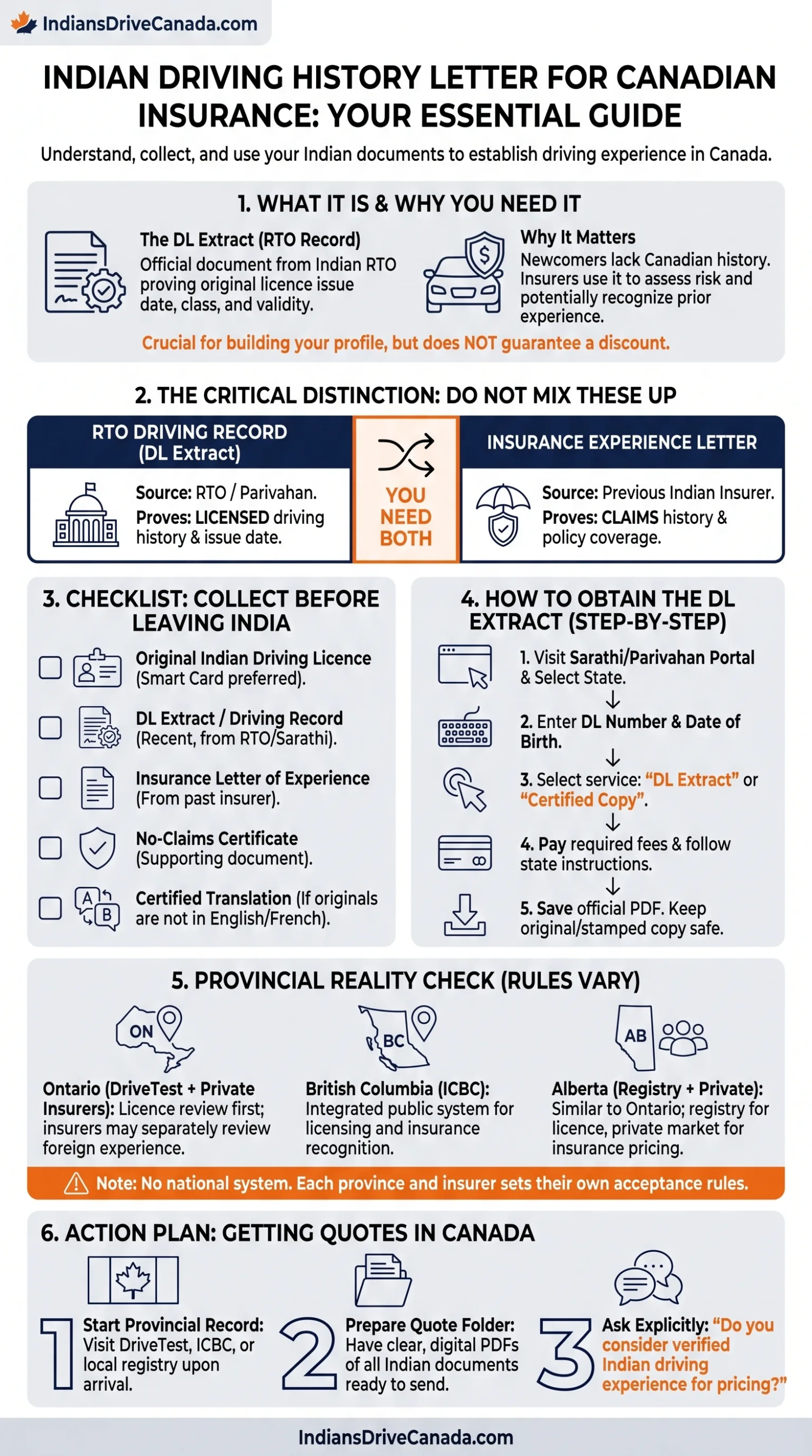
An Indian driving history letter is a document that shows when you first received your Indian driving licence, what vehicle class you were allowed to drive, and whether the issuing authority can confirm your licence details. In India, this is often called a DL extract, driving licence extract, or driving record.
For Canadian insurance, this document is useful because a new immigrant may not have a Canadian driving record yet. Canada.ca says car insurance cost can depend on your age, location, driving record, and driving experience. It also says insurance is required if you own and drive a car in Canada Canada.ca.
Driving History Letter vs Insurance Letter of Experience
These are not the same document.
- Driving history letter: Comes from the RTO, Parivahan/Sarathi system, or licensing authority. It proves licensed driving history.
- Insurance letter of experience: Comes from your previous car insurer. It shows policy dates, drivers listed, claims history, and cancellation details.
- No-claims certificate: Often shows that you had no claim during a policy period, but may not prove when you first received your licence.
Most Canadian insurers want to see both the driving record and the insurance experience record. One proves you were licensed. The other proves how you were insured.
Pro tip: Ask your Indian insurer for the letter before your policy ends, because getting it after moving can take longer.
Can an Indian Driving History Letter Lower My Canadian Car Insurance?
An Indian driving history letter may help, but it depends on the province and the insurer. No Canadian insurer has to accept foreign experience from India. Some will count part of it. Some will ask you to first register your foreign driving record with the provincial licensing authority. Some will price you like a new driver until you build Canadian history.
This is why two Indian newcomers with the same licence age can receive different quotes. One insurer may value the Indian record. Another may not. A broker may also ask for the document in a very specific format before sending it to underwriting.
In Ontario, private insurers usually rely on the licence record available through Ontario systems. If your foreign experience is accepted by MTO or DriveTest, it may help insurers see more than zero local history. Ontario states that a valid foreign licence can give up to one year of experience, while more than one year needs an official authentication document from the issuing foreign government or agency, written in English or French Ontario.ca.
In B.C., ICBC is clearer than many private markets. ICBC says it can credit up to 15 years of driving experience when you provide proof showing the original date you received your licence ICBC.
Watch out: A letter can support your quote, but it is not a coupon or fixed discount.
Which Indian Documents Should I Collect Before Moving to Canada?
Collect your documents while you are still in India if possible. It is easier to visit your RTO, update your mobile number, request records, and speak to your insurer before you leave. After landing in Canada, time zones, OTP access, and old policy portals can slow you down.
For Canadian insurance, try to build a small document set. Keep clear PDF scans and carry originals where needed. If a document is not in English or French, ask the Canadian province or insurer what type of translation they accept. Ontario, for example, requires foreign licence material to be in English or French, or translated by an accepted translator in many cases DriveTest.
| Document | Where It Comes From | Why It Helps |
|---|---|---|
| Indian driving licence | RTO / Parivahan / physical card | Shows licence class, validity, and identity match. |
| DL extract or driving record | RTO or Sarathi/Parivahan service | Shows issue date, class, validity, and licence authority details. |
| Insurance letter of experience | Past Indian insurer | Shows policy period, listed drivers, claims, and cancellations. |
| No-claims certificate | Past Indian insurer | May support a clean insurance history review. |
| Certified translation | Accepted translator, if needed | Helps when any record is not in English or French. |
Pro tip: Make sure your name, date of birth, and licence number match across all documents.
How Do I Get a DL Extract or Driving Record From India?
The common route is through the Sarathi/Parivahan driving licence service for your state. Some Indian states list “DL Extract” as a driving licence service. The National Government Services Portal describes a driving licence extract as an official document that includes details such as issue date, validity, and driving class authorization, and notes that it may be needed for insurance or international use National Government Services Portal.
Some state transport departments also publish DL extract steps. Odisha’s transport department, for example, lists DL Extract as a certified copy service through Parivahan, with steps to enter the licence number and date of birth, select DL Extract, pay, and book or complete the needed submission process Odisha Transport.
Here is the usual path, step by step:
- Open Sarathi/Parivahan and select the Indian state that issued your licence.
- Choose driving licence related services.
- Enter your DL number and date of birth.
- Select DL Extract, Certified Copy, or a similar service if shown for your state.
- Pay the fee shown by the portal.
- Follow the state-specific instruction for download, slot booking, or RTO visit.
- Save the PDF and keep the original or stamped copy if issued.
The Consulate General of India in Toronto also refers applicants to Parivahan licence verification for IDP renewal paperwork, which shows why keeping access to your Indian licence data matters after arrival Consulate General of India, Toronto.
Watch out: Do not rely only on a screenshot of the Parivahan status page if a Canadian office asks for an original or stamped record.
What Should the Letter Say to Help an Insurer Accept It?
A useful Indian driving history letter should be easy for a Canadian insurer, broker, or licensing office to verify. The document should not look like a personal note. It should be on official letterhead or come from an official portal or licensing authority where possible.
For insurance review, the letter should show who issued it, what licence it refers to, and what period of experience it confirms. ICBC gives a good example of the kind of detail a licensing record should include: licensing body name and contact details, your name, birth date, licence number, class of licence, and original issue date ICBC.
Include These Details Where Possible
- Your full legal name as shown on your passport.
- Date of birth.
- Indian driving licence number.
- RTO or licensing authority name.
- Original issue date.
- Current expiry date.
- Vehicle class, such as LMV for car use.
- Any suspension, endorsement, or restriction if shown.
- Official stamp, signature, QR code, or verification method.
- English or French wording, or an accepted translation.
Your insurance letter of experience should include policy number, start and end date, listed drivers, claim history, and cancellation reason if any. Canadian insurance sources commonly use these fields when describing insurance experience letters.
Pro tip: Ask for separate letters from each Indian insurer if you changed insurers over the years.
How Do Provinces Treat Indian Driving History for Insurance?
Canada does not use one national driving record system for newcomers. Each province has its own licensing body and insurance market. That matters because your Indian driving history letter may be handled differently in Toronto, Vancouver, Calgary, Winnipeg, Montreal, or Regina.
Public insurance provinces can be easier to understand because one public insurer manages basic auto insurance. Private insurance provinces can vary by company. In Ontario and Alberta, one insurer may ask for more proof than another. In B.C., Manitoba, and Saskatchewan, the basic insurance process goes through public systems, though optional coverage may still involve other providers.
| Province | How Long Indian DL May Be Used After Moving | Where Driving History Is Reviewed | Official Link |
|---|---|---|---|
| Ontario | Usually 60 days after becoming a resident | DriveTest / MTO first; private insurer may then review records | Ontario licence exchange |
| British Columbia | Usually 90 days after becoming a resident | ICBC driver licensing and insurance | ICBC moving to B.C. |
| Alberta | 90 days after moving to Alberta | Registry agent for licensing; private insurers for premium review | Alberta ID and licence rules |
| Manitoba | 3 months for new residents with a valid out-of-country licence | MPI / Autopac agent | MPI new to Manitoba |
| Quebec | Up to 6 months for a new resident with a valid foreign licence | SAAQ for licence recognition; private insurer for vehicle coverage | SAAQ foreign licence |
As of April 2026, Manitoba Public Insurance says newcomers with driving and claims experience should bring both documents to an Autopac agent or MPI Service Centre to check discount eligibility MPI.
Watch out: The province may accept your driving history for licensing, while one insurer may still make its own pricing decision.
How Do I Use the Letter When Asking for Quotes?
Do not wait until the dealer is handing you the car keys. Use your Indian driving history letter early, while you are comparing insurance quotes. Brokers and insurers may need time to send the documents to underwriting, especially if the file includes a foreign licence, a new Canadian address, and no local insurance history.
Here is the exact process, step by step:
- Get your provincial licence record started. Go to DriveTest, ICBC, MPI, SAAQ, a registry agent, or the correct provincial office. Timing can range from same-day document intake to later review.
- Prepare a quote folder. Include your Indian licence, DL extract, insurance letter of experience, no-claims proof, Canadian address proof, study/work permit or PR proof, and vehicle details.
- Ask the right question. Say: “Do you consider Indian driving experience or only Canadian licensed years?”
- Send clean copies. Use PDFs, not blurry phone photos. Keep file names clear, such as “RTO-DL-Extract-Name.pdf”.
- Ask for the quote with and without foreign experience. This shows whether the document changed the price.
- Repeat with more than one insurer or broker. Private insurance markets can vary a lot.
Money and timing vary by province, vehicle, address, licence class, and insurer. In many cases, the document itself costs less than one month of insurance difference, so it is worth preparing even if the final discount is not known.
Pro tip: Ask the insurer to note your file that foreign documents were submitted, even if they need a later review.
What Should Indian Drivers Adjust for Canadian Roads?
Based on reports from Indian immigrants in Ontario forums, many newcomers are not worried only about documents. They also worry about driving habits, road tests, and whether one small mistake can affect insurance. The Indian driving history letter can help prove past experience, but insurers and licensing offices still care about your Canadian record from day one.
Canadian driving feels different because lane discipline, right-of-way rules, school zones, and winter conditions receive close attention. You do not need to fear the system. You just need to adjust early.
Common Adjustment Areas After Driving in India
- Full stops: At stop signs, the car must come to a complete stop before moving again.
- Four-way stops: The first vehicle to stop usually goes first. If two arrive together, the driver on the right usually goes first.
- School buses: Rules are strict when a school bus stops with lights flashing.
- Speed changes: Speed limits can drop quickly near schools, construction zones, and residential streets.
- Winter tyres: In colder provinces, late tyre changes can raise risk even when not always required by law.
- Left turns: Wait for a clear gap. Do not copy the car ahead if visibility is blocked.
A clean first year in Canada can help more than any paper from India. Avoid tickets, keep continuous insurance if you own a car, and do not let policy payments lapse.
Watch out: A strong foreign record will not protect your premium if your Canadian record starts with tickets or at-fault claims.
What Are Real Questions From Indian Immigrants?
Real questions from Indian immigrants:
- “My Indian licence is 10 years old, but my Canadian insurer quoted me as a new driver. Why?”
- “Is a Parivahan printout enough, or do I need an RTO stamped letter?”
- “Can I use my father’s car insurance history from India if I drove the family car?”
- “Should I buy a car before getting my Ontario G2 or G licence?”
The answer usually comes down to proof, ownership, and local rules. If the Indian policy did not list you as a driver, a Canadian insurer may not treat that policy as your insurance history. If the licence record does not show the original issue date, the insurer may not know how many years to count. If your name is spelled differently across passport, licence, and insurance papers, review can slow down.
A Parivahan or DL extract can be useful, but some Canadian offices prefer original, stamped, or officially issued records. In Ontario, DriveTest says drivers from non-exchange jurisdictions who want more than one year of credit must provide an official letter issued within the last six months by the licensing jurisdiction, consulate, embassy, or High Commissioner’s Office, and the letter and licence must be in English or French or translated by an MTO-recognized translator DriveTest.
Pro tip: If your Indian document is more than six months old, ask the Canadian office or insurer before relying on it.
What Should Ontario Newcomers Know About Bill 60 and Licence Proof in 2026?
Ontario 2026 update: Bill 60 added Highway Traffic Act wording that lets the Minister require evidence of Ontario residency, legal presence in Canada, and, for prescribed licence or vehicle classes, legal ability to work in Canada. This is separate from your insurance discount question, but it can affect what documents you should carry when applying for or renewing an Ontario licence.
For Indian newcomers in Ontario, Bill 60 does not mean your Indian driving history letter is useless. It means licence applications may involve more identity, residency, and status checks than some older articles mention. The official Bill 60 text says the Minister may require evidence that the person is a resident of Ontario, is legally present in Canada, and is legally able to work in Canada for certain prescribed licence or vehicle classes Legislative Assembly of Ontario.
For a regular passenger vehicle licence, keep your documents clean and ready: passport, PR card or work/study permit, proof of Ontario address, Indian licence, DL extract, and any translation required. For commercial driving plans, check the latest MTO and DriveTest pages before making career or training decisions.
Watch out: Do not use an old forum answer as your only source for Ontario licence steps after April 2026.
Frequently asked questions
Can I Get Cheaper Insurance in Canada With an Indian Driving History Letter?
Yes, it may help, but it is not guaranteed. Some insurers may consider your Indian driving history if the document is official, readable, and accepted by the province or insurer. Ask for quotes with and without the foreign experience applied.
Can I Use a No-Claims Certificate Instead of a DL Extract?
A no-claims certificate is helpful, but it is not the same as a DL extract. A no-claims certificate shows insurance claim history. A DL extract shows licensed driving history, licence class, and issue date.
How Long Should My Indian Driving History Letter Be Valid?
Some offices care about document age. In Ontario, DriveTest refers to an official letter issued within the last six months when a driver from a non-exchange jurisdiction wants more than one year of experience credit. For insurance, ask the broker or insurer if they have their own age limit.
Do I Need a Translation for My Indian Driving Documents?
If the document is not in English or French, you may need an accepted translation. The exact translator rule depends on the province. Ontario and DriveTest give specific translation rules, so check before paying for a translation.
What Happens if My Insurer Does Not Accept Indian Driving Experience?
You can still buy insurance, but the quote may be priced like a new driver. Try another insurer or broker and ask whether they consider foreign licensed years. Keep your Canadian record clean and build local insurance history from your first policy.
Can International Students From India Use These Documents?
Yes, students can prepare the same driving and insurance documents. The insurance company may also ask for a study permit, Canadian address, enrolment proof, and licence details. Provincial driving rules still decide how long you can use a foreign licence before needing a local one.
Can I Use My Indian Licence After I Get a Canadian Licence?
Once you become licensed in a Canadian province, follow that province’s rules about holding and using licences. Some provinces may require you to surrender the foreign licence during exchange or testing steps. Do not assume you can keep using both for daily driving.
Pro tip: Save every quote, letter, and licence record in one folder so your next renewal is easier.