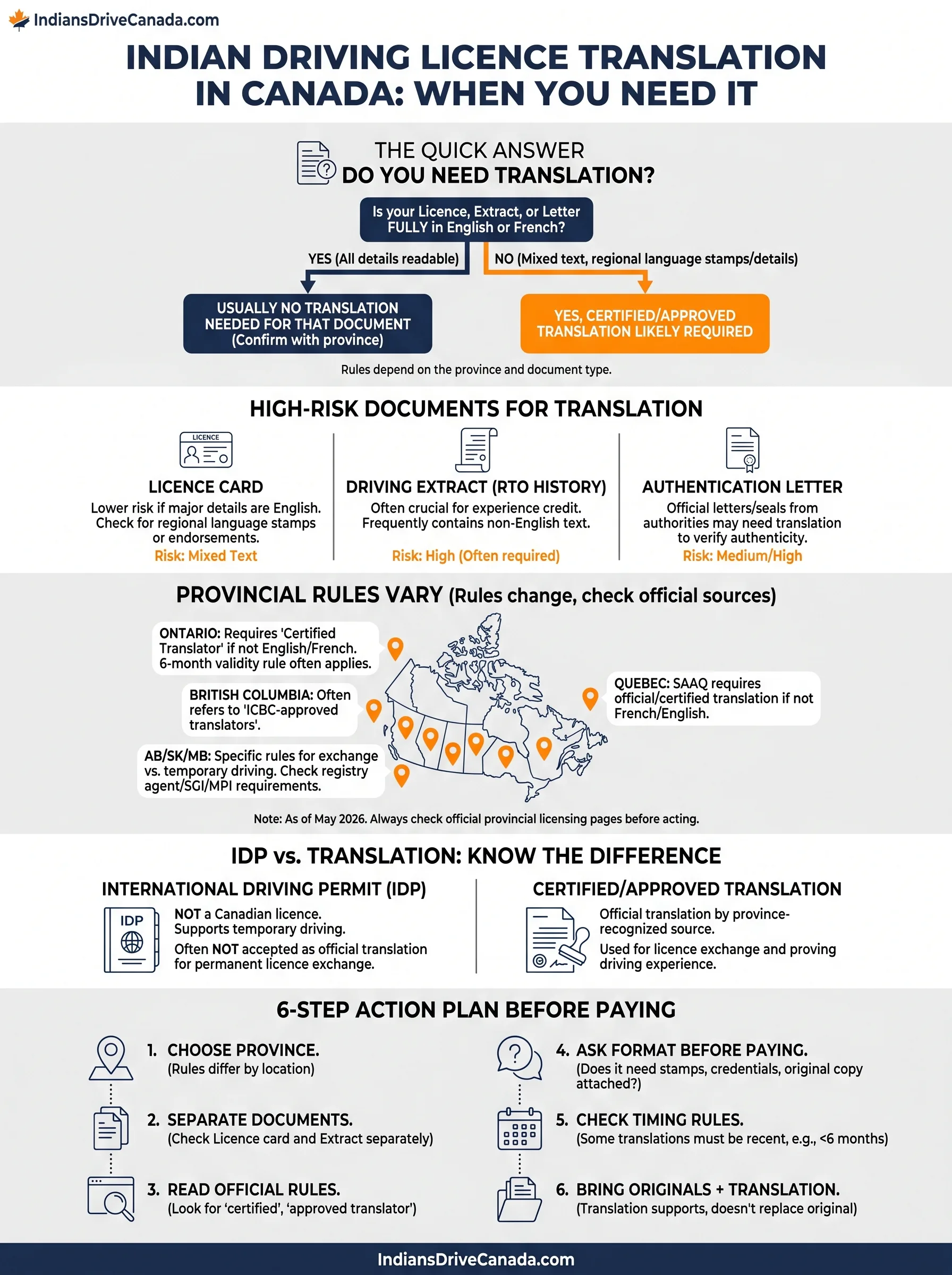
An Indian driving licence does not automatically need translation simply because it was issued in India. A modern licence printed entirely in clear English may be accepted without translation in some provinces. A translation may still be required when the card contains Hindi or another regional language, foreign characters, handwritten endorsements, unclear vehicle classes, or information that the provincial authority cannot reliably interpret.
The licence card must also be checked separately from a driving extract, authentication letter, previous licence, or other proof of experience. An English-language card does not remove the translation requirement for a supporting record issued in another language.
Rule verification: Provincial information on this page was checked on July 27, 2026. Translation policies can change, and the licensing authority may request additional evidence after examining the original document.
Check the Licence Before Ordering a Translation
The first decision is not whether the licence is “Indian.” The first decision is whether every part of the document needed for the Canadian transaction is readable in the language accepted by the province.
Examine the front and back of the physical licence. The following information should be clear and understandable without guessing:
- The licence holder’s full name
- Date of birth
- Licence number
- Issuing state or Regional Transport Office
- Issue date and expiry date
- Vehicle categories or class codes
- Restrictions, endorsements, and handwritten additions
- The date each vehicle category was first authorized, if shown
A card may appear to be in English because the name, licence number, and expiry date are easy to read. The back may still contain vehicle descriptions, restrictions, renewal notes, or issuing-authority text in another language. Provincial authorities may treat the document as a whole rather than reviewing only its English fields.
A modern plastic licence printed entirely in English
A clear plastic or smart-card licence with all relevant information in English may not need translation. British Columbia, for example, lists India as a country for which translation is not normally required. That does not guarantee acceptance of every Indian licence format.
A licensing officer may still ask for translation when the document is damaged, unusually formatted, partly handwritten, or unclear about the vehicles the holder is allowed to drive.
A bilingual or mixed-language licence
A mixed-language card needs closer review. English labels beside regional-language text may be sufficient in one province and insufficient in another.
Manitoba applies a strict test: a driving document must be entirely in English or French. A foreign word or character can make an official translation mandatory. British Columbia instead uses a country-and-document assessment and may accept a standard Indian licence without translation while requesting one for an older or alternative format.
An older paper, booklet, or laminated licence
Older Indian licences can present issues that are not solved by looking only at the language. Information may be spread across several pages, written by hand, covered by stamps, or recorded using older vehicle-class descriptions.
A translation can explain the visible text, but it cannot recover a first issue date that is missing or confirm that a handwritten alteration is authentic. A separate driving record or authentication document may be needed.
A digital licence or screenshot
A DigiLocker image, mParivahan record, scan, or phone screenshot should not be assumed to replace the physical original during a Canadian licensing transaction. Provincial authorities may require the original card and may insist that the translation be prepared from that original or from a copy certified by the licensing office.
Carry the physical licence unless the provincial authority has confirmed another document format in writing.
Four Documents with Different Jobs
Licence applicants often pay for the wrong service because translation, driving history, authentication, and an International Driving Permit are treated as if they were interchangeable. They serve different purposes.
| Document | What it does | What it does not do |
|---|---|---|
| Licence translation | Explains the information already printed or written on the licence. | Does not create a missing first issue date or independently verify the licence. |
| Driving extract or driving record | May show original licensing dates, classes, status, and recorded driving history. | Does not replace the valid physical licence when the province asks to see it. |
| Authentication letter | Confirms licensing information through an accepted issuing authority or other accepted channel. | Does not automatically translate a document written in another language. |
| International Driving Permit | Provides a standardized multilingual interpretation for temporary driving where accepted. | Does not replace the original licence and is not accepted as an exchange translation in several provinces. |
Do not order an International Driving Permit as a substitute for a certified licence translation without checking the province. Manitoba, Quebec, and Nova Scotia expressly reject an IDP as the official translation used for a licence application or exchange. Saskatchewan and New Brunswick allow it in certain translation-related situations. The original Indian licence must still accompany the IDP.
Temporary Driving and a Canadian Licence Application Use Different Rules
A document that is sufficient when a visitor is stopped by police may not satisfy a provincial licensing office. The transaction determines which evidence is needed.
Driving during a visit
A visitor may be able to drive with a valid Indian licence for the period allowed by the province. An IDP may be required or recommended when the licence is not in English or French, or when the visit continues beyond a stated period.
The IDP must normally be carried with the valid original licence. It is not a stand-alone driving licence.
Driving after becoming a resident
New residents usually receive a limited period in which they may use a valid out-of-province licence. The start of that period is governed by the province’s residency rule and should not automatically be treated as the date of arrival in Canada.
Translation does not extend the time allowed to drive on the Indian licence. It only assists the authority in reading the document.
Applying for a provincial licence
A provincial application can involve identity verification, vision testing, knowledge testing, road testing, document validation, and recognition of previous experience. The Indian licence and its translation are only part of that process.
India does not have a direct passenger-vehicle licence exchange agreement with several major provinces. A translated licence should not be described as creating a test-free exchange right.
Claiming previous driving experience
The card may prove that a licence is currently valid but fail to show when the holder was first licensed. This is common when the current card shows only its most recent renewal or reissue date.
Where driving experience affects a waiting period or licence level, the authority may request a driving extract, driving record, authentication letter, or previous licence. Each supporting document must meet the province’s language and document-age rules.
Provincial Translation Rules
| Province | When translation is generally needed | IDP treatment | Where to verify |
|---|---|---|---|
| Ontario | Application documents not in English or French require translation by an MTO-recognized translator. | Do not use it in place of the required application-document translation. | DriveTest foreign licence applications |
| British Columbia | India is normally listed as not requiring translation, but ICBC may request one for non-English characters, older formats, paper descriptions, or unclear documents. | ICBC-approved translators or eligible consular services are used when translation is requested. | ICBC country translation requirements |
| Alberta | Documents used in the exchange or experience-review process must be in English or include a written translation from an approved document translator. | An IDP does not remove the approved-translation requirement for non-English documents. It must be surrendered with the foreign licence when required in the application. | Alberta foreign licence exchange rules |
| Manitoba | Translation is mandatory if any part of the licence or driving record is not entirely in English or French or contains foreign words or characters. | Not accepted as an official translation. | Manitoba translation requirements |
| Saskatchewan | A licence not written in English or French must be accompanied by a translation document acceptable to SGI. | SGI gives an IDP as an example of an acceptable translation document. | SGI out-of-province licence rules |
| Quebec | An official or certified translation is required for application documents written in a language other than French or English. | Not considered an official translation for a Quebec licence application. | SAAQ foreign licence process |
| Nova Scotia | A certified English or French translation is required when the licence is printed in another language. | Cannot be used as the translation for a licence exchange. | Nova Scotia foreign licence exchange |
| New Brunswick | An official translation is required when the licence is not in English or French. | The province lists a translation agency or an international driver’s licence as possible translation evidence. | New Brunswick licences for new residents |
| Prince Edward Island | A certified translation or a translation from the province’s named newcomer-service provider may be requested. | An IDP may appear among supporting documents for particular exchange arrangements, but it should not be assumed to replace every translation requirement. | PEI out-of-province licence rules |
| Newfoundland and Labrador | An English translation is required when the licence is in a language other than English or French. | Confirm temporary-driving and application requirements separately. | Newfoundland and Labrador translation rules |
| Yukon, Northwest Territories, and Nunavut | Contact the territorial licensing office before ordering a translation because public document-format instructions are less detailed and the treatment of an IDP may relate to temporary driving rather than document translation. | Do not assume that an IDP will satisfy a territorial licence application. | Yukon licence transfer information |
Ontario: Translation and Experience Credit Are Separate Decisions
Ontario requires documents associated with a driver’s licence application to be in English or French unless DriveTest states otherwise. An Indian licence, driving record, or authentication letter written in another language must be accompanied by a translation from an MTO-recognized translator.
The original document and its translation should be presented together. A translation does not change India’s status as a jurisdiction without a direct Ontario passenger-vehicle licence exchange agreement.
The July 1, 2026 experience-credit rule
Effective July 1, 2026, an applicant from a jurisdiction without an Ontario exchange agreement can receive no more than 12 months of verified foreign driving experience. This applies to Indian licence holders seeking recognition of previous experience.
The applicant must still complete the required Ontario testing path. DriveTest states that affected drivers must complete the G2 road test and then the G road test after the applicable waiting period. A translation may allow a document to be read, but it does not give the applicant a direct Full G exchange.
Where DriveTest requests an authentication letter, the letter must meet its content and recency rules. The official foreign-experience page states that the authentication letter must be in English or French and dated within the previous six months.
Before submitting an original driving extract or authentication letter in Ontario, keep a clear copy for personal records. DriveTest may retain original supporting documents and translations used to assess foreign experience.
An English licence with a Hindi driving extract
In this situation, the card itself may not need translation. The driving extract does. Paying to translate the already-English card while leaving the extract untranslated will not solve the experience-credit issue.
A card showing only the most recent renewal date
Translation cannot turn a renewal date into the date the driver was first licensed. A suitable driving record or authentication letter is needed if the original licensing date affects the Ontario application.
Confirm document and experience-credit details through the DriveTest foreign licence experience requirements before requesting documents from India.
British Columbia: A Standard Indian Licence May Not Need Translation
ICBC’s country list, last updated July 14, 2026, records India: No under the normal translation requirement. This is useful for a holder of a modern, readable Indian licence, but it is not an automatic approval of every document.
ICBC states that translation may still be requested when a licence:
ICBC also reserves discretion to request a translation even when its country list says that one is not normally required.
Driving records are reviewed separately
An English-language Indian licence does not make a regional-language driving record acceptable. ICBC requires a non-English experience document to be translated by an ICBC-approved translator.
The translation must be prepared from the original document or from a copy approved and stamped by an ICBC driver licensing office. The original or approved copy must accompany the translation when it is submitted.
Use the ICBC driving-experience evidence rules when the aim is to prove how long the Indian licence has been held, rather than merely to show that the current card is valid.
Manitoba: A Foreign Word or Character Can Trigger Translation
Manitoba does not use the same country-based assumption as British Columbia. Manitoba Public Insurance requires an official translation when a licence or other driving document is not printed entirely in English or French.
The translation requirement applies when:
- The document contains text in another language
- The document contains foreign characters or words
- A driving history document is partly in another language
- The date system cannot be clearly read using the required calendar format
A bilingual Indian card can therefore require translation in Manitoba even when the main identifying fields are already in English.
Manitoba’s document-format requirements
An accepted translation must be an original document prepared by an approved translator or agency. It must include the translator’s name, signature, and date on every page, together with contact information or official letterhead.
The package must also include copies of the front and back of the source document and be presented with the physical licence or other document being translated.
A non-certified translator’s work must be stamped and notarized by a Manitoba-based notary public or commissioner for oaths. A family member’s translation is not accepted, even when that family member has it notarized or claims translation ability.
MPI also rejects:
Quebec, Alberta, and Nova Scotia Require Province-Approved Translation Paths
Quebec
For a Quebec licence application, documents written in a language other than French or English require an official or certified translation. The SAAQ expressly states that an International Driving Permit is not considered an official translation of the foreign licence.
An IDP may still have a role in temporary driving. For example, a non-resident who remains in Quebec beyond the initial foreign-licence period may need an IDP and must carry it with the original licence. That temporary-driving rule does not make the IDP acceptable as the certified translation used in a Quebec licence application.
An Indian licence is handled under the process for a jurisdiction without a Quebec licence-exchange agreement. Translation makes the documents readable; it does not remove knowledge-test or road-test requirements that apply to the applicant.
Alberta
Alberta requires documents used for a foreign-licence exchange or Graduated Driver Licensing exemption review to be in English. A document not in English must include a written translation from an approved document translator.
If the applicant holds an IDP, Alberta may require it to be surrendered with the foreign licence during the exchange process. The existence of an IDP does not remove the approved-translation requirement for another non-English document submitted for experience review.
Nova Scotia
Nova Scotia requires a certified English or French translation when the licence is printed in another language. The province identifies the following translation providers:
The translated package must be accompanied by the original licence and a true copy carrying the translator’s official stamp or organizational credentials. Nova Scotia says that a separate barrister or notary-public stamp is not required when the translation already meets its approved-provider rules.
An IDP cannot be used as the translation for a Nova Scotia licence exchange.
Choose the Translator for the Province, Not Just the Language
A translator who can accurately translate Hindi, Punjabi, Gujarati, Bengali, Tamil, Telugu, Marathi, Malayalam, Kannada, or another Indian language is not automatically accepted by every provincial licensing authority.
Before paying, confirm all of the following:
- The translator or agency is accepted by the destination province
- The translator can work from the type of source document you have
- The province permits translation from a scan, or requires the original or a licensing-office-certified copy
- The fee covers both sides and every page of the licence
- Stamps, handwritten notes, and vehicle-class codes will be included
- The completed document will show the translator’s credentials, signature, contact details, and date
- Any required affidavit, notarization, declaration form, or official letterhead is included
- The translation will be delivered in the original paper format when the province requires an original
Do not rely only on advertising terms such as “certified Canadian translation.” Ask which provincial licensing authority accepts the translator and what proof of professional status will appear on the finished document.
Notarization does not solve every acceptance issue
A notary generally verifies an oath, signature, or copy. The notary does not necessarily confirm that the translator belongs to the association or provider group required by the province.
Manitoba allows a defined notarized route for certain non-certified translators. Nova Scotia does not require an additional notary stamp when an approved organization has prepared the translation. A document prepared for one province can therefore be refused in another.
What the Translation Must Preserve from an Indian Licence
Vehicle-class abbreviations
Indian licence codes such as LMV, MCWG, MCWOG, HMV, TRANS, NT, or TR should not be silently replaced with a Canadian licence class.
The translator should preserve the original code and translate the description that appears on the source document. The provincial licensing authority—not the translator—decides whether an Indian vehicle category corresponds to a Canadian passenger, motorcycle, or commercial class.
A translation that turns “LMV” directly into “Ontario Class G,” “B.C. Class 5,” or another provincial class may overstate what the source document says.
First issue date and card issue date
An Indian licence can contain several dates:
The translation should label each date according to the source document. It should not describe a card-printing or renewal date as the first licensing date.
Day, month, and year order
Indian documents commonly use day-month-year order. A date such as 05/08/2024 can be misread as either May 8 or August 5.
The translation should clearly identify the date order or write the month in words where the provincial format permits it. Manitoba expressly requires translated dates to clearly distinguish the day, month, and year.
Name order, initials, and spelling
The name on an Indian licence may not appear in the same structure as the name on a passport or Canadian immigration document. Differences can include:
The translator should reproduce the name shown on the licence rather than changing it to match another document. A separate marriage certificate, legal name-change record, affidavit, or other accepted document may be needed to connect the records.
Handwritten endorsements and stamps
A translator should not guess at blurred handwriting, damaged seals, or text hidden by lamination. Unreadable material should be identified as unreadable according to professional translation practice.
When an endorsement affects the authorized vehicle category or original issue date, obtain a clearer licensing record rather than relying on an uncertain interpretation.
A Translation Package Ready for Provincial Review
Licence translation package
- The original physical Indian driving licence
- A clear copy of the front and back
- A complete translation of all text, codes, stamps, and handwritten entries
- The original vehicle-class abbreviations with translated descriptions
- Clearly identified issue, renewal, and expiry dates
- The translator’s full name and contact information
- The translator’s professional association, membership number, or accepted-provider credentials
- The translator’s signature and completion date
- Official letterhead, stamp, affidavit, declaration form, or notarization when required by the province
- The source and target languages
- A statement that the translation is accurate and complete
A licence translation does not automatically make a driving extract or authentication letter acceptable. Prepare each supporting document according to the same provincial language rules.
When Translation Does Not Fix the Document Problem
The first licensing date is absent
The translator can only translate what appears on the source. If the licence shows the date of the current card but not the original licensing date, request an accepted driving-history document.
The licence is expired
Translating an expired licence does not make it valid. Provincial rules differ on whether an expired foreign licence can support experience recognition, testing exemptions, or any licence application.
The issuing authority cannot be identified
A licence with an unclear RTO name, damaged seal, missing number, or unreadable issuing state may require additional evidence. A translated guess is not a substitute for official verification.
The vehicle class does not show passenger-car authority
A translation can describe the vehicle category but cannot grant a Canadian passenger-vehicle entitlement. The provincial authority will assess what the Indian class allows and what Canadian testing remains necessary.
The licence and passport names do not match
The translator should not alter the licence name. Use accepted name-linking documents to explain the difference.
The experience record is too old for the application
Some authorities impose a recency limit on an authentication or experience letter. Ontario, for example, states that its authentication letter must be dated within the previous six months. A perfect translation of an outdated letter can still be refused.
Match the Document to the Situation
English smart-card licence in British Columbia
The licence is modern, readable, and entirely in English. ICBC’s July 14, 2026 country list says an Indian licence does not normally require translation.
Likely action: Bring the original licence. Do not order translation unless ICBC identifies a format, character, vehicle-class, or readability issue.
English front with regional-language text on the back in Manitoba
The identifying fields are in English, but restrictions or vehicle descriptions include another language.
Likely action: Obtain an official translation that meets MPI’s requirements. Manitoba treats foreign words or characters as a translation trigger.
English licence with a non-English driving extract in Ontario
The card is readable, but the document intended to prove the first licensing date is in Hindi or another regional language.
Likely action: Translate the driving extract through an MTO-recognized translator. Translating the English card alone will not make the extract acceptable.
IDP presented for a Nova Scotia exchange
The IDP provides multilingual information, but Nova Scotia does not accept it as the certified translation for a licence exchange.
Likely action: Use one of the organizations accepted by Nova Scotia and bring the original Indian licence with the completed translation package.
Old booklet licence showing only a recent renewal
The licence is translated correctly, but the applicant wants recognition of several years of driving experience.
Likely action: Obtain an accepted driving record or authentication letter showing the original licensing date. Translation cannot supply history that is absent from the booklet.
Documents Worth Preparing Before Leaving India
Provincial authorities may need evidence that is easier to request while the licence holder still has access to the issuing RTO or state transport services.
- Keep the valid physical driving licence in good condition
- Save clear images of both sides for personal records
- Check whether the first issue date appears on the current card
- Retain older licence cards or booklets that show previous issue dates
- Request a driving extract or record if previous experience may affect the Canadian process
- Check that the record identifies the issuing authority and licence number
- Obtain name-change evidence when the licence and passport differ
- Review whether an IDP is useful for temporary driving in the destination province
- Do not laminate, alter, annotate, or “correct” an official record yourself
- Do not pay for Canadian translation until the destination province and accepted translator type are known
If the current card shows only a renewal date, request evidence of the original issue date before travelling. A Canadian translator cannot obtain missing RTO history or convert a recent card date into earlier driving experience.
Document Check Before the Licensing Appointment
- The province’s translation rule has been checked on its licensing-authority page
- The translator is accepted by that province
- Both sides and all pages have been translated
- The original licence will be available at the appointment
- Vehicle-class abbreviations have not been converted into an unsupported Canadian class
- The first issue date has not been confused with a renewal or reprint date
- The date order is unambiguous
- Names match the source document exactly
- Name differences are supported by accepted evidence
- The driving extract or authentication letter has been translated separately when needed
- Any document-age rule has been checked
- Copies have been retained before submitting original supporting records
- The IDP is being used only for a purpose the province accepts
A translated Indian licence does not guarantee driving-experience credit, a test exemption, a direct licence exchange, or continued authority to drive after the provincial newcomer period ends. Those decisions are made separately under the destination province’s licensing rules.