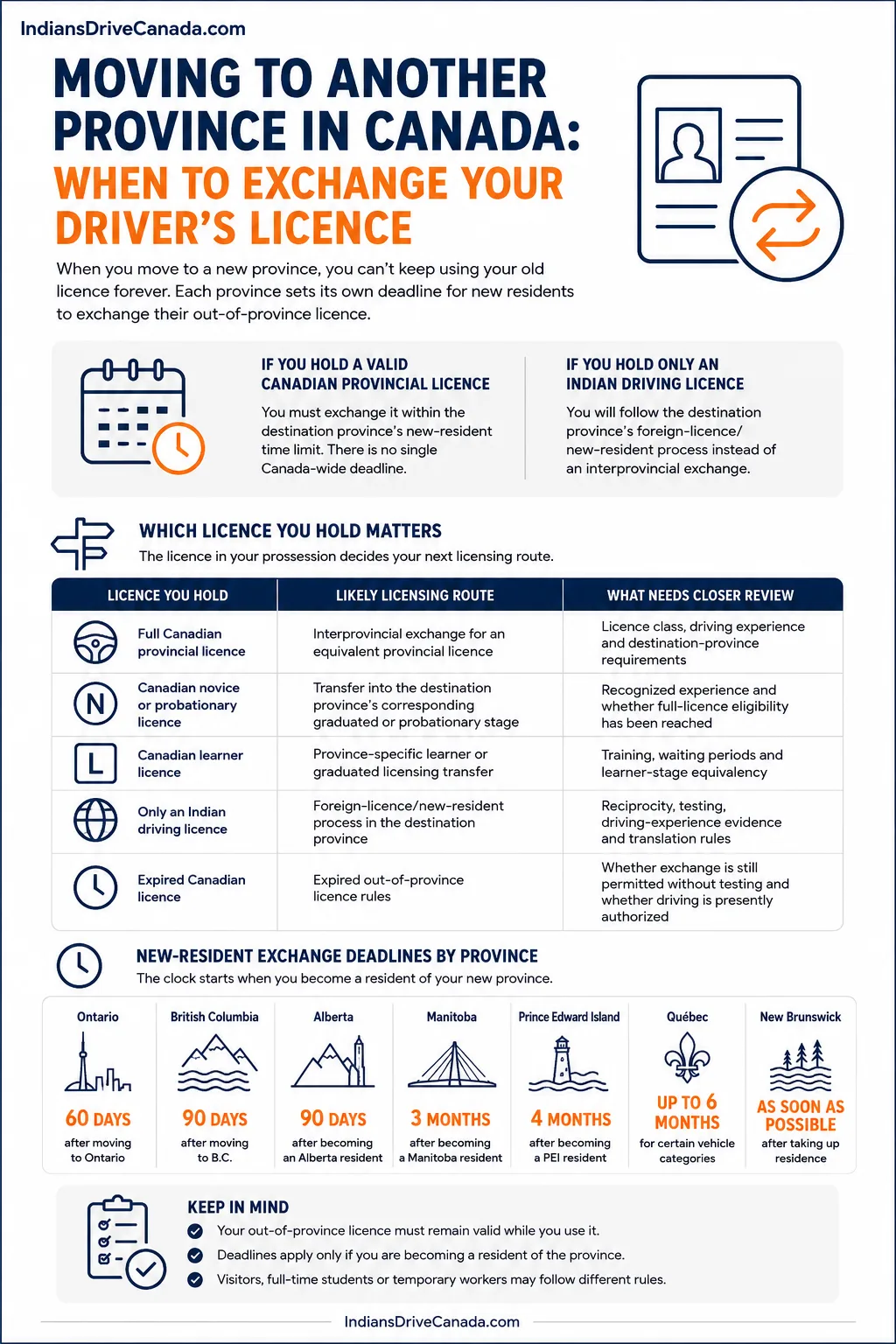
If you become a resident of another Canadian province while holding a valid provincial driver’s licence, the destination province normally expects you to exchange that licence within its own new-resident time limit. There is no single Canada-wide deadline. Ontario gives 60 days, several provinces use 90 days, Manitoba uses three months, Prince Edward Island uses four months, Québec allows up to six consecutive months for certain vehicle categories, and New Brunswick tells new residents to exchange as soon as they take up residence.
If you still hold only an Indian driving licence when you move, the situation is different. You are generally entering the destination province’s foreign-licence process rather than transferring a Canadian provincial licence.
First identify which licence you are moving with
The province that first licensed you is not always the jurisdiction that controls your next application. What usually matters is the licence you legally hold when you establish residence in the new province.
| Licence held when moving | Likely licensing route | What needs closer review |
|---|---|---|
| Full Canadian provincial licence | Interprovincial exchange for an equivalent provincial licence | Licence class, driving experience and destination-province requirements |
| Canadian novice or probationary licence | Transfer into the destination province’s corresponding graduated or probationary stage | Recognized experience and whether full-licence eligibility has been reached |
| Canadian learner licence | Province-specific learner or graduated licensing transfer | Training, waiting periods and learner-stage equivalency |
| Only an Indian driving licence | Foreign-licence/new-resident process in the destination province | Reciprocity, testing, driving-experience evidence and translation rules |
| Expired Canadian licence | Expired out-of-province licence rules | Whether exchange is still permitted without testing and whether driving is presently authorized |
The resident deadlines below assume you are actually becoming a resident of the destination province. A visitor, full-time student or person temporarily working away from their home province may fall under a different rule. Do not use a permanent-move deadline to decide a temporary-resident case.
Resident exchange deadlines by province
The date printed on the old licence does not create a Canada-wide right to keep using it until expiry. The new province sets the period during which a valid out-of-province licence can continue to be used after the move.
| Destination province | New-resident rule | Point that can change the practical deadline |
|---|---|---|
| Ontario |
60 days after moving to Ontario [Resident deadline] |
The out-of-province licence must remain valid while it is being used. |
| British Columbia |
90 days after moving to B.C. [Resident deadline] |
ICBC asks for the current licence and proof of driving experience when the B.C. application is made. |
| Alberta |
Within 90 days of becoming an Alberta resident [Resident deadline] |
Leaving Alberta during those 90 days does not stop or restart the period. |
| Saskatchewan |
Before the old licence expires or within 90 days of becoming a resident, whichever comes first [Earlier deadline] |
A short remaining validity period on the old card can make the effective deadline much earlier than day 90. |
| Manitoba |
Up to three months with a qualifying valid licence [Resident deadline] |
MPI uses the term three months rather than converting the period to a fixed 90-day figure. |
| Québec |
Up to six consecutive months after settling in Québec for a passenger vehicle, motorcycle, moped or scooter [Vehicle-class rule] |
The six-month permission does not extend the same way to trucks, buses, emergency vehicles, minibuses, taxis and comparable professional vehicle categories. |
| New Brunswick |
Exchange as soon as you take up residence [Residence rule] |
Do not assume that the 60- or 90-day periods used by other provinces also apply in New Brunswick. |
| Nova Scotia |
The provincial exchange page says a person who has recently moved may be able to drive for up to 180 days [Service-page rule] |
The Motor Vehicle Act separately states 90 days from the date a person becomes a Nova Scotia resident. [Statutory rule] |
| Prince Edward Island |
Up to four months after becoming a PEI resident [Resident deadline] |
PEI states that the period can be extended when the exchange process was started but not completed within those four months. |
| Newfoundland and Labrador |
First 90 days of residency [Resident deadline] |
The old licence must be surrendered when the provincial licence is obtained. |
Licence expiry and the provincial exchange deadline are separate limits. A 90-day new-resident period does not keep an expired licence valid. Saskatchewan states this especially clearly by requiring the application before the old licence expires or within 90 days, whichever happens first. Other provincial rules also base temporary driving authority on the old licence remaining valid.
Nova Scotia has a published conflict that should not be ignored. Its current exchange service page uses wording of up to 180 days, while the Motor Vehicle Act says a driver who becomes a resident may use the previous licence for 90 days from the date residency begins. A new resident should not plan to continue driving beyond 90 days without first confirming how the Registry of Motor Vehicles applies the rule to that situation.
A Canadian licence usually becomes the starting point for the next move
Receiving a Canadian provincial licence changes the nature of a later provincial move. If a driver originally arrived from India, completed the licensing process in Ontario and now holds an Ontario licence, a later permanent move to Alberta is assessed as a move from Ontario, not as a first-time India-to-Alberta licence application.
Example: Indian licence → Ontario licence → move to Alberta → Alberta licence → later move to British Columbia. Once each new provincial licence is issued, the next province generally deals with the Canadian licence that is then in force. The original Indian driving history can still matter when a province needs to determine total driving experience, but it does not turn the later move back into the original foreign-licence process.
This distinction matters because Canadian licences are included in provincial exchange systems that can allow equivalent passenger-vehicle licences to transfer without the knowledge and road testing that may apply to licences from non-reciprocal foreign jurisdictions.
Full, novice and learner licences do not transfer in the same way
The word “exchange” can sound as though every Canadian licence is converted card-for-card. In practice, the new province also looks at the class and stage of the licence.
| Current licence status | What normally happens | What should not be assumed |
|---|---|---|
| Full passenger licence | An equivalent passenger class can normally be exchanged without repeating the ordinary knowledge and road tests used for a new driver. | Professional classes and endorsements are not automatically covered by the passenger-vehicle rule. |
| Novice or probationary licence | The destination province can recognize previous licensed experience and place the driver at an appropriate stage in its own graduated system. | A novice licence from one province does not automatically become a full licence in another. |
| Learner licence | The result depends on the destination province’s learner-equivalency rules. | Learner time should not be treated as though it were full-privilege driving experience. |
| Commercial licence | Medical requirements, training, testing or a different class assessment may apply. | A test-free passenger-vehicle exchange does not prove that Class 1 to 4 privileges will transfer unchanged. |
| Motorcycle licence or endorsement | The new province checks its own class and endorsement equivalency. | Do not assume every motorcycle or air-brake endorsement is automatically reproduced on the new card. |
There are useful examples of these differences in the provincial rules. Alberta can place a driver with less than two years of qualifying Class 5 or 6 experience into Graduated Driver Licensing. Québec can issue a probationary licence when it recognizes less than 24 months of passenger-vehicle experience. Saskatchewan places an equivalent Canadian learner into its GDL process, while Nova Scotia has its own rules for exchanging Canadian learner licences.
If a move to B.C. places the driver in the Graduated Licensing Program, a scheduled change may affect the later Class 7-to-Class 5 step. Effective October 19, 2026, eligible Class 7 novice drivers with the required safe-driving record are scheduled to use a Driving Record Assessment instead of taking the second road test, followed by a 12-month Class 5 restriction period. Until October 19, 2026, the existing GLP rules remain in effect.[Scheduled GLP change]
Prepare the records before surrendering the old licence
Document requirements are not identical across Canada. A driver moving between provinces should separate documents needed to prove identity and residence from documents used to prove driving experience.
Documents to have ready
- Current physical provincial driver’s licence: this is the main licence being exchanged and should remain valid while it is being used to drive.
- Identity documents: the destination province may require additional government identification rather than accepting the old driver’s licence as the only ID.
- Proof of new provincial residence: prepare documents showing that the destination province is now your place of residence when its licensing authority requires address evidence.
- Proof of legal status in Canada where required: a PR card, work permit, study permit or another accepted immigration document may be relevant for a non-citizen applicant.
- Driver abstract or licence history when needed: this can establish the original licensed date, previous class and driving experience when the card alone does not show enough information.
- Name-supporting documents when records differ: prepare the appropriate marriage, legal name-change or identity record if the name on the provincial licence differs from the passport or immigration documents.
A driver abstract is not universally mandatory for every interprovincial passenger-licence exchange. Its value depends on the destination and the licence history. ICBC asks new B.C. residents for proof of driving experience, while the SAAQ recommends a driving record because it may help establish recognized experience. Keeping the record available can also prevent a recently issued card from hiding an older first-licensed date.
Before handing over the old licence, keep a personal record of the front and back of the card, the licence number, class, issue date, expiry date and any restrictions. A photograph or photocopy is only a record. It does not authorize driving after the original licence has been surrendered or is no longer valid.
Expect the old provincial licence to be surrendered
Moving provinces is normally a transfer of licensing authority rather than a way to accumulate active provincial licences. British Columbia requires the previous licence to be surrendered when the new B.C. licence is issued. Alberta requires surrender of out-of-Alberta licences, including other licences in the applicant’s possession. Manitoba states that the licence given to MPI is not returned, and Newfoundland and Labrador states that holding more than one driver’s licence is illegal.
This is another reason to preserve the basic licence details and obtain any driving-history record that may be useful before the exchange is completed.
Do not treat the final day as the day to begin the exchange
The resident period is the time during which the old valid licence may provide driving authority. It should not be treated as a promise that every document review, appointment or licence-class assessment can be completed on the last day.
Alberta also makes one timing issue explicit: travelling outside Alberta during the 90-day resident period does not pause or restart the exchange clock. A short trip should not be used as a way to calculate a new deadline.
If you move before getting any Canadian driver’s licence
A person can live in one province without ever converting an Indian licence and then move elsewhere. In that situation, there is no Canadian provincial licence to transfer. The new province evaluates the Indian licence under its foreign-licence rules.
For example, consider a full-time student who was permitted to use a valid Indian licence under a provincial student rule and then permanently moves to Ontario for work. Once Ontario residence is established, Ontario’s new-resident rules become relevant. The fact that the person previously lived in another Canadian province does not turn the Indian licence into an out-of-province Canadian licence.
Ontario has two 2026 rules worth separating from a normal Canadian licence transfer. From May 11, 2026, Class G and M applicants must declare that Ontario is their primary place of residence and that their presence in Canada is legal. Effective July 1, 2026, applicants for Class G1, G2 or G licensing from a jurisdiction without an exchange agreement can receive no more than 12 months of credited foreign driving experience under the revised rule.[2026 Ontario rules]
Those foreign-experience rules matter when the applicant is still relying on an Indian or other non-exchange foreign licence. They should not be applied as though an Ontario resident transferring a valid Canadian provincial licence were beginning the foreign-licence process again.
Three moves that look similar but lead to different licence routes
| Move | Licence held | Main licensing issue |
|---|---|---|
| Ontario to Alberta | Full Ontario G licence | Canadian interprovincial exchange. Alberta requires a permanent resident of the province to exchange within 90 days and normally transfers an equivalent Class 5 passenger licence without a knowledge or road test. |
| British Columbia to Ontario | B.C. novice licence | Ontario assesses the Canadian licence and recognized experience. The driver should not assume that novice status automatically becomes a full Ontario G licence. |
| B.C. to Ontario | Indian licence still being used under an eligible temporary or student situation | There is no Canadian provincial licence to exchange. If the person becomes an Ontario resident, the Indian licence is handled under Ontario’s foreign-licence rules and the 60-day new-resident period becomes relevant. |
The driver’s licence deadline does not set the vehicle deadline
A provincial move can create separate dates for the driver, vehicle registration and insurance. The licence table above should not be used to calculate how long an out-of-province vehicle can stay registered in the previous jurisdiction.
British Columbia is a clear example. A new B.C. resident has 90 days to switch the driver’s licence, but ICBC generally gives 30 days to register, license and insure a vehicle after arriving in B.C.; commercial vehicles have a stricter rule.[Vehicle deadline] The longer driver’s-licence period should not be applied to the vehicle.
When the move does not fit the standard full-licence exchange
Can the old provincial licence be used until the expiry date printed on it?
Only while the destination province still permits its use and the licence remains valid. A card that expires after the provincial deadline does not extend that deadline, and a card that expires earlier does not gain extra validity from the new-resident period.
Does leaving the new province for a few days restart the exchange period?
Do not calculate a new deadline on that basis. Alberta expressly states that travel outside Alberta during its 90-day period does not change the requirement. For another province, use the resident rule published by that province rather than assuming a trip resets the clock.
Do years of Indian driving experience disappear after getting a Canadian licence?
No. Older driving history can still be useful when a province needs evidence of the original licensed date or total experience. The difference is that the current Canadian licence becomes the main licence being exchanged during the provincial move.
Can a full Canadian passenger licence always be exchanged without any additional requirement?
Passenger-vehicle exchanges between Canadian jurisdictions are generally simpler than foreign non-reciprocal licensing, but the exact result still depends on class and experience. Novice, learner, motorcycle and commercial licences need separate class-equivalency review, and medical or testing requirements can apply to professional classes.