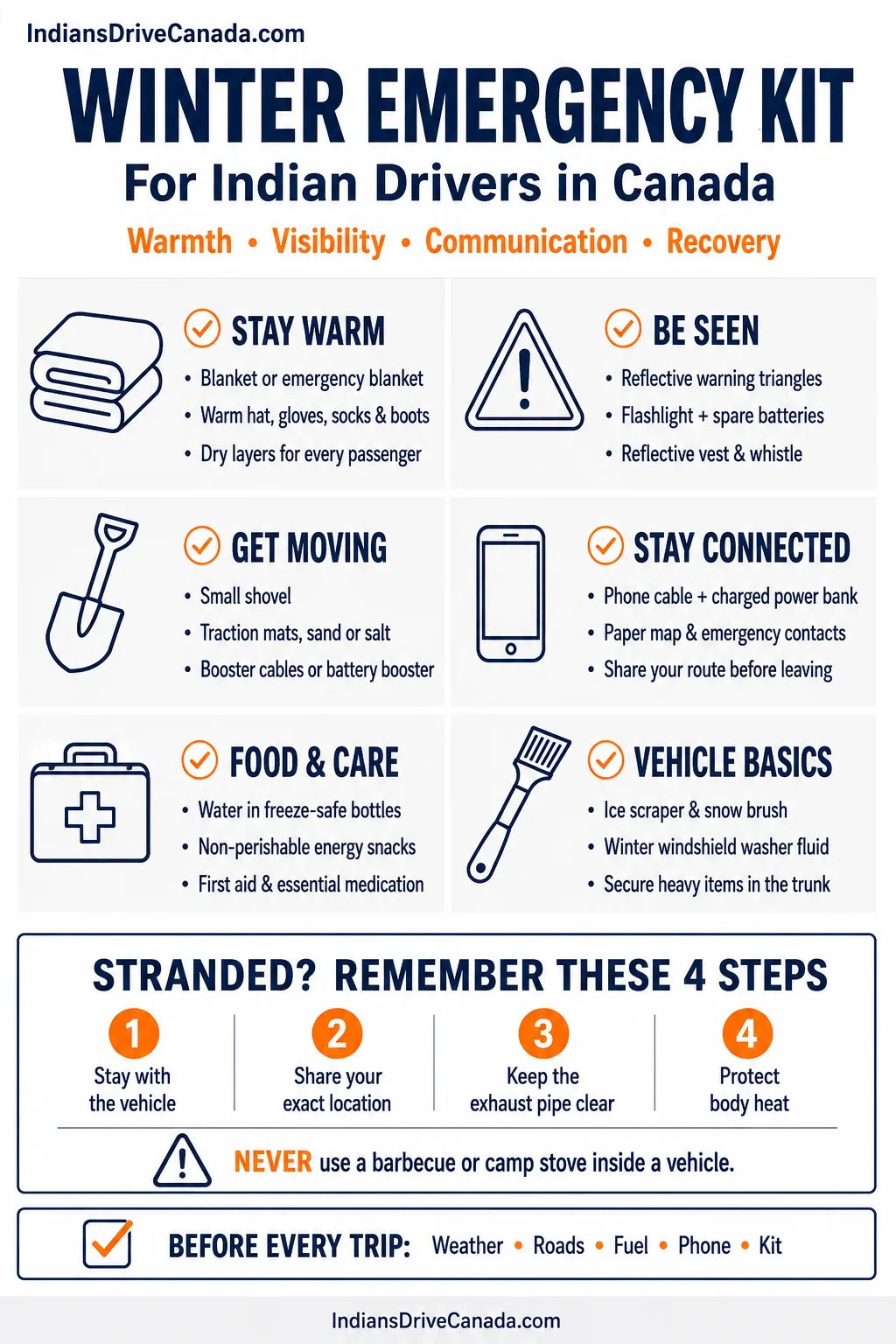
A winter emergency kit for Indian drivers in Canada should do more than fill space in the trunk. It should keep everyone warm, help the vehicle regain traction, make the vehicle visible and preserve communication while roadside assistance or emergency services are on the way.
Build the kit around four needs: warmth, traction, visibility and communication. Keep items needed immediately inside the cabin, place recovery equipment where it can be reached without unloading the trunk, and expand the kit before highway, rural or northern travel.
The Government of Canada’s basic vehicle kit includes non-perishable food, water in plastic bottles, blankets, extra clothing, first aid supplies, a shovel, scraper, snow brush, flashlight, whistle, road maps, traction material, jumper cables, washer fluid and warning equipment.[Emergency kit] A prepared vehicle may still be unsafe to drive if the tires, battery, brakes, lights or defroster are not ready for winter.
Pack the kit by route, not by bag size
A short city commute and a winter highway trip do not create the same waiting time, exposure or communication risk. Start with a basic kit, then add equipment for the route, forecast, passengers and distance from help.
| Driving pattern | Main risk | Kit depth | Add before departure |
|---|---|---|---|
| Urban commuting | Battery failure, traffic delay, icy parking area | Basic vehicle and personal kit | Warm layer, power bank, scraper, shovel and traction material |
| Suburban or highway travel | Road closure, long assistance wait, poor visibility | Basic kit plus extended warmth and visibility equipment | Extra food, water, blankets, warning triangles and full-size charging pack |
| Rural or low-traffic route | Weak mobile signal and fewer nearby services | Extended kit for every passenger | Printed route, additional clothing, larger food supply and more than one light source |
| Northern or remote travel | Long exposure and delayed rescue | Route-specific preparation | Local emergency advice, fuel planning, communication backup and supplies matched to expected rescue time |
| Rental vehicle | Unknown equipment and unfamiliar controls | Portable personal kit plus vehicle inspection | Confirm tires, roadside assistance, scraper, spare tire or repair kit and charging equipment |
An emergency kit does not make a dangerous trip safe. Severe weather warnings, closed roads, unsuitable tires or a poorly maintained vehicle may require delaying the trip rather than adding more equipment.
The kit’s four jobs
Keep people warm and dry
The clothing stored in the vehicle should be suitable for standing outside, clearing snow or waiting without a working heater. A regular office jacket may not provide enough protection after exposure to wind, wet snow or freezing rain.
- One warm blanket for each regular passenger, where practical
- A toque or warm hat
- Water-resistant gloves suitable for handling a shovel
- Extra wool or thermal socks
- Warm, water-resistant footwear
- A dry base layer or sweater
- Hand and foot warmers
- A compact rain or wind-resistant outer layer
Keep at least one warm layer and one pair of gloves inside the cabin. A damaged, frozen or snow-blocked trunk may be difficult to open after a collision or when the vehicle is stuck.
Restore limited traction
Recovery equipment is intended for a minor loss of traction, such as a vehicle spinning its wheels in a snow-covered parking space. It cannot safely recover every vehicle from a ditch, deep snowbank or unstable roadside shoulder.
- Small shovel with a handle long enough to reach around the wheels
- Traction mats sized for the vehicle
- Sand, salt or non-clumping cat litter in a sealed container
- Snow brush and separate ice scraper
- Booster cables or a compatible portable battery booster
- Extra winter windshield washer fluid
- Small tool kit
- Work gloves that remain usable when wet
A snow brush, ice scraper and shovel serve different purposes. The brush clears loose snow from the roof, hood, windows and lights. The scraper removes bonded ice from glass. The shovel clears packed snow around the tires, underbody and tailpipe.
Make the vehicle and passengers visible
Visibility equipment should work in darkness, blowing snow and poor roadside lighting. It should also be reachable before anyone steps outside the vehicle.
- Reflective safety vest within the driver’s reach
- Warning light or approved roadside warning equipment
- Reflective safety triangles
- Flashlight with tested batteries
- Backup wind-up or battery-powered light
- Whistle for attracting attention
Place warning equipment only when it is safe to exit. Standing beside a vehicle on a high-speed road can be more dangerous than remaining belted inside.
Keep communication available
A mobile phone is useful only while it has power and can connect to a network. Transport Canada advises drivers to charge the phone before leaving, carry a charging cable and consider a battery pack for longer trips.[Trip preparation]
- Phone charging cable compatible with the vehicle
- Fully charged power bank
- Roadside assistance membership or policy details
- Emergency contact information written on paper
- Vehicle make, model, colour and licence plate number
- Downloaded or printed route information for longer trips
- Provincial or territorial 511 traveller information access
Keep the power bank in the cabin rather than leaving it permanently in the coldest part of the trunk. Recharge it regularly, even when it has not been used.
What belongs inside the cabin
Equipment needed during the first moments of a problem should not be buried under luggage. Store it securely so it cannot become a projectile during sudden braking or a collision.
| Keep inside the cabin | Keep in an accessible trunk area |
|---|---|
| Seatbelt cutter and window hammer | Shovel |
| Reflective vest | Traction mats |
| Flashlight | Sand, salt or non-clumping litter |
| Phone cable and power bank | Booster cables |
| Warm gloves, hat and one blanket | Extra washer fluid |
| Small first aid pouch | Tool kit and fire extinguisher |
| Emergency contacts and roadside assistance details | Additional food, water, clothing and footwear |
The seatbelt cutter and window hammer must be reachable while seated. A tool stored in the trunk cannot help if the doors are jammed or the vehicle is resting in a position that prevents the trunk from opening.
Food, water and personal supplies
Choose food that does not need cooking, has a long shelf life and can be eaten by the people who regularly travel in the vehicle. The kit can include vegetarian, vegan, nut-free or other dietary options without relying on unfamiliar emergency ration products.
- Energy bars or other shelf-stable snacks
- Dried fruit, crackers or roasted snacks in sealed packaging
- Food suitable for children travelling in the vehicle
- Plastic water bottles that allow room for freezing expansion
- Basic hygiene supplies
- Personal information needed during an emergency
The federal emergency car kit page recommends carrying water in plastic bottles so the containers are less likely to break when frozen and replacing the water every six months.[Water storage]
Medication requires separate planning. Do not leave temperature-sensitive medicine permanently in a freezing trunk. Follow the storage instructions provided with the medicine and carry required doses in a way that keeps them accessible.
Passenger needs change the kit
Travelling with a baby or child
- Child-sized warm clothing and dry socks
- Age-appropriate food, water and hygiene supplies
- Blanket that does not interfere with the child restraint
- Required medicines and care instructions
- Emergency contact information
Transport Canada advises families to follow the child car seat manufacturer’s instructions because bulky winter coats and snowsuits may affect how the harness fits.[Child restraint] Warm the child with approved layers or a blanket placed over the secured harness rather than placing unapproved padding beneath the straps.
Travelling with an older adult
- Additional blanket and easy-to-wear warm layer
- Non-slip winter footwear
- Required medication and written dosage information
- Mobility support that can be reached without unloading the vehicle
- Emergency contact and relevant care information
Travelling with a pet or service animal
Pack a separate animal kit with a carrier or restraint, leash or harness, food, water, bowls, medication, waste supplies, a blanket and identification records.[Animal supplies]
The animal should not be released beside a highway or during a storm without secure control. Fear, traffic noise and poor visibility can cause unexpected movement even in a normally calm pet.
Check a rental car before accepting the keys
A rental vehicle may not contain the same winter equipment as a personally owned vehicle. Before leaving the rental location, confirm what is included and how roadside help works.
- Inspect the tire markings and visible tread condition.
- Confirm whether the vehicle meets any tire or chain requirement on the planned route.
- Look for a snow brush and ice scraper.
- Locate the spare tire, inflator or puncture repair kit.
- Confirm the roadside assistance telephone number and coverage limits.
- Locate the hazard-light control and hood release.
- Check whether a charging cable is available for an electric vehicle.
- Review the fuel or charging return requirement.
- Save the rental location’s contact details before leaving.
A compact personal pouch can move between rental cars. It can contain a warm hat, gloves, socks, reflective vest, flashlight, power bank, charging cable, snacks and emergency contacts. Larger items such as a shovel and traction mats still need to be confirmed separately.
The vehicle must be ready before the kit matters
An emergency bag cannot compensate for a weak battery, worn tires, failed defroster or empty washer-fluid reservoir. Transport Canada’s winter preparation advice includes checks of the battery, charging system, lights, brakes, exhaust, heating system, defroster, wipers and tires.[Vehicle readiness]
- Test the battery and charging system before sustained cold weather.
- Confirm the heater and front and rear defrosters work.
- Replace wiper blades that streak or leave untreated areas.
- Check the lights after clearing snow and ice.
- Inspect the exhaust system for leaks.
- Check tire pressure when the tires are cold.
- Confirm the spare tire or repair kit is usable.
- Keep the fuel level or electric driving range suitable for an unexpected delay.
Transport Canada recommends winter washer fluid in the -40°C temperature range and carrying an extra jug. It also recommends at least 4 mm of tread depth on winter tires for safer winter driving.[Winter vehicle check] These are federal safety recommendations, not a statement that every province uses the same legal tread or washer-fluid rule.
Transport Canada also recommends winter tires on all wheels when driving in cold, snowy or icy conditions because their rubber and tread design provide better traction than all-season tires.[Winter tires]
Winter tire and chain laws are provincial or route-specific. A kit does not replace a legal tire or chain requirement. Check the transportation ministry and 511 service for the province or territory where the vehicle will be driven.
Cold-weather driving checks before departure
Transport Canada advises drivers to review weather and road conditions, allow more travel time, tell someone the route and expected arrival time, keep the phone charged and prepare for delays. It also recommends keeping the fuel tank at least half full and ensuring an electric vehicle has enough range for unplanned events because cold weather can reduce range.[Departure check]
Check the weather warning, not only the temperature
Look for snowfall, freezing rain, blowing snow, blizzard, wind and extreme-cold warnings. Environment and Climate Change Canada publishes active weather alerts by location and province or territory.[Weather alerts]
Check the whole route
A clear street near home does not show the condition of an exposed highway, rural section or mountain pass. Review the applicable provincial or territorial 511 service for road conditions, closures, incidents and available maintenance information.
Check whether the trip can wait
Delay the trip when an official warning, road closure or deteriorating visibility makes the route unsuitable. Carrying more equipment does not remove the risk created by a closed road or severe storm.
Tell someone the route and arrival time
Share the destination, planned route, vehicle details and expected arrival time. Update the person if the route changes or the trip is delayed.
When the wheels spin but the vehicle is still safe
Repeatedly pressing the accelerator can polish the snow into ice, overheat components and dig the tires deeper. Stop and assess the vehicle before making another attempt.
Stop spinning the wheels
Place the transmission in park, apply the parking brake and check whether the vehicle is in a safe location. Do not stand where the vehicle could slide or where another driver may strike you.
Clear the tailpipe first
Remove snow from around the exhaust outlet before running the engine. Continue checking it while snow is falling or drifting.
Open a path for the drive wheels
Clear packed snow in front of and behind the drive wheels. If the vehicle’s underbody is resting on snow, removing only the snow around the tires may not be enough.
Add traction
Place a traction mat, sand, salt or non-clumping litter where the drive tire needs grip. Keep hands, clothing and tools away from a moving wheel.
Use gentle movement
Keep the front wheels as straight as the situation allows and apply light accelerator pressure. Stop if the vehicle moves toward traffic, a ditch, a person or another obstacle.
Check the owner’s manual before changing stability controls
Transport Canada notes that electronic stability control may need to be turned off when a vehicle is stuck, but controls and operating instructions differ by vehicle.[Vehicle control] Restore the normal setting after the vehicle is free.
Stop recovery attempts if the vehicle is in a ditch, the roadside surface is unstable, the wheels cannot be reached safely, the vehicle is damaged or traffic makes it unsafe to work outside. Call roadside assistance or emergency services as the situation requires.
If the vehicle becomes a shelter
If the vehicle is not at risk of being struck, Transport Canada advises remaining inside during a storm because the vehicle provides shelter and leaving it can lead to becoming lost or exposed to severe cold.[Stranded vehicle]
Make the first calls while the phone has power
- Call 911 for a collision, injury, fire, immediate medical danger or another emergency.
- Contact roadside assistance for a mechanical or recovery problem that is not an immediate emergency.
- Send the vehicle’s location and direction of travel to a trusted contact.
- Provide the road name, nearest exit, kilometre marker or visible landmark.
- Switch the phone to a power-saving mode after sending the required information.
Prevent exhaust gas from entering the cabin
A tailpipe blocked by snow can allow carbon monoxide to enter the vehicle. Clear the exhaust outlet before starting the engine and recheck it as snow accumulates. Transport Canada also advises opening a window slightly on the side protected from the wind and running the engine as little as possible while stranded.[Exhaust safety]
Headache, dizziness, nausea, confusion or unusual sleepiness may be signs of carbon monoxide exposure. Move to fresh air when it is safe and contact emergency services.
Reduce heat loss
- Put on dry layers before becoming very cold.
- Cover the head, hands and feet.
- Share blankets without blocking seatbelts or exits.
- Use hand and foot warmers according to their instructions.
- Move arms and legs gently to maintain circulation.
- Avoid exercise that causes heavy sweating.
- Keep wet clothing separate from dry supplies.
Transport Canada warns against heavy lifting, forceful shovelling or pushing a vehicle in bitter cold while stranded.[Cold exposure]
Stay visible without draining the battery
- Use hazard lights when appropriate.
- Set out warning equipment only when exiting is safe.
- Wear the reflective vest before opening the door.
- Use the interior dome light to help searchers identify the vehicle.
- Avoid leaving headlights on continuously if battery power is limited.
Kit failures that are easy to prevent
| Preparation failure | Why it creates a problem | Safer action |
|---|---|---|
| All equipment is under luggage | The kit cannot be reached during a roadside stop. | Keep recovery and visibility items near the trunk opening. |
| Power bank is never recharged | The phone loses its communication backup. | Test and charge it monthly during winter. |
| Water is stored in glass | Freezing can break the container. | Use plastic bottles and replace the supply every six months. |
| Only a scraper is carried | It cannot efficiently clear the roof or deep snow around a tire. | Carry a scraper, snow brush and shovel. |
| Booster cables are carried without instructions | Incorrect connection can damage a vehicle or cause injury. | Follow the vehicle manual or use trained roadside assistance. |
| The traction material is loose | Moisture and spills can make it unusable. | Store it in a sealed, labelled container. |
| The kit is sized for one person | Food, warmth and water may be insufficient for regular passengers. | Review the kit whenever passenger needs change. |
| A tow rope is attached without checking the manual | Vehicles have different approved recovery points. | Use only manufacturer-approved points and suitable recovery help. |
| The kit replaces vehicle maintenance | The driver still faces preventable battery, tire or visibility failures. | Complete winter maintenance before relying on the kit. |
Winter kit inspection schedule
Before the first winter trips
- Remove every item and inspect the packaging.
- Replace expired food and first aid supplies.
- Replace stored water if six months have passed.
- Charge the power bank and portable battery booster.
- Test flashlights and warning lights.
- Confirm clothing and footwear fit current passengers.
- Inspect the shovel, traction mats and booster cables for damage.
- Review roadside assistance contact details.
- Check the vehicle manual for battery boosting and recovery instructions.
Once a month during winter
- Confirm the kit remains accessible.
- Recharge electronic equipment.
- Check for leaking water or washer fluid.
- Inspect food packaging for damage.
- Test the flashlight.
- Confirm the scraper, brush and shovel are still in the vehicle.
- Update the kit for children, older adults, pets or new regular passengers.
After any item is used
- Replace consumed food, water and first aid supplies.
- Dry blankets and clothing before repacking them.
- Recharge battery-powered equipment.
- Clean salt, sand and moisture from tools.
- Replace damaged traction mats or warning equipment.
- Record any item that was missing when it was needed.
Final departure check for a winter journey
- The weather warning and full route have been checked.
- The road is open and suitable for travel.
- The tires meet the law applying to the province, territory and route.
- The windshield, roof, hood, lights and licence plate are clear of snow and ice.
- The fuel level or electric range allows for an unexpected delay.
- The phone and power bank are charged.
- A trusted person knows the route and expected arrival time.
- Warmth supplies match the number and needs of passengers.
- The shovel, traction material and warning equipment are accessible.
- The tailpipe can be located and cleared if the vehicle becomes stuck.
- Roadside assistance and emergency contact details are available without internet access.
- The trip will be delayed if conditions deteriorate before departure.