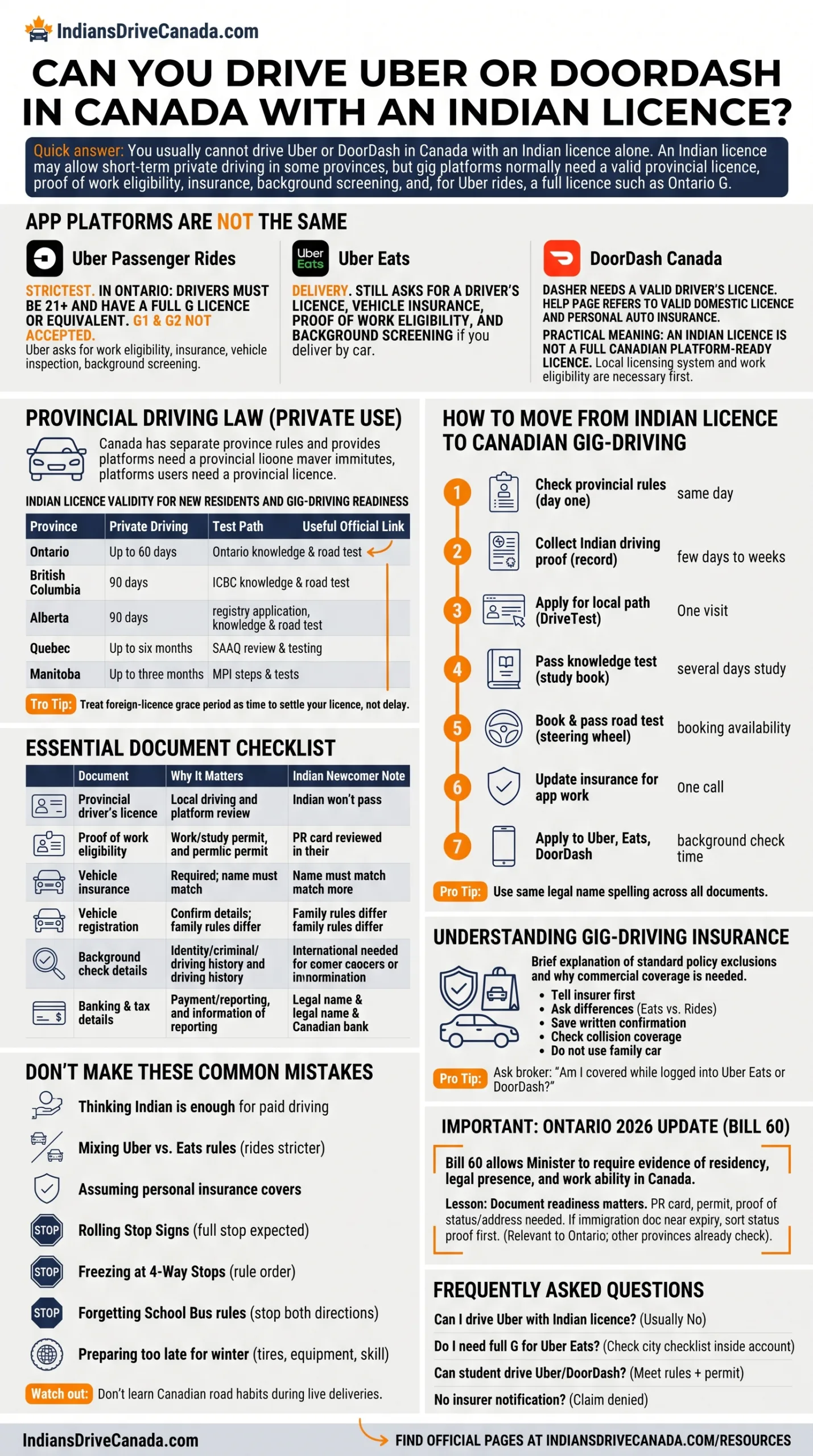
An Indian driving licence by itself is not enough to start carrying Uber passengers in Canada. Passenger rides are regulated work and normally require a full provincial licence, local ride-hailing approval, screening, suitable insurance and, in British Columbia or Alberta, a commercial licence class.
Car delivery is different, but a foreign licence still does not create automatic eligibility. DoorDash Canada says applicants using a motor vehicle must have a full licence class, while its general car-delivery rules refer to a valid domestic licence and personal auto insurance. Uber Eats says car-licence requirements vary by location and also checks insurance, work eligibility and driving history. A newcomer may therefore be allowed to drive personally with an Indian licence yet still fail platform verification.
Bike or foot delivery may be available in selected cities without a driver’s licence, provided the applicant has legal permission to work and passes the platform’s identity and background checks.
Requirements checked on July 27, 2026. Platform rules, accepted transportation modes and municipal ride-hailing conditions can change. Confirm the requirements shown for the exact city and delivery mode before buying a vehicle, changing insurance or paying for a commercial-licence test.
| Work type | Can the Indian licence be relied on? | What usually decides the result |
|---|---|---|
| Uber passenger rides | No | Provincial and municipal passenger-transport rules require an eligible local licence and additional approvals. |
| DoorDash by car | Normally no | DoorDash Canada accepts full licence classes and its car rules call for a domestic licence and insurance. |
| Uber Eats by car | Do not assume approval | Licence requirements vary by location; insurance, work documents and a driving-history screen also apply. |
| Delivery by bike | A driver’s licence may not be required | The mode must be offered in the city, and work-eligibility and background checks still apply. |
| Delivery on foot | Possible only in selected markets | The platform must offer walking delivery in the applicant’s area. |
Three separate approvals control whether you can work
The first question is whether the province permits you to drive a private vehicle with your Indian licence. The second is whether Uber or DoorDash accepts the licence during account screening. The third is whether the vehicle, insurance and local passenger-transport rules allow the proposed paid activity.
Passing one test does not pass the others. Ontario, for example, permits a new resident to use a valid foreign licence for 60 days. That rule allows temporary personal driving while the person moves to an Ontario licence. It does not require Uber, DoorDash, a municipality or an insurer to approve paid trips.
Personal driving and paid platform driving are different uses. A foreign-licence grace period deals with the right to operate a vehicle on public roads. Platform onboarding deals with identity, licence class, driving history and contractual requirements. Passenger transportation also brings provincial or municipal licensing rules.
Uber passenger trips require more than a foreign licence
Driving passengers for payment falls under ride-hailing or remunerated passenger transportation rules. An Indian licence, even when valid for temporary personal driving, does not replace the provincial class and local approvals required for this work.
Ontario: a full G licence is the starting point
Uber’s Ontario regulatory requirements state that a passenger driver must hold a full G licence or an accepted equivalent; G1 and G2 licences are not accepted. In Toronto, the municipal requirement is narrower: a private transportation company driver must hold a valid Ontario Class G or higher licence. New Toronto applicants must also complete a City-approved third-party driver training program.
Toronto also uses a minimum driving-experience requirement for vehicle-for-hire licensing. A newcomer should not assume that years shown on an Indian licence will automatically appear in the form required by the city or platform. The Ontario driver record and the documents used to establish the earliest licensing date may affect the assessment.
- Full Ontario G or higher licence for Toronto passenger work
- Proof of legal permission to work in Canada
- Driver record and criminal background screening
- City-approved training where required
- Ontario vehicle registration, insurance and safety certificate
- Any local private transportation company licence or vehicle identifier
Official checks: Uber’s Ontario regulatory requirements and the City of Toronto rules for private transportation company drivers.
British Columbia: the licence must be issued by B.C.
British Columbia requires a ride-hail driver to hold a valid B.C.-issued licence. Class 1, 2 or 4 is accepted, with Class 4 being the normal commercial class for this type of passenger vehicle. A Class 5 licence is not the final ride-hailing qualification.
To obtain Class 4, the driver must be at least 19, have at least two years of non-learner driving experience, meet the driving-record standard, pass the Class 4 knowledge and road tests, complete a vehicle pre-trip inspection test and pass a medical fitness examination. The provincial page also states that testing is completed in English without assistance from a translator.
A driver who has not lived in B.C. for the previous three years may need a driver’s abstract from the earlier jurisdiction so that three years of records can be reviewed. This is one reason an Indian driving extract can remain useful after the provincial licence is issued.
See the B.C. passenger directed vehicle driver requirements.
Alberta: Class 5 is not enough for passenger rides
Alberta requires ride-for-hire drivers using a transportation network company to hold Class 1, 2 or 4. The province expressly states that Class 5 is not enough. Moving from an Indian licence to a standard Alberta Class 5 licence therefore does not complete the Uber passenger route.
The upgrade to Class 4 involves a knowledge test, road test and medical fitness check. The transportation network company must also obtain the required police screening and confirm insurance that covers ride-for-hire use. Alberta vehicles used for this work require the applicable commercial registration and plate class.
See Alberta’s ride-for-hire service requirements.
Quebec: passenger transportation needs separate authorization
A foreign licence holder may be allowed to drive a passenger vehicle in Quebec for a limited period, but paid passenger transportation is a separate regulated activity. A person providing remunerated passenger transportation must be authorized by the SAAQ or registered through an authorized transportation system operator.
The SAAQ’s driver requirements call for a Class 5 or higher licence and at least 12 months of experience before an authorized driver permit can be issued. A valid Indian licence during Quebec’s foreign-licence period does not replace that authorization.
Check the SAAQ requirements for remunerated passenger transportation drivers.
Do not accept Uber passenger requests while registered only for food delivery. Carrying passengers without the required driver, vehicle and insurance approvals can expose the driver to account action, a denied insurance claim, fines or provincial licensing consequences.
DoorDash car delivery has its own licence screen
DoorDash delivery does not involve carrying passengers, so Class 4 passenger-transport rules do not normally apply. That does not make an Indian licence automatically acceptable for a car account.
DoorDash’s Canadian sign-up material asks for consent to a background check, two pieces of government identification, a valid Business Number or Social Insurance Number, and a full-class driver’s licence when applicable. Its Canada background-check page says only full licence classes are accepted. DoorDash’s broader car requirements also refer to a valid domestic driver’s licence and valid personal auto insurance.
An Indian licence is a foreign licence rather than a domestic Canadian licence. The practical reading of those published requirements is that a newcomer should expect to need a full provincial licence for car delivery. An account screen may also need a motor vehicle record that can be matched to the licence. Temporary permission to drive under provincial law does not force DoorDash or its screening provider to accept the document.
What the DoorDash screen may request
- Two pieces of government-issued identification
- A valid SIN or Business Number, depending on the sign-up route
- A full licence class when using a motor vehicle
- Consent for the Canadian background check
- Personal auto insurance for car delivery
- Matching legal name, date of birth and address information
DoorDash’s official pages do not promise that a foreign licence used during a provincial newcomer period will pass onboarding. Check the DoorDash Canada background-check requirements and the Canadian Dasher sign-up document list before relying on a particular licence.
Why a valid document can still fail
Complete the provincial full-licence process before purchasing a car mainly for DoorDash. Platform approval, insurance approval and licence conversion should be confirmed separately so that one successful step is not mistaken for final eligibility.
Uber Eats depends on the delivery mode
Uber publishes separate document rules for car delivery and for delivery by bike or on foot. The selected mode changes whether a driver’s licence and vehicle insurance are required.
Delivering by car
Uber Eats states that car-delivery licence requirements vary by location. It also requires proof of vehicle insurance showing the delivery person’s name, proof of work eligibility and a background screen. The car screen includes driving history.
This wording does not create a Canada-wide promise that every valid Indian licence will be accepted. The city selected in the app, the licence class, the ability to verify driving history and the provincial insurance position can all affect onboarding. A newcomer should treat approval as unresolved until the documents have been accepted for the exact market.
Delivering by bike or on foot
Uber’s Canadian delivery requirements do not list a driver’s licence for the bike or foot route. Applicants must meet the provincial age requirement, provide acceptable proof of work eligibility and complete criminal-history screening. Walking delivery is offered only in selected cities.
DoorDash also advertises car, bike, e-bike, scooter and motorcycle delivery in Canada, but available modes depend on location. The account must be opened with the mode actually used. A bicycle account is not a lawful way to avoid licence and insurance checks while delivering by car.
| Mode | Driver’s licence | Vehicle insurance | Other checks |
|---|---|---|---|
| Car | Required; accepted class and jurisdiction depend on platform rules | Required | Work eligibility, identity and driving-history screening |
| Motorcycle or motor scooter | Correct motorcycle or scooter class required | Required | Registration, work eligibility and screening |
| Bicycle or qualifying e-bike | Normally not required for a pedal bicycle | Not personal auto insurance | Mode availability, work eligibility and screening |
| On foot | Not required | Not required | Only where the platform offers walking delivery |
Check Uber’s Canadian delivery requirements by transportation mode.
The foreign-licence period is not a gig-work approval period
New residents do not receive the same foreign-licence window in every province. These periods describe how long a person may continue driving privately after becoming a resident. They should not be used as a countdown for starting platform work.
| Province | Personal driving period | Effect on Uber or DoorDash |
|---|---|---|
| Ontario | 60 days after becoming a resident | Does not replace a full G requirement or platform document approval. |
| British Columbia | 90 days after moving, subject to stated exemptions | Ride-hailing still requires a B.C.-issued Class 1, 2 or 4 licence. |
| Alberta | 90 days after becoming a resident | Passenger work still requires Class 1, 2 or 4; Class 5 is not enough. |
| Quebec | Up to six consecutive months for a qualifying foreign licence holder | Paid passenger transportation still requires SAAQ authorization. |
Ontario’s period is confirmed on the Ontario foreign-licence exchange page. B.C. explains its 90-day rule and student or visitor exceptions on the ICBC moving from another country page. Alberta gives new residents 90 days to exchange on its non-Alberta licence exchange page. Quebec explains the six-month period on the SAAQ foreign-licence page.
The deadline is normally linked to becoming a resident of the province, not simply the date printed on a flight ticket or the first date the licence holder entered Canada. A visitor, student and new resident may be treated differently. Confirm which status applies before calculating the last day of foreign-licence use.
An International Driving Permit does not upgrade the licence
An International Driving Permit is used with the underlying valid national licence. It helps present or translate licence information when driving abroad. It does not convert an Indian licence into an Ontario G, B.C. Class 4, Alberta Class 4 or Quebec Class 5 licence.
An IDP also does not:
The federal driving in Canada information recommends obtaining an IDP in the home country when planning to use a foreign licence. The permit should be treated as a supporting document, not a substitute for the local licence required for paid work.
Indian driving experience can still shorten the route
The Indian licence may not be the final work document, but verified experience can affect the provincial licensing process. A driving extract, licence-history letter or similar authority-issued record may help establish when full driving privileges began.
The licence card, a driving-experience record and a translation are not the same document:
| Document | Possible use | What it does not prove by itself |
|---|---|---|
| Valid Indian driving licence | Shows the class and active driving authority stated on the card | Local ride-hailing or platform approval |
| Driving extract or licence-history letter | May establish issue dates, class history and status | A right to drive after the provincial foreign-licence period |
| Certified or approved translation | Makes a non-English or non-French record readable to the authority | Authentication or proof that the record is genuine |
| Provincial driver abstract | Shows the driving record held by the Canadian province | Work authorization or insurance coverage |
British Columbia, for example, says a driver applying for a full-privilege licence must prove at least two years of driving experience or may be placed in the graduated licensing program. ICBC may also use verified experience when calculating insurance history. Document format and translation rules differ by province, so obtain the record before leaving India when possible and confirm the issuing authority’s required format.
Keep the original Indian licence, the most detailed official driving extract available and any required translation together. A platform may ask for a Canadian abstract later, while the provincial licensing office may need the Indian record to establish earlier experience.
Permission to work must exist before the account is used
A driver’s licence only answers the driving question. It does not grant permission to earn money in Canada. The applicant must have immigration status and permit conditions that allow the proposed work.
Permanent residents and citizens
A permanent resident or Canadian citizen generally has unrestricted access to employment, subject to the platform, licensing, tax and insurance rules that apply to the activity.
Work permit holders
An open work permit may allow self-employed platform work. An employer-specific permit may restrict the holder to the employer, occupation or location written on the document. The permit conditions should be checked before opening a driver or courier account.
International students
As of July 27, 2026, an eligible international student may work up to 24 hours per week off campus during regular academic terms. During a scheduled break, unlimited off-campus hours may be allowed when all federal conditions are met.
Self-employed students must keep their own records and prove compliance. IRCC defines work hours by the time spent earning wages, being paid for a service or collecting commission. Time records should therefore be based on the student’s actual working activity and retained with app statements and payment records, rather than estimated later.
Read the federal off-campus work conditions for international students.
Visitors
A visitor may have temporary permission to drive a private vehicle, but visitor status does not normally authorize employment or self-employed delivery work. Most foreign nationals need a work permit unless a specific exemption applies. Platform acceptance does not override immigration conditions.
An activated account is not proof that the account holder is allowed to work under Canadian immigration law. The person using the account remains responsible for permit restrictions, study-hour limits and any date on which work authorization ends.
Insurance must cover the activity, not only the car
A valid pink slip, policy certificate or provincial insurance document proves that a policy exists. It does not necessarily prove that app-based delivery or passenger work is permitted under the personal policy.
Uber passenger and Uber Eats coverage
Uber maintains commercial auto insurance for covered periods while a driver is using the app. The exact protection depends on the province and whether the driver is waiting, travelling to a pickup or carrying a passenger or delivery. Uber also states that the driver is responsible for informing the personal broker or insurer about ridesharing or delivery activity.
For car delivery, Uber requires the insurance document to show the delivery person’s name and to be unexpired. Platform insurance does not remove the need for personal auto insurance when the app is off, and some collision or physical-damage protection under a platform policy depends on the coverage held personally.
Review the Uber delivery insurance periods and discuss the intended use with the personal insurer before the first trip.
Ontario insurers are reviewing rideshare underwriting before 2027
Ontario insurance update: FSRA expects personal auto insurers to review their rideshare rating and underwriting practices as soon as practicable before January 1, 2027. Where a driver’s rideshare activity is covered by a commercial rideshare insurance program, FSRA expects that rideshare use should not, by itself or together with other factors, cause the driver to be declined for personal auto insurance. FSRA also expects an additional personal-policy premium tied to rideshare use to be supported by actuarial evidence of added personal-insurance claim exposure.[Ontario insurance]
This does not mean every Uber or other gig driver must now be accepted by every insurer. Insurers are reviewing their own practices, so implementation can differ. Drivers still need to disclose paid driving, identify the exact platform, and confirm what the personal policy covers when the app is off and what the platform or commercial policy covers while the app is in use.
The FSRA expectation is most directly tied to rideshare activity covered by a commercial rideshare insurance program. It should not be treated as automatic personal-policy approval for DoorDash or another delivery platform where the insurance arrangement may be different.
DoorDash car insurance needs direct confirmation
DoorDash’s general car requirements call for valid personal auto insurance. The policyholder should ask the insurer or licensed broker whether paid food, grocery or parcel delivery is allowed and request a clear record of the answer.
For Ontario, the Financial Services Regulatory Authority lists approved delivery insurance products for Amazon Flex, Cornershop and Uber Eats on its consumer page. DoorDash is not shown in that delivery list as of August 23, 2026. This does not by itself decide every DoorDash claim or policy, but it makes direct confirmation with the personal insurer especially important.
Ontario drivers can check the FSRA list of approved ridesharing and delivery insurance products.
Do not describe the vehicle as personal-use only when the intention is paid delivery or passenger work. An inaccurate use declaration can affect underwriting, premiums and claim handling. Ask about the exact platform and activity before accepting an order or ride.
The safest route depends on the work you want
For Uber passenger rides
- Move from the Indian licence to the provincial licence required in the province.
- Obtain the full or commercial class required for passenger transportation.
- Collect the driving records and police checks required by the province, city and platform.
- Complete municipal training, vehicle inspection and local licensing where applicable.
- Confirm personal and platform insurance before carrying a passenger.
For DoorDash or Uber Eats by car
- Complete the full provincial passenger-vehicle licence route rather than relying on the foreign-licence grace period.
- Ask the insurer whether the exact delivery platform and paid use are covered.
- Prepare matching identity, work-eligibility, licence and insurance documents.
- Complete the platform’s background and driving-history screening.
- Wait for the stated transportation mode and documents to be approved before delivering.
For bike or foot delivery
- Check whether the platform offers that mode in the city.
- Confirm legal permission to work and any student-hour restriction.
- Register with the true delivery mode and complete identity and background screening.
- Confirm that an e-bike or scooter is legally classified for licence-free use in the province.
- Do not switch to a motor vehicle without updating the account and satisfying licence and insurance rules.
Newcomer situations that produce different answers
| Situation | Likely result | Next action |
|---|---|---|
| New Ontario resident with only an Indian licence | May drive personally during the 60-day resident period, but cannot rely on it for Uber passengers or DoorDash car approval. | Start the Ontario licensing process and verify experience documents. |
| Ontario G2 holder | Not eligible for Uber passenger driving; DoorDash Canada’s full-class rule may also block car onboarding. | Complete the full G road-test route. |
| B.C. Class 5 holder | May be considered for car delivery, subject to platform and insurance checks, but is not qualified for ride-hailing passengers. | Obtain Class 4 for passenger work. |
| Alberta full Class 5 holder | Class 5 may support ordinary car delivery but is expressly insufficient for transportation network passenger rides. | Upgrade to Class 4 for passenger work. |
| International student without a Canadian licence | Bike or foot delivery may be possible where offered, subject to federal work conditions and screening. | Check the permit wording, weekly hours and available delivery modes. |
| Visitor with an Indian licence and IDP | May have temporary personal driving permission but normally lacks permission to work. | Do not perform paid trips without valid work authorization. |
| Full provincial licence but insurer has not approved delivery use | Driving document may pass, but the vehicle should not be used for paid trips until coverage is confirmed. | Contact the insurer or broker before going online. |
Applications that fail for avoidable reasons
| Error | Why it causes a problem | Safer correction |
|---|---|---|
| Uploading an Indian licence as though it were a Canadian full licence | The issuing jurisdiction and licence class do not match the requested document. | Use the platform’s foreign-document route if one is offered, or obtain the required provincial licence. |
| Treating G2, N or another novice class as full | Passenger platforms and DoorDash Canada may require a full class. | Complete the province’s full-licence stage before applying by car. |
| Opening a bike account and delivering by car | The account bypasses motor-vehicle, record and insurance screening. | Change the transportation mode and submit the required documents before using the car. |
| Assuming an IDP is a Canadian licence | An IDP supports the foreign licence; it does not change its jurisdiction or class. | Use it only with the valid Indian licence and follow the provincial conversion route. |
| Using a spouse’s or relative’s car without being listed properly | The platform document and insurance policy may not identify the delivery person as an insured driver. | Ask the insurer to confirm driver status and paid-use coverage. |
| Ignoring name differences between documents | Screening can fail when the licence, passport, permit and tax records cannot be matched. | Provide the legal name consistently and include accepted proof of any name change. |
| Working after a permit or study condition ends | Platform access does not extend immigration authorization. | Stop working when authorization ends and resume only after the new status permits it. |
Records to keep after approval
Platform income is generally treated as self-employment income. Canadian residents earning through gig platforms must report the income, including applicable tips, and keep records supporting income and expenses. The Canada Revenue Agency identifies Form T2125 as the form commonly used to report business or professional activities for a sole proprietor.
- Weekly platform statements and annual tax summaries
- Dates and hours worked, especially for study-permit compliance
- Vehicle-use and kilometre records separated between personal and business travel
- Insurance confirmations and policy changes
- Fuel, maintenance, parking and other receipts connected to earning income
- Licence, registration, inspection and screening renewal dates
Read the CRA’s tax information for gig-economy workers.