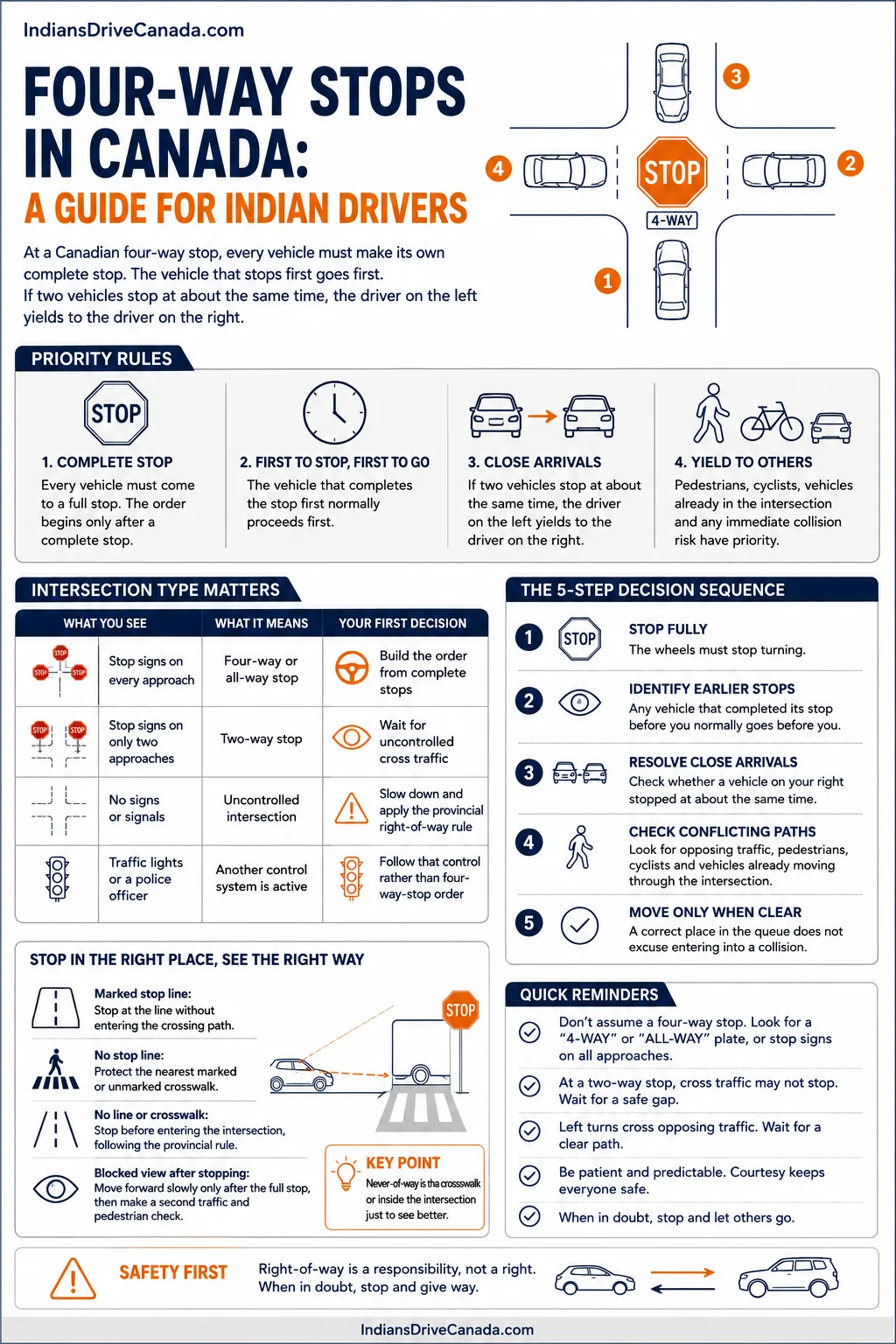
At a Canadian four-way stop, every vehicle must make its own complete stop. The vehicle that completes the stop first normally moves first. If two vehicles stop at about the same time, the driver on the left yields to the driver on the right. A driver turning left must also wait for any opposing movement that crosses the turn. Pedestrians, cyclists, vehicles already inside the intersection and any immediate collision risk take priority over the vehicle sequence.
A four-way stop is a queue controlled by stop signs rather than traffic lights. The difficult part is not remembering one sentence. It is identifying the type of intersection, stopping in the right place, tracking the arrival order and checking whether another road user interrupts that order.
For a driver accustomed to left-side traffic in India, the mental reset is especially relevant during turns. Canadian traffic keeps right, so a left turn crosses the path of opposing traffic. The safest routine is to decide the order while the vehicle is fully stopped, then check the intended path once more before moving.
Confirm that every approach has a stop sign
Do not apply four-way-stop priority merely because a STOP sign faces your vehicle. Look for a small 4-WAY or ALL-WAY plate below the sign, or confirm that stop signs control all approaches. In Québec, the main sign normally reads ARRÊT. The Québec newcomer driving page describes the same first-to-stop sequence and requires drivers to yield to pedestrians already in the intersection.[Québec all-way rule]
A two-way stop is a different situation. Cross traffic may have no stop sign and may continue at road speed. Do not enter because you reached your stop sign before a vehicle on the through road reached the intersection.
| What you see | What it means | First decision |
|---|---|---|
| Stop signs on every approach | Four-way or all-way stop | Build the order from complete stops |
| Stop signs on only two approaches | Two-way stop | Wait for uncontrolled cross traffic |
| No signs or signals | Uncontrolled intersection | Slow down and apply the provincial right-of-way rule |
| Traffic lights or a police officer | Another control system is active | Follow that control rather than four-way-stop order |
The order begins only after a complete stop
Arrival order is based on vehicles that actually stop, not on which driver approached fastest or reached the neighbourhood first. Ontario’s driver handbook states that, where stop signs are present at all corners, a driver must yield to the first vehicle to come to a complete stop.[All-way priority]
Use this five-part decision sequence:
- Stop fully. The wheels must stop turning.
- Identify earlier stops. Any vehicle that completed its stop before you normally goes before you.
- Resolve close arrivals. Check whether a vehicle on your right stopped at about the same time.
- Check conflicting paths. Look for opposing traffic, pedestrians, cyclists and vehicles already moving through the intersection.
- Move only when the path remains clear. A correct place in the queue does not excuse entering into a collision.
ICBC advises drivers to make a complete stop at stop signs and to remain ready to yield when right-of-way is uncertain.[Stop safety]
Stop before solving the visibility problem
The legal stopping point and the best viewing point may not be the same place. A parked van, snowbank, hedge or building can block the view from the stop line. That does not mean the first stop should be made inside the crosswalk or intersection.
Saskatchewan’s stopping-position guidance directs drivers to stop at a clearly marked stop line or at the nearest crosswalk, including an unmarked crosswalk, and gives a separate fallback where neither is present.[Stopping position]
Two separate actions may be needed: first, a complete stop at the required position; second, a very slow forward movement to gain sight distance. The second movement does not replace the first stop.
Resolve close arrivals from the right
If one vehicle clearly stopped first, the sequence is usually simple. When two vehicles stop at about the same time on roads that cross each other, the driver on the left yields to the driver on the right. Saskatchewan’s handbook also states that the remaining vehicles at a three- or four-way stop yield to the driver on their right.[Right-side tie]
“The vehicle on the right” means the vehicle positioned to your immediate right as you face into the intersection. It does not mean the vehicle intending to turn right.
Opposing vehicles that stop together
Vehicles facing each other do not have one another on their right. Their intended movements decide whether they can proceed without conflict.
Saskatchewan’s handbook states that a left-turning driver must yield to approaching vehicles when the turn would interfere with them. It also warns drivers not to insist on right-of-way when another road user fails to yield.[Left-turn rule]
| Situation | Who normally moves first | What can still require waiting |
|---|---|---|
| One vehicle stopped clearly before the others | The first vehicle to complete its stop | A pedestrian, cyclist or vehicle already in its path |
| Two vehicles stopped together on crossing roads | The vehicle on the right | An unclear signal or a road user entering unexpectedly |
| Opposing vehicles stopped together; one turns left | The non-left-turning vehicle when the paths conflict | Pedestrians and cyclists crossing either path |
| The order cannot be determined | No driver should force entry | Wait until one movement is clearly established |
| Another driver enters out of turn | Let that vehicle clear | Rebuild the sequence before moving |
The India-to-Canada turn reset
Driving experience from India remains valuable, but the road-side orientation changes the conflict pattern. India uses left-side traffic. Canada uses right-side traffic. The longer crossing turn therefore changes sides.
| Road reference | Indian traffic orientation | Canadian action |
|---|---|---|
| Normal road position | Keep left | Keep right after entering the new road |
| Turn that crosses opposing traffic | Right turn | Left turn |
| Short turn | Left turn | Right turn |
| Lane after a normal turn | Enter the appropriate left-side traffic lane | Enter the appropriate right-side traffic lane without drifting wide |
At a Canadian four-way stop, the most useful mental cue is: left turn means crossing the opposing path. Before starting that turn, check the opposing vehicle’s signal, wheel direction and actual movement. A turn signal is useful information, but it is not proof that the vehicle will turn.
While practising, say the intended movement silently before releasing the brake: “straight,” “short right,” or “crossing left.” This separates the Canadian movement pattern from an older automatic response.
Pedestrians and cyclists can interrupt the vehicle queue
Being first among the vehicles does not grant a clear path through a person who is crossing. Before moving, scan the full route of the vehicle rather than only the centre of the intersection.
For a right turn
- Check the crosswalk directly in front of the vehicle.
- Check the right-side blind area and any cycling space beside the vehicle.
- Look for a person approaching from behind the passenger side.
- Do not start the turn merely because the vehicle opposite has stopped.
For a left turn
- Check opposing traffic before crossing its path.
- Scan the crosswalk at the entrance to the turn and the crosswalk at the exit.
- Look for a cyclist travelling straight through the intersection.
- Complete the turn into the correct lane without cutting across a waiting vehicle.
A cyclist who arrives at a stop-controlled intersection is also a road user in the sequence. Do not assume a bicycle is outside the priority order or that its lower speed permits a vehicle to turn across its path.
Track two orders at a multi-lane all-way stop
A wider intersection creates two separate questions:
- Which approach has priority?
- Which lane movement conflicts with yours?
The vehicle beside you may have stopped at a different time, may be using a turn-only lane or may have a clear path while yours remains blocked. Its movement is not permission for your vehicle to follow.
When the order is too close to call
Two vehicles may stop within a fraction of a second. Four vehicles may appear to stop together. In an exact four-vehicle tie, every driver has another vehicle on the right, so the right-side rule does not produce a practical first mover by itself.
Use a low-risk reset:
- Keep the vehicle stopped and maintain the turn signal.
- Look for a driver who clearly remains stopped and yields.
- Make eye contact where possible, but continue checking all other paths.
- If another vehicle begins a clear, controlled movement, let it pass.
- If two vehicles start together and the paths may conflict, stop again.
A hand wave transfers no control over the rest of the intersection. The waving driver may not see a pedestrian, cyclist, second lane or another approaching vehicle. Accept the courtesy only after completing your own safety check.
Do not use the horn to claim the next turn. Do not inch forward repeatedly to pressure another driver. Those actions make intentions less clear and reduce the space available for correcting an error.
A four-car sequence worked through
Vehicle A stops first
Vehicle A normally receives the first opportunity to move, but it still checks pedestrians, cyclists and conflicting vehicles before entering.
Vehicles B and C stop together
After Vehicle A clears, B and C compare positions. The vehicle on the left yields to the vehicle on the right. If they face each other, their intended movements determine whether one must wait.
Vehicle D stops last
Vehicle D waits for the earlier vehicles. It does not gain priority merely because one earlier driver remains cautious or takes longer to turn.
The sequence is checked again after every movement
A new pedestrian, cyclist or vehicle may arrive while the first vehicle is crossing. The remaining drivers should not treat the original order as an automatic countdown that overrides new hazards.
Habits that create a bad decision at the stop line
Following the vehicle ahead through the sign
Each vehicle must make its own complete stop. After the vehicle ahead leaves, move to the proper stopping position and stop again. A queue of cars does not operate as one long vehicle.
Rolling because the road appears empty
A slow crawl is still movement. ICBC specifically advises a complete stop at stop signs, including when turning right.[Complete stop]
Watching only the vehicle with priority
The first vehicle may conceal a pedestrian or a smaller road user. Scan beyond it, especially when a van, pickup or snowbank blocks the far side.
Changing the plan after entering
Signal early and choose the correct lane before the stop. A late change from straight to left can invalidate the assumptions made by every other driver.
Taking courtesy as a command
If another driver gives up a turn, treat it as information about that one vehicle only. It does not confirm that the entire intersection is safe.
Snow changes the approach, not the order
Snow can cover stop lines, narrow the visible road edge and increase the distance needed to stop. Begin braking earlier and approach at a speed that allows a smooth full stop. Saskatchewan’s braking guidance notes that snow and slush can lengthen stopping distance, including in vehicles equipped with ABS.[Winter braking]
- Search for the stop sign and the crosswalk area before the line disappears under the vehicle.
- Allow extra space for a vehicle ahead that may slide or stop late.
- Do not choose a stopping point that blocks the route used by pedestrians.
- After stopping, move forward only as slowly as needed to see around a snowbank.
- Expect another driver to misjudge traction and remain ready to wait.
ABS may help preserve steering control during hard braking, but it does not create normal dry-road stopping distance on snow or slush. Brake early rather than relying on the system near the intersection.
Road-test practice should make each decision visible
A road-test examiner must be able to observe a clear stop and a controlled decision. There is no need to exaggerate head movement, but the scan should be deliberate enough to show that all approaches and crossing paths were checked.
- Reduce speed early without stopping far behind the line.
- Stop at the correct position with the wheels fully still.
- Keep the turn signal active when turning.
- Look left, ahead and right, including the crosswalks.
- Identify vehicles that stopped before or with you.
- Check again immediately before releasing the brake.
- Accelerate smoothly without forcing another road user to brake.
- Enter the correct lane after the turn.
Do not memorize a fixed pause such as “three seconds” and use it as a substitute for observation. The required action is a complete stop followed by a safe decision. A longer wait may be necessary when the intersection is occupied or visibility is poor.
Decision drills
You and a vehicle on your right stop together. Both intend to go straight. Who waits?
You wait. The vehicle on your right normally moves first. Check that it actually starts and that no pedestrian enters before you move.
You and an opposing vehicle stop together. You are turning left and the other vehicle is going straight. Who moves first?
The opposing vehicle goes first because your left turn crosses its path. Remain stopped until the movement and any crossing users are clear.
You stopped first, but a pedestrian enters the crosswalk. Do you keep vehicle priority?
Your place in the vehicle order does not create a clear path through the pedestrian. Wait until the intended movement can be completed safely.
The car ahead stopped and crossed. Can you follow it through?
No. Move to the stopping position, make your own complete stop and assess the new order from that point.
Another driver waves you through while a cyclist approaches on your right. Should you go?
No. The wave concerns only the driver who gave it. Wait for the cyclist and any other road user in your path.
Two drivers begin moving at the same time and their paths may cross. What is the safest response?
Stop again. Avoiding the collision takes precedence over proving which driver had the earlier turn.
The final scan before releasing the brake
- Is this an all-way stop rather than a two-way stop?
- Has the vehicle made a complete stop?
- Is it behind the stop line or protected crossing path?
- Which road users completed their stops before this vehicle?
- Did anyone on the right stop at about the same time?
- Will a left turn cross an opposing movement?
- Is a pedestrian or cyclist entering any part of the intended path?
- Has another driver started moving unexpectedly?
- Can the turn end in the correct lane?
- Can the vehicle proceed without making another road user brake or change direction?