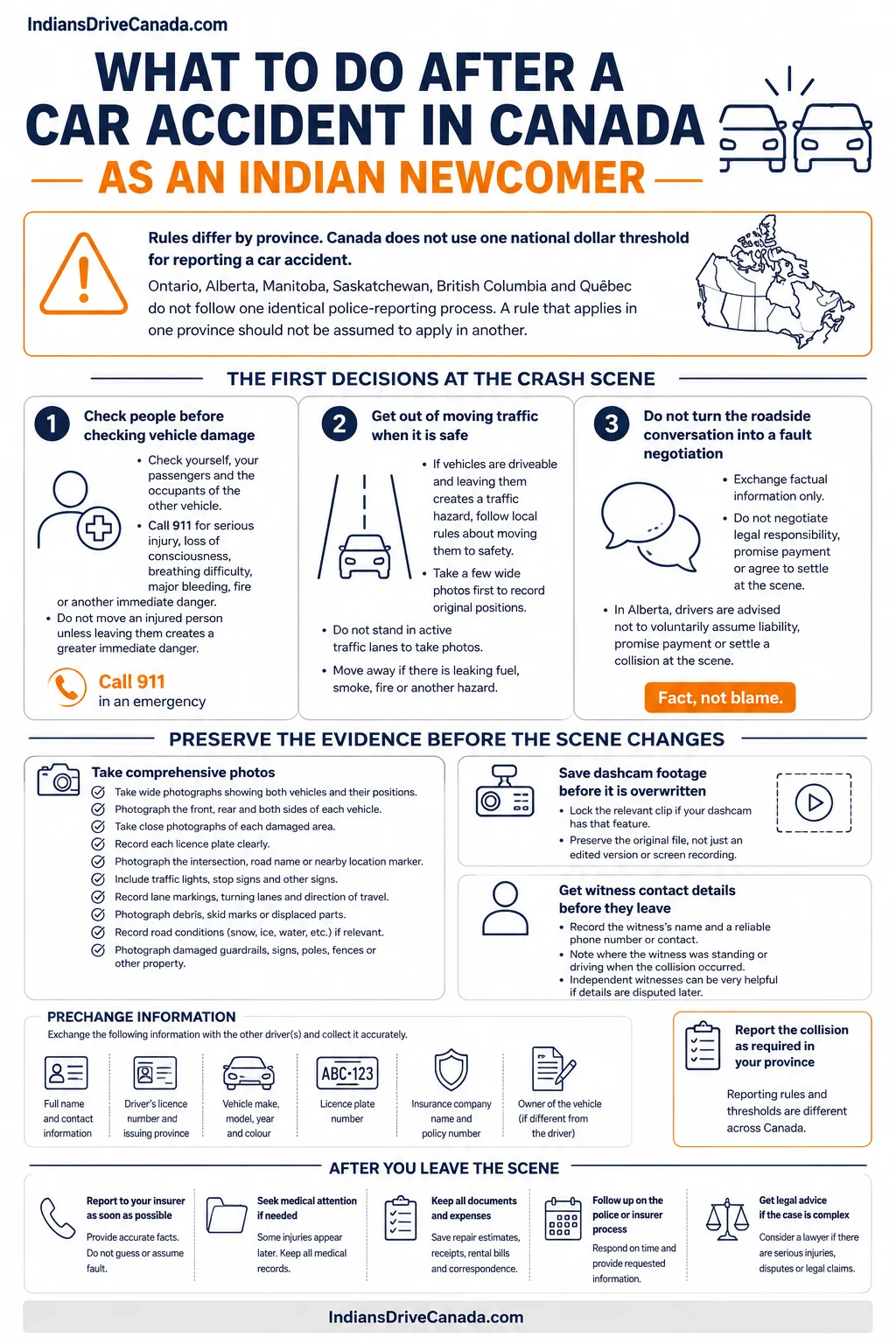
If anyone is injured, a vehicle is on fire, traffic is in immediate danger, or impaired driving or another crime is suspected, call 911. If there is no immediate emergency, move to a safe position, record the scene, exchange information and determine how the collision must be reported where it happened.
Canada does not use one national dollar threshold for reporting a car accident. Ontario, Alberta, Manitoba, Saskatchewan, British Columbia and Québec do not follow one identical police-reporting process. A rule that applies in one province should not be assumed to apply in another.
For an Indian newcomer, there can be another layer to sort out after the crash: which licence was being used, whether the foreign licence was still valid for that driver’s situation, who owns the vehicle, whose insurance covers it and whether the vehicle was personal, borrowed, rented or being used for delivery or rideshare work.
The first decisions at the crash scene
Check people before checking vehicle damage
Check yourself, your passengers and the occupants of the other vehicle. Call 911 for a serious injury, loss of consciousness, breathing difficulty, major bleeding, fire or another immediate danger. Do not move an injured person simply to clear the scene unless leaving them where they are creates a greater immediate danger.
A person may feel normal immediately after a collision and develop pain or other symptoms later. Do not make a medical conclusion at the roadside simply because there is no obvious injury.
Get out of moving traffic when it is safe to do so
If the vehicles are driveable, nobody is seriously injured and leaving them where they stopped creates a traffic hazard, follow the local police or road-authority rules about moving them to safety. When possible, take a few wide photographs first so the original vehicle positions are recorded.
Do not remain between damaged vehicles or stand in an active traffic lane to take photographs. If there is leaking fuel, smoke, fire, damaged electrical infrastructure or another immediate hazard, move away from it.
Do not turn the roadside conversation into a fault negotiation
Exchange factual information and describe what happened accurately when police, an insurer or a claims representative asks. There is no need to negotiate legal responsibility with the other driver at the scene, promise to pay their repair bill or agree that the matter will never be reported.
In Alberta, the provincial collision guidance specifically advises drivers not to voluntarily assume liability, promise payment or settle a collision at the scene.[Roadside liability]
Preserve the evidence before the scene changes
Once vehicles are moved, debris is cleared and traffic resumes, some useful evidence disappears. Photographs should show more than a close-up of a damaged bumper.
- Take wide photographs showing both vehicles and their positions.
- Photograph the front, rear and both sides of each involved vehicle where it is safe.
- Take close photographs of each damaged area.
- Record each licence plate clearly.
- Photograph the intersection, road name or nearby location marker.
- Include traffic lights, stop signs and other signs that may relate to the collision.
- Record lane markings, turning lanes and the direction each vehicle was travelling.
- Photograph debris, skid marks or displaced vehicle parts before they are removed.
- Record snow, ice, standing water or another road-surface condition if it affected the scene.
- Photograph damaged guardrails, signs, poles, fences or other property.
Save dashcam footage before loop recording overwrites it
If the vehicle has a dashcam, protect the original recording as soon as it is safe. Lock the relevant clip if the camera supports that feature, then preserve the original file rather than keeping only an edited version or a screen recording.
SGI specifically identifies dashcam footage as information that may help with a Saskatchewan collision claim.[Dashcam evidence]
Get witness contact details before witnesses leave
An independent witness may be useful if the drivers later disagree about the light, lane, direction of travel or sequence of events. Record the witness’s name and a reliable phone number or other contact method. If possible, note where the witness was standing or driving when the collision occurred.
A passenger in one of the involved vehicles can still provide information, but identifying an independent witness separately can make the evidence easier to assess.
Exchange enough information to open a claim
A phone number alone is not enough. Record the driver, vehicle and insurance details while both parties are still present.
| Category | What to record |
|---|---|
| Driver | Full name, driver’s licence details and contact information. |
| Vehicle | Licence plate, plate province, make, model and identifying details. |
| Insurance | Insurer, policy number and policyholder information shown on the insurance documents. |
| Collision | Date, exact time, location and direction of travel. |
| Witnesses | Name and contact information for anyone who independently saw the collision. |
Do not assume the driver, registered owner and insurance policyholder are always the same person. This matters when someone is driving a spouse’s car, a friend’s vehicle, an employer vehicle or a rental.
If another driver refuses to provide information, leaves the scene or cannot be identified, record as much as possible without creating a confrontation and contact police according to the rules where the collision occurred.
Police reporting depends on the province
The amount of damage is only one possible reporting trigger. Injuries, suspected impairment, a hit-and-run, an undriveable vehicle, damaged public property or an out-of-province vehicle can change the requirement in some provinces.
| Province | Police or collision-reporting point | Where the vehicle claim normally starts |
|---|---|---|
| Ontario | Ontario reporting requirements include injury, combined vehicle/property damage over $5,000, or damage to private, municipal or highway property. Local police services determine how their Collision Reporting Centre process operates.[Ontario reporting] | The driver’s automobile insurer. |
| Alberta | Reportable situations include serious injury, suspected Criminal Code offences, missing required driver information, a vehicle that cannot be driven and combined property damage of $5,000 or more. Damage to public traffic-safety devices or other public property must also be reported.[Alberta reporting] | The driver’s automobile insurer. |
| British Columbia | Do not rely on an Ontario or Alberta dollar threshold. Use police for emergencies, suspected offences and situations where police attendance or reporting is required locally; the collision claim itself is reported to ICBC. | ICBC, online or by phone depending on the claim.[B.C. claim] |
| Manitoba | A straightforward fender-bender does not automatically require a police report. Police reporting is required for specified situations including a fatality, hospitalization from an injury, an unlicensed driver, an unregistered vehicle, a hit-and-run or unidentified vehicle, failure to obtain the other driver’s particulars, or suspected alcohol or drug impairment. MPI states these police-reportable situations should be reported within seven days.[Manitoba reporting] | Manitoba Public Insurance. |
| Saskatchewan | SGI lists circumstances requiring police reporting that include death, suspected impairment, a vehicle that is not roadworthy and requires towing, an unlicensed vehicle and a collision involving an out-of-province plate.[Saskatchewan reporting] | SGI. |
| Québec | The insurance route is split by the type of loss. Bodily injury arising from automobile use is handled through Québec’s public SAAQ system, while vehicle and other property damage is handled through private automobile insurance.[Québec claim system] | Private insurer for property damage; SAAQ for bodily injury. |
A Collision Reporting Centre is not the same thing as police attending the crash scene. In places that use reporting centres, police may direct a non-emergency collision there instead of sending an officer to the roadside. Follow the instructions of the police service responsible for the location where the collision occurred.
The table is deliberately not a single Canada-wide threshold chart. If the collision happened in another province or territory, check the local police and provincial insurer or regulator instructions rather than borrowing a rule from Ontario, Alberta or another jurisdiction.
Alberta’s online collision report is limited to eligible cases
Alberta’s Report My Collision service does not replace every in-person report. The online service requires an Alberta driver’s licence, an Alberta.ca account, an eligible passenger-vehicle collision that happened in Alberta and other eligibility conditions. Commercial vehicles are excluded, and two-vehicle online reporting is currently limited to Calgary.[Online reporting]
Your Indian licence status can matter after the crash
A collision does not create a special licence rule for Indian newcomers, but the licence that was being used can become part of the claim and reporting record.
Be ready to identify exactly what you were driving on:
If you were still using an Indian licence, check whether you were legally entitled to use a foreign licence in that province on the date of the accident. Do not assume that the expiry date printed on the Indian card alone answers that question. New-resident, visitor, student and temporary-worker rules can differ by province.
Give the insurer the licence information that actually applied on the accident date. Do not substitute a different licence number, hide the fact that an Indian licence was being used or describe yourself as holding a Canadian licence that had not yet been issued.
Licence validity and insurance coverage are also separate questions. A driver can have a licence issue, a policy issue or both. The insurer may need to know who owned the vehicle, whether the driver had permission to use it and how the driver was listed or covered under the policy.
Do not change the facts to make a claim look simpler. Give the insurer the actual driver’s licence, vehicle-owner and use information. A claim can become more difficult if the information supplied later conflicts with the police report, photographs, policy records or licensing records.
Open the insurance claim with the right information
Police reporting and the insurance claim are separate tasks. Completing one does not automatically complete the other.
Before contacting the insurer, ICBC, MPI or SGI, gather what is already available:
- Insurance policy number.
- Your driver’s licence details.
- Vehicle registration information.
- Date, time and exact location of the collision.
- Other driver’s information.
- Other vehicle’s plate and insurance information.
- Police or Collision Reporting Centre file number, if one exists.
- Photographs and dashcam footage.
- Witness contact details.
- Where the vehicle was towed, if applicable.
- Whether the vehicle can still be driven safely.
- Any known injuries.
- Whether the vehicle is rented, borrowed, leased, financed or used for commercial app-based driving.
Questions worth asking during the first claim call
In British Columbia, ICBC asks for collision details and then uses the available information to assess responsibility and manage the repair claim.[Claim assessment]
A police finding and an insurance responsibility decision are not the same thing
A police officer may investigate traffic offences, impaired driving, dangerous conduct or another legal issue. An insurer separately decides how the policy responds to the claim and how responsibility is assessed under the applicable insurance rules.
Alberta’s provincial guidance expressly states that police do not determine insurance liability and that receiving a traffic charge does not necessarily mean the driver will be considered liable for the insurance claim.[Responsibility decision]
Three events should not be treated as interchangeable:
Give a factual account and preserve the evidence rather than trying to settle the responsibility question at the roadside.
If anyone is injured, the claim has another process to follow
Vehicle repairs and bodily injury do not always run through the same system. This is especially visible in Québec, but provincial accident-benefit rules also differ elsewhere.
Ontario accident benefits changed on July 1, 2026
Do not assume that every Ontario accident benefit is automatically included in the same way as before July 1, 2026. Ontario changed its standard accident-benefit structure on that date. Medical, rehabilitation and attendant-care benefits remain mandatory, while several other benefits, including income replacement, are optional coverage. The actual policy should be checked before assuming a particular benefit is available.[Ontario benefits]
This matters to a newcomer who may have bought a policy without knowing which optional benefits were selected. The declarations page, policy documents or insurer can show what was actually purchased.
British Columbia has a different injury-treatment process
Under ICBC’s Enhanced Care system, eligible people can access certain pre-approved treatments during the first 12 weeks after a crash after opening an injury claim. ICBC also advises keeping receipts for eligible out-of-pocket expenses.[B.C. treatment]
Québec uses SAAQ for automobile bodily injury
A newcomer injured in a Québec automobile accident should not assume that the private vehicle-damage claim handles the bodily injury claim as well. SAAQ has a separate process for tourists and newcomers, and eligibility or compensation can depend on the person’s circumstances and how the accident occurred.[Newcomer injury claim]
Record symptoms that appear later
Neck stiffness, headache, back pain, bruising, dizziness, numbness or restricted movement may not be obvious at the scene. If symptoms develop, seek appropriate medical care rather than trying to diagnose the problem yourself.
Record when the symptoms began, tell the healthcare provider that they followed a motor-vehicle collision and keep treatment records and relevant receipts. If an injury claim has already been opened, follow the insurer or provincial claims body’s instructions for submitting the documents.
Do not let towing or repairs create a second problem
A badly damaged vehicle may need to be removed quickly, but towing the vehicle does not mean a repair shop should automatically begin every repair.
Ontario gives drivers specific towing rights
Ontario’s towing rules require consumer consent in many non-police-initiated situations and give drivers rights relating to the tow operator, destination, rates, consent form and invoice. Restricted Tow Zones and certain police or authorized-official directions can change the normal choice of tow provider.[Towing rights]
Do not sign a blank towing, storage or repair form. Read the destination and charges before signing. Keep your copy of the consent form and the itemized invoice.
Consent to tow a vehicle should not be treated as automatic permission for a body shop to carry out unrelated repairs. Ask the insurer what inspection, estimate or authorization is needed first.
Ask before authorizing repairs
If the vehicle can wait safely, contact the insurer before approving non-emergency repairs. The insurer may need photographs, an appraisal or an inspection before work begins.
This is particularly important when the collision occurs outside the province where the vehicle is insured. MPI, for example, tells Manitoba policyholders travelling outside Manitoba to obtain pre-authorization before having collision repairs performed and to keep related bills and receipts.[Repair authorization]
When the vehicle is not actually yours
Rental vehicle
Notify the rental company through the accident procedure in the rental agreement and contact the relevant insurer or coverage provider. Do not assume a credit card benefit, personal auto policy or rental-company protection automatically pays every loss. Each has its own terms and exclusions.
Keep the rental agreement, damage report, towing records and all correspondence. Do not authorize major repairs to a rental vehicle without the rental company’s instructions.
Borrowed vehicle
Tell the registered owner promptly. Record the owner’s insurance information and make it clear to the claims representative who was driving at the time.
The owner, driver and policyholder may be different people. Avoid guessing which policy ultimately responds; provide the facts so the insurers involved can determine coverage under the applicable policies.
Leased or financed vehicle
Open the insurance claim normally, but check whether the lease or financing agreement imposes repair, body-shop or total-loss requirements. A lender or leasing company may have an interest in a total-loss settlement.
Rideshare or delivery vehicle
If the vehicle was being used for Uber, another rideshare platform or delivery work, preserve the app status at the time of the collision. A screenshot showing whether the app was offline, waiting for a request, travelling to a pickup or actively completing a trip can help establish which coverage arrangement may apply.
Tell the personal insurer and platform insurer the actual use of the vehicle. Do not describe a commercial trip as personal driving to avoid a coverage question.
Hit-and-run, uninsured drivers and roadside cash offers
If the other vehicle leaves
Do not chase a fleeing vehicle or create a second collision. Record whatever can be observed safely:
- Full or partial licence plate.
- Vehicle make, model and colour.
- Direction of travel.
- Visible damage on the fleeing vehicle.
- Driver description if it was visible without putting anyone at risk.
- Witness contact details.
- Dashcam recording.
- Nearby businesses, homes or public locations that may have cameras.
Report the incident to police when required and tell the insurer that the other vehicle was unidentified. Do not wait for the other driver to contact you before opening the claim.
If the other driver appears to have no insurance
Still collect the driver’s identity, vehicle details and plate information. Do not decide at the roadside that there is no possible insurance response simply because the other driver cannot produce an insurance card.
Contact your own insurer and explain exactly what was provided or missing. Provincial uninsured-vehicle protections and policy coverage differ, so the available recovery route has to be determined under the policy and the province where the claim is handled.
If someone offers cash to keep insurance out of it
A small-looking bumper mark can involve brackets, sensors, cameras, paint work or hidden structural damage. Physical symptoms can also appear later. A roadside amount may therefore have little connection to the eventual loss.
A private payment offer does not cancel a legal police-reporting requirement. It also does not preserve evidence that may be needed later.
Document the collision first, satisfy any reporting requirement and avoid signing an improvised release or making a payment promise before knowing the actual damage and insurance position.
The next 24 hours after the collision
Once everyone is safe and the roadside issues are finished, the remaining tasks should create a clean record rather than more versions of the event.
- Complete any required police or Collision Reporting Centre report.
- Open the insurance, ICBC, MPI or SGI claim promptly.
- Write down the claim number and the name or contact details of the person handling it.
- Back up photographs and the original dashcam file.
- Keep the police or collision-report file number.
- Save towing, storage, transportation and medical receipts.
- Record symptoms that appear after leaving the scene.
- Tell the insurer where the vehicle is located if it was towed.
- Ask whether inspection or repair authorization is required before work begins.
- Keep copies of forms and documents submitted to the insurer.
- Correct any factual error in a report or claim record through the proper reporting or claims process rather than creating a conflicting second version.
Keep one accident folder. Store the police or reporting-centre record, claim number, photographs, dashcam file, witness details, towing invoice, repair documents and injury records together. This makes it easier to answer later questions without relying on memory.