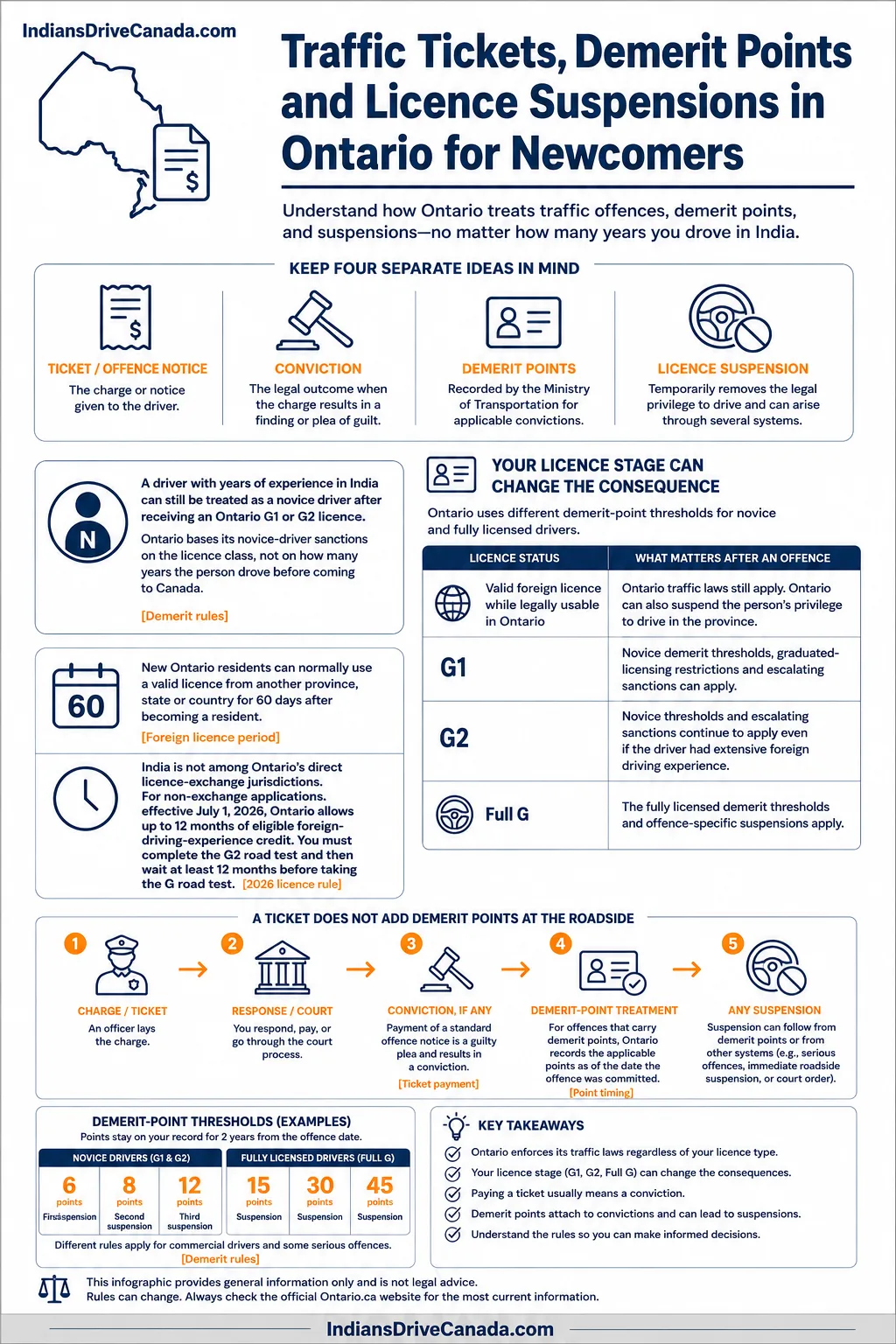
An Ontario traffic ticket can lead to a fine, a conviction, demerit points, a licence suspension, or several of these outcomes together. They are not the same thing. For a newcomer, the result can also change depending on whether the driver held a G1, G2, full G licence, or was still legally driving with a foreign licence when the incident occurred.
A driver with years of experience in India can still be treated as a novice driver after receiving an Ontario G1 or G2 licence. Ontario bases its novice-driver sanctions on the licence class, not on how many years the person drove before coming to Canada.[Demerit rules]
Keep four separate ideas in mind:
Your licence stage can change the consequence
Ontario uses different demerit-point thresholds for novice and fully licensed drivers. A G1 or G2 holder is a novice driver. A full Class G holder uses the fully licensed driver thresholds.
| Licence status | What matters after an offence |
|---|---|
| Valid foreign licence while legally usable in Ontario | Ontario traffic laws still apply. Ontario can also suspend the person’s privilege to drive in the province. |
| G1 | Novice demerit thresholds, graduated-licensing restrictions and escalating sanctions can apply. |
| G2 | Novice thresholds and escalating sanctions continue to apply even if the driver had extensive foreign driving experience. |
| Full G | The fully licensed demerit thresholds and offence-specific suspensions apply. |
A new Ontario resident may normally use a valid licence from another province, state or country for 60 days after becoming a resident.[Foreign licence period] That 60-day rule should not be confused with protection from Ontario enforcement. A traffic offence committed while using an Indian licence can still have Ontario consequences.
Why G2 status now deserves extra attention for drivers arriving from India: India is not among Ontario’s listed direct licence-exchange jurisdictions. For applications from non-exchange jurisdictions made under the rules effective July 1, 2026, Ontario allows up to 12 months of eligible foreign-driving-experience credit. The applicant must complete the G2 road test and then wait at least 12 months before attempting the G road test.[2026 licence rule] A driver may therefore remain subject to G2 novice sanctions for a full year even after many years of driving outside Canada.
A ticket does not add demerit points at the roadside
An officer does not normally hand a driver “three points” or “four points.” The officer lays the charge. Demerit points are connected to the resulting conviction for an offence listed in Ontario’s demerit system.
Paying a standard offence notice is not simply paying an administrative bill. Ontario describes payment as voluntarily pleading guilty. Once payment is accepted, the charge results in a conviction.[Ticket payment]
For offences that carry demerit points, Ontario records the applicable points as of the date the offence was committed. Demerit points remain on the record for two years from the offence date.[Point timing]
A useful sequence is:
Charge or ticket → response or court process → conviction, if any → demerit-point treatment → any separate novice, roadside or court suspension.
Not every case reaches every stage. Some offences can trigger an immediate roadside suspension before the court case is resolved.
Point values for offences drivers commonly encounter
The point number depends on the offence of conviction. The table below focuses on offences that are useful for understanding the thresholds rather than reproducing every offence in Ontario’s regulations.
| Points | Examples | What to watch for |
|---|---|---|
| 2 | Improper right or left turn, failing to signal, driver seat-belt offence | These points can still move a G1 or G2 driver into a novice warning range. |
| 3 | Speeding 16–29 km/h over, failing to yield, failing to obey a stop sign or traffic signal | Accumulated points matter even when a single offence does not trigger novice escalating sanctions. |
| 4 | Speeding 30–49 km/h over where a higher stunt-driving rule does not apply, following too closely, failing to stop at a pedestrian crossover | For G1/G2 drivers, an offence associated with four or more points can enter the novice escalating-sanction system. |
| 6 | Careless driving, racing or stunt driving, failing to stop for a school bus, certain excessive-speed offences | These offences can involve consequences beyond the normal accumulated-point system. |
| 7 | Failing to remain at a collision scene, failing to stop when directed by police | This is the highest point value in Ontario’s standard demerit table. |
Ontario’s published demerit list supports these point values.[Point values]
G1 and G2 drivers can be suspended before reaching nine accumulated points
Nine points is not the only suspension threshold for a G1 or G2 driver. Ontario also has a separate Novice Driver Escalating Sanctions system for certain convictions.
The ordinary accumulated-point thresholds for novice drivers are:
| Accumulated points | G1 or G2 | Full G |
|---|---|---|
| 2–5 | Warning letter | No equivalent warning threshold at this level |
| 6–8 | Second warning; ministry action may apply under the demerit system | Warning letter |
| 9–14 | At 9 or more, first accumulated-point suspension is 60 days | Second warning |
| 15+ | Already above the novice suspension threshold | First accumulated-point suspension is 30 days |
After a demerit-point suspension, Ontario reduces the recorded total rather than automatically returning it to zero: to four points for a novice driver and seven points for a fully licensed driver. Reaching the applicable suspension threshold again can result in a six-month suspension.[Suspension thresholds]
The separate novice escalating-sanction route
A G1 or G2 driver can also face escalating sanctions for qualifying convictions. These include a breach of graduated-licensing conditions and Highway Traffic Act offences associated with four or more demerit points, regardless of whether those points are actually recorded for the novice driver.[Novice sanctions]
After a third qualifying conviction, the driver must reapply and restart the graduated licensing process. Ontario also states that credited time and time discounts previously earned can be lost.
A four-point offence does not always mean “four points plus a 30-day novice suspension.” The MTO Driver’s Handbook states that when a novice driver receives a Novice Driver Escalating Sanction for a qualifying four-or-more-point offence, the demerit points are recorded as zero and do not count toward the accumulated demerit-point system.[Novice point treatment] The suspension can therefore matter even when the point total does not rise.
Distracted driving shows why zero points can still mean a suspension
Distracted-driving penalties make the difference between full G and novice licensing especially clear.
| Driver | First conviction | Further novice consequences |
|---|---|---|
| Full G | 3 demerit points and a 3-day suspension, in addition to the applicable fine | Later convictions carry higher point and suspension consequences |
| G1 or G2 | No demerit points; 30-day suspension | Second conviction: 90 days. Third: licence cancellation and removal from graduated licensing |
These are offence-specific distracted-driving penalties, not the same thing as waiting for the driver to accumulate nine or 15 points.[Distracted driving]
Speeding can become stunt driving before 50 km/h over
The ordinary speeding point scale can be misleading if the posted limit is below 80 km/h. Ontario defines certain excessive speeds as stunt driving.
| Posted speed limit | Stunt-driving speed threshold |
|---|---|
| Less than 80 km/h | 40 km/h or more over the posted limit |
| 80 km/h or higher | 50 km/h or more over the posted limit |
| Any Ontario road | Driving at 150 km/h or more can be treated as stunt driving |
Ontario’s stunt-driving regulation and provincial speeding information set these thresholds.[Stunt threshold]
For example, driving at 92 km/h in a 50 km/h zone is 42 km/h over the limit. Looking only at a generic “30–49 over” speeding row would miss the lower-road stunt threshold.
A stunt charge can affect the licence immediately
A driver involved in alleged stunt driving or street racing can receive an immediate 30-day driver’s licence suspension and a 14-day vehicle impoundment at the roadside, whether or not the driver owns the vehicle. A conviction can then bring separate consequences, including six demerit points, a substantial fine, a post-conviction licence suspension and a mandatory driver improvement course.[Stunt penalties]
There is also a 2026 demerit-rule detail for stunt driving. Ontario’s demerit regulation generally prevents points from being recorded when the court’s penalty includes a licence suspension, but it expressly excludes offences under Highway Traffic Act sections 78, 78.1 and 172 from that general rule. Section 172 covers racing and stunt driving. The section 172 exception appears in the regulation from January 1, 2026.[2026 stunt rule]
Roadside suspension and demerit suspension are different systems
A demerit suspension happens after accumulated points reach the applicable threshold. A roadside suspension can take effect immediately under legislation dealing with particular conduct. Stunt driving is one example.
This distinction matters when reading a ticket or suspension notice. A driver may have a roadside suspension even though no court conviction has yet been entered, and a later conviction may create additional consequences. The end date of one suspension should not be assumed to resolve every other licensing requirement connected with the case.
Read the document before choosing what to do with the ticket
Not every document handed to a driver follows the same process.
| Document | What it means for the next step |
|---|---|
| Offence notice | Depending on what the notice offers, options can include paying, pleading guilty with an explanation, requesting early resolution, or requesting a trial. |
| Summons | The driver or representative must attend court at the time and place stated on the summons. |
| Penalty notice | Processed through an administrative penalties system rather than the normal Provincial Offences Act court process. Follow the instructions from the municipality or issuing entity. |
Ontario’s traffic-ticket service describes these routes and states that paying an offence notice is a voluntary guilty plea.[Ticket options]
The 15-day response period matters
For a standard offence notice, Ontario’s process uses a 15-day period for requesting options such as early resolution or a trial. If the driver does not respond within the period on the notice, the case may proceed without the driver and a conviction may be entered in their absence, with further costs possible.
The safest approach is to read the actual offence notice rather than relying on a general deadline remembered from another ticket.
Disclosure can show what the prosecution has
A person charged with a provincial offence is entitled, free of charge, to relevant information in the prosecutor’s possession or control. This is called disclosure. It can include police notes, witness statements, diagrams or photographs. The defendant must request it.[Case disclosure]
Language interpretation can also be requested through the court process. When a summons, possible suspension or disputed charge has serious consequences, legal advice from an Ontario lawyer or licensed paralegal may be appropriate. There is no single response option that is automatically best for every ticket.
Moving after receiving a ticket requires a separate court address update
Updating a driver’s licence address through ServiceOntario does not update an outstanding Provincial Offences Court file.
A person with an outstanding provincial offence matter must make sure the court has the current address. Ontario states that court dates, fine information and payment notices can be affected, and enforcement can still proceed if the court does not have the current address.[Court address]
This creates two separate address tasks after a move: update the driver’s licence or vehicle information as required, and contact the Provincial Offences Court handling the outstanding matter.
An Indian licence is not a backup licence during an Ontario suspension
If Ontario has suspended the driver’s licence or the person’s privilege to drive in Ontario, a valid Indian licence cannot be used to continue driving in Ontario.
The Highway Traffic Act states that a person whose driver’s licence or privilege to drive a motor vehicle in Ontario has been suspended must not drive in Ontario. Ontario’s legislation also provides for suspension of the Ontario driving privilege when the person holds a licence issued by another jurisdiction.[Suspension rule]
The fact that an Indian licence has not reached its printed expiry date does not override an Ontario suspension.
Unpaid fines and reinstatement requirements can keep a driver off the road
Ontario distinguishes defaulted driver fines from vehicle-related fines. A defaulted driver fine is an unpaid moving-violation fine, such as one arising from speeding or careless driving. Defaulted driver fines must be paid before certain licensing transactions can be completed.
More importantly, paying the fine or a licence reinstatement fee does not by itself guarantee that the person is eligible to drive. Ontario expressly warns that other outstanding licensing requirements may remain.[Reinstatement]
Before driving after a suspension
- Confirm that the suspension period has actually ended.
- Confirm that the licence or Ontario driving privilege is valid.
- Check whether any defaulted driver fines remain unpaid.
- Complete any applicable reinstatement fee or licensing requirement.
- Check for any separate court or Ministry of Transportation requirement connected with the suspension.
- Make sure the vehicle is properly insured before driving.
Driving while suspended creates a new offence
Driving during a suspension is not simply an extension of the original ticket. Under the current Highway Traffic Act provision for ordinary driving while suspended, a first conviction carries a fine of $1,000 to $5,000 and can also result in imprisonment for up to six months, or both. A conviction under that provision also produces an additional six-month licence suspension, served consecutively to other applicable suspension time.[Suspended driving]
Ontario has enacted higher section 53 fine ranges, including a future $2,000–$10,000 range for a first ordinary driving-while-suspended offence. The current consolidated Highway Traffic Act marks that amendment as not yet in force and says it will take effect on a day named by order.[Pending penalty change] The future amounts should not be treated as the present fine range until the provision is brought into force.
Two years of demerit points does not mean the whole record disappears
Demerit points remain for two years from the offence date, but that two-year period should not be treated as the lifespan of every record connected with the conviction.
Ontario’s common three-year driver record includes the current demerit-point total as well as active fine suspensions and Highway Traffic Act or Criminal Code convictions, suspensions and reinstatements for the past three years.[Driver record]
Demerit-point period ≠ conviction-record period. A point balance can change or expire while information about the conviction or suspension remains available on an Ontario driver record for a different period.
Insurance does not use a fixed price per demerit point
There is no useful Ontario calculation such as “each demerit point raises insurance by a fixed percentage.” The Financial Services Regulatory Authority of Ontario says insurers build a driver’s insurance profile using several factors. The driving-record factors it identifies include previous accidents, how long the person has held a licence, driver training, speeding tickets and driving convictions.[Insurance rating]
The underlying conviction can therefore matter to an insurer even when focusing only on the driver’s current demerit-point total would suggest otherwise. The actual premium effect can differ by insurer and by the driver’s wider rating profile.
How the same situation changes with licence status
G2 driver: 20 km/h over the speed limit
Speeding 16–29 km/h over is associated with three demerit points. It is below the four-or-more-point threshold that triggers novice escalating sanctions on that basis alone. The points can still contribute to the G2 driver’s accumulated novice total.
G2 driver: 35 km/h over the speed limit
Ordinary speeding 30–49 km/h over is associated with four points. For a G2 driver, that places the conviction within the novice escalating-sanction rules. On a first qualifying conviction, the novice suspension is 30 days. The MTO handbook states that the points are recorded as zero when the Novice Driver Escalating Sanction applies, so the case should not be analysed simply as “four new accumulated points.”
G2 driver: first distracted-driving conviction
The driver receives no demerit points for the distracted-driving conviction but faces a 30-day novice suspension. Zero points does not mean zero licence consequence.
Full G driver with 12 accumulated points: new four-point conviction
If four points are recorded and the total rises from 12 to 16, the driver crosses the 15-point fully licensed threshold. The first accumulated-point suspension at that level is 30 days.
Driver at 92 km/h in a 50 km/h zone
The driver is 42 km/h over the posted limit. Because the posted limit is below 80 km/h, 40 km/h or more over can meet Ontario’s stunt-driving speed definition. The roadside stunt-driving consequences must be considered rather than treating the situation only as ordinary 30–49 km/h-over speeding.
Driver under an Ontario suspension with a still-valid Indian licence
The Indian licence does not restore the right to drive in Ontario. Driving during the Ontario suspension can create a separate driving-while-suspended offence and additional suspension time.