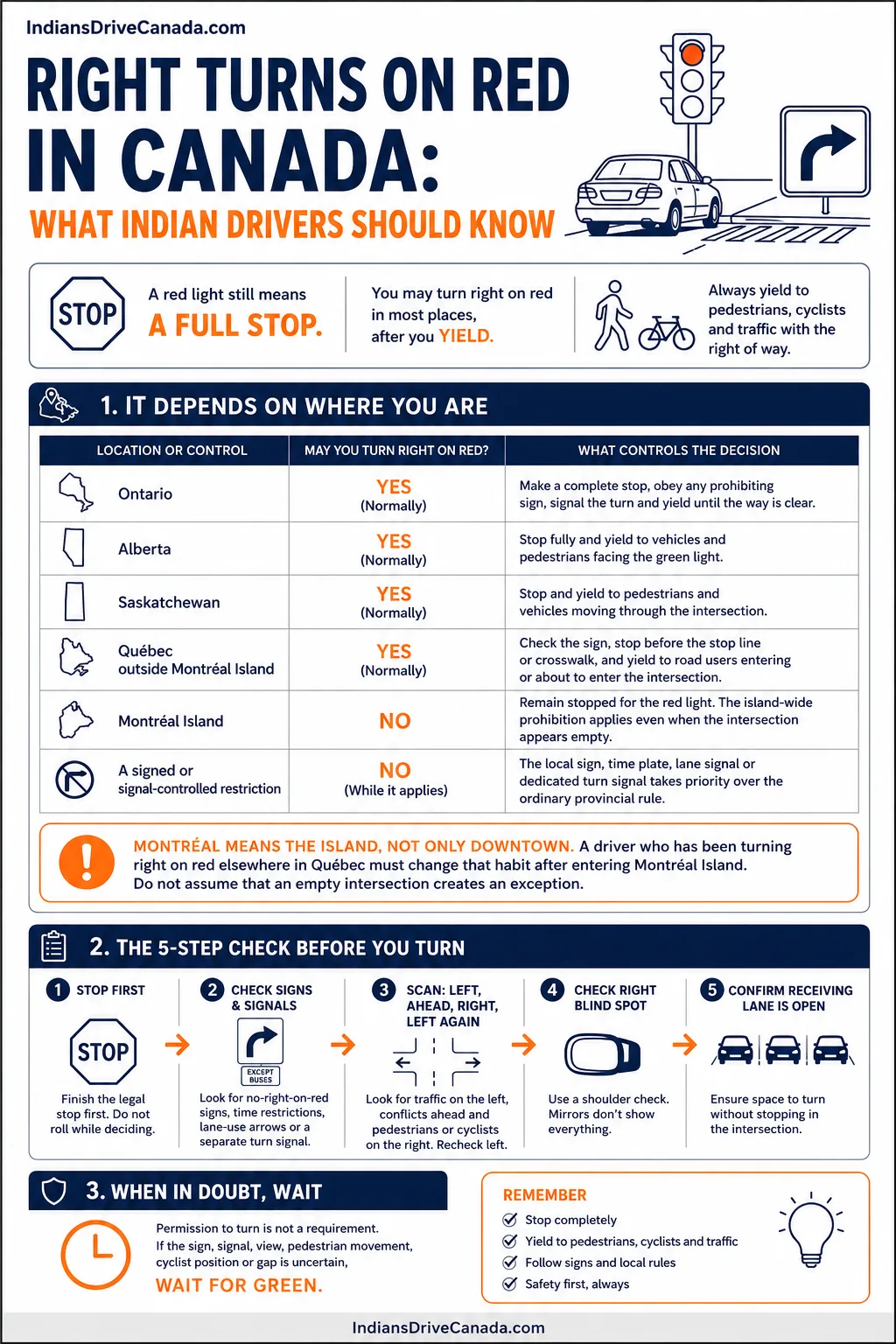
A red light still means a full stop. In Ontario, Alberta and Saskatchewan, a driver may normally turn right after stopping when no sign prohibits the movement, but only after yielding to pedestrians, cyclists and traffic that has the right of way. [Ontario rule] [Alberta rule] [Saskatchewan rule]
Québec has a location-based exception: right turns on red are not allowed on the island of Montréal. Outside Montréal Island, Québec normally permits the manoeuvre unless a sign prohibits it. [Montréal exception]
The permission to turn is not a requirement to turn. Waiting for green is the correct choice whenever the sign, signal, view, pedestrian movement, cyclist position or available gap is uncertain.
The rule you apply before the wheels move
Canada does not use one single road-rule manual for every province and territory. The words, signs and road-test standards can vary by jurisdiction. The ordinary decision at a solid red light, however, follows a familiar pattern in several provincial handbooks: stop, read the intersection, yield, and move only when the complete turn can be made safely.
| Location or control | May the driver turn? | What controls the decision |
|---|---|---|
| Ontario | Normally yes | Make a complete stop, obey any prohibiting sign, signal the turn and yield until the way is clear. |
| Alberta | Normally yes | Stop fully and yield to vehicles and pedestrians facing the green light. |
| Saskatchewan | Normally yes | Stop and yield to pedestrians and vehicles moving through the intersection. |
| Québec outside Montréal Island | Normally yes | Check the sign, stop before the stop line or crosswalk, and yield to road users entering or about to enter the intersection. |
| Montréal Island | No | Remain stopped for the red light. The island-wide prohibition applies even when the intersection appears empty. |
| A signed or signal-controlled restriction | No, while the restriction applies | The local sign, time plate, lane signal or dedicated turn signal takes priority over the ordinary provincial rule. |
Montréal means the island, not only downtown. A driver who has been turning right on red elsewhere in Québec must change that habit after entering Montréal Island. Do not assume that an empty intersection creates an exception.
Resetting the scan after driving in India
A driver accustomed to left-side traffic in India already knows how to judge gaps and watch several road users at once. In Canada, those skills must be applied to a reversed traffic flow. The most common moving-vehicle threat during a right turn usually approaches from the left, while pedestrians, cyclists and other curbside users may appear on the right.
Looking left for a safe traffic gap is only one part of the decision. A driver can find a clear gap on the left and still turn across a person walking from the right, a cyclist travelling beside the vehicle, or a rider approaching in a bike lane.
1. Stop before searching for a gap
Finish the legal stop first. Do not combine braking, scanning and turning into one rolling movement.
2. Read the sign and the signal controlling your lane
Check for a no-right-on-red sign, a time restriction, a lane-use arrow or a separate turn signal. Read any smaller plate attached below the main sign.
3. Scan left, ahead, right and back to the left
Look for cross traffic on the left, turning or blocked traffic ahead, and pedestrians or cyclists on the right. Recheck the left before moving because the gap may have changed while you examined the crosswalk.
4. Check the right blind spot
A mirror does not show every cyclist, scooter or small vehicle beside the car. Use a shoulder check before the vehicle begins to cross the curbside path.
5. Confirm the receiving lane is open
Do not enter if traffic is backed up beyond the corner or if the vehicle would stop inside the intersection or across the crosswalk.
The scan sequence is a practical memory aid, not a replacement for the provincial handbook. An unusual intersection may require extra checks, slower movement or waiting for green.
The complete stop is separate from the turn
A rolling right turn treats the red light as though it were a yield sign. That is not the ordinary rule. The vehicle must become fully stationary before the driver decides whether the permitted turn can be made.
Use the first legal stopping position
Where Québec permits a right turn on red, its published rule tells drivers to stop before the stop line or crosswalk. [Stop position] The same practical order should be applied when reading any provincial handbook:
- Stop before the marked stop line when one is present.
- If there is no stop line, keep the marked crosswalk clear.
- Do not place the front of the vehicle where it blocks a person using the crossing.
- Do not follow the vehicle ahead through the turn without making your own separate stop.
Limited visibility does not cancel the first stop
A parked van, snowbank, utility box or large vehicle may block the view of cross traffic. Make the required stop at the correct position first. If a clearer view cannot be obtained without entering a crosswalk or creating another conflict, remain stopped and wait for green.
Moving a little farther forward does not create a right to enter the intersection. The driver must still protect pedestrians, cyclists and traffic with priority. In winter, snowbanks can also hide a child, a shorter pedestrian or a cyclist until the vehicle has moved too far forward.
Pedestrians and cyclists may move while the car is stopped
A red light facing the driver does not mean every other road user has stopped. Cross traffic may have green, and a pedestrian signal may allow people to cross the street into which the driver wants to turn.
Ontario’s driver handbook tells a right-turning driver to wait for pedestrians who are in or approaching the vehicle’s path and to check the blind spot for cyclists approaching from behind, including cyclists in a bike lane, on a sidewalk or on a trail. [Pedestrian and cyclist rule]
The left-side gap can distract from the right-side conflict
The driver often turns their head left to judge vehicle speed and distance. During those seconds, a pedestrian can step from the right curb or a cyclist can move alongside the passenger side. Before releasing the brake, return attention to the crosswalk, the bike lane and the right blind spot.
Do not turn through an occupied crossing path
Wait when a person is in the part of the crossing that the vehicle will use. Also wait when someone is clearly entering or approaching the vehicle’s path under the applicable pedestrian signal or right-of-way rule. A pedestrian does not need to be directly in front of the bumper to be placed at risk by the turn.
Watch for the right-hook conflict
A right-hook conflict occurs when a turning vehicle crosses the path of a cyclist or rider continuing straight on the vehicle’s right side. The risk may be harder to judge when:
Use the second right-side check immediately before moving. A cross-traffic gap can remain open while the pedestrian or cyclist situation changes.
Signs and lane signals that change the ordinary rule
The traffic light is only one instruction at the intersection. A driver must also read regulatory signs, smaller time plates, lane arrows and any separate signal controlling the turn lane.
| What the driver sees | What it means for the turn |
|---|---|
| No right turn on red | Wait until the signal permits the turn. An empty road does not cancel the sign. |
| No right turn | The turn itself is prohibited under the conditions shown, not only while the light is red. |
| A smaller plate showing hours or days | Apply the restriction during the displayed period. Outside that period, continue to follow the ordinary light and right-of-way rules. |
| A dedicated turn signal | Follow the signal controlling the turn lane rather than assuming the ordinary solid-red rule applies. |
| Lane-use arrows or reserved-lane signs | Use only a lane from which the right turn is permitted and obey any restrictions applying to buses, bicycles or other reserved traffic. |
Québec states that a smaller sign may show the period during which a right turn on red is prohibited. [Timed restriction] Manitoba’s driver handbook also distinguishes a no-right-on-red sign from a no-right-turn sign and shows that a turn prohibition may apply during displayed hours. [Sign meanings]
French wording may appear on Québec signs
The symbol is usually the first clue, but a smaller plate can contain French text, days or hours. Read the whole assembly before deciding. Do not rely on the vehicle ahead; that driver may have misread the restriction or may be responding to a different lane signal.
Choose the lane before accepting the gap
A safe gap is not enough if the vehicle starts from the wrong lane or finishes the turn in the wrong lane. Prepare the lane position before reaching the stop line, unless road markings or signs direct another movement.
Approach from the proper right-turn lane
Signal in time, check the right blind spot and move toward the right side only when the lane is legal and clear. Do not cut across a bike lane, bus lane or reserved lane without first understanding the markings and local rule.
Finish in the first available driving lane
Saskatchewan’s turning guidance tells drivers to approach close to the right curb or road edge, search left, ahead, right and left again, and complete the right turn in the first available driving lane when no hazard remains. [Lane rule]
Do not swing directly into a farther lane merely because it appears empty. Complete the turn first, stabilize the vehicle, then make a separate lane change with a signal, mirror check and shoulder check when permitted.
Double right-turn lanes need lane discipline
Saskatchewan specifically states that a driver in the outside left lane of a double right-turn arrangement may turn right on red after stopping and yielding, while warning that this is not a common manoeuvre. [Double-turn rule]
Do not apply that example automatically in another province or at another intersection. Check the lane arrows, signals and provincial handbook. When two lanes turn together, stay within the path assigned to your lane and do not drift into the neighbouring vehicle’s space.
Turn or wait in these intersection situations
| Situation | Best decision | Reason |
|---|---|---|
| Clear suburban intersection, no restriction sign | Turn only after a full stop and final scan | The empty appearance does not remove the stop, signal or yielding duties. |
| Pedestrian countdown is active | Check the crossing and wait for anyone in or entering the path | The driver’s red light does not prove that pedestrian movement has ended. |
| Cyclist approaching on the right | Wait | The vehicle would cross the cyclist’s forward path. |
| Parked truck blocks the view to the left | Wait if a safe view cannot be obtained | Guessing the speed or distance of hidden traffic is not a safe gap assessment. |
| Snowbank hides the corner | Keep the crossing clear and wait when visibility remains poor | The snowbank may conceal both moving traffic and shorter road users. |
| Driving on Montréal Island | Wait for a permitted signal | The island-wide rule prohibits the red-light right turn. |
| Restriction sign applies only during listed hours | Read the displayed period before moving | The same intersection can have a different legal answer at a different time. |
| Traffic is backed up beyond the corner | Remain stopped | The vehicle should not enter unless it can complete the turn without blocking the intersection or crossing. |
| Driver behind sounds the horn | Use your own safe decision | The horn does not change the sign, signal, visibility or right of way. |
Road-test practice for this manoeuvre
Road-test scoring and terminology differ across provinces. The safe habits remain useful wherever the test occurs: signal, use the correct lane, make a full stop in the correct place, check the blind spot, yield and accept only a suitable gap.
Manitoba’s official Class 5 test preparation page lists signalling before turns, correct lane position, a complete stop at the correct location, shoulder checks and yielding to pedestrians and oncoming traffic among the skills a test candidate needs to perform. [Road-test skills]
- Signal before the corner: give other road users time to understand the intended movement.
- Show a real stop: allow the vehicle to settle rather than immediately releasing the brake.
- Move the head as well as the eyes: a clear shoulder check is needed for the right blind spot.
- Do not force a small gap: legal permission to turn does not make an unsafe opening acceptable.
- Stay in the proper lane: avoid a wide turn followed by an unplanned lane change.
- Rescan after a delay: if the light changes or the vehicle remains stopped for several seconds, rebuild the picture before moving.
Do not assume a test examiner expects every permitted right turn on red. If visibility is blocked or another road user has priority, waiting can be the correct response. Follow the handbook and test instructions for the province where the test is booked.
Driving habits that need a Canadian replacement
The safest adjustment is not to discard previous driving experience. It is to replace automatic actions that no longer match the traffic direction, lane position or signal practice at the Canadian intersection.
| Habit | Replacement action |
|---|---|
| Slowing without fully stopping | Make a separate full stop, then begin the gap decision. |
| Following the vehicle ahead through the turn | Stop again and make an independent scan. |
| Watching only traffic from the left | Return attention to the right crosswalk, bike lane and blind spot before moving. |
| Turning directly into a farther lane | Enter the first lawful lane and change lanes later as a separate action. |
| Moving because the driver behind is impatient | Wait until your own view and right-of-way checks support the turn. |
| Moving immediately when the light turns green | Check again for a late pedestrian, cyclist or vehicle before accelerating. |
| Assuming Québec has one rule everywhere | Separate Montréal Island from the rest of Québec and still read local signs. |
A driver-seat decision card
Use the following order while practising with a qualified supervising driver or instructor. It is short enough to remember without looking at a phone while driving.
- STOP: Is the vehicle fully stationary at the correct position?
- SIGN: Does a sign, time plate or turn signal prohibit or control the movement?
- LEFT: Is cross traffic approaching too close or too fast?
- AHEAD: Is another vehicle turning, reversing, making a U-turn or blocking the intersection?
- RIGHT: Is a pedestrian, cyclist or rider entering the turning path?
- SHOULDER: Is the right blind spot clear?
- LANE: Is the first lawful receiving lane open?
- WAIT: Is any part of the decision uncertain?
“Wait” is part of the decision card. A permitted turn can still be the wrong move at that moment. The driver behind cannot see every hazard visible from your seat.
Questions that arise at the stop line
Do I have to turn right on red when the road looks clear?
No. The rule gives permission when all legal and safety conditions are met. It does not require the manoeuvre. You may wait for green when the view, sign, pedestrian movement, cyclist position or gap is uncertain.
Can I turn right on red in downtown Montréal?
No. The prohibition applies across Montréal Island, not only the downtown area. Remain stopped until the applicable signal permits movement.
Can I move after the pedestrian has passed the front of my car?
Only when the person is fully clear of the vehicle’s turning path under the applicable provincial rule and no other pedestrian or cyclist is entering that path. Check the entire arc of the turn, not only the space directly in front of the bumper.
Does a green arrow beside a red light allow the turn?
Follow the signal controlling your lane and the direction shown by the arrow. Continue to check the crossing and comply with any sign or yielding duty that applies. Signal meanings and layouts can vary, so use the handbook for the province where you drive.
What if the vehicle ahead turns right without stopping?
Do not copy that movement. Make your own full stop and independent decision. Another driver’s action does not change the red light or transfer their gap assessment to your vehicle.