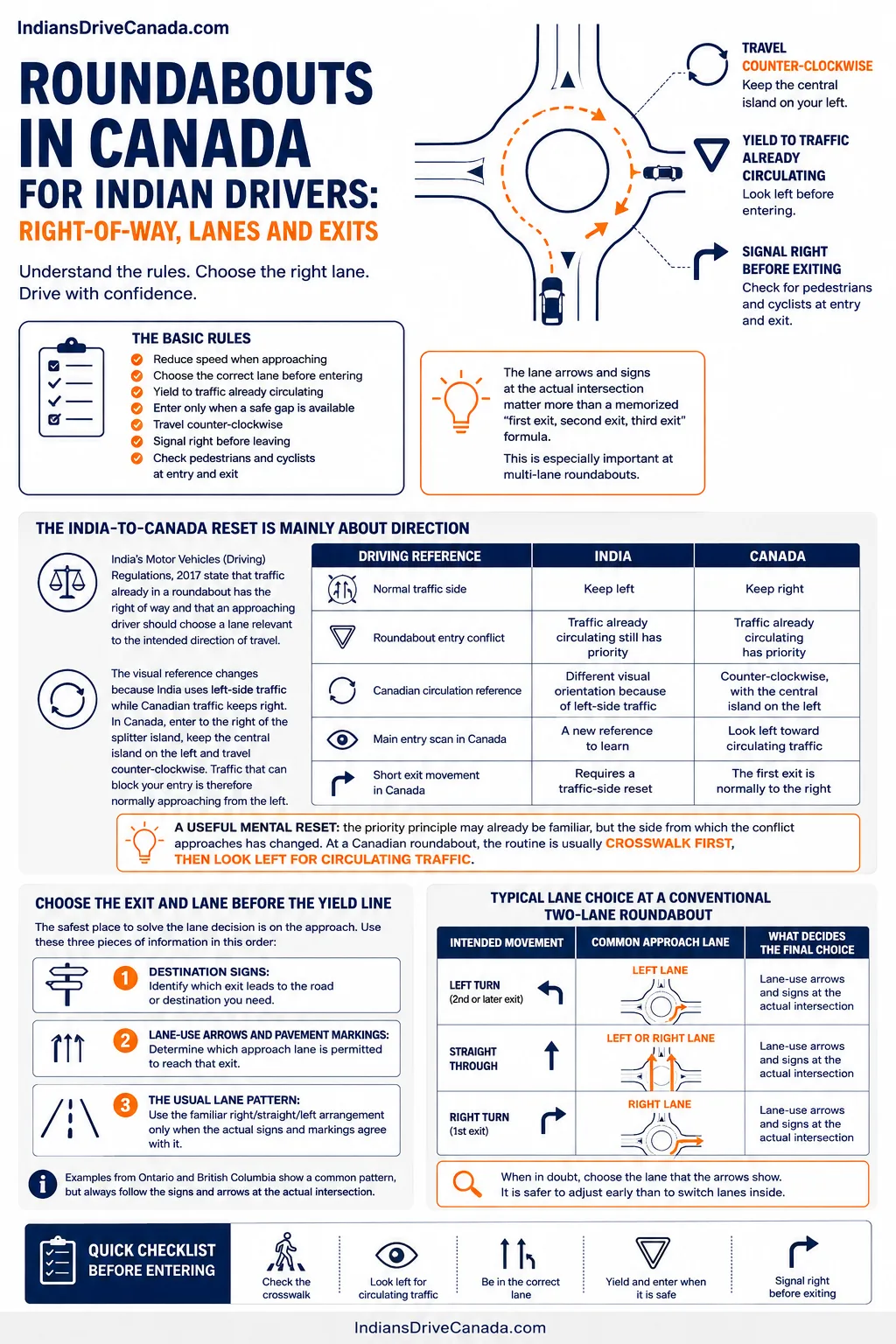
At a Canadian roundabout, reduce speed, choose the correct lane before entering when there is more than one lane, yield to traffic already circulating, enter only when a safe gap is available, travel counter-clockwise, and signal right before leaving. Pedestrians and cyclists must also be checked at the entry and exit. [Roundabout rule]
The lane arrows and signs at the actual intersection matter more than a memorized “first exit, second exit, third exit” formula. This becomes especially important at multi-lane roundabouts, where an incorrect approach lane can leave no safe path to the exit you wanted.
The India-to-Canada reset is mainly about direction
Roundabout right-of-way is not an entirely new concept for a driver coming from India. India’s Motor Vehicles (Driving) Regulations, 2017 state that traffic already in a roundabout has the right of way and that an approaching driver should choose a lane relevant to the intended direction of travel. [India roundabout rule]
The visual reference changes because India uses left-side traffic while Canadian traffic keeps right. In a Canadian roundabout, the vehicle enters to the right of the splitter island, keeps the central island on the left and travels counter-clockwise. Traffic that can block your entry is therefore normally approaching from the left.
| Driving reference | India | Canada |
|---|---|---|
| Normal traffic side | Keep left | Keep right |
| Roundabout entry conflict | Traffic already circulating still has priority | Traffic already circulating has priority |
| Canadian circulation reference | Different visual orientation because of left-side traffic | Counter-clockwise, with the central island on the left |
| Main entry scan in Canada | A new reference to learn | Look left toward circulating traffic |
| Short exit movement in Canada | Requires a traffic-side reset | The first exit is normally to the right |
A useful mental reset: the priority principle may already be familiar, but the side from which the conflict approaches has changed. At a Canadian roundabout, the routine is usually crosswalk first, then look left for circulating traffic.
Choose the exit and lane before the yield line
The safest place to solve the lane decision is on the approach, not after the vehicle has entered the circle. Ontario, British Columbia and Québec all direct drivers at multi-lane roundabouts to use signs or road markings to select the appropriate lane before entering. [Lane selection]
Use three pieces of information in this order:
- Destination signs: identify which exit leads to the road or destination you need.
- Lane-use arrows and pavement markings: determine which approach lane is permitted to reach that exit.
- The usual lane pattern: use the familiar right/straight/left arrangement only when the actual signs and markings agree with it.
On a common two-lane design, the right lane may serve the first exit and straight-through movement, while the left lane may serve straight-through and later exits. Ontario’s handbook uses that pattern, and ICBC gives a similar example. It is an example, not permission to ignore a different arrow painted on the road. [Two-lane example]
| Intended movement | Common approach lane | What decides the final choice |
|---|---|---|
| First exit / right | Usually right lane | Lane arrows and signs |
| Straight | Often either lane | Lane arrows and exit geometry |
| Later / left-like exit | Usually left lane | Lane arrows and signs |
| Return toward the road of approach | Often left where permitted | Local markings, signs and roundabout design |
Do not force a generic lane rule onto the intersection. A five-leg roundabout, spiral roundabout, lane-drop design or separately marked turning lane may not fit the usual first-exit/straight/later-exit pattern. Follow the lane-use signs and pavement arrows you actually see.
Yield at the entry without turning every YIELD into a STOP
Traffic already in the roundabout has priority over a vehicle waiting to enter. Slow enough to judge the circulating traffic, and stop when a pedestrian, cyclist, vehicle or lack of a safe gap requires it. If the crossing area and circulating path are clear, a YIELD sign does not automatically require the same full-stop routine as a STOP sign. [Entry priority]
Look left, but do not look only left
The main vehicle conflict comes from circulating traffic approaching from the left. Ontario specifically tells entering drivers to pay particular attention to vehicles on the left, while Nova Scotia describes the same safe-gap check. [Entry scan]
That does not make the rest of the intersection irrelevant. Before releasing the brake or accelerating into the entry, also check the pedestrian crossing, cyclists, the lane beside you and any vehicle whose path could reach your entry point.
A multi-lane roundabout requires a gap across every conflicting lane
Seeing the nearest circulating lane empty is not always enough. ICBC instructs drivers entering a multi-lane roundabout to make sure cross traffic is clear in every approaching lane. [All-lane check]
For example, an outside circulating lane may appear open while a vehicle in the inside lane follows a marked path that will cross the area you intend to enter. Judge the complete path rather than treating each lane as an isolated road.
Do not enter beside a circulating vehicle just because there seems to be room
Ontario advises against entering directly beside a vehicle already in the roundabout because that vehicle may be preparing to take the next exit. [Safe gap]
A larger gap behind that vehicle is easier to read than a narrow side-by-side position in which the other driver’s intended exit is uncertain.
Do not treat another vehicle’s indicator as permission to enter. A right signal suggests that the driver intends to leave, but wait until the vehicle’s actual path creates a safe gap. An indicator communicates intention; it does not clear the intersection for you.
The pedestrian check happens twice
Roundabouts separate several conflicts that occur together at a conventional intersection. For a driver, this creates two distinct pedestrian checks.
Before entering
Where a crosswalk is positioned before the roundabout entry, clear it before becoming absorbed in the traffic coming from the left. ICBC’s roundabout sequence places the pedestrian check before the yield-to-traffic check and tells drivers never to block the crosswalk. [Entry crosswalk]
This matters because the vehicle may still be creeping forward while the driver’s head is turned left. Stop or yield for the person crossing before moving toward the circulating-traffic decision point.
Before leaving
A second crossing may sit just beyond the exit. Ontario, B.C., Québec, ICBC and Nova Scotia all direct drivers to watch for pedestrians when leaving a roundabout. [Exit crosswalk]
Do not accelerate through the exit simply because the vehicle portion of the roundabout is clear. Scan the exit crossing and the area beside the vehicle before completing the movement.
Think of the approach as two separate decisions: first clear the crossing area; then decide whether there is a safe gap in circulating traffic. At the exit, reverse the focus: prepare to leave the circle, then check the crossing before completing the exit.
A single-lane roundabout is an exit-counting problem
With only one circulating lane, there is no internal lane choice to solve. The main tasks are identifying the correct exit, maintaining the counter-clockwise path and signalling before leaving.
| Destination | Driving action |
|---|---|
| First exit | Yield, enter to the right, follow the circle briefly and take the first exit. |
| Straight / second exit | Enter, pass the first exit, signal right as the required exit approaches and leave. |
| Later exit | Continue around the single lane until the required exit approaches, then signal right and leave. |
| Missed exit | Continue around rather than braking sharply or reversing; take the exit when it comes around again where the design allows. |
Counting exits can be more dependable than mentally translating each movement into “left turn” or “right turn.” A navigation instruction such as “take the third exit” maps directly to what the vehicle must do inside the circle.
In a multi-lane roundabout, follow the lane path rather than the island
The circular shape can tempt a driver to steer toward the exit as soon as it becomes visible. In a multi-lane roundabout, the painted lane path is the better reference.
Ontario and B.C. explicitly tell drivers not to change lanes inside a modern roundabout. Québec tells drivers at a multi-lane roundabout to choose the destination lane before entering and remain in it until the exit. Nova Scotia’s dedicated roundabout page likewise says the entry lane determines where a driver can exit and tells drivers to stay in their lane. [Lane path]
If the lane you chose cannot legally reach the exit you wanted, do not repair the mistake with an abrupt lane change. Follow the movement permitted from your lane, leave safely and reroute. Missing a turn is safer than crossing another vehicle’s path at the last moment.
Provincial instructions are similar, but the details are not identical
Canada does not have one passenger-driver handbook that replaces provincial and territorial rules. The basic roundabout pattern is broadly consistent across the provincial guidance reviewed here, but multi-lane instructions can contain local details.
| Province | Lane instruction to know |
|---|---|
| Ontario | Choose the lane on approach. The common example uses left for left/straight and right for right/straight. Do not change lanes inside the roundabout. |
| British Columbia | Choose the lane from the intended exit and signs. Stay in the lane entered; do not change lanes inside. |
| Québec | Choose the lane matching the destination before entering and remain in that lane until the exit. |
| Alberta | The two-lane example keeps right-lane traffic in the right lane and left-lane traffic in the left lane. Alberta also states that, within the circular intersection, a driver on the right yields to a driver on the left. |
| Saskatchewan | The handbook states that a vehicle on the right yields to a vehicle on the left and recommends the right lane mainly for the first available exit, with the left lane used for later travel. |
| Nova Scotia | The dedicated roundabout instructions say to choose the lane before entry, follow signs and road markings, and stay in the lane through the roundabout. |
The Alberta and Saskatchewan inside-lane yielding instruction is a good example of why a province-specific handbook matters when two circulating lanes interact. [Provincial lane rule]
Use this priority order when deciding what to follow: traffic controls at the intersection first, lane arrows and markings second, the applicable provincial handbook next, and generic roundabout diagrams only as a learning aid.
Roundabout, rotary and traffic circle can describe different layouts
A circular intersection should not be classified only by its shape. Ontario notes that some older traffic circles are larger than modern roundabouts, allow higher speeds and involve more merging and weaving. Nova Scotia also distinguishes modern roundabouts from older rotaries or traffic circles. [Intersection type]
When the layout looks unfamiliar, rely on the controls in front of you:
Do not assume that every circular intersection permits the same lane movement merely because another roundabout nearby did.
Signal right for the exit, not for the entire circle
The provincial sources reviewed here consistently tell drivers to use the right turn signal when preparing to leave a roundabout. Ontario gives a particularly useful timing cue: after passing the exit immediately before the one you want, activate the right signal. [Exit signal]
This lets a driver waiting at the next entrance know that you intend to leave, but it does not transfer right-of-way or guarantee that another driver will interpret the signal correctly.
Do not turn “signal left while circulating” into a Canada-wide rule. Provincial material is not identical on every signalling detail. The dependable shared instruction in the sources used here is to signal right when preparing to exit and to follow any local signs or lane controls.
Missing an exit is easier to fix than a late exit
A driver who notices the exit too late should not brake hard, reverse, stop in the circulating lane or cut across another lane.
Ontario tells drivers who miss an exit from the inside lane to continue around until they meet the exit again. Québec also permits another trip around the circle when the roundabout design allows it, and Nova Scotia gives the same practical instruction for its modern roundabouts. [Missed exit]
If the exit is already beside the vehicle
- Keep the vehicle in its lane.
- Do not make a sudden cross-lane movement.
- Continue around where the lane and design permit.
- Prepare for the exit before reaching it again.
- Signal right and complete the exit only when the path and crossing are clear.
Large trucks need space that a passenger car does not
Truck and bus paths can look unusual inside a roundabout because their turning radius is much larger. A truck may swing wider, occupy more roadway or use a mountable truck apron beside the central island.
Ontario warns drivers to give large vehicles extra room, and ICBC advises drivers not to travel alongside trucks or buses in a roundabout because they may need more than one lane-width of space to complete the movement. [Large vehicle]
Do not stop inside the circle for an approaching emergency vehicle
If an emergency vehicle approaches before you enter, avoid entering in a way that blocks its path. If you are already circulating, provincial guidance such as Ontario, B.C. and Nova Scotia directs drivers to leave the roundabout and then pull over rather than stopping inside the circle. [Emergency vehicle]
The exact pull-over action must still follow the road layout and the applicable emergency-vehicle rules in the province. The roundabout-specific point is simple: avoid turning the circulating roadway into a blockage.
Snow can hide the information used to choose a lane
A Canadian winter can make a familiar roundabout harder to read without changing its right-of-way structure. Snow or slush may cover pavement arrows, lane separators and parts of the splitter island. Snowbanks can also reduce the view of a person approaching a crosswalk.
A repeatable roundabout routine
The entire decision can be reduced to a short sequence that begins well before the steering wheel turns.
- Exit: identify the destination and count the exit if that helps.
- Lane: read the lane-use signs and move into the required approach lane.
- Speed: slow early enough to read the intersection and stop if necessary.
- Crosswalk: clear pedestrians and cyclists at the approach crossing.
- Left: check circulating traffic approaching the entry.
- Gap: make sure every conflicting lane is clear.
- Enter: turn right into the roundabout and travel counter-clockwise.
- Lane path: stay with the lane markings instead of steering directly toward the exit.
- Signal: use the right turn signal as the intended exit approaches.
- Exit crossing: check again for pedestrians and cyclists before completing the exit.
If the wrong lane was chosen, the exit was missed or another driver behaves unexpectedly, preserve space rather than trying to rescue the original route. Continue on a lawful lane path, let the conflict clear and reroute when necessary.