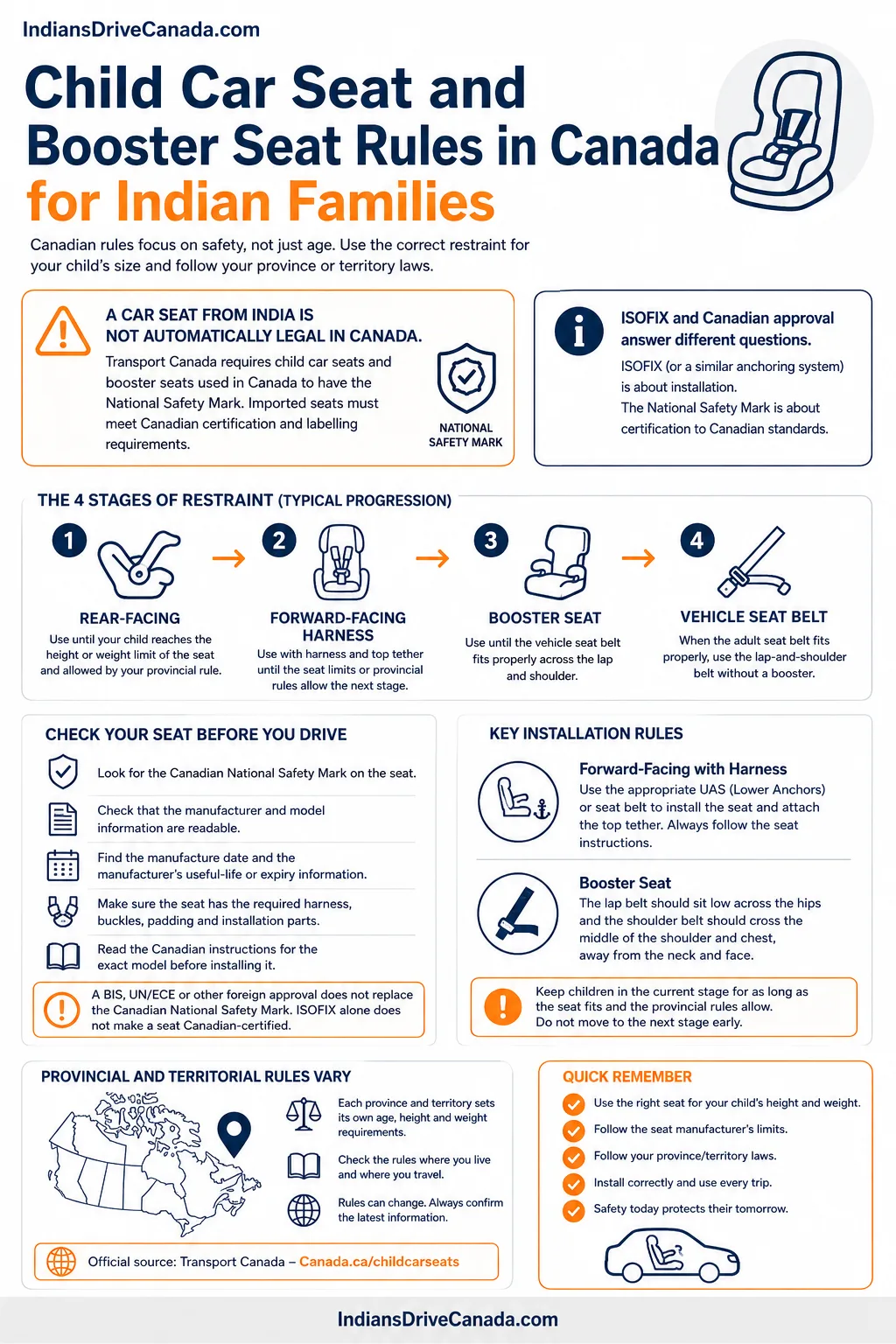
Child car seat and booster seat rules in Canada are not based on one nationwide age limit. Federal rules determine whether a child restraint is certified for use in Canada, while provinces and territories decide when a child must use a rear-facing seat, forward-facing seat, booster seat or regular seat belt.
A car seat brought from India should not be assumed to be legal in Canada. Transport Canada states that child car seats and booster seats used in Canada must carry the National Safety Mark. A seat imported into Canada must still meet the Canadian certification and labelling requirements.[Canadian certification]
This distinction matters even if the seat bought in India has ISOFIX connectors or an approval mark from another country. ISOFIX describes how a seat can attach to a vehicle; it does not replace Canadian certification. Before driving with a child after arriving in Canada, check the seat itself and the rules of the province or territory where the vehicle will be used.
Using a child car seat brought from India
The fastest check is the label on the restraint. Transport Canada identifies the National Safety Mark as proof that a child car seat meets Canadian safety standards. The seat should also have its product information label attached.[Safety mark]
- Look for the Canadian National Safety Mark on the seat.
- Check that the manufacturer and model information are readable.
- Find the manufacture date and the manufacturer’s useful-life or expiry information.
- Make sure the seat still has the required harness, buckles, padding and installation parts.
- Read the Canadian instructions for the exact model before installing it.
A BIS, UN/ECE or other foreign approval does not take the place of the Canadian National Safety Mark. Likewise, a seat does not become Canadian-certified simply because its ISOFIX connectors fit the lower anchors in a Canadian vehicle.
ISOFIX and Canadian approval answer different questions. ISOFIX or a similar anchoring system concerns installation. The National Safety Mark concerns whether the restraint is certified to Canadian requirements.
Transport Canada also warns against cross-border purchases of restraints that do not meet Canadian requirements. A family ordering a seat online after arriving in Canada should check the certification label rather than relying on the seller’s statement that the model is compatible with Canadian vehicles.
The correct restraint depends on more than age
Canadian child-passenger rules use combinations of age, weight and height. The manufacturer’s limits matter as well. Reaching the minimum point at which a province permits the next stage does not mean a child has to move immediately.
The normal progression is:
- Rear-facing car seat
- Forward-facing car seat with a harness
- Booster seat
- Vehicle lap-and-shoulder seat belt
Transport Canada advises choosing a restraint made for the child’s height and weight and following the manufacturer’s labels and instructions. Provincial and territorial age, height and weight rules must also be checked.[Restraint stage]
Rear-facing
A child should not be turned forward simply because a commonly quoted minimum age or weight has been reached. If the provincial rule and the seat instructions allow the child to remain rear-facing, the restraint can generally continue to be used until the child reaches the applicable height or weight limit of that seat.
Forward-facing harness
The next stage uses a child restraint with a harness. For a forward-facing installation, Transport Canada instructs users to secure the seat with the appropriate UAS or seat-belt method and attach the top tether.[Installation rule]
A child should remain in the harness while the seat still accommodates the child’s size and the applicable provincial rule permits it. A minimum booster weight should not be treated as a reason to move a child out of a correctly fitting harness early.
Booster seat
A booster raises the child so the vehicle’s adult seat belt crosses the stronger areas of the body. The lap belt should sit low across the hips, and the shoulder belt should cross the middle of the shoulder and chest. A booster must not be used in a seating position that has only a lap belt.[Booster fit]
Booster seat laws differ across Canada
There is no single age at which every child in Canada may stop using a booster. Some jurisdictions use an age, weight and height combination. Others allow the legal requirement to end when any one threshold is reached. Alberta does not make booster seats mandatory in the same way as most provinces.
| Province or territory | Main legal threshold | What families should notice |
|---|---|---|
| Ontario | A booster generally applies to a child under 8 who weighs 18–36 kg and is under 145 cm. A seat belt alone becomes legally available when the child reaches 8 years, 36 kg or 145 cm.[Ontario rule] | Only one of the three exit thresholds has to be reached. Belt fit should still be checked. |
| Alberta | A properly installed child restraint is required for a child younger than 6 who weighs 18 kg (40 lb) or less. Booster seats are not required by Alberta law.[Alberta rule] | Alberta recommends a booster after the harness stage until the adult belt fits properly. |
| British Columbia | Rear-facing is required until at least age 1 and 9 kg. Forward-facing follows until at least 18 kg. A booster is then required until the child reaches age 9 or 145 cm, whichever comes first.[B.C. rule] | The province also allows children to remain in an earlier stage longer when permitted by the restraint manufacturer’s limits. |
| Manitoba | Provincial law requires a booster until the child reaches at least 145 cm, 36 kg or 9 years old.[Manitoba rule] | The first applicable exit threshold can change the legal requirement; proper seat-belt fit still matters. |
| Saskatchewan | A booster is mandatory when the child is under 7, under 145 cm and under 45 kg (100 lb).[Saskatchewan rule] | All three conditions must apply for the booster mandate. SGI still recommends checking belt fit before removing the booster. |
| Quebec | A child must use an appropriate child safety seat until reaching 145 cm or age 9.[Quebec rule] | Quebec advises continuing a booster if the regular seat belt still does not fit correctly. |
| Nova Scotia | Rear-facing applies to a child younger than 2, or to a child of any age who weighs less than 10 kg. The 5-point-harness stage applies when the child is at least 2 and at least 10 kg, and is either younger than 4 or is 4 or older but weighs less than 18 kg. The booster stage applies when the child is at least 4 but younger than 9, weighs at least 18 kg and is under 145 cm.[Nova Scotia rule] | Effective October 19, 2026, Nova Scotia requires rear-facing until at least age 2 and a 5-point harness until at least age 4; the weight thresholds can keep either stage in place longer.[Stage change] |
| New Brunswick | A child restraint is required when the passenger is under 9, under 36 kg and under 145 cm.[New Brunswick rule] | New Brunswick also states that child seats purchased in other countries are not legal for use in Canada. |
| Prince Edward Island | A booster is required for a child who weighs at least 18 kg, is 9 years old or younger and is under 145 cm. PEI states that the booster requirement ends when the child is over 9 or at least 145 cm.[PEI rule] | The child must also stay within the limits printed on the booster itself. |
| Newfoundland and Labrador | For children age 8 or younger, the Highway Traffic Act sets rear-facing requirements below 9 kg, child-seat requirements from 9 kg to under 18 kg, and booster or qualifying child-seat use from 18 kg through 37 kg when the child is under 145 cm.[NL rule] | The statutory age, weight and height conditions should be read together rather than reduced to a single booster age. |
| Yukon | Rear-facing applies below 10 kg and until the child can walk unassisted. The forward-facing stage applies from over 10 kg until 22 kg. A booster is required above 22 kg until the child reaches 145 cm or 45 kg, whichever comes first.[Yukon rule] | Yukon’s public child-seat page gives unusually specific stage thresholds, so Ontario-style age rules should not be copied to Yukon. |
| Northwest Territories | The NWT Basic Driver’s Manual states that once a child is over 18 kg, the vehicle seat belt must be used and an approved booster is strongly recommended according to the manufacturer’s instructions.[NWT guidance] | The public manual does not use the same legislated booster threshold model seen in provinces such as Ontario or Manitoba. |
| Nunavut | Nunavut’s public driver material states that child car seats must be used for small children, but the driver manual does not provide a detailed age-height-weight booster threshold comparable with the provincial tables.[Nunavut guidance] | Use a Canadian-certified restraint appropriate to the child’s size and confirm the territorial requirement before relying on a seat belt alone. |
Read “and” and “or” carefully. For example, Saskatchewan’s booster mandate applies when the child is under 7 and under 145 cm and under 45 kg. Ontario allows the child to reach any one of three legal milestones: age 8, 36 kg or 145 cm. Those rules can produce different answers for children of the same age.
Legal permission to use a seat belt does not prove that it fits
A child may reach a provincial age or weight threshold while still being too small for an adult seat belt to sit correctly. Transport Canada says children should continue using a booster if the vehicle belt does not fit snugly on the lap and correctly across the shoulder.[Seat-belt fit]
Check the child in the actual vehicle rather than relying only on age:
- The child’s back stays against the vehicle seatback.
- The knees bend comfortably at the edge of the vehicle seat.
- The lap belt sits low across the hips rather than the stomach.
- The shoulder belt crosses the middle of the shoulder and chest rather than the neck.
- The child can remain in that position for the whole trip without moving the belt under an arm or behind the back.
This also means that a child who fits a seat belt correctly in one vehicle may not have the same fit in another vehicle with a deeper seat cushion or different belt geometry.
| Legal position | Practical safety check |
|---|---|
| The province allows the next restraint stage. | Keep using the present stage if the child still fits it and the manufacturer’s instructions allow continued use. |
| The child has reached the province’s booster exit threshold. | Check whether the adult belt actually fits the hips, shoulder and seating position. |
| A booster is not mandated by the province. | A booster can still be appropriate when the adult belt does not fit the child correctly. |
Taxi, rideshare and rental-car rules need a separate check
A family arriving at Toronto, Vancouver, Calgary, Montreal or another Canadian airport should not assume that a taxi, rideshare vehicle and rental car all follow the same child-restraint exception.
The rules differ enough that the type of vehicle can change the legal answer.
| Jurisdiction | Example that affects families |
|---|---|
| Ontario | A taxicab driver transporting a passenger for hire is exempt from specified child-restraint requirements. Ontario lists exceptions to that exemption, including certain school transportation and personal transportation situations.[Taxi rule] |
| Alberta | Alberta states that child restraints are not required, although still recommended, in taxis and in vehicles rented or leased for 14 days or less.[Vehicle exemption] |
| British Columbia | B.C. exempts a vehicle being operated as a taxi, but the regulation excludes a taxi operating as a passenger-directed vehicle under a transportation-network-services authorization only. A traditional taxi and an app-based rideshare should therefore not be assumed to have the same exemption.[Taxi and rideshare] |
| Quebec | Quebec provides a child-seat exception in taxis and vehicles comparable to taxis. If no child seat is available, a child who can sit upright must use the available seat belt. SAAQ still recommends using a suitable safety seat whenever possible.[Taxi exception] |
| Saskatchewan | SGI states that since December 16, 2020, parents and legal guardians are responsible for ensuring children under 16 are properly restrained in taxis, rideshare vehicles and other vehicle-for-hire services where passenger restraints are required.[Rideshare rule] |
| New Brunswick | New Brunswick specifically states that drivers using rental vehicles in the province must comply with booster-seat legislation when carrying a child who requires one.[Rental-car rule] |
Do not treat “taxi exemption” as a Canada-wide rule. It can depend on the province, the type of for-hire vehicle and who is legally responsible for the child. If a family will need a taxi or rideshare immediately after landing, check the destination province before the trip.
Arriving in Canada without a Canadian-certified seat
A relative or friend is collecting the family
A private family vehicle does not become exempt simply because the driver is a relative or friend. The restraint requirement of the jurisdiction where the vehicle is being driven must be applied, subject to any specific exception in that jurisdiction.
Some provinces have unusual exceptions. PEI, for example, permits regular seat-belt use for certain occasional transportation when the driver is not the child’s parent or guardian, while stating that this does not cover the child’s usual transportation.[Occasional trip]
The family is collecting a rental car
Do not assume that renting a vehicle removes the child-seat requirement. New Brunswick explicitly requires compliance in rental vehicles, while Alberta has a specific exemption for rentals or leases of 14 days or less. Different rules in different provinces make advance checking worthwhile.
If a restraint is being supplied by the rental company, confirm that the available model suits the child’s weight and height. The driver still needs to install and use it according to the restraint and vehicle instructions.
The family plans to take a taxi or rideshare from the airport
Check the rule for the exact service type before the journey. A legal exception is not the same as a recommendation that a child travel without a restraint. Where a compliant seat can be used correctly, it remains the safer travel arrangement.
Buying a car seat after arriving in Canada
A Canadian retail listing can contain many age ranges and marketing descriptions, but the decision can be reduced to a few checks.
- Canadian certification: find the National Safety Mark.
- Child fit: check minimum and maximum height and weight for the mode being used.
- Vehicle fit: make sure the restraint can be installed in an approved seating position in the vehicle.
- Installation method: check whether the position will use UAS or the vehicle seat belt.
- Forward-facing tether: confirm the vehicle has the correct tether anchor.
- Useful life: check the manufacturer’s expiry or useful-life information.
- Recall status: check the manufacturer and model against Transport Canada’s child-seat notices.
A large convertible seat may meet every legal requirement and still be a poor fit in a compact vehicle if it cannot be positioned and tightened as required. Transport Canada’s buying checklist therefore includes both the child’s measurements and whether the restraint fits the vehicle.[Buying check]
Be cautious with used car seats
Transport Canada does not recommend buying or using pre-owned child car seats, although it provides checks for situations where a used restraint is being considered. A cheap marketplace seat is not a good purchase if its history cannot be established.[Used-seat check]
- The National Safety Mark is present.
- The restraint has not been involved in a collision.
- The model is not affected by an unresolved recall or safety notice.
- The manufacture date and useful-life information can be determined.
- The shell does not show cracks or damage.
- The harness, webbing, buckle and chest clip are intact.
- No required hardware or original parts are missing.
- The instructions for that exact model can be obtained.
If the seller cannot reliably answer whether the seat has been in a collision, that missing history should be treated as a safety issue rather than a minor detail.
Installation checks that matter before driving
Test movement at the belt path
After installing a rear-facing or forward-facing restraint, hold it where the UAS belt or vehicle seat belt passes through the seat and try to move it from side to side and front to back. Transport Canada says it should not move more than 2.5 cm (1 inch) at that point.[Installation check]
Use the top tether when forward-facing
For a forward-facing child car seat, attach the top tether to the vehicle’s designated tether anchor and tighten it according to the child-seat and vehicle manuals.[Top tether]
Keep rear-facing seats away from an active frontal airbag
Rear-facing restraints should not be installed in front of an active frontal airbag. Several provincial rules state this directly, and Transport Canada recommends keeping children in the rear seating area.
Use both lap and shoulder portions with a booster
A booster needs the lap-and-shoulder belt to position the restraint across the child’s hips, chest and shoulder. A lap-only seating position is not suitable for a booster.[Booster belt]
Canadian winter clothing changes harness fit
A thick puffer jacket or snowsuit can create extra space between the child and a harness. Saskatchewan’s child-seat guidance advises against bulky clothing between the child and the car-seat straps and recommends lightweight warm layers instead.[Winter clothing]
Buckle and tighten the harness over thin clothing that allows the straps to sit close to the child. Add warmth in a way that does not interfere with the harness, following the restraint manufacturer’s instructions.
This is a useful adjustment for families experiencing a Canadian winter for the first time. The concern is not the temperature itself; it is whether bulky material prevents the restraint from holding the child as designed.