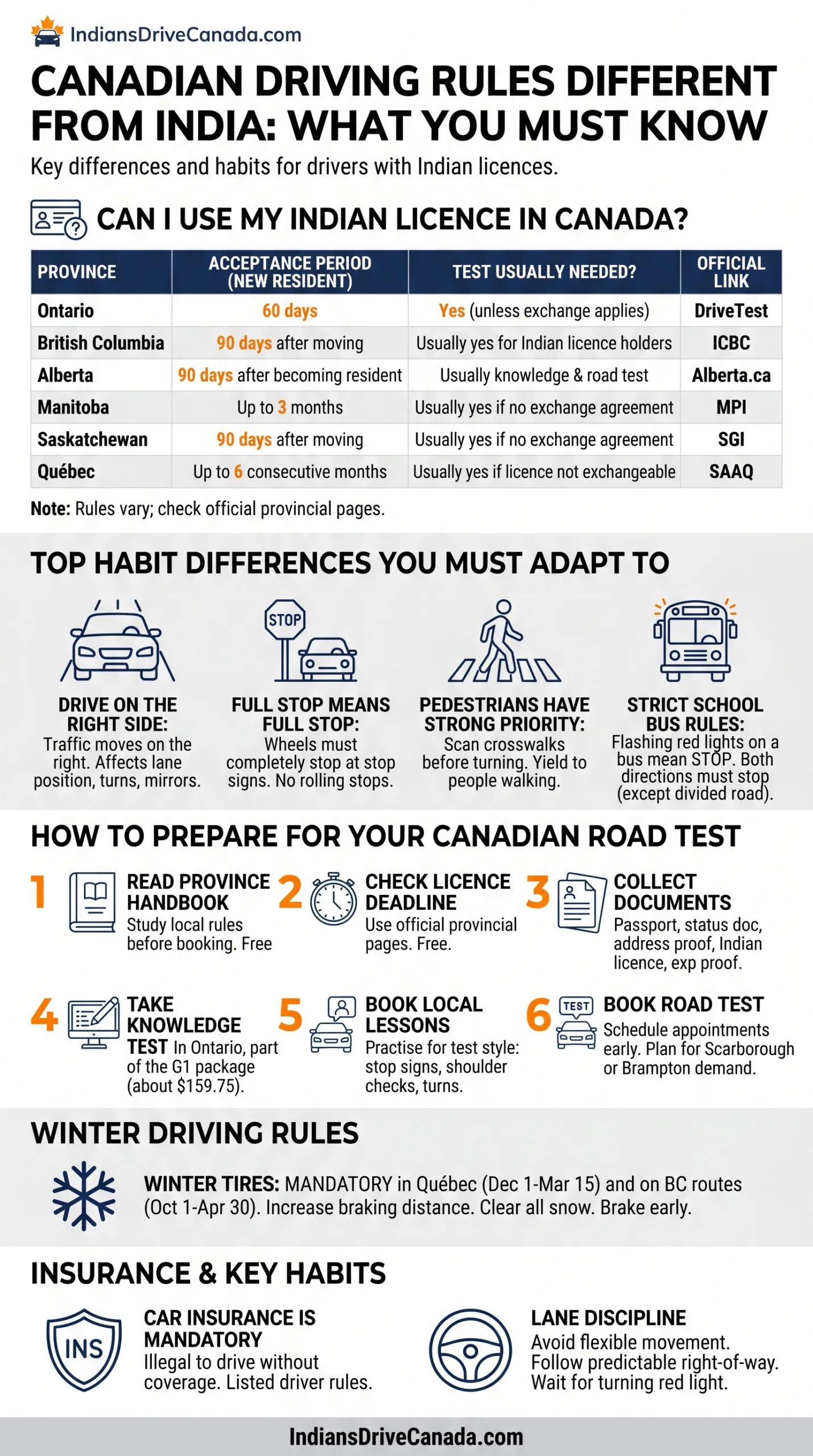
Quick answer: Canadian driving rules that are different from India start with driving on the right side, stricter stop-sign habits, school bus rules, right turns on red, winter driving, lane discipline, insurance rules, and province-based licence deadlines. Indian drivers should study the local handbook before driving alone or booking a road test.
You’ve just landed in Ontario with your Indian licence and no idea where to start. The road looks familiar, but the habits are not the same: cars move on the right, stop signs are treated very strictly, and a school bus with flashing red lights can stop traffic in both directions.
This page explains how your Indian driving experience fits into Canadian driving rules, which daily road habits feel different after driving in India, and what to practise before you drive alone, rent a car, or book a road test. It also links naturally to our pillar page on driving rules in Canada for Indians for a wider beginner-friendly overview.
As of May 2026, official pages from DriveTest, IRCC, ICBC, Alberta.ca, SAAQ, and other provincial agencies all point to one clear truth: Canada does not use one national driver licensing rule, so your province matters.
Can I Use My Indian Licence in Canada?
Yes, you can usually use a valid Indian driving licence for a short time after arriving in Canada, but the limit depends on the province. Canada lets provinces and territories manage driver licensing, so Ontario, British Columbia, Alberta, Québec, and other provinces set their own timelines.
In Ontario, DriveTest says a new resident can use a valid foreign licence for 60 days. After that, you need to apply for an Ontario driver’s licence. If you are visiting Ontario for less than three months, DriveTest says you may use your valid home-country licence, but you must still follow Ontario road rules. You can check the official DriveTest foreign licence page here: DriveTest foreign licences.
IRCC also advises newcomers to check the rules in the province or territory where they live and says an International Driving Permit can help because it translates your licence into English and French. Read the federal newcomer driving page here: IRCC driving in Canada.
| Province | How Long an Indian Licence Is Usually Accepted | Test Usually Needed? | Official Link |
|---|---|---|---|
| Ontario | 60 days for new residents | Yes, unless exchange rules apply | DriveTest |
| British Columbia | 90 days after moving | Usually yes for Indian licence holders | ICBC |
| Alberta | 90 days after becoming a resident | Usually knowledge and road test | Alberta.ca |
| Manitoba | Up to 3 months | Usually yes if no exchange agreement applies | MPI |
| Saskatchewan | 90 days after moving | Usually yes if no exchange agreement applies | SGI |
| Québec | Up to 6 consecutive months | Usually yes if your licence is not exchangeable | SAAQ |
Watch out: Do not assume your friend’s Ontario timeline applies in Alberta, B.C., or Québec.
Which Canadian Driving Rules Are Most Different From India?
The first difference is the side of the road. In India, traffic moves on the left. In Canada, traffic moves on the right. That changes your lane position, turns, mirror checks, and how you judge gaps at intersections.
The second difference is how strictly small rules are tested and enforced. In many Canadian driving tests, a rolling stop, late shoulder check, weak lane position, or missed blind-spot check can hurt your result. The examiner is not only checking whether you can move the car. They are checking whether you follow predictable road habits.
The third difference is pedestrian and school-zone behaviour. Canadian roads often give strong priority to pedestrians at crosswalks and school crossings. You must scan sidewalks, bike lanes, and crosswalks before turning. This is very different from busy Indian city traffic, where movement can feel more flexible and negotiated.
- Drive on the right: Keep your lane position steady, especially after turns.
- Full stop means full stop: Pause before the stop line, not after it.
- Pedestrians matter: Check both sides before turning.
- School buses have special rules: Flashing red lights mean stop.
- Winter changes everything: Braking distance, visibility, and tire grip can change fast.
These Canadian driving rules are not hard to learn, but they do require calm repetition. A driver who has years of Indian road experience may still need a few lessons to adjust to Canadian test expectations.
Pro tip: Practise in quiet residential streets first, then move to busier roads once right-side driving feels natural.
How Do Stop Signs and Four-Way Stops Work in Canada?
Stop signs are one of the biggest adjustment points for Indian drivers. In Canada, a stop sign does not mean “slow down and continue if clear.” It means stop fully. Your wheels should stop moving before you proceed.
At a normal stop sign, stop before the stop line. If there is no line, stop before the crosswalk. If there is no crosswalk, stop before entering the intersection. Then check left, right, straight ahead, pedestrians, cyclists, and any car that may already have priority.
At a four-way stop, the first vehicle to stop usually goes first. If two vehicles stop at the same time, the vehicle on the right usually goes first. If you are turning left, you may need to yield to a vehicle going straight. This is where many newcomers panic, not because the rule is complex, but because everyone expects a predictable pause.
- Reach the stop sign and stop before the line.
- Count a short pause, just long enough to show a real stop.
- Check pedestrians and cyclists first.
- Check which car arrived before you.
- Move only when your turn is clear and safe.
Canadian driving rules reward patience at stop signs. If another driver waves you through, still make your own safety check before moving.
Watch out: A rolling stop may feel harmless, but it can lead to a ticket or a road-test failure.
Can I Turn Right on Red in Canada?
In many Canadian provinces, you can turn right on a red light after a complete stop, unless a sign says you cannot. This rule can surprise Indian drivers because the movement looks like crossing a red signal. The legal idea is different: you must first stop, then yield, then turn only when it is safe.
In Ontario, the official driver handbook says you may turn right on red only after coming to a complete stop and waiting until the way is clear, unless a sign says not to. In Québec, the rule is also allowed in many places, but not on the island of Montréal. The Québec government explains the Montréal exception here: Québec right turn on red rules.
Before turning right on red, check four things. First, look for a “No Right Turn on Red” sign. Second, stop before the line. Third, check pedestrians crossing from both sides. Fourth, check cyclists and cars coming from the left.
Never turn because the driver behind you honks. Canadian driving rules make the turning driver responsible for yielding. If you cannot see clearly, stay stopped until the light turns green.
Pro tip: In a driving test, a safe stop and no turn is better than a rushed turn on red.
What Should Indian Drivers Know About School Buses and School Zones?
School bus rules are stricter than many newcomers expect. In Ontario, when a school bus is stopped with its upper red lights flashing, drivers approaching from behind must stop at least 20 metres behind the bus. Drivers coming from the opposite direction must also stop unless the road is divided by a median. The official Ontario school bus rule is explained here: Ontario school bus law.
This matters because children may cross near the bus. Do not try to pass slowly. Do not move because another car moves. Wait until the red lights stop flashing and the stop arm is no longer extended.
School zones also need extra attention. Speed limits may drop during school hours. Crossing guards may enter the road and control traffic. Children may step out from between parked cars, especially in the morning and afternoon.
For Indian drivers, the habit change is simple but serious: treat school areas as places where the road belongs to children first. Slow early, scan sidewalks, and leave more space than you think you need.
- Slow down before entering a school zone.
- Stop fully for crossing guards and pedestrians.
- Do not pass a stopped school bus with flashing red lights.
- Watch for posted time-based speed signs.
Watch out: The safest choice near a school bus is to stop early and wait until the bus signal ends.
What Do Indian Drivers Often Get Wrong in Canada?
Based on reports from Indian immigrants in Ontario forums, the same problems appear again and again: not knowing how strict stop signs are, feeling unsure at four-way stops, turning wide after switching to right-side driving, and underestimating winter braking distance.
This does not mean Indian drivers are unsafe. It means the driving environment is different. In India, drivers often manage dense traffic through eye contact, horn use, and flexible gaps. In Canada, drivers expect lane discipline, clear signals, and predictable right-of-way.
Ontario 2026 Update: Bill 60, the Fighting Delays, Building Faster Act, 2025, received Royal Assent and added wording to the Highway Traffic Act that lets the Minister require evidence that an applicant is an Ontario resident, legally present in Canada, and legally able to work in Canada for some prescribed licence or vehicle classes. Read the official bill page here: Ontario Bill 60. Keep your PR card, work permit, study permit, visitor record, or other status documents ready when applying or renewing.
Real Questions From Indian Immigrants
- “Can I drive with my Indian licence while waiting for my G1?”
- “Will my Indian experience reduce my waiting time?”
- “Do I need a letter from India?”
- “Why did I fail for a rolling stop when the road was empty?”
The short answer is that licence timing, experience credit, and documents depend on the province. In Ontario, DriveTest may ask for your original licence, ID, translation if needed, and sometimes a letter of authentication or driver abstract issued within the last six months.
Pro tip: Bring more proof than the minimum, especially if your Indian licence does not show the first issue date clearly.
How Should I Prepare for a Canadian Road Test?
Here is the exact process, step by step:
- Read your province handbook. Do this at home before booking. It may take 3 to 5 evenings. Cost is usually free online; printed books may cost extra.
- Check your licence deadline. Use the official province page. This takes 15 to 30 minutes. Cost is free.
- Collect your documents. Prepare passport, status document, proof of address, Indian licence, translation if needed, and experience proof. This can take a few days or longer if you need records from India.
- Take the knowledge test. In Ontario, this is done at DriveTest. The G1 package is listed by DriveTest at $159.75, and an extra knowledge test attempt is $16.00. Check the current fee page here: DriveTest fees.
- Book lessons with a local instructor. Even 2 to 4 lessons can help you adjust to right-side driving, shoulder checks, stop signs, and test routes. Cost varies by city and school.
- Book the road test. In Ontario, DriveTest lists the G road test at $91.25 and a G2 road test at $53.75 if charged separately. Timing depends on available slots.
DriveTest centres in Scarborough and Brampton have been known to serve many newcomer drivers, so appointment planning helps. Do not leave booking until your foreign licence use period is nearly over.
Watch out: Passing in India does not automatically prepare you for Canadian examiner habits, so practise the test style, not only daily driving.
How Do Winter Rules Change Driving in Canada?
Winter is not just “more careful driving.” Snow, black ice, freezing rain, and early darkness can change how your car responds. If you learned to drive in Delhi, Mumbai, Ahmedabad, Hyderabad, Chandigarh, or Bengaluru, Canadian winter roads may feel unfamiliar at first.
Québec has a clear winter tire rule for vehicles registered in the province. The official Québec page says vehicles must be winter-ready from December 1 to March 15. You can read the official rule here: Québec winter tire requirements.
British Columbia also has winter tire or chain requirements on many routes. The B.C. government says winter tires or chains are required on most routes from October 1 to April 30, with some routes ending March 31. Check the official B.C. page here: B.C. winter tire routes.
Even where winter tires are not legally required, they can make driving smoother and safer. Increase following distance, brake earlier, clear all snow from windows and lights, and avoid sudden steering.
Pro tip: Your first winter drive should be short, slow, and familiar, not a highway trip during snowfall.
Do Canadian Driving Rules Affect Insurance and Car Sharing?
Yes. In Canada, driving is tied closely to insurance. IRCC says it is illegal to drive without car insurance in Canada. If you own a car, you need coverage. If you regularly drive a family member’s or friend’s car, you should make sure their insurance allows it and that you are listed where needed.
This is different from casual driving habits in some countries, where family members may pass a car around with fewer questions. In Canada, insurance companies care about the listed driver, address, licence class, driving history, and sometimes how the vehicle is used.
If you rent a car or use car sharing, read the licence rules carefully. Some companies may not accept a foreign licence after you become a resident, even if the province still gives you a short grace period. Others may ask for an International Driving Permit with your Indian licence.
- Carry your licence whenever you drive.
- Keep proof of insurance in the vehicle.
- Do not drive a friend’s car unless insurance allows it.
- Update your address with the licence or insurance authority when required.
Canadian driving rules are not only about traffic signs. They also connect to documents, insurance, and your legal ability to drive that vehicle on that day.
Watch out: A valid Indian licence does not automatically mean a rental company, insurer, or car-share app will accept you.
Frequently Asked Questions
Can I Drive in Canada With an Indian Licence?
Yes, usually for a short time after arrival, but the limit depends on your province. Ontario gives new residents 60 days, while several other provinces use 90 days or 3 months. Always check the official provincial page before driving.
How Long Can I Drive in Ontario With My Indian Licence?
DriveTest says new Ontario residents can use a valid foreign licence for 60 days. After 60 days, you need to apply for an Ontario driver’s licence. Visitors may have different rules from residents.
Do I Need an International Driving Permit From India?
An International Driving Permit is not a replacement for your Indian licence. It is a translation document that can help when your licence is not in English or French. IRCC advises getting it before arriving if you plan to use a foreign licence in Canada.
Can My Indian Driving Experience Help Me Get a Canadian Licence Faster?
It may help in some provinces if you can prove your experience. Ontario may ask for a letter of authentication or driver abstract, depending on your case. The document should be official and may need to show the original licence issue date.
What Happens if I Keep Driving After My Foreign Licence Period Ends?
You may be treated as driving without a valid local licence. That can create problems with police, insurance, rentals, and future licensing. Apply before your province’s deadline, not after it.
Can I Turn Right on Red in Canada?
In many places, yes, but only after a complete stop and only when no sign prohibits it. You must yield to pedestrians, cyclists, and other traffic. On the island of Montréal, right turns on red are prohibited.
Do I Need Winter Tires Everywhere in Canada?
Not everywhere by law, but they are strongly recommended in winter conditions. Québec requires winter tires for vehicles registered there from December 1 to March 15. B.C. requires winter tires or chains on many marked routes during winter months.
What Is the Biggest Mistake Indian Drivers Make in Canadian Road Tests?
The most common mistake is treating a stop sign like a slow-down sign. Examiners expect a clear full stop, mirror checks, blind-spot checks, and calm right-of-way decisions. Practise these habits before booking your test.
Canadian driving rules feel easier after a few calm weeks of practice. Start with your province’s handbook, confirm your licence deadline, and build habits around full stops, right-side driving, pedestrian awareness, and winter safety.